.png)
OpenAI's ad run rate went from $0 to more than $1 billion in under 200 days after ChatGPT ads launched. That pace has turned ChatGPT ads into a paid channel inside AI search that marketing teams now need to plan around. OpenAI has not updated that figure recently, and Matt would not be surprised if it is now a multiple.
Josh Spilker, Head of Search Marketing at AirOps, hosted Matt Hammel, Cofounder and COO, and Alex Hallenbeck, Lead Product Manager, both of AirOps. Matt shared the run-rate figure, and both explained how to test ChatGPT ads as part of one organic and paid system. Alex brings more than 15 years of enterprise search experience across ads and SEO, and he walked through what AirOps has learned from customer data.
Top Takeaways
- Run organic and paid as one system: The brand facts that shape organic AI answers also power generative ads.
- Buy reach where you are missing: AirOps data shows brands mostly advertise on prompts where they earn no organic mention, which extends net reach.
- Expect rivals you do not track: Advertisers on your priority prompts often sit outside your competitor set, including review sites such as Capterra.
- Pay more per click for better buyers: Tighter targeting raises cost per click (CPC) and conversion rates together, improving return on ad spend.
- Give every test four weeks: Early adopters fund tests with 10% or less of their traditional ad budget then judge results on conversions.
Best Practices and Key Learnings
ChatGPT ads reward teams that connect brand data and measurement before they scale spend on the channel. Each lesson that follows draws on AirOps customer data and the ad tests the AirOps team ran on its own account.
Why should organic and paid share one brand system?
Matt named six inputs every generative ad needs to perform: product truth, claims and evidence, customer policies, brand rules, action interfaces, and measurement. Those same inputs feed the organic answers models give, so one central source of brand and product truth can power both channels.
- Inputs matter more as ads gain agency. An ad that talks with buyers needs accurate return and discount policies before it answers a single question.
- Action interfaces move the user to the next step, such as completing a purchase inside the surface or reaching the right booking page.
- Map every AI discovery channel your buyers use. Matt expects more agents and more ad products to appear across them over the coming months.
"It's really helpful to think about organic and paid as one system." - Matt Hammel

How do you keep generative ads on brand?
Matt recalled a car dealership chatbot that a user talked into selling a 2024 Chevy Tahoe for $1, an extreme case of manipulation. Ads that converse with buyers carry similar risk now that ChatGPT formats are progressing through direct placements, sponsored agents, and ads that complete transactions.
- Name one strong technical systems thinker to map data sources and tools. AirOps took this approach when building its own version of the shared system.
- Set clear governance on which go-to-market teams can read from or write to the shared brand system, and who approves changes to it.
- Give legal and regulatory reviewers the access they need to approve both the inputs and the finished ads before anything reaches a buyer.
Where do ChatGPT ads add net-new reach?
Alex asked ChatGPT which database supports ACID (atomicity, consistency, isolation, durability) transactions, and Neon appeared in the ad slot with no organic mention. Neon's copy never referenced ACID, so a variant such as "ACID-compliant serverless SQL" could have matched the prompt and the buyer's need more closely.
- Compare paid placements against your AI brand mentions to find priority prompts where competitors win organically and your brand is absent.
- Build ad groups for every funnel stage. AirOps data shows ads on educational, early-stage prompts, with the largest share in the consideration stage.
- Watch advertisers outside your competitor set, such as the review site Capterra. Their presence confirms that third-party sources shape how buyers discover and compare brands.
"The majority of the times, brands, when they are advertising within answers, the prompts that they're showing up in are not areas where they're being organically mentioned." - Alex Hallenbeck
How long should a ChatGPT ads test run?
Alex pointed to OpenAI Ads guidance that sets four weeks as the default testing span for judging whether a campaign succeeds. Results after two days, or even one week, will not tell you whether the channel works for your brand and budget.
- Week one covers launch and setup. Week two compares which ad variants perform and which fall behind on clicks and conversions for each ad group.
- Use the following weeks to refine variants and spot new opportunities, then confirm the winners before you shift more budget into the channel.
- Install the OpenAI Pixel to tie spend to conversions. Impressions and CPC alone will not show the business impact your leadership expects.
Which targeting and creative choices improve ChatGPT ads performance?
ChatGPT ads target the context of a conversation, so Alex recommends context phrases of five to seven words that define the product, situation, and persona. Send each ad group to a dedicated landing page that matches the specific intent it targets, a habit carried over from traditional paid search.
- Narrow your audience with zip-code targeting and inclusion or exclusion lists. Expect CPC to rise along with conversion rates and return on ad spend.
- Launch every new ad group with three to five variants, so you have enough creative to compare within the first two weeks of the test.
- AirOps lifted click-through rate (CTR) by 7% with identical targeting after swapping its logo for a person's photo in the ad image.
"Cheap clicks don't mean cheap customers, and that transfers over to a lot of what's been happening within ChatGPT ads." - Alex Hallenbeck
How to Put ChatGPT Ads Insights Into Practice This Quarter
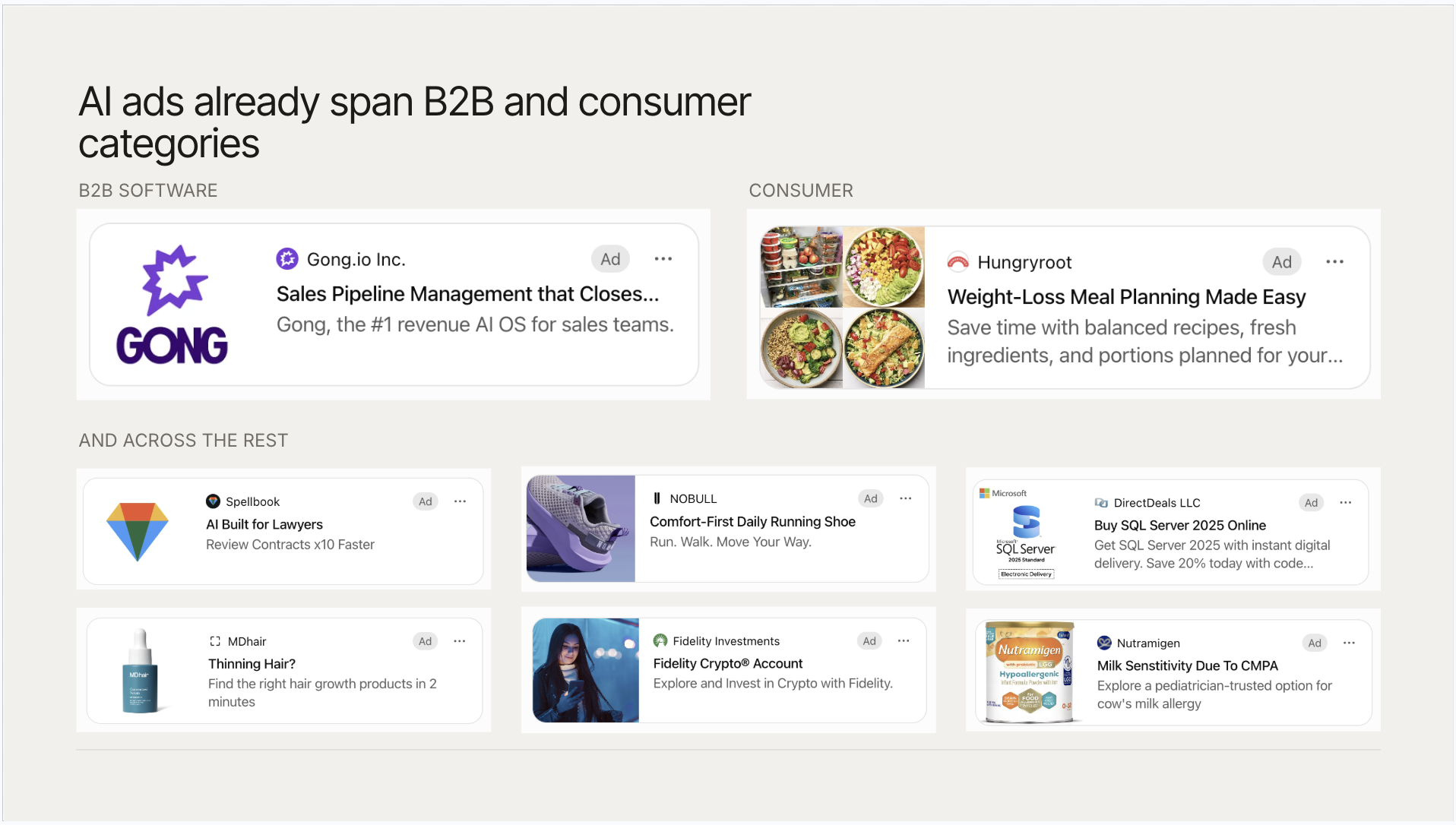
Matt saw ad load in consumer financial services grow 110x from its initial weeks over a three-to-four-week period. One marketer at a dinner with Matt said the format has worked well mid-funnel, which that team did not expect at first. Business-to-consumer (B2C) brands still lead, while business-to-business (B2B) spend is rising for product-led growth (PLG) and prosumer offers with free plans.
Start with audiences already on the ChatGPT Free and Go tiers, and pair each test with AI search visibility tracking data. After relaunching its website with new positioning, AirOps built a Playbook with Quill that drafted ad variants and pushed them to OpenAI. AI Ads in AirOps runs the same loop, with human approval before launch and spend, CTR, and conversion results flowing back from ChatGPT Ads Manager.
What Comes Next for Paid AI Search
Ad formats will keep gaining agency, moving past sponsored agents toward ads that complete purchases on behalf of the user inside the chat. Matt expects connected apps to become the next way brands feed evidence to models, which pulls product, paid, and SEO teams into the same work. Aligning those teams now puts a shared brand system in place before those formats reach your buyers.
See how AirOps helps your team launch and measure ChatGPT ads alongside organic AI search. Work with us.
Get the latest on AI content & marketing
