The old AI-visibility playbook was simple: own the page that answers the question.
That still matters, but as consumer behavior is undergoing a huge shift with AI search, it’s no longer the whole playbook.
Creator/social (representing Youtube, LinkedIn, Meta, TikTok, X, and more) is now the fastest-rising source category in AI Search. And it’s rising exactly as owned brand pages are losing ground.
This shift raises a strategic question: as owned brand pages have a declining share of citation, how do creator, influencer, and social sources affect your AI visibility?
Beca Ramón and the AirOps research team analyzed nearly 3.5 billion source citations that AI engines use in their answers, tracked monthly from August 2025 through June 2026. The deeper cuts in this piece (by funnel stage, by AI engine, & more) draw on a 93-million-citation snapshot across six engines.
Here is what we found:
- Owned brand.com/product citation share fell 10% between August 2025 and June 2026.
- Over the same 11 months, Creator/social citation share grew 140%. No other source category more than 2x’d in that same time span.
- YouTube drove most of that growth, increasing its share of all AI citations by 158%.
- AI engines overwhelmingly cite individual pieces of content, not the creator/social accounts behind them.
- Creator/Social citation share varied sharply by AI engine and vertical, so there isn’t a one-size fits all strategy.
Creator content is becoming AI-search infrastructure.
This shift isn't confined to AI citations. Creator is growing as a category in its own right, and the ad dollars are already following.
The category's spend is already scaling rapidly, growing from $13.9B in 2021 to $44B in 2026 (US only). Nearly 4x the growth rate of media spending overall in the last year alone.
However, brands are still funding creators as episodic social campaigns for human reach, under-utilizing the category as part of a brand's AI-visibility strategy.
Creator content could become the always-on acquisition surface for both the human customer and the second customer: the agent.
The industry said as much for itself this June: Cannes Lions 2026's dominant theme was creators moving from campaign line items to commerce infrastructure, discovered and cited by the same AI systems this piece is measuring.
A brand’s creator gap is now also their AI visibility gap. Brands treating creator content as a campaign channel are behind on how AI engines understand, validate, and recommend them, whether they've noticed it yet or not.
Most of the growth in creator/social has one name: YouTube.
YouTube led the creator as a source growth, nearly tripling its citation share to 4.6% of all AI citations, up 158% in eleven months.
While Reddit, the other emerging player, remains larger than most single creator platforms, it is more volatile, peaking near 5.3% around the holidays, before leveling out to 3.3%. Every other player on this chart, LinkedIn included, stayed flat.
A budget spread evenly across the major platforms in "creator and social" treats each as if they were the same opportunity. Brands that cast a wide-net social strategy will fall short.
.png)
There is no universal creator play.
Platform isn't the only axis where creator/social splits apart. It splits by industry too. A citation mix that reflects real buyer behavior in Fintech can be almost meaningless applied to Consumer & Retail.
.png)
Of the six verticals, no two lean on creator the same way. In some, creator content carries real weight on its own. In others, it only works paired with a different non-brand source entirely.
- B2B Software: LinkedIn and answer-shaped YouTube carry the creator signal, while Instagram and TikTok carry almost none.
- Consumer & Retail: YouTube is doing most of the work. Instagram and TikTok pick up a smaller, secondary share of the same buyer discovery behavior.
- HR & Workforce: Creator content works best paired with review-site presence and community, not on its own.
- Fintech: Media and reviews already carry the evidentiary weight here (comparison sites, financial publishers); creator content adds to it, not instead of it.
- Travel & Experiences: Booking and listing ecosystems, plus community discussion, do the work creators do in other industries.
- Legal Services: Practitioner Q&A and community discussion shape AI answers more than professional network content does.
Across all six verticals, creator content earns its citation by reinforcing what the industry already trusts, not by replacing it.
The engine influences the creator strategy.
Vertical fit isn't the last variable, either. Which AI engine a buyer uses changes the equation just as much.
Some engines already treat creator content as a primary source. Others barely touch it at all.
Google is the most creator-oriented environment in the analysis. Google AI Overview pulls approximately one in every 9.5 citations from creator surfaces and approximately one in 12 citations comes from YouTube alone.
Within Google AI Overview, AI Mode, and Perplexity, YouTube alone already carries more citation weight than every other creator platform combined.
ChatGPT flips the picture entirely.
Creator sources contribute only 0.9% of its citations, with YouTube alone is a rounding error at 0.1%. A B2B brand whose buyers live in ChatGPT could pour money into YouTube, copying the exact playbook that works on Google, and see zero citation lift.
The same YouTube video can be a citation goldmine in Google AI Overview and functionally invisible in ChatGPT. The engine that a brand’s buyers rely on isn’t a reporting filter applied after the campaign… it’s part of the strategy itself.
AI cites the creator content, not the creator platform.
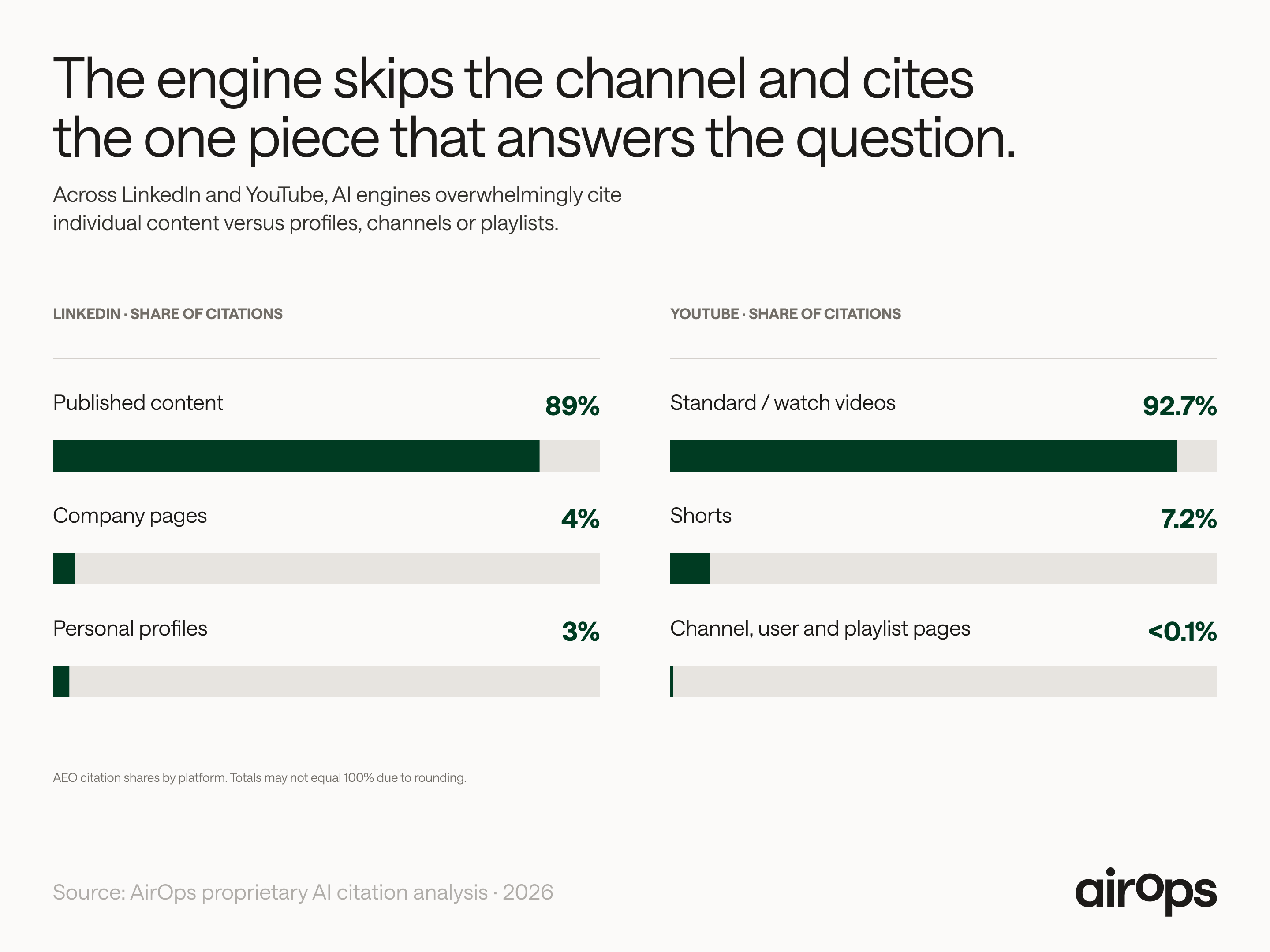
Matching the engine still isn't enough. Underneath every engine sits the same reality: AI doesn't cite platforms, it cites the content.
Most creator strategy still treats the channel as the asset, something to grow, brand, and keep an audience coming back to. However, that's not how AI decides what to cite. It cites the one piece of content that answers the question in front of it, almost never the channel, profile, or page around it.
On LinkedIn, published written content accounts for 89% of its citations, while personal profiles and company pages combined account for only 7%. Years of consistent posting and a large following might earn a human audience's trust. However, it’s nearly invisible to whatever the engine is actually deciding to cite.
YouTube shows the identical pattern. ~99% of the time the AI engine cites one specific video (either a standard video or a short), not the channel around it. Subscriber count, channel branding, and playlist design might earn a human viewer's trust. However, they're nearly invisible to whatever the engine is actually deciding to cite.
Note: We'll dive deeper on Youtube in a following report, stay tuned!
That tracks with how these platforms work under the hood. Retrieval happens against indexed content, not necessarily brand equity. An AI engine matches the specific wording of a question to the specific wording of an answer (a transcript, a caption, a paragraph) instead of a channel's follower count or a decade of consistent posting.
That inverts a basic assumption behind how most B2B content programs are built, that a channel compounds: more followers, more posts, more authority, over time. For AI citation specifically, one exceptional article on an under-followed page can out-cite a company page with ten times the audience and nothing worth citing on it.
The unit of an AI citation is the individual piece of content, not the audience gathered around it.
Creator impact peaks at the edges.
We understand that creator/social content earns the citation, but this source category is not distributed evenly across the buying journey. It clusters at the two moments: when a buyer is still learning & when they're about to decide. In between, while buyers are comparing options, creator citation quiets down.
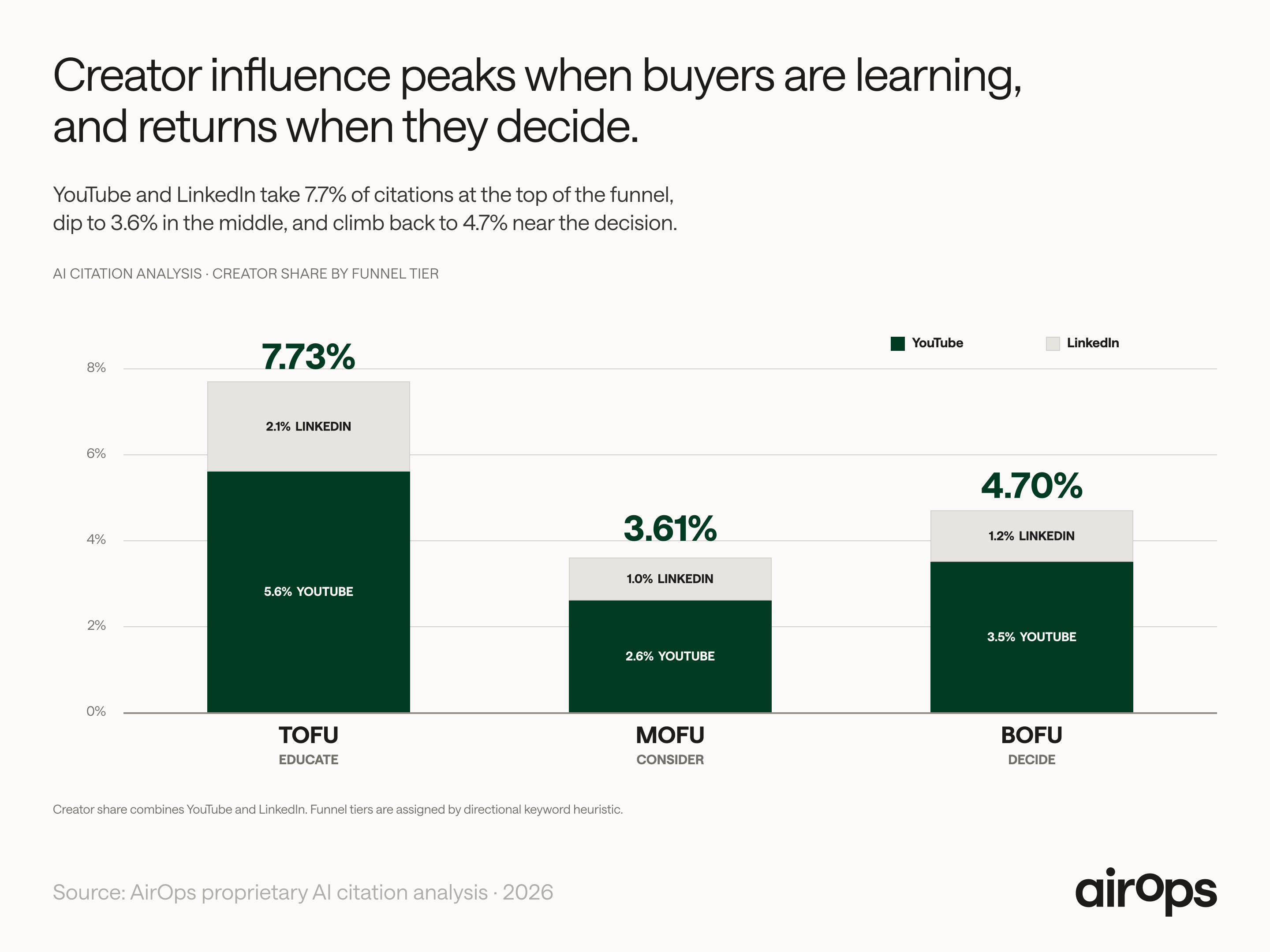
Creator/sources are most prevalent at the TOFU, where buyers ask what is, how does, and how to questions.The category accounts for approximately 7.73% of citations at this stage. At the top of the funnel, YouTube and LinkedIn do what education content does well: demonstrations, guides, and practitioner perspectives.
Creator influence quiets in the middle of the funnel before returning at the BOFU, where it reaches 4.7%. Near the decision, firsthand demonstrations and use-case validation can help a buyer understand how a product works and whether it fits.
Creator content does not need to occupy every stage to influence the outcome. It needs to answer the questions for which AI engines already consider creator evidence useful, TOFU and BOFU.
Bottom line: Creator is growing and AI engines have already decided it counts as evidence.
Strip away the platform-by-platform, engine-by-engine, industry-by-industry detail, and one fact survives all of it: creator and social citations more than doubled in eleven months, while the owned-pages brands have spent years building lost ground over the same stretch.
That's not a channel gaining share. It's evidence that AI engines are re-weighting where trust comes from, away from owned authority, toward earned proof.
Recognizing a growing source category is only the first step. Brands still need to determine which buyer questions matter, where they are missing from AI-generated answers, and what creator content could credibly close those gaps.
That is the idea behind AirOps’ partnership with Linqia, an influencer marketing agency. AirOps identifies the questions, competitive gaps, and AI-search opportunities around a brand; Linqia uses those insights to activate creators and produce social and video content addressing them. The goal is to connect AI-search intelligence with creator execution, and measure whether the resulting content strengthens the brand’s visibility across AI answers.
Own the creator narrative in AI search before your competitor does. Book a demo.
Methodology note
This analysis draws on AirOps' own AI-citation tracking infrastructure, which continuously monitors how leading AI answer engines cite sources when responding to real buyer questions across enterprise brands.
The headline trend covers approximately 3.5 billion citations tracked from August 2025 through June 2026.
“Creator/social” includes YouTube, LinkedIn, Instagram, TikTok, Facebook, and X. It excludes Reddit and Quora, which are classified as Communities, and Medium and Substack, which are classified as long-form publishing.
The industry, AI-engine, and funnel-stage findings use smaller, purpose-built samples from within the broader dataset. The industry analysis covers approximately 80 high-citation brands across six manually assigned industries.
Get the latest on AI content & marketing
