Webinar Recap: Why You Shouldn't Wait for Perfect AI Search Measurement with Bain
Nearly 90% of marketing leaders call AI search visibility a top priority. Only 23% feel confident measuring its impact. That gap is the whole story.
Matt Hammel, Co-founder and COO of AirOps, and Zak Prauer, Expert Partner at Bain, joined host Josh Spilker, Head of Search Marketing at AirOps, to unpack that gap and what a credible measurement plan looks like while the data is still messy.
The biggest takeaway: invest in focused opportunities now while building the baselines, experiments, and evidence needed to measure their impact. Waiting for precise attribution can mean falling behind, but investment still needs a clear strategy.
Top Takeaways
- Finance needs a thoughtful plan, not perfect proof: CFOs want clear baselines, defined activities, and a credible explanation of how those activities drive growth.
- Leaders move, laggards stall on ROI: Bain's research of 1,400 CMOs and CFOs found leaders are twice as likely to shift spend toward AI search, while laggards cite unclear ROI and budget constraints as top blockers.
- Start with a focused pilot and protect what already works: Pick a specific prompt category, use case, or customer segment and demonstrate progress there before expanding.
- Measure whether you're becoming a recommended answer: Mention rate and recommendation rate show how often your brand appears, ideally favorably, in relevant answers.
- Referral traffic captures only part of AI search's influence: Buyers often see a brand in an AI answer, then arrive through branded search, direct traffic, or a later paid interaction.
- Build better measurement while you execute: Keep existing analytics and attribution systems in place, then strengthen them as you collect more data.
Best Practices and Key Learnings
The gap between expectation and proof shows up everywhere
Bain surveyed roughly 1,400 CMOs, CFOs, and senior marketing and finance executives. AI adoption is widespread: 47% of leaders call AI a core capability, versus 30% of laggards, and that gap is closing.
The bigger finding is a disconnect between expectation and proof. 70% of respondents expect significant or transformational value from AI investments in marketing. Only 6% say AI is a fundamental driver of performance today. Leaders are twice as likely to attribute double-digit revenue growth or cost savings to AI.
AirOps ran a parallel survey of 250 CMOs with the same pattern: close to 90% call AI search visibility a top priority, but only 23% feel confident measuring its impact.
"What we're doing about it and is it flowing through to dollars and cents is the gap here." — Matt Hammel
Matt noted the channel evolved unusually: teams can see how they're doing against competitors before they can see dollar-and-cents impact, which creates board-level pressure before the measurement tools catch up.
Finance needs a thoughtful plan, not perfect proof
Bain asked CFOs which functions they trust. Finance trusts finance more than other functions. But even with that in mind, most CFOs want growth, not a clean ROI figure. Think o fROI as an efficiency metric they'll tolerate uncertainty on, as long as the growth case is credible.
"The expectation is not perfection. The expectation is thoughtfulness, directional improvements, involvement in the process, establishing clear baselines." — Zak Prauer
What finance actually asks for: a clear baseline before the investment starts, a defined set of activities, a credible link between those activities and growth, and dedicated resources behind a real roadmap rather than an ad hoc test. Bring finance in early and agree on which signals you trust.
Leaders move money without waiting for perfect measurement
According to studies from Bain, unclear ROI and budget constraints are the two blockers laggards cite roughly twice as often as leaders.
Leaders move anyway, twice as likely to shift spend toward AI search. What's different isn't better math, it's structure: AI search is a top-down strategic priority, there's a centralized roadmap with dedicated resources, and owned channels get maxed out first since they're the levers teams control directly.
"Leaders have established AI investments as a strategic priority, funded it appropriately, dedicated resources, and are giving their leaders some degree of autonomy to move money around." — Zak Prauer
Zak's caution: don't quietly defund a productive demand-gen channel to feed an unproven one without understanding the cost. Sophisticated organizations already know their marginal ROI curves elsewhere, so they know roughly what they'd give up.
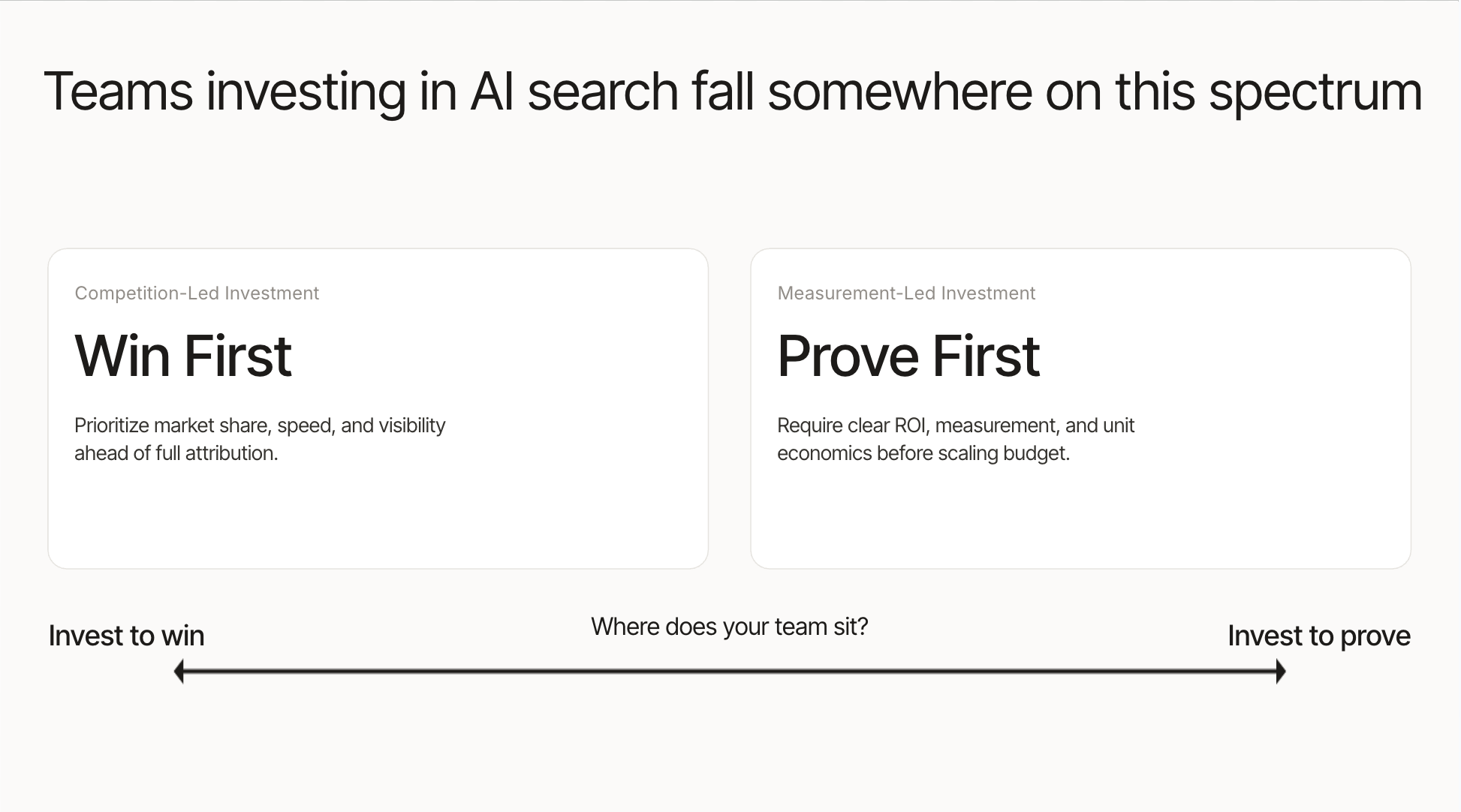
Two camps: win first and prove first
Matt described a recurring split among similarly sophisticated teams. Some invest as a first-principles, competition-driven priority, on the belief that early presence shapes how models remember a brand. Others need dollar-level attribution flowing through existing systems before they'll scale spend.
"That's not to say the win-first group doesn't care about attribution, it's just the second-order priority to being first in the ChatGPT answer." — Matt Hammel
A live poll found 63% of the audience identified as win-first. Zak noted Bain sits there too, with a caveat: win first still means being deliberate about data infrastructure, not spraying budget and hoping.
AI search behaves like brand and performance at once
Zak referenced a prior Bain study with Google: 80% of B2B buyers have a "day one" vendor list, and roughly 90% buy from it. Day-one lists are shaped by word of mouth, owned content, and review sites, the same inputs shaping AI answers.
Matt framed the brand side through a board member's line: brand is what people say about you when you're not in the room. An LLM answer is a synthesis of what others have said, presented to your buyer, often outside your control. At the same time, the clear traffic lift from AI search behaves like a performance channel worth optimizing directly. Zak added this duality shows up in team structure: AEO and GEO work pulls in web, social, PR, paid, and SEO at once, which argues for a cross-functional team rather than a tack-on for the SEO group.
Measure whether you're becoming a recommended answer
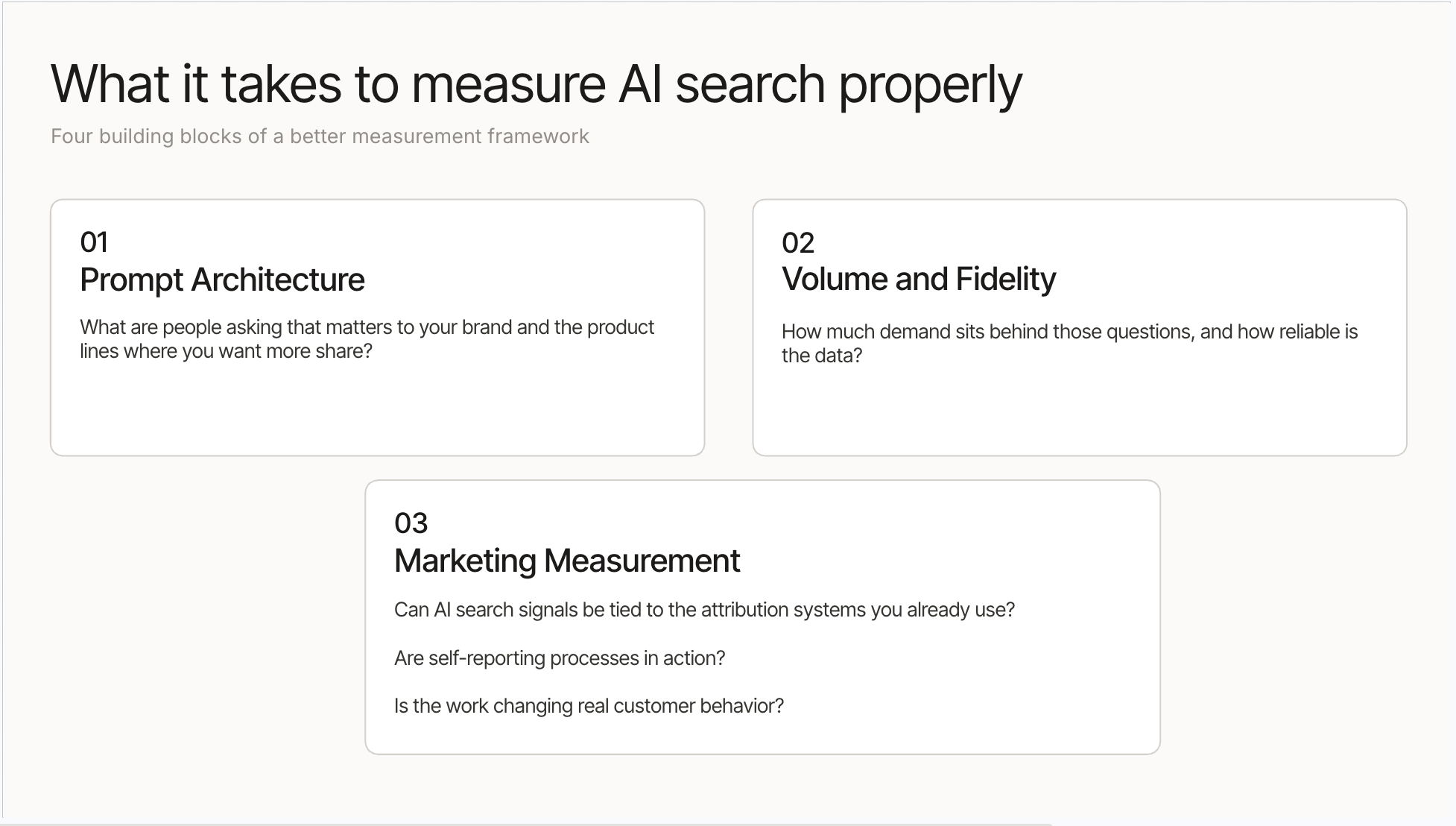
Matt recommended starting with mention rate and recommendation rate. Build the underlying question set from customer interviews, surveys, forums, keyword research, and synthetic personas where available, grouped by topic and buyer need rather than ported from old keyword lists. Because answers are probabilistic, one response is a sample, not a benchmark.
"Can we increase the probability of being the recommended answer is what we should be optimizing for." — Matt Hammel
Referral traffic captures only part of the picture
AI search traffic converts at 4 to 23x the rate of traditional organic search across several studies Matt cited, while "how did you hear about us" surveys consistently show direct referral traffic undercounts real influence. Compare multiple signals together: AI referrals (directional only), surveys, branded search, direct traffic, and conversions.
Build better measurement while you execute
Keep existing systems in place rather than overhauling them. Record what changed, when, and how leading indicators responded. Zak suggested testing optimization in selected prompt categories while leaving others untouched as a control, since full marketing-mix modeling needs at least a year of consistent exposure data the platforms don't yet provide reliably. Give marketing, analytics, and finance one shared mission.
No-regret moves
Invest in owned content. It's the foundation for authority with both Google and LLMs, increasingly where models pull product detail for transactional queries, and the source third-party coverage points back to.
Build a cross-functional team with a shared mission. AEO and GEO work touches too many functions to be one person's side project.
What Comes Next
Matt's close: the "just win" camp and the "measure first" camp are both right, and the next six to nine months are about bringing them into harmony. Zak's parting line is an encouragement for nervous marketers:
"Don't let the fear of the finance overlords slow you down because progress comes quick." — Zak Prauer
Get the latest on AI content & marketing
