Prompts to evaluate AI content platforms on security and scale
Summary
- The right prompts to evaluate AI content platforms make each vendor prove security controls and scale with written evidence.
- Request a SOC 2 Type II report, pen test summary, data processing agreement, and sub-processor list early.
- Test scale in a pilot that uses your real brands, regions, and page volumes.
- Score every answer on a four-point scale, and disqualify vendors who refuse written evidence.
- Re-run the security prompts every year, since vendors change models and sub-processors after you sign.
These prompts to evaluate AI content platforms give you a copy-paste question bank for security reviews and scale pilots. Shadow AI use is common enough that security reviewers ask how each vendor handles unapproved model traffic. Gartner surveyed 302 cybersecurity leaders and advises adding GenAI risk to software-as-a-service (SaaS) assessments. These prompts give you a repeatable way to judge which vendor is the best AEO platform for enterprise companies on your own requirements.
Your AI vendor evaluation checklist needs questions that vendors answer in writing. Platforms like AirOps publish their security controls, so you can test each answer against public documentation. This guide groups prompts by evaluation area, with tables you can paste into a request for proposal (RFP).
What prompts should you use to evaluate AI content platforms?
The right prompts make a vendor prove two things: security controls and scale under your real workloads. Use them as your core questions to ask AI vendors, and route each answer to its approver.
The table maps eight evaluation areas to the evidence you request and the person who signs off.
Evaluation area | What to ask for | Who signs off |
|---|---|---|
Certifications | SOC 2 Type II report, audit period, and bridge letter | Security |
Data handling | Model training policy, retention terms, and deletion window | Privacy and legal |
Access | Single sign-on (SSO), System for Cross-domain Identity Management (SCIM), and role-based access control (RBAC) | IT |
Contracts | Data processing agreement (DPA), sub-processor list, and breach notice terms | Legal and procurement |
Brand governance | Rules per brand, region, and audience, plus approval logs | Brand lead |
Workload scale | Pilot results at your monthly page volume | Marketing operations |
AI search coverage | Engines tracked and page-level citation data | You, as marketing lead |
Cost | Pricing at three times your seats or volume, with metered features listed | Finance |
Pair this question bank with a plan for enterprise buying and rollout. That plan keeps security, legal, and finance approvals moving in parallel.
Run the same prompts at four points in the buying process:
- Paste them into your RFP so every vendor answers identical questions in writing.
- Repeat the top five during the live demo, and ask for proof on screen.
- Ask an AI assistant to pre-research each vendor's public security pages before the first call.
- Close with a time-boxed pilot that runs on your real brands and volumes.
Keep every answer in one shared document. Each approver then reviews the same evidence on the same timeline. Date each answer so you can spot stale documents at renewal.
Security prompts to evaluate AI content platforms before procurement
Security prompts force a vendor to hand over evidence your security reviewer can verify. Send them before the first demo, while you still have room to negotiate.
The stakes are measurable. IBM’s Cost of a Data Breach Report 2026 puts the global average breach cost at a record $4.99 million. That figure rose 12% from the prior year.
Use the prompts below as your AI vendor security questionnaire. Each group covers one part of security, compliance, and data privacy.
Certifications and audits
Certification prompts confirm that an independent auditor has tested the vendor's controls. Ask for the documents themselves, since a trust badge on a website proves little. Your security reviewer needs dates, scope, and auditor names.
- "Share your most recent SOC 2 Type II report under a non-disclosure agreement (NDA), plus its audit period."
- "Send the executive summary of your latest third-party penetration test, with its test date."
- "Which product features and AI models fall inside your SOC 2 audit scope?"
- "Provide a bridge letter that covers the gap between your audit period and today."
Security buyers expect this evidence. In 2025, ISC2 surveyed 1,062 cybersecurity professionals about supply chain vendors. 77% cited compliance with standards such as ISO 27001, NIST, or SOC 2 as their top requirement.
Check that the audit scope names the AI features you plan to buy and roll out. A report written before those features shipped tells you nothing about them.
Data handling and model training
Data prompts confirm where your briefs, drafts, and brand files travel after upload. Your prompts and brand guidelines are company intellectual property, so training terms matter here. Ask whether any answer changes by plan tier.
- "Do you or your model providers train on our prompts, inputs, or outputs?"
- "Which large language model (LLM) providers process our data, and do they offer zero data retention?"
- "How do you encrypt our data at rest and in transit, and which standards apply?"
- "How many days after contract end do you permanently delete our data?"
IBM’s 2025 breach study compared organizations by their use of unapproved AI tools, or shadow AI. Breaches at those with high levels cost $670,000 more on average than at those with low or none. An approved platform with clear data terms gives your writers a sanctioned option.
Get each answer in the contract, since a help center page can change without notice.
Access and identity
Identity prompts show whether the platform fits the access controls your IT team already runs. Put SSO and SCIM on the first call, because retrofitting identity delays rollout. Ask for a live walkthrough in your own identity provider.
- "Which SSO identity providers do you support, and can we enforce SSO for every seat?"
- "Do you support SCIM provisioning, including automatic deprovisioning when someone leaves?"
- "Can RBAC limit each person to specific brands, workspaces, or regions?"
- "Do audit logs record who edited, approved, and published each asset, and can we export them?"
For reference, the AirOps enterprise offering lists SSO via Okta, Azure AD, and Google Workspace. RBAC and SCIM provisioning come included on its enterprise plans.
Contracts and sub-processors
Contract prompts turn verbal promises into terms your legal team can enforce. Ask for the full document set before you negotiate price. Start legal review in parallel with the pilot so contract terms never stall the decision.
- "Send your data processing agreement, and confirm it includes Standard Contractual Clauses (SCCs)."
- "Share your current sub-processor list and the notice period before you add a new one."
- "What is your breach notification window, and who on our side receives the notice?"
- "When we exit, in what format do you return our data, and how fast?"
Sub-processor terms deserve extra attention with AI vendors, since each model provider counts as a sub-processor. Ask for advance notice and a right to object before a new provider touches your data.
Independent privacy certifications and clear data-ownership terms belong in every vendor scorecard. Grade each document against this security evidence checklist as it arrives.
Evidence | Acceptable answer | Red flag |
|---|---|---|
SOC 2 Type II report | Current report under NDA, with AI features in scope | Type I only, or no audit date |
Penetration test | Third-party test with a dated summary | An internal scan offered as a pen test |
Model training | Written no-training commitment in the contract | An opt-out buried in account settings |
Data retention | A defined deletion window after contract end | Open-ended retention to improve the service |
SSO and SCIM | Included on the plan you are buying | A roadmap item with no date |
DPA and SCCs | Signed DPA with SCCs and a sub-processor list | DPA offered only after signature |
Breach notice | A contractual window and a named contact | Notice only as required by law |
AirOps publishes its security and compliance documentation as one public reference point. It states SOC 2 Type II compliance, with the report available under NDA. It also names its encryption standards for data at rest and in transit.
The same page offers a DPA with SCCs and deletes customer data 30 days after account closure. Enterprise customers also get OpenAI's Enterprise Zero Data Retention. Hold every vendor on your shortlist to that same level of written, dated detail.
Brand governance at scale
Brand voice governance at scale means each brand, region, and audience follows its own rules. Ask the vendor to show those rules running on your content. The AirOps Brand Kit screenshot below shows tabs for foundations, product lines, content types, audiences, and regions.
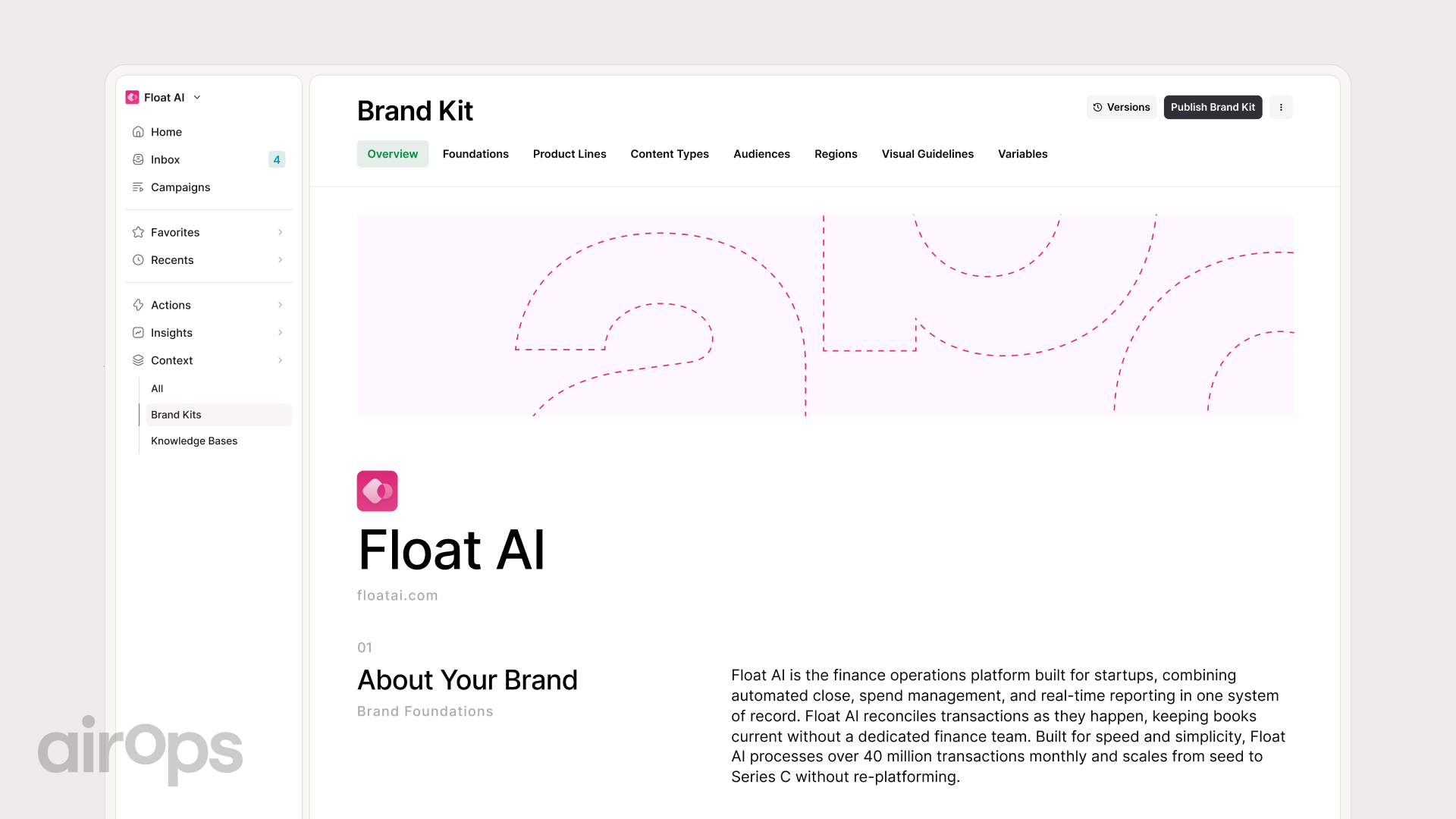
- "Show how you store separate rules for each brand, region, and audience in one account."
- "When a draft breaks a brand rule, do you flag it, block it, or rewrite it?"
- "Can approvers differ by brand, and does the platform log every approval?"
- "Where do human review checkpoints sit before anything publishes?"
For portfolio-level guidance, see this hub on brand governance at AI scale. It covers how governance holds as you add brands, regions, and approvers. Use it to brief your brand lead before the pilot starts.
Workload and integrations
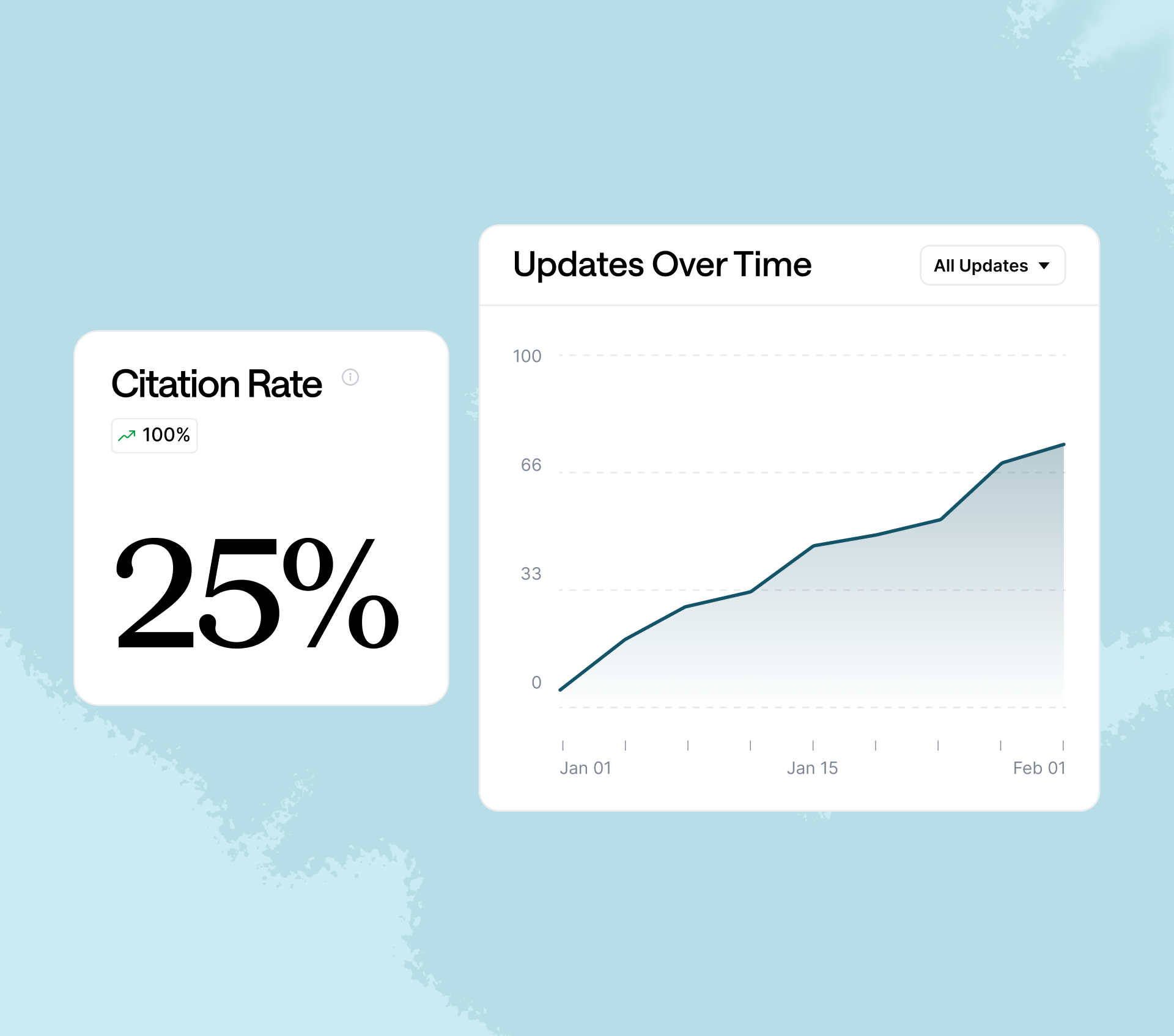
Workload prompts test integration capabilities and throughput against your real stack. Ask for pilot output at the volume you plan to run in month six. The AirOps view below pairs citation rate with content updates over time.
- "How many pages per month do your enterprise customers run, and can we speak with one?"
- "Run a bulk refresh of 50 of our existing pages during the pilot."
- "Show live connections to our content management system (CMS), Google Search Console, and Google Analytics 4."
- "What are your API rate limits, and what happens when we exceed them?"
Ask for a named integration owner during the pilot. Connection gaps surface fast once page volume rises in month two.
Compare each answer with the AirOps platform workflows so you know what good looks like.
AI search coverage
Answer engine optimization (AEO) is the practice of earning citations in AI search answers. Coverage prompts check whether a platform connects AI search tracking to the next action. Page-level citation data tells you which page to fix first.
- "Which AI search engines do you track, and how often do you refresh results?"
- "How many prompts can we track per brand and region on our plan?"
- "Do you show page-level citation data, and does it link to recommended actions?"
Cost at scale
Cost prompts expose total cost of ownership before a renewal surprises you. Ask for every tier name and price in writing, including enterprise terms.
- "What would we pay at three times today's seats or volume, written into the contract?"
- "Which features consume credits, and what does each action cost?"
- "Which onboarding, training, and strategy services does the price include?"
Run these scenarios in the pilot, and record the pass signal for each.
Scenario | What to request in the pilot | Pass signal |
|---|---|---|
Multi-brand launch | Two brands with separate rules in one account | Each draft follows its own brand rules |
Regional rollout | One page localized for two regions | Regional rules apply without manual fixes |
Bulk refresh | 50 existing pages refreshed in one run | Reviewers approve drafts with light edits |
Access change | One person removed through SCIM | Access ends without a support ticket |
Volume spike | Triple the pilot volume for one week | Quality holds, with no unplanned charges |
AI search reporting | Citation report for 20 tracked prompts | Each citation maps to a page and a next step |
For a worked example across brands, read about multi-brand content governance.
How to score vendor answers on security and scale
Score every answer on the same four-point scale so you can compare vendors fairly. The red flags column helps you stop a weak deal early.
Score | What the answer looks like | AI vendor red flags |
|---|---|---|
Strong (3) | Written evidence with current dates and terms you can add to the contract | None |
Partial (2) | Evidence exists with gaps, such as an expired bridge letter | Promises to close gaps after signature |
Weak (1) | Verbal answers, or marketing pages in place of documents | Answers like "on the roadmap" with no date |
Disqualify (0) | Refusal to share evidence, even under NDA | Training on your data with no opt-out |
- Weight security higher for regulated brands, and weight scale higher for multi-brand portfolios.
- Bring IT, legal, and procurement in before the demo so they shape your AI content platform RFP questions.
- Ask each finalist for two enterprise references who run your volume.
- Re-score each vendor yearly. Many organizations review vendors mainly at onboarding, then rarely again. Reassess at least once a year.Key takeaways
- Written evidence is the only answer that counts in a security review.
- Scale multiplies security gaps, since each new brand and region adds people and data.
- A pilot on your real brands exposes cost and governance gaps before you commit budget.
- Fixed score bands keep your decision defensible when finance and legal review it.
FAQ on evaluating AI content platforms
Is a SOC 2 report enough to approve an AI content platform?
No. SOC 2 confirms general controls, and you still need answers on model training, retention, and sub-processors. Check that the audit scope includes the AI features you plan to use.
How often should you reassess an AI vendor after purchase?
Reassess at least once a year. Run the prompts again after any change to the vendor's models, sub-processors, or ownership.
Who should be involved in evaluating an AI content platform?
Bring in security, IT, legal, procurement, and finance alongside your brand and marketing operations leads. You own the final call on brand fit and scale.
How long should a pilot run?
Run the pilot through one full publishing and refresh cycle on at least two brands. Shorter pilots miss approval delays and cost spikes.
AirOps for AI content platform security and scale evaluations
Security evidence prompts and score bands help you choose a partner who knows AI discovery. AirOps gives you the intelligence to see where your brand stands in AI search. Brand Kits support brand governance at scale, and the security documentation is ready for your reviewer.
AirOps pairs its platform with experts who set strategy and guide execution. Its channel mix covers owned content, external content, AI ads, community, and influencer and social. They work alongside your team and adjust the plan as results come in.