Prompts to enforce brand voice in AI content: 5 guardrails
Summary
- Prompts to enforce brand voice in AI content turn a voice guide into testable rules.
- A five-prompt guardrail chain runs in a fixed order on every draft.
- Each rule gets a pass or fail test and a proof quote from approved samples.
- The rewrite prompt edits only failing sentences and locks every fact.
- A human editor makes the final call before anything publishes.
A voice guide full of adjectives gives a model little to enforce. Words like "confident" and "warm" read as loose hints to AI. Prompts to enforce brand voice in AI content turn those hints into checkable rules. If you are comparing the best AEO platform for enterprise companies, check that it enforces these voice rules before anything ships.
AirOps applies Brand Kit writing rules as hard constraints during content generation. You can run the same discipline in any chat model with five prompts. Each prompt does one job and passes its output to the next.
The chain starts with your approved samples. It pulls out rules, and each rule carries a quote as proof. Then it scores every draft against those rules, one at a time.
The rewrite step edits only the sentences that failed. A claims lock keeps every fact and figure exactly as written. Your editor reviews the result and signs off.
Before you start, gather your voice guide and a few approved samples. Pick recent pieces that a senior editor approved without heavy edits.
Keep all the samples to one format, such as blog posts. Mixed formats blur the patterns the model extracts.
This guide assumes your brand tone is already set. For tone settings, start with these tone of voice prompts first. Here, you get the enforcement step that comes next.
What are prompts to enforce brand voice in AI content?
Prompts to enforce brand voice in AI content test drafts against fixed, written rules. They constrain the model while it writes. They also check each draft after it is written.
These brand voice guardrails do four jobs.
- They convert adjectives into rules with a clear pass or fail test.
- They score each draft rule by rule, with a quote as proof.
- They limit rewrites to failing sentences, so facts stay intact.
- They hand the final decision on every piece to a human editor.
Enforcement runs at two points in your process. The system prompt shapes the draft during writing. The audit prompts check the finished draft before an editor sees it.
Both points matter on long drafts. Long drafts give a model more room to slip from a rule stated once at the top. A separate audit catches what the system prompt missed.
Review is already standard practice. In 2025, Ahrefs reported that 97% of respondents edit and review AI content. Only 4% publish pure AI content.
That survey covered 879 marketers from December 2024 to February 2025. Enforcement prompts give that review a fixed checklist.
Tone prompts and enforcement prompts solve different problems. Use this table to tell them apart.
Dimension | Tone prompt | Enforcement prompt |
|---|---|---|
Purpose | Sets how a new draft should sound | Checks whether a draft follows your rules |
Input | A tone description and a topic | Your rules file and a finished draft |
Output | A new draft in the requested tone | A pass or fail score per rule, with quotes |
Failure it catches | A draft that sounds wrong for the moment | Rule breaks, such as banned phrases or hedge words |
Run both types in sequence. Set the tone first with a tone prompt. Enforce your rules on the result with the five guardrails below.
Readers care whether brand writing feels human. That preference is why voice rules must be checkable before publish.
That makes on-brand AI content a reader issue as well as a style issue. The next two sections give you the five prompts in order.
How do you turn a voice guide into rules AI can follow?
Your approved samples already show the voice at work. Guardrail 1 pulls rules out of them. Guardrail 2 turns those rules into a system prompt for brand voice.
Guardrail 1 prompt extracts voice rules from approved samples
Paste three to five approved samples into a new chat. Then run this prompt. Each rule it returns must cite a quote from your samples.
You are a brand voice analyst. Below are approved samples of our writing.
Extract 8 to 12 voice rules from these samples. Write each rule as one testable instruction a reviewer can mark PASS or FAIL.
For each rule, include one exact quote from the samples that proves it. Drop any rule you cannot prove with a quote.
Describe observable patterns, such as sentence length or point of view. Do not describe mood or personality.
Return a numbered list in this format: Rule, Test, Proof quote.
Samples: [paste approved samples here]
Review the output before you use it. Delete any rule that conflicts with your written guide. Keep the proof quotes for later audits.
Guardrail 2 prompt sets a system prompt with numbered rules
The second prompt becomes your standing instruction for every draft. Paste it into the system prompt or custom instructions field. It pairs your numbered rules with a ban list and a claims lock.
You write for [brand name]. Follow every rule below in every response.
Voice rules: [paste the numbered rules from Guardrail 1]
Ban list: never use these words or phrases: [paste ban list]
Claims lock: use only facts and figures from the source I provide. Never add a statistic or claim that is missing from the source.
Before you answer, check your draft against each numbered rule. Fix every rule break before you return the draft.
Keep the rule count tight so each rule gets attention. A testable rule has four traits.
- It names one observable pattern in the text.
- A reviewer can mark it pass or fail in seconds.
- It cites a proof quote from an approved sample.
- It points to a specific fix when it fails.
Voice guides lean on adjectives, and adjectives resist testing. This glossary entry on on-brand voice covers the core definition. The table below converts common guide adjectives into rules a model can follow.
Adjective in your guide | Testable rule | How to check |
|---|---|---|
Confident | Zero hedge words from your ban list | Search the draft for each hedge word |
Clear | Every sentence stays under 20 words | Count the words in each sentence |
Direct | Each paragraph opens with its main point | Read the first sentence of each paragraph |
Expert | Every claim names a source or example | Mark each claim with no named source |
Warm | Address the reader as "you" | Check each section for second-person address |
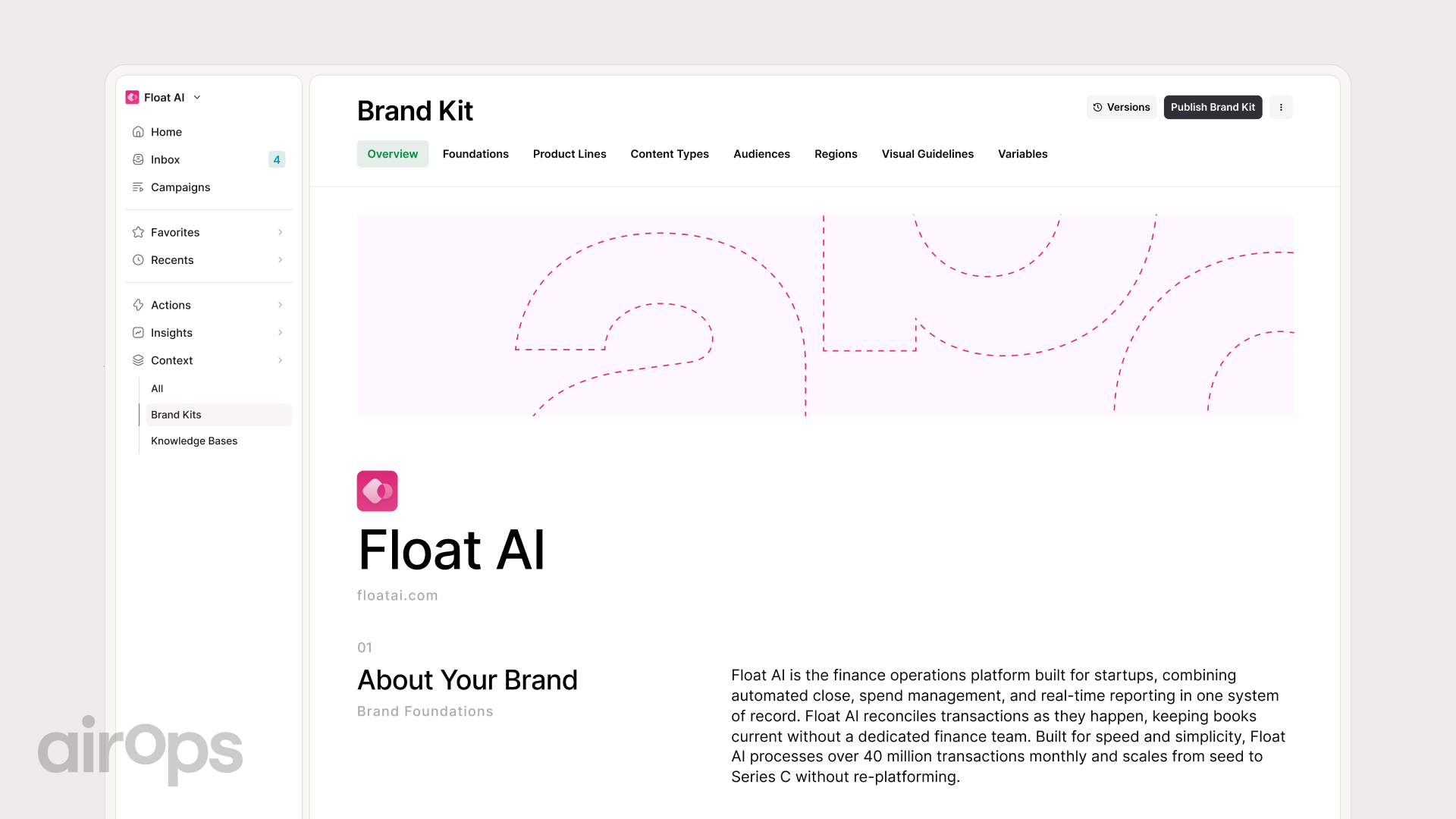
The screenshot below shows the AirOps Brand Kit view, where voice rules are stored.
How do you score a draft and fix only what fails?
A score tells you which rules broke and where. A targeted rewrite fixes those spots and leaves the rest alone. Run these three guardrails on every draft.
Guardrail 3 prompt scores each rule pass or fail
Open a fresh chat for the audit. A new session keeps the writing context out of the grading. Paste in your rules and the draft with this brand voice audit prompt.
You are a strict brand voice auditor. Score the draft below against each numbered rule.
For each rule, return its number and a PASS or FAIL score. Quote the exact sentence that proves the score.
Quote failing sentences word for word. Do not rewrite anything yet.
End with a count of passed rules and a list of failing sentences.
Rules: [paste rules] Draft: [paste draft]
Log the failing rules after each audit. Repeat failures on one rule signal brand voice drift. That pattern shows you which rule needs a sharper test.
Guardrail 4 prompt rewrites only the failing sentences
This prompt fixes failures and leaves passing text alone. The claims lock stops the model from changing facts while it edits wording.
Rewrite only the sentences marked FAIL in the audit below. Leave every other sentence exactly as written.
Claims lock: keep every fact, number, name, and quote unchanged. Do not add new claims or remove existing ones.
For each rewrite, show the original sentence next to the new one. Name the rule it now passes.
Audit: [paste Guardrail 3 output] Draft: [paste draft]
Compare each rewrite with the original. Reject any edit that alters meaning. Then paste the approved rewrites back into the draft.
Guardrail 5 prompt runs the ban list and pre-publication voice check
The last guardrail is a final sweep before an editor signs off. It catches banned phrases that slipped back in during rewrites.
Run a pre-publication voice check on the draft below.
Step 1: List every word or phrase from the ban list that shows up, with its sentence.
Step 2: Confirm each numbered rule passes. Quote any sentence that still fails.
Step 3: List every number and named claim. Mark whether each one shows up in the source.
Return READY only when all steps come back clean. Otherwise, return NOT READY with the list of issues.
Ban list: [paste] Rules: [paste] Source: [paste] Draft: [paste]
The table below shows the full chain in order.
Guardrail | When to run | Input | Output |
|---|---|---|---|
1. Extract rules | Once, and again each quarter | Three to five approved samples | Numbered rules with proof quotes |
2. Set system prompt | Before every generation | Rules plus ban list and claims lock | A draft written under your rules |
3. Audit draft | After each draft | Rules and the draft | PASS or FAIL per rule, with quotes |
4. Rewrite failures | After each audit with failures | Audit output and the draft | Fixed sentences with facts unchanged |
5. Final check | Before editor sign-off | Ban list, rules, source, and draft | READY or NOT READY with issues |
Keep the audit useful with these habits.
- Run the audit in a fresh session, apart from the writing chat.
- Require a quote for every score, pass or fail.
- Reject any rewrite that changes a fact or number.
- Log repeat failures to track brand voice drift over time.
How do you run prompts to enforce brand voice in AI content at scale?
A guardrail chain holds across a team only with shared inputs. Everyone runs the same rules in the same order. This guide to brand governance at scale covers the wider operating model.
Use these practices to keep the chain consistent as output grows.
- Keep one shared rules file and version every change.
- Run the five guardrails in the same order on every draft.
- Give a human editor the final call on every piece.
- Review logged failures monthly to catch brand voice drift early.
- Update proof quotes whenever you approve new samples.
Clear ownership keeps the chain from breaking between handoffs.
Role | Owns | Checks |
|---|---|---|
Content lead | The rules file and its versions | Monthly failure patterns |
Writer or operator | Guardrails 2 to 4 on each draft | Audit scores before handoff |
Editor | Guardrail 5 and final sign-off | Facts and meaning in every rewrite |
Brand owner | The ban list and approved samples | New rules before they go live |
Detectable AI writing carries a cost with readers. A shared chain with human sign-off keeps drafts sounding like your team.
With several brands, you need one rules file per brand. A shared ban list still works across all of them. This post on multi-brand content governance covers how to split ownership.
Key takeaways
- Voice enforcement runs on evidence, so every rule needs a proof quote.
- Scoring and rewriting belong in separate steps to protect your facts.
- The claims lock is what makes AI edits safe for factual content.
- Repeat failures are data that show where your guide needs sharper rules.
Frequently asked questions
Can AI preserve brand voice during refreshes?
Yes, when the refresh runs through the same chain. Run Guardrail 3 on the old page first to find failing sentences. Use Guardrail 4 for voice fixes, and update stale facts in a separate, sourced pass.
Can ChatGPT keep a brand voice across conversations?
ChatGPT keeps rules only where you store them, such as custom instructions or a project. Paste Guardrail 2 into that field so every chat starts with your rules. Keep running Guardrail 3, because stored rules guide output without checking it.
How many rules belong in a brand voice system prompt?
Aim for 8 to 12 numbered rules plus a ban list. Each rule needs its own pass or fail test. Merge overlapping rules until each one checks a single pattern.
What is the difference between brand voice and tone?
Brand voice is the fixed set of rules that makes your writing recognizable. Tone is how that voice adjusts for a channel or moment. The tone of voice prompts linked in the introduction cover tone settings.
AirOps for brand voice enforcement in AI content
The AirOps platform runs the guardrails from this guide inside your content workflow. Each guardrail maps to a specific part of the platform, so the chain runs on every draft.
- Brand Kit holds the numbered rules and ban list from Guardrails 1 and 2.
- Playbooks apply the audit and rewrite steps from Guardrails 3 and 4, with the claims lock in place.
- Grids run the same checks across many pages at once, such as a full refresh batch of older posts.
- The final check from Guardrail 5 runs on each draft before editor sign-off.
- Your editors review flagged failures and make the final call on every piece before it publishes.
AirOps also gives your team intelligence on how AI search describes your brand. Your editors stay in charge of what publishes, with the five guardrails backing every review. Rule changes go into Brand Kit once, and every new draft picks them up.