The most competitive consumer finance prompts in AI search
What consumers ask AI for personalized financial advice and how AI answers back
A college freshman asks an AI engine for her first credit card. She says she is a student, the way she would tell a banker. Answers name 3.6 cards on average, and one card appears in 83.7% of them. Two in three answers recommend a card outright, and the picture barely changes across engines or from week to week. Together, those measures point to one issuer that owns the answer. For any other card issuer, this is the hardest and most important credit card prompt to win.
A freelancer asking for loans for the self-employed finds a more open field. The most-named lender appears in 29.5% of answers. Engines regularly recommend a lender, but no one brand owns the answer.
AI lets consumers ask money questions in their own terms: a student, a freelancer, a first home, a card for groceries. The answers to some prompts are largely settled, with the same provider consistently on top, a short list of contenders, and a definitive pick. Others are still open.
Almost a third of consumer finance prompts have the top provider named in at least 60% of answers.
We scored prompts inside eight consumer finance topics: credit cards, banking, personal loans, mortgage and home equity, investing, payments apps, auto insurance, and home and renters insurance. The score combines five within-topic measures so marketers can see which prompts are hardest to win:
- Hard to earn a slot: fewer providers named per answer ranks higher
- Recommendations matter: a higher share of answers with an explicit provider recommendation ranks higher
- Top-provider presence: a higher share of answers naming the prompt's most-named provider ranks higher
- Hard to displace: less shift in the named providers across engines and weeks ranks higher
- Citation diversity: more distinct sites cited per answer ranks higher, because more evidence surfaces are in play
The rankings below show which prompts were most competitive in October, what changed month over month, and where and how challengers can still earn their space in the answers that matter to them and their customer.
Most competitive credit card prompts
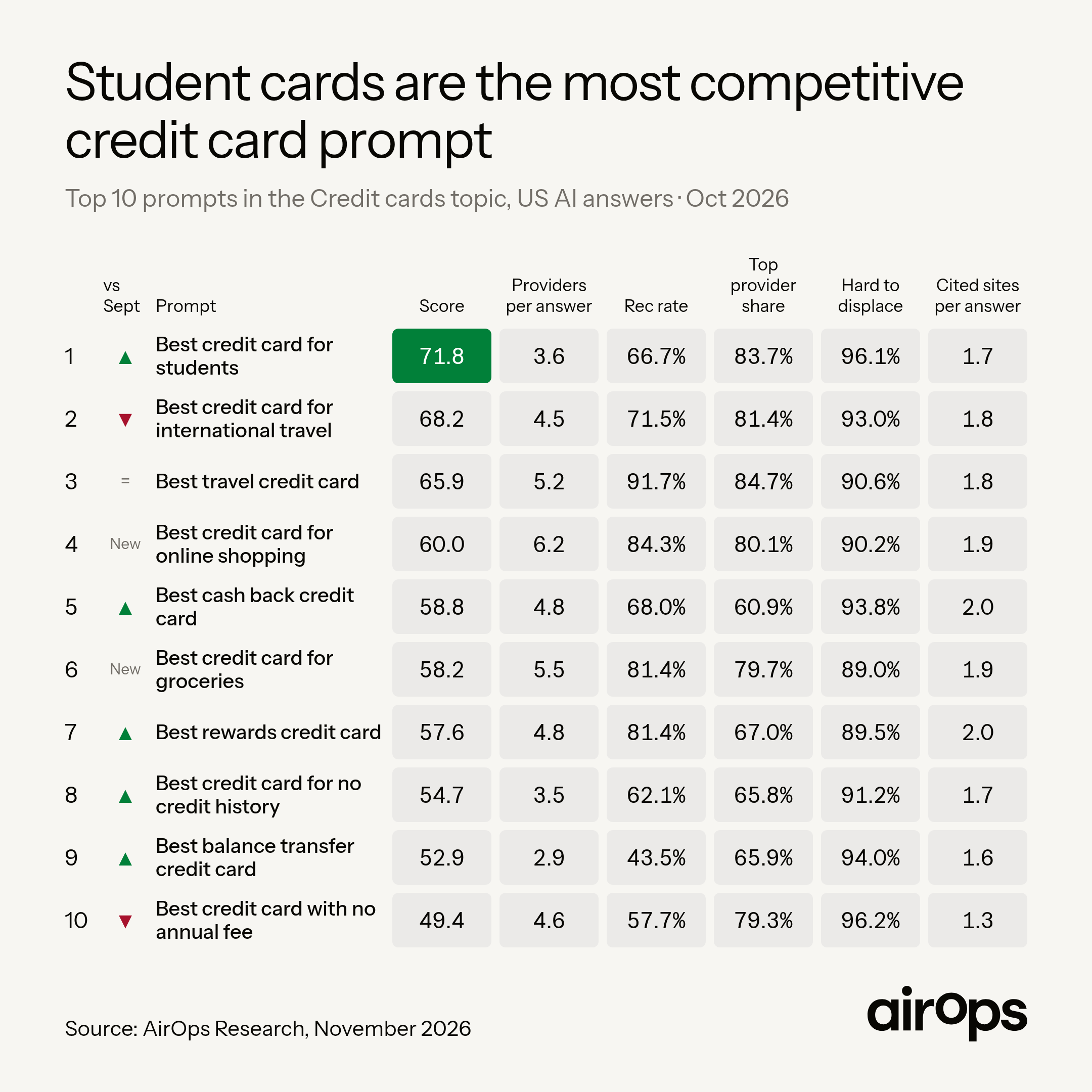
Student cards moved up to first from second, driven by a shrinking shortlist and a hard to displace leader. Cash back cards made the bigger move, jumping from 12th to 5th as the share of answers with an explicit recommendation rose from 60.3% to 68.0%.
Capital One was the most-named issuer across credit card prompts AirOps tracked in October, and it led student-card answers at 83.7%.
At the other end of the leaderboard, “How to compare credit cards” remains the most open prompt.
Much of the competition for credit cards comes from an evidence mix that leans heavily on comparison sites. These sites appear in 72% of answers and make up an outsized share of the evidence at 27% of citations, against the 18% average across consumer finance topics.
Most competitive banking prompts
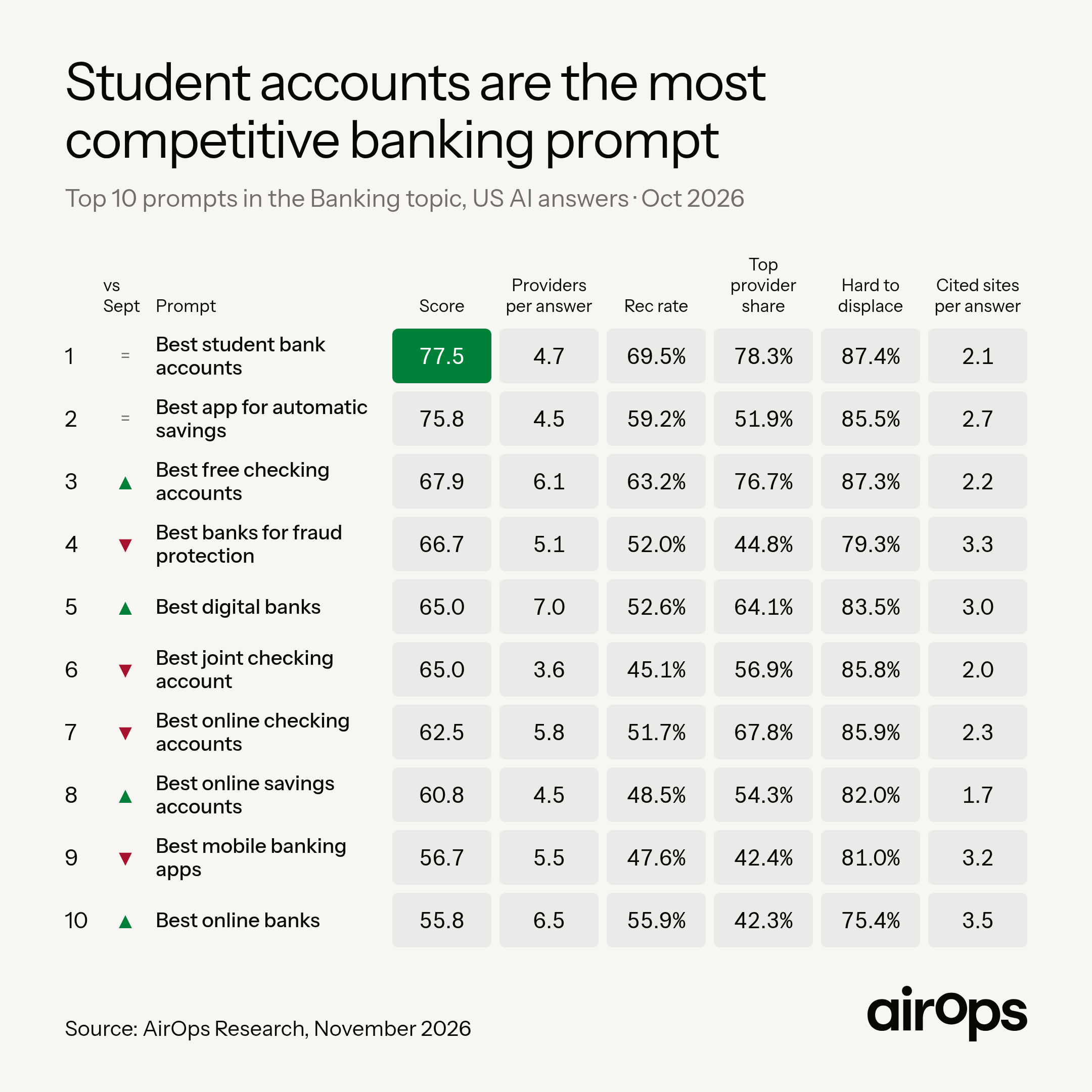
Student bank accounts remain the most competitive, and the top provider's share of answers rose from 73.7% to 78.3%. Digital banks rose from 9th to 5th. Free checking moved up to third from fourth. Online banking is getting more competitive with the top bank appearing in 42.3% of answers, up from 33.8% in September, and the prompt rising from 13th to 10th. Credit union vs bank prompts newly qualified this month but remain outside of the top 10.
SoFi leads digital-bank answers at 64.1%. Chime climbed 10.1 points from September and now appears in 61.6% of them.
Bank answers are driven by provider sites, which take 46% of citation slots, the highest of any topic, and appear in 77% of answers. Bankrate (28% of answers) and CNBC (23%) are the main outside sources. Student-account answers are unique and pull in a college savings site, savingforcollege.com, in 27% of answers — highlighting that evidence is highly topic and persona dependent.
Most competitive personal loan prompts
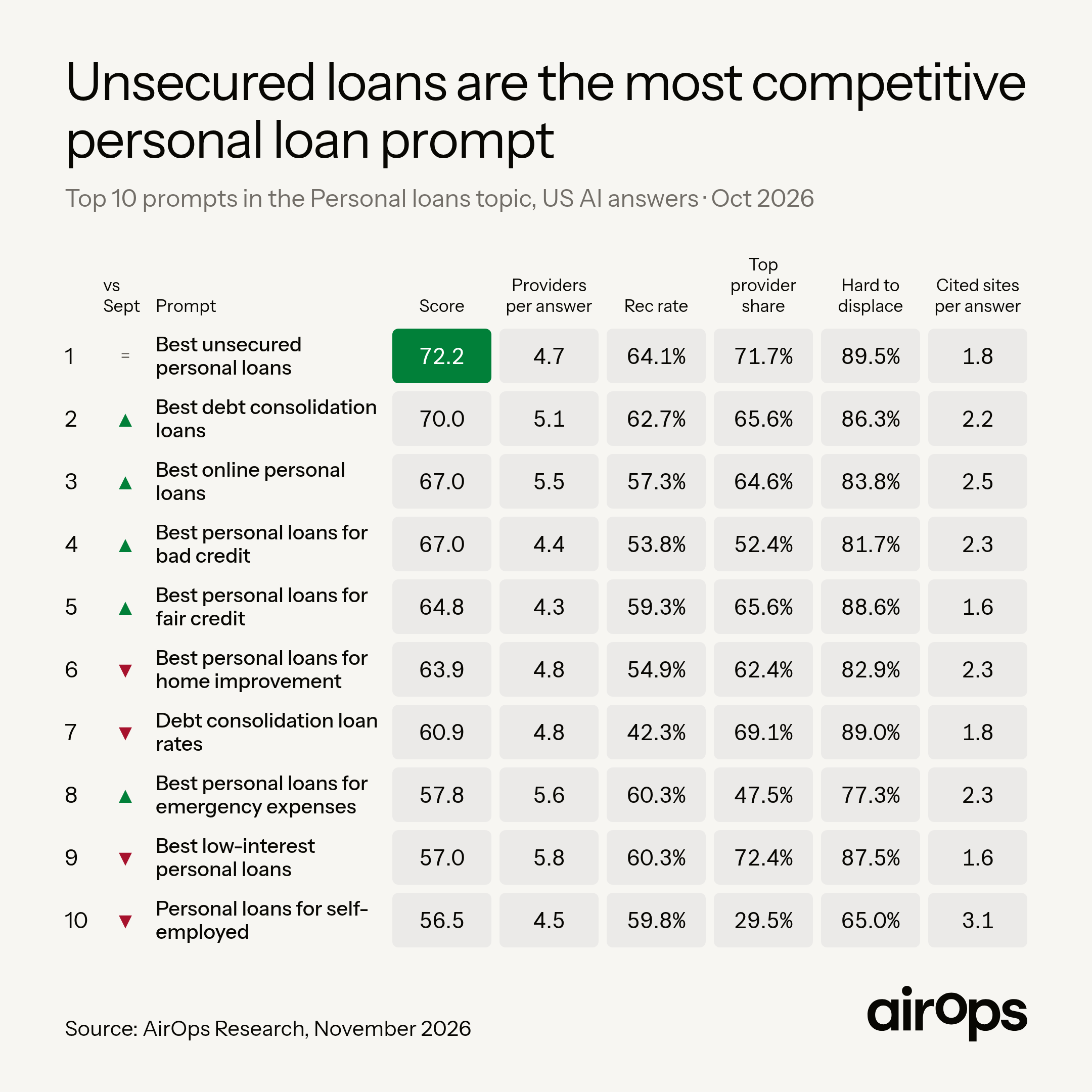
Online personal loans jumped from 13th to 3rd as answers became more consistent. Volatility fell from 0.357 to 0.162, and the top lender's share rose from 48.0% to 64.6%. Unsecured personal loans held first, with recommendations up from 57.4% to 64.1%.
SoFi was the most-named lender across personal loan prompts AirOps tracked, and it led unsecured-loan answers at 71.7%, up from 65.8% in September.
Self-employed and emergency-expense loans remain open, though the leading lenders gained ground in both. For self-employed loans, the top lender appears in 29.5% of answers, up from 20.4% in September, while 59.8% of answers recommend a lender. For emergency-expense loans, those figures are 47.5% top-provider presence, up from 37.9%, and a 60.3% recommendation rate.
On the evidence side, credit-bureau pages take 7% of citation slots here, against 2% overall. Experian appears in 30% of answers, rising to a whopping 44% for debt consolidation. Answers to personal loan prompts cite 5.7 sites per answer, the most of any topic.
Most competitive mortgage prompts
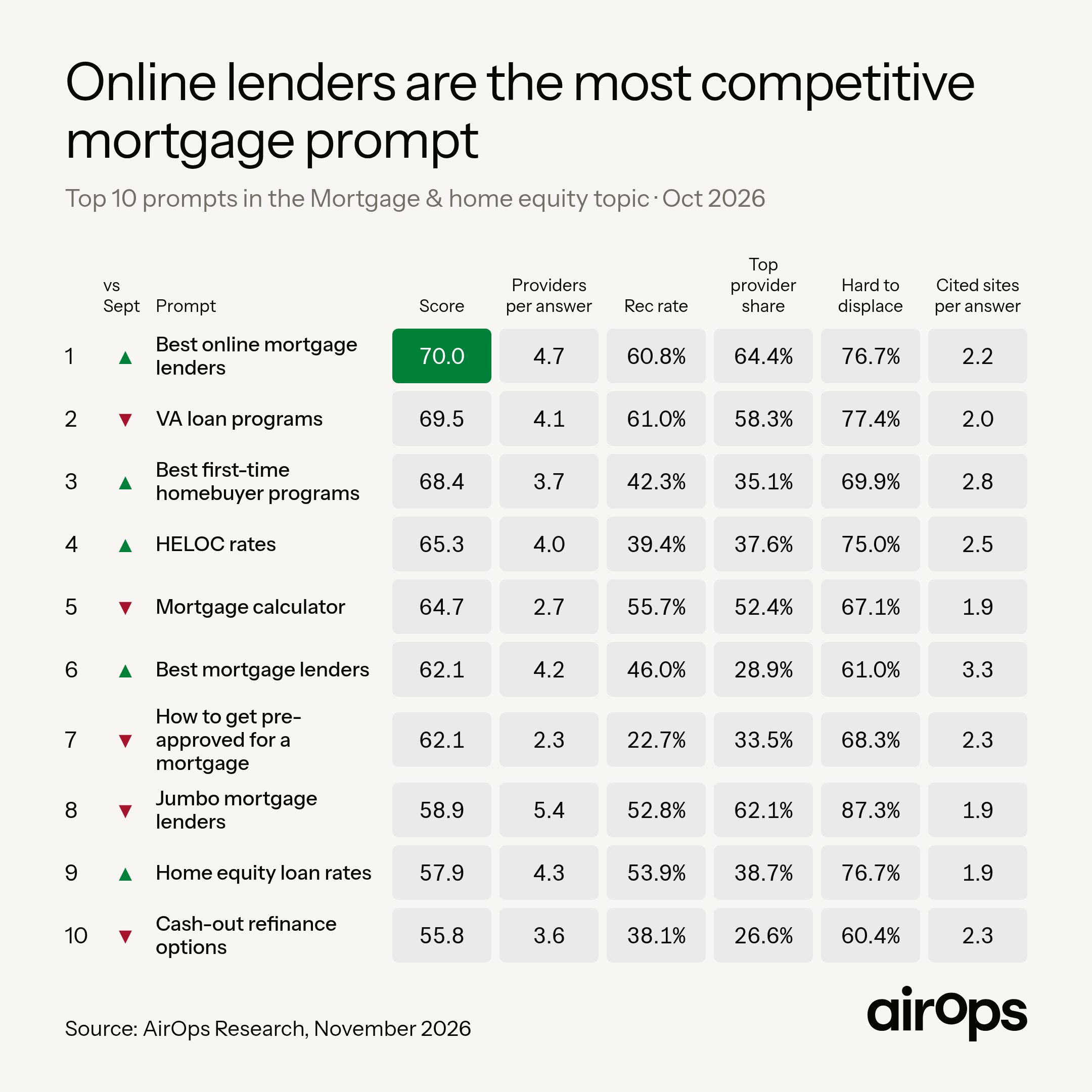
Online mortgage lenders moved from 4th to 1st as the recommendation rate rose from 51.9% to 60.8%. VA loan programs, September's leader, slipped to second by half a point.
Rocket Mortgage led online-lender answers at 64.4%, up from 60.4% in September.
Down payment assistance is still the most open prompt in the table, with the top name in only 8.4% of answers. Mortgage brokers newly qualified this month at 16th, with the top broker in 24.8% of answers and a recommendation in 42.0%.
Bankrate appears in 38% of mortgage answers, about twice its rate across all eight topics. Lender sites take 43% of citation slots. And, unsurprisingly, VA.gov is cited in 25% of VA-loan answers. Government pages appear in 17% of mortgage answers overall suggesting that building .gov adjacent evidence will strengthen a brand’s competitive position.
Most competitive investing prompts
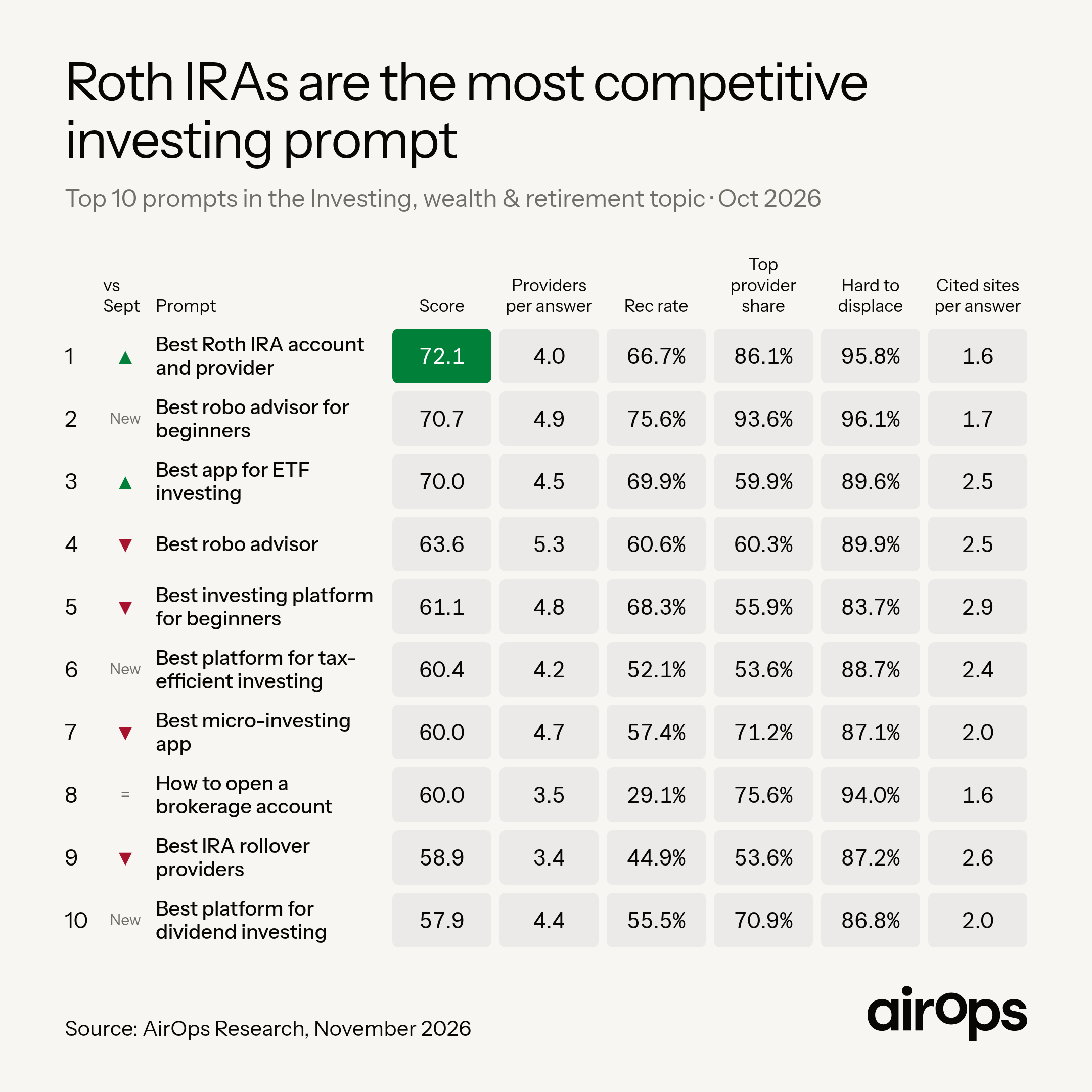
Roth IRA accounts moved from 3rd to 1st as the recommendation rate jumped from 44.2% to 66.7% and the top provider's share rose from 70.6% to 86.1%. Charles Schwab dominated Roth IRA answers at 86.1%, up from 65.1% in September. Robo advisors for beginners newly qualified this month at second, with one provider dominating, appearing in 93.6% of answers.
Wealth management services stay open, with the top provider in only 35.0% of answers, but climbing from 26.4% — the prompt fell from 16th to 26th. How to choose a financial advisor names the top provider in only 20.1% of answers.
The evidence underlying investing prompts cites brokerage pages 45% of the time. Educational sites double their share versus the broader set of consumer finance topics. Investopedia appears in 16% of answers. Comparison sites take 12%, the lowest of any topic.
Most competitive payments prompts
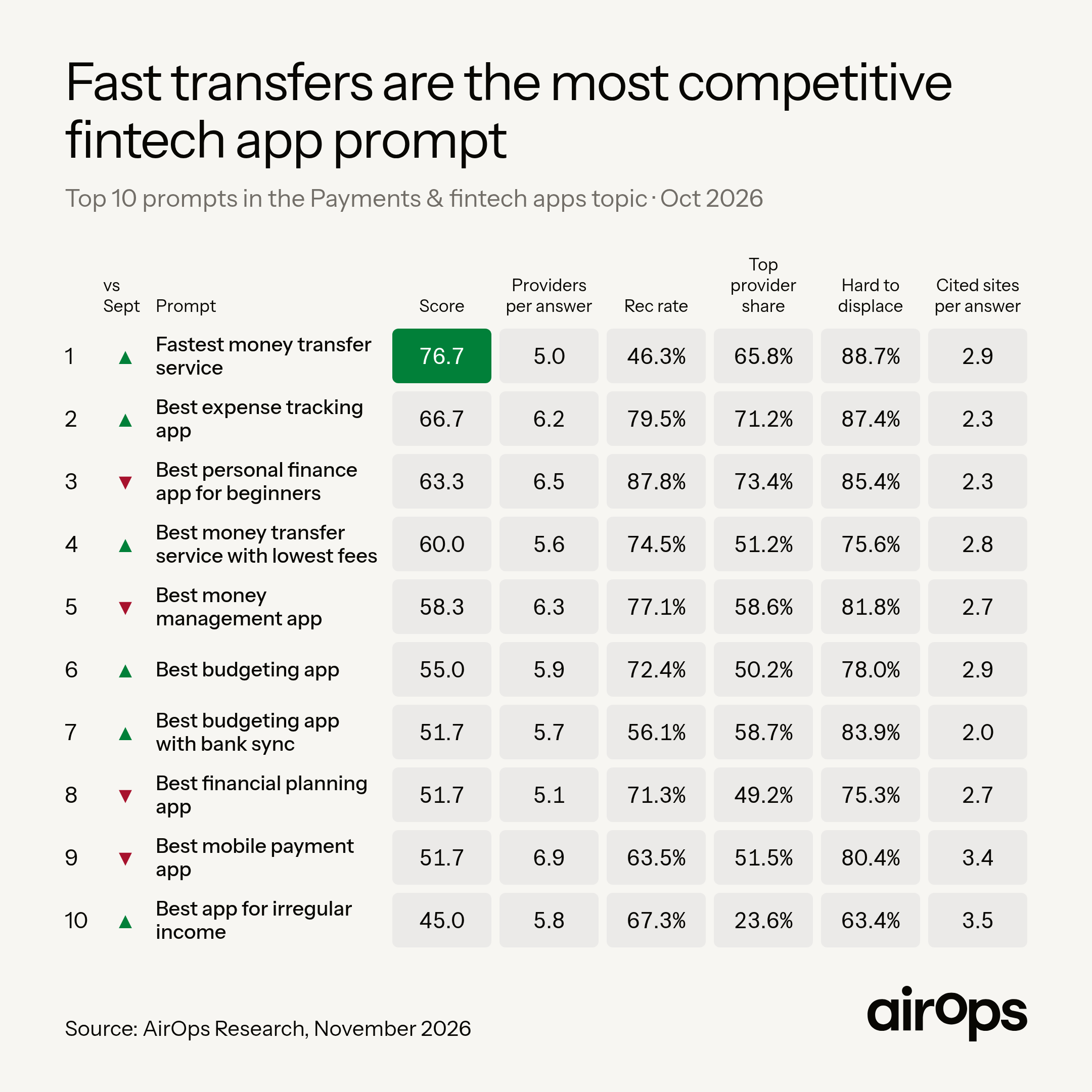
Speed is of the essence as fastest money transfer jumped from 6th to 1st. Its citation spread widened from 1.97 to 2.89 domains per answer, and its top provider's share rose from 60.1% to 65.8%. Cash App led fastest-transfer answers at 65.8%, up from 53.8% in September. September's leader, banks for international transfers, fell out of the top 10.
Irregular-income apps newly cracked the top 10. The top app appears in 23.6% of answers, down from 36.9% in September, while engines still make a recommendation in 67.3% of answers.
Payments answers draw on tech reviews and app-store listings that barely appear in other topics. PCMag appears in 10% of answers, about 12 times its rate across all topics, and Kiplinger appears in 12%. App-store listings show up in 10%. Provider pages are heavily cited, especially for fastest-transfer answers which lean on provider pages for 56% of their citations.
Most competitive auto insurance prompts
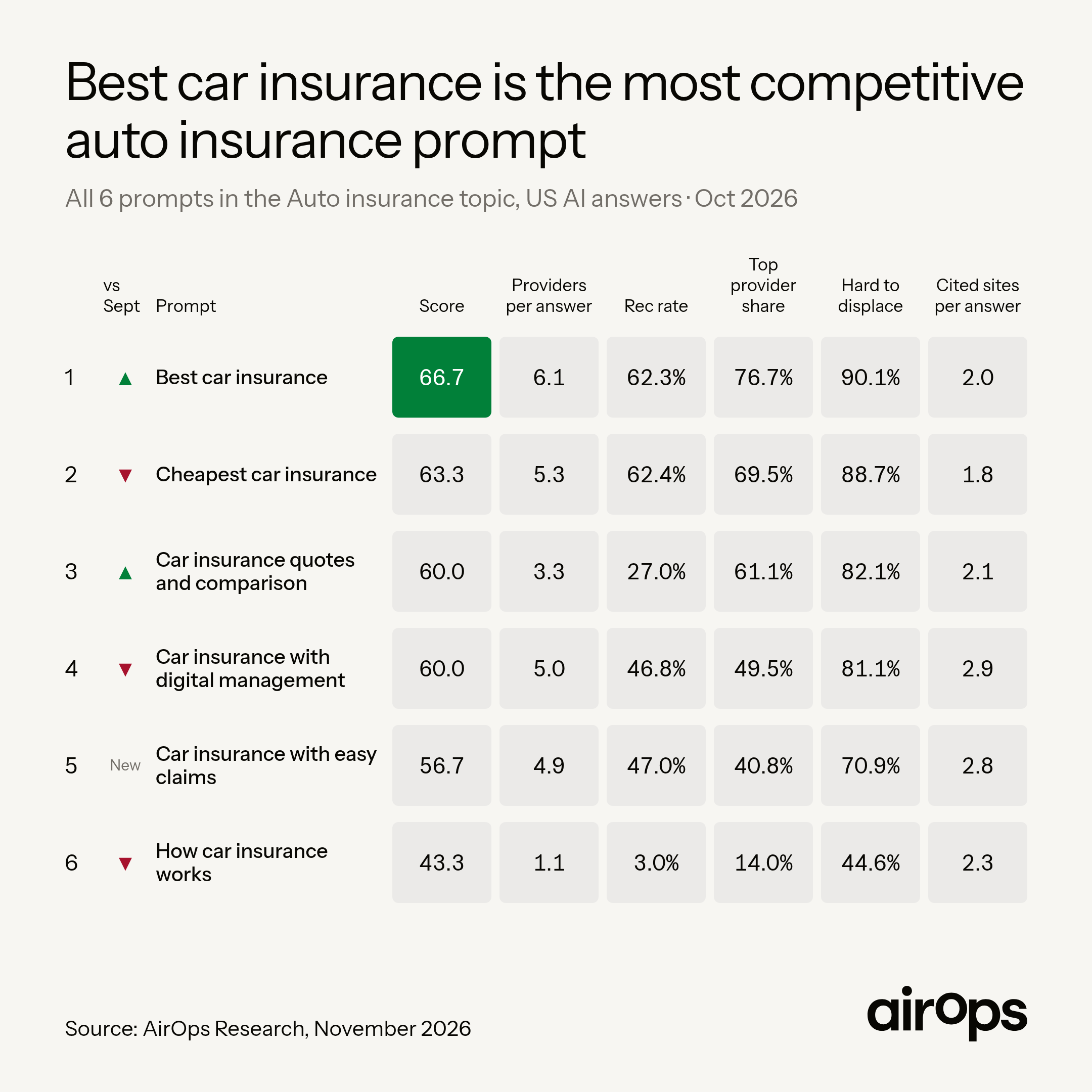
Best car insurance now beats out cheapest car insurance as the top insurer's share rose from 68.6% to 76.7%. GEICO bumped their lead on best-car-insurance answers at 76.7%, up from 64.4% in September. Quotes and comparison rose from 4th to 3rd as its top insurer's share jumped from 45.2% to 61.1%.
Easy claims newly qualified this month at 5th, with the top insurer in 40.8% of answers and a recommendation in 47.0%. How car insurance works remains the most open prompt.
Insurance answers go straight to the source as insurer sites appear in 69% of answers. Comparison and quote sites take 27% of citation slots, matching credit cards for the highest share and exceeding the 18% overall average. Insurify appears in 22% of answers. Compare.com shows up in 32% of quotes-and-comparison answers.
Most competitive home and renters insurance prompts
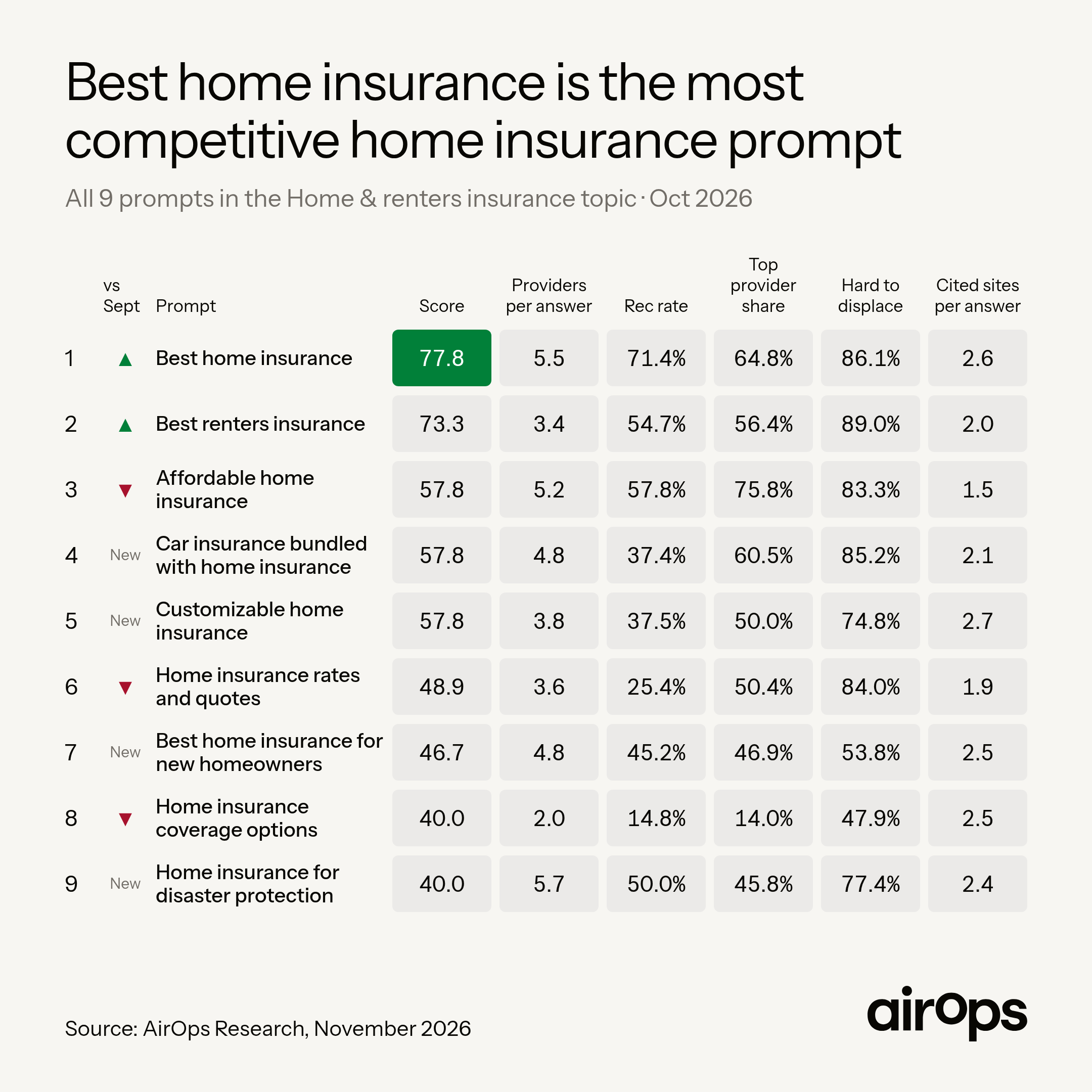
Best home insurance moved up to first from second. State Farm was the most-named insurer across home and renters prompts AirOps tracked, and it led best-home-insurance answers at 64.8%. Affordable home insurance, September's leader, fell to third after its recommendation rate dropped from 69.8% to 57.8%. Four prompts newly qualified this month, including bundling at fourth, new-homeowner at seventh, and disaster protection at ninth.
The evidence mix for home insurance depends on whether you rent or buy. Renters answers lean on insurer sites, which take 49% of their citation slots. Best home insurance answers draw more on outside reviews, with U.S. News in 24% of answers and Policygenius in 18%.
Where to defend, where to enter
Use the monthly rankings to choose which prompts to defend and where to build a presence inside each product line.
Defend the settled prompts you own. Maintain the pages and third-party coverage engines already cite. Track your presence, the recommendation rate, and how consistently providers appear across engines and weeks.
Enter through open prompts where engines already recommend. Opportunity lies where there is a specific consumer need to address where the leading provider appears in fewer than half of answers.
Build around the sources each prompt draws on. Check the pages cited for your target prompt, then use that evidence to guide updates to your own content and priorities for outside coverage.
Treat how-to and rates prompts as a citation opportunity. Engines rarely pick a provider there, so aim to become the source the answer explains from. Low top-provider presence alone does not make an explanatory prompt a recommendation opportunity.
Go forth and win the prompts that matter most to your customers (and you).
Methods
Scope: AirOps tracked-prompt data, U.S., October 1 to 31, 2026, compared with September 1 to 30, 2026. Engines: ChatGPT, Gemini, Google AI Mode, and Google AI Overviews. Findings describe AI answers to non-branded consumer finance prompts.
Exclusions: Comparison publishers, credit bureaus, payment networks, rating agencies, and regulators are not counted as providers.
Scores: The competitiveness score is the mean of five within-topic percentiles. Hard to earn a slot ranks fewer providers named per answer higher. Rec matters ranks a higher share of answers with at least one explicit provider recommendation higher. Top-provider presence ranks a higher share of answers naming the prompt's single most-named provider higher. Hard to displace ranks lower volatility higher. Volatility averages the cross-engine and first-half versus second-half differences in which providers are named. Citation diversity ranks more distinct cited domains per answer higher, because more evidence surfaces are in play.