The cost of waiting in AI search
Across the answers AirOps tracked from January to September 2026, brands that first showed up on a prompt over the summer were named about a tenth as often as the brands already there.
Ask an AI engine which software, credit card, hotel, etc. to shortlist, and the answer comes back in seconds with a handful of names. Ask again a week later and only about a third of the pages it cited are cited again. It is easy to conclude that, unlike in SEO, AI search is a channel where every answer is up for grabs.
The brands being named in the answers week over week tell a different story. On 62.8% of the questions tracked from January through September on ChatGPT, Gemini and Google AI Mode, the brand AI search named most in January and February was still named most in September. While it may not take the same amount of time to break into AI answers and agent choices as it does to rank for SEO, brands who built their lead early are having an easier time defending it. The wording of an answer changes week to week, while the brands named in the shortlist it presents hold for months.
Admittedly, making claims about “the cost of waiting” is close to home for us. We exist to help people invest in this growing channel. But, this also means that we have the data on the differences between the best and the rest (or those who haven’t even started yet).
For this report we followed hundreds of thousands of the same questions, and tens of millions of answers, from January to September 2026, recording which brands each answer named and which pages it cited. The data that follows describe how the engines behave across the answers we tracked.
Key findings
- It is easier to defend a lead. Brands already named in answers in Q1 and Q2 are being named 10x more than brands that first appeared in answers to the same questions in Q3. The share of mentions going to newcomers fell from 4.3% in spring to 3.0% in summer.
- The field is narrowing. In banking, AI search named 7.6 brands per answer in January and 4.7 in September. Across all sectors, answers named 7.7 brands on average in January and 5.3 in September.
- Durable visibility is both owned and earned. Of brands named in an answer carrying the brand’s site plus two or more other sites as evidence, 77.2% were still named on the same question in September. The less evidence an answer cited, the less likely a brand was to stay named nine months later.
It is easier to defend a lead
Brands that break into an AI search answer late get a fraction of the visibility of the brands already there. On the same questions, brands first named in an answer in Q3 2026 appeared in only 3.6% of that question's answers. Brands that AI search was already naming in Q1 and Q2 2026 appeared 10x more often (36.7%).
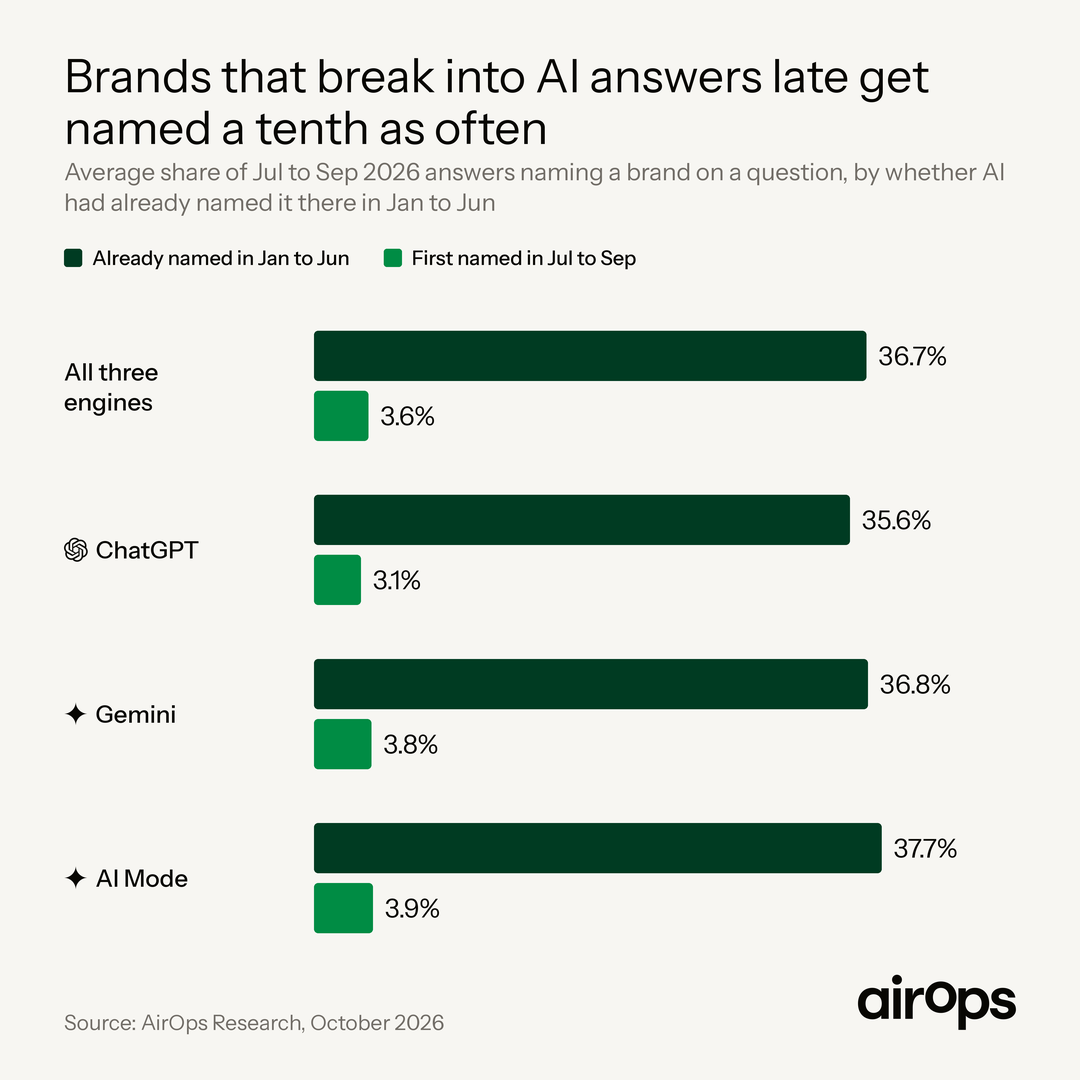
In a rare instance of similarities between engines, the ratio is practically the same, about 1 to 10, on each engine: ChatGPT 3.1% against 35.6%, Gemini 3.8% against 36.8%, Google AI Mode 3.9% against 37.7%.
While the brands already being named kept their spots, the room for newcomers also shrank. In spring, newly named brands took 4.3% of brand mentions. In summer, they took 3.0%.
The pattern fits a world where AI engines lean on what they have already read and recommended. Unsurprisingly, this is sort of like what the friend or colleague you ask for a recommendation would do. They have their favorites and only update when there is overwhelming evidence for a new option. The citations behind AI answers, covered below, are mostly third-party pages that accumulated over months and name the brands that were present when they were written. A brand that delays investing in AI search is asking AI search to revise a reference set it has little reason to revise, which makes visibility on a question behave more like a reputation than a constantly updating ranking.
The downstream effect is that the #1 brand tends to keep their spot.
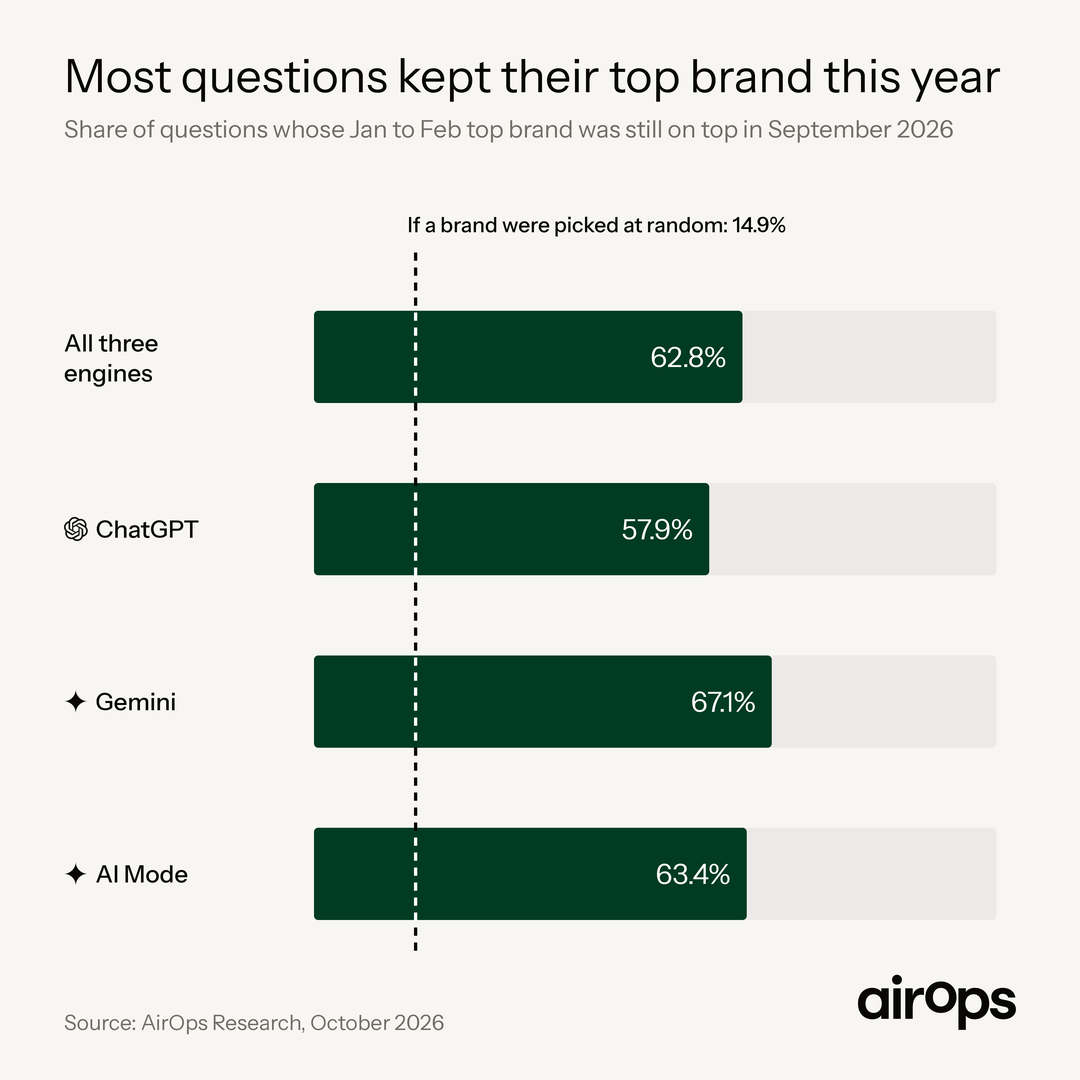
On 62.8% of questions, the brand AI search named most in Jan to Feb was still named most in September. If a brand were picked at random, only 14.9% of questions would have the same leader in September that they did in January.
Leaders also tend to keep their share of the answer. In banking, the top brand on a typical question appears in 84 of every 100 answers that recommend any brand. A share that has stayed consistent all year.
This is the first cost of waiting. A leader’s seat is easier to hold than it is to take.
The field is narrowing
Not only is it hard to displace a leader, but answers are also getting shorter lists, and the brands around a leader are the ones that no longer appear. In banking, the shortlist length has dropped every month since April.
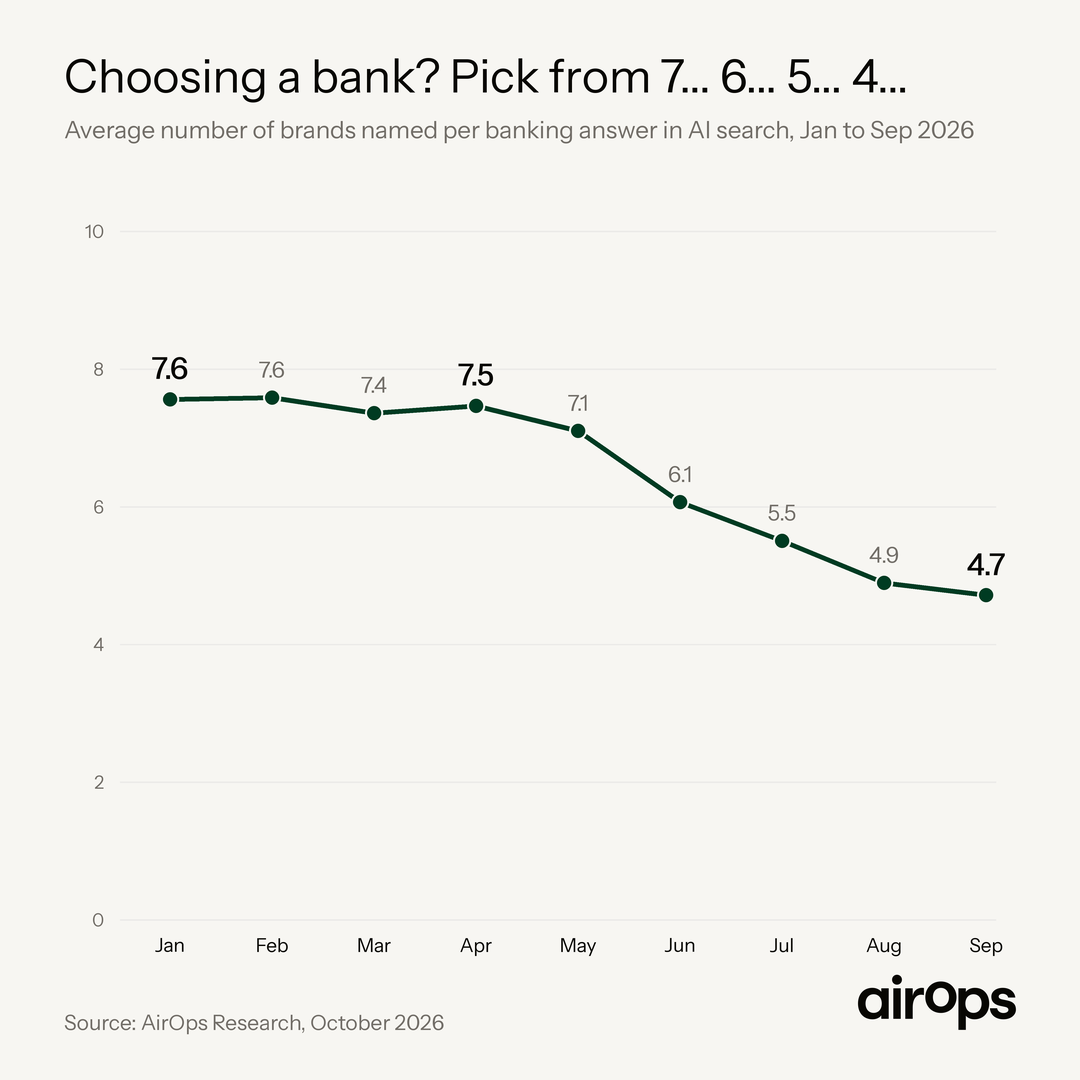
The same thing is happening across sectors. On the questions AI search answered every month this year, answers named 7.7 brands on average in January and 5.3 in September, down ~31%. Every engine and every sector we measure moved the same way. From July to September, the top brand's share of brand mentions on a question also rose 1.5 points, so more of each answer is going to the leader.
This is the second cost of waiting. A brand that waits is competing for a shorter list.
The evidence that helps you stay on top
So, what does it take to show up and stay there?
The short answer is “the right mix of evidence”, both constantly updated and evergreen, and both owned and earned. The most durable leaders are the brands that can get their own pages cited and that other sites vouch for.
We took every brand named in a January answer and checked whether the answer to the same question, on the same engine, still named it in September. Then we sorted those brands by what the January answer cited. When it cited the brand's own site plus two or more other sites that named the brand, 77.2% were still named in September. When none of the cited pages named the brand, 40.7% were. That is a 36-point gap over nine months. The 40.7% shows how often an engine kept naming a brand with no cited page behind it.
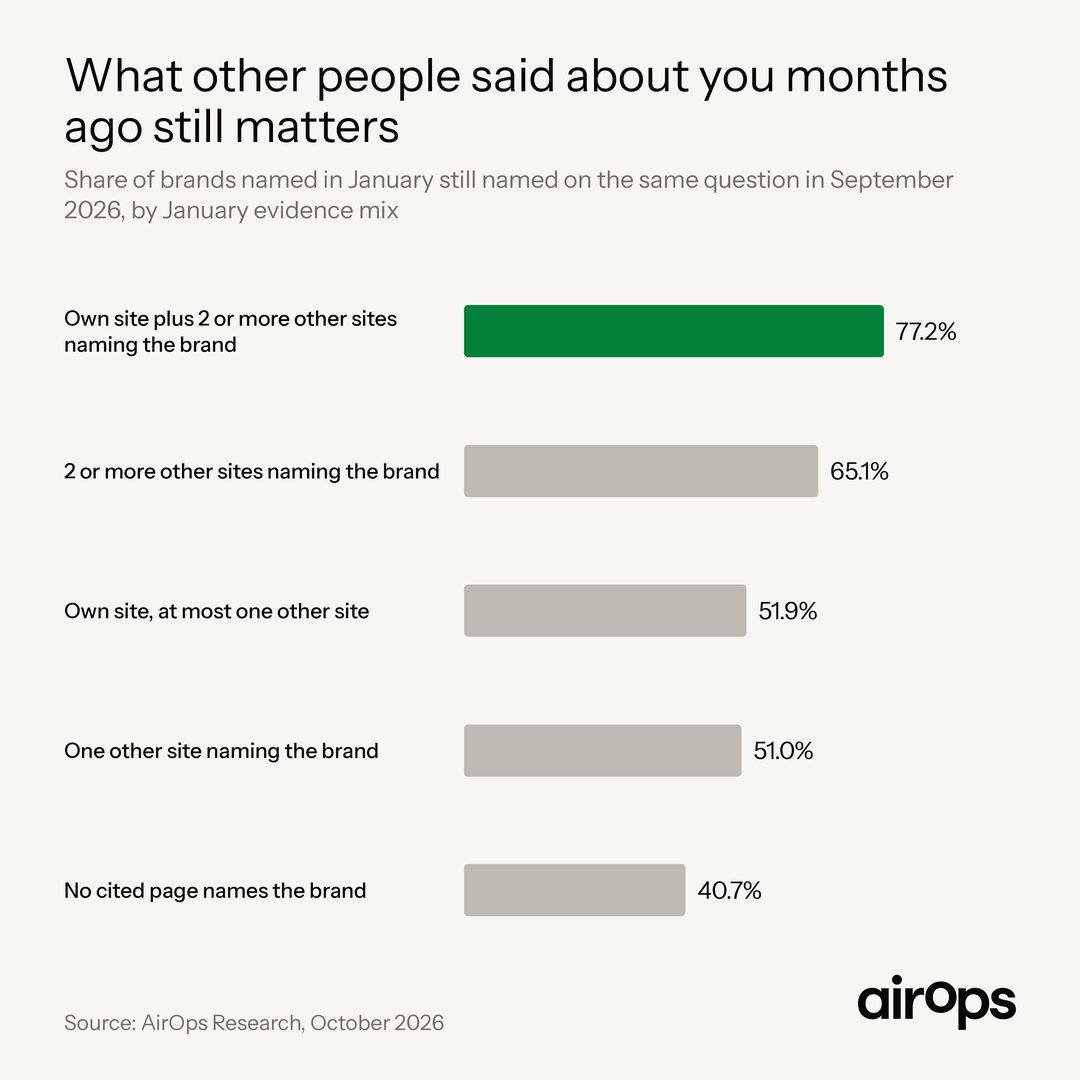
A broader mix of evidence changes how an engine finds, understands, and reasons about a brand. A brand with its own page and several outside pages in the search results is easier to find on the next search. It is easier to describe, because the sources agree on what it does. And it is easier to recommend, because independent sites back up what the brand says about itself. A brand that no cited page mentions is held in the answer by little more than the engine's memory or a lucky search. The next answer to the same question can drop the brand without contradiction.
Yes, “better-known” brands are both more cited and more stable, but we still see that well-supported brands lost less ground by September than their baseline would predict.
AI search runs on evergreen evidence
Most of the evidence AI search cites is borrowed and evergreen; it comes from third-party sources and is cited months after it was published. For example, the most cited Reddit threads and YouTube videos are more than six months old (75.2% for Reddit and 70.3% for YouTube). Only 4.3% of cited Reddit threads and 5.9% of cited YouTube videos were less than 30 days old.
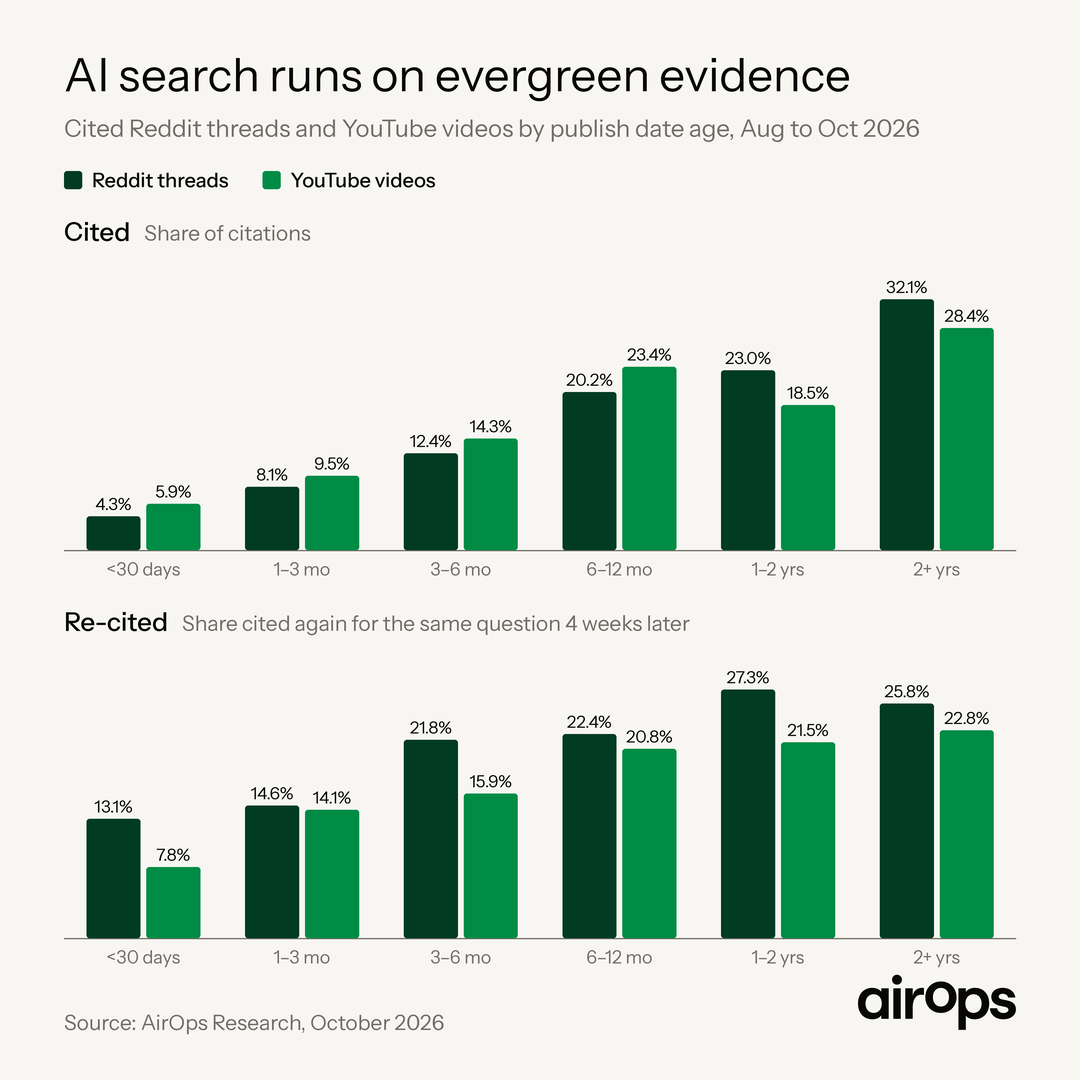
Evergreen pages also hold their citation rate better. A Reddit thread more than two years old is cited again for the same question four weeks later 25.8% of the time. A thread less than a month old comes back 13.1% of the time. YouTube follows the same pattern.
This is the third cost of waiting. Evergreen, third-party evidence makes up most of what AI search cites, and it holds its place the longest. Every new third-party mention a late brand earns starts out young, and maturity is the one input that isn’t “buy now”.
The cost of waiting keeps climbing
A brand starting to invest in AI search now is fighting to break into answers where leaders are entrenched, lists are shorter, and the evidence that holds a place takes months to build. Consequently, the cost of waiting is becoming more intense as agents become buyers, buyers build habits and engines become more opinionated. The seat at the top of the answer is worth more and is harder to take.
The answer refreshing every week is a poor reason for the brand to wait to own its place in AI search. The wording will keep changing. The names inside it are being settled now, by brands that started months ago. We will know we are wrong if newcomers' share of mentions climbs back above its spring level of 4.3%, or if answers start naming more brands again. Through September, both were moving the other way.
The marketing leader’s dashboard should show whether AI keeps naming the brand on the questions that matter. And beyond the dashboard, the real question is what impact is that spot on the leaderboard has on pipeline and revenue… Track which recommendations persist, which disappear, and what sources support them. An answer can refresh every week while a competitor keeps its place for months.
Methodology
This analysis uses AirOps' tracking of how ChatGPT, Gemini and Google AI Mode answer buyer questions. It covers non-branded questions from January to September 2026, pooled across brands, with the three engines weighted equally.
- Questions and brands. A question is one tracked question in one country, for one persona, on one engine. Brands include tracked brands and brands that appear in AI answers.
- When a brand appears. "Already named" brands appeared in answers to a question from January to June. "First named" brands did not, and appeared from July to September.
- Top brand. The tracked brand named most often on a question in January and February, with a clear lead over the next brand. The random line shows how often the leader would stay on top if a brand were picked at random among those tracked on that question.
- Durability. We followed brands named in a January answer and checked whether the September answer to the same question named them again. We grouped them by which pages the January answer cited: the brand's own site, other sites that named the brand, or no cited page that named it.
- Citations. A page counts as re-cited when it is cited again for the same question four weeks later. Page age uses Reddit and YouTube publish dates. The brand-site re-cite rate covers brand and vendor pages of all ages.