The Fan-Out Effect: What Happens Between a Query and a Citation
What 353,799 pages reveal about retrieval rank, query match, and AI citations.
Outline
- Introduction
- Background and Related Work
- From SEO to AEO/GEO and Retrieval-Augmented Answers
- Economics of Sponsored Search and Brand Conquesting
- Fintech Customer Acquisition and Intermediary Density
- Positioning Our Contribution
- Data and Setting
- Methods and Definitions
- Ad Load Is Rising Steeply
- The Advertiser Landscape
- Ad Lifecycle and Creative Churn
- Branded Prompts and Conquest
- Sentiment
- The Paid-Organic Relationship
- What Drives an Ad
- Creative Themes
- Discussion: Implications for AEO/SEO in Fintech
- The Paid Layer Arrived Fast and Is Not Content-Targeted
- Branded Queries Are Contested
- Organic and Paid Are Largely Independent
- Limitations
- Open Questions
- Conclusion
- Impact and Ethics
- Bayesian and Empirical-Bayes Models
- Hierarchical Bayesian logistic model of ad presence
- Empirical-Bayes shrinkage of conquest and defense rates
- A buy-till-you-die model of creative lifespans
- References
Abstract
Advertising has begun to appear inside conversational-search answers, yet its behaviour is largely unmeasured. We study a corpus of 2,826,899 ChatGPT answers spanning 131 fintech brands over sixteen weeks in 2026, of which 207,785 carry at least one observed advertisement. We define measurement primitives that separate ad load (how often an ad appears) from ad mix (who appears when there is one), and report four findings. First, ad load rose from near zero in April to roughly 53% of answers in the most recent week, and a factor-spread analysis shows the single strongest predictor of whether an ad appears is recency, not prompt or answer content. Second, the most prominent advertiser is a comparison marketplace, and intermediaries out-place most direct brands. Third, on brand-named prompts, competitors seize the placement roughly 13°ø more often than the named brand defends it, and conquest is strongly directional. Fourth, when the organic answer contains brand context, the ad overwhelmingly intercepts a competitor rather than reinforcing what the answer says. We frame these patterns for answer-engine optimization (AEO) and discuss what they imply for how fintech brands should treat the emerging paid layer of AI search.
Key figure
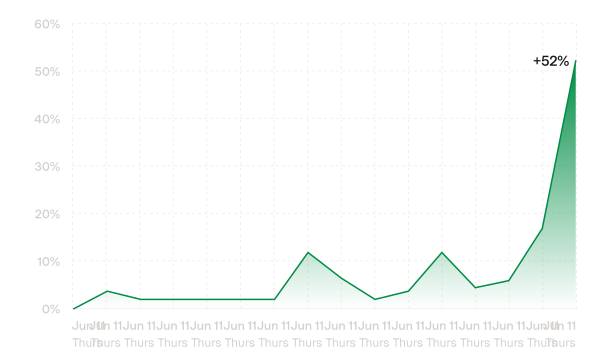
Figure 1: Weekly ad load over all in-scope fintech brands. From near zero in April to ≈ 53% in the week of 2026-07-13. The window average is 7.35%; the trajectory, not the average, is the story.
Download the
full research
Tell us your goals and we'll show you exactly how to hit them.