How AI shops for the holidays
Buying a gift requires reconstructing someone else's preferences, putting your own budget around them, and making sure it is thoughtful for the recipient.
This means that there are three distinct parts to holiday shopping: knowing who it is for, finding the right thing, and finding a good price.
As a consequence, when you ask AI for help with holiday shopping, it constructs answers very differently than it does for regular shopping questions.
We compared how ChatGPT, Gemini, Perplexity, Google AI Mode and AI Overviews answer gift, deal, and regular shopping prompts across U.S. retail, consumer technology, and home categories.
The way that answers shift tracks the art of gift giving. AI search looks for gift terms, names the person, sends deal hunters to big-box stores, and puts a price on the page. But, shockingly, in mid-November there is still one part of holiday shopping that is conspicuously absent from answers, unless the shopper brings it up.
AI search looks for gifts and deals
The difference starts in the searches the engine runs.
Across answers on ChatGPT from Nov 2 to 10, 46.6% of answers to holiday questions ran a search containing "gift," against 0.3% of answers to regular shopping on similar questions. A deal term showed up in 20.4% of holiday searches versus 5.1%, and an under-$ price cap in 14.4% versus 0.3%.
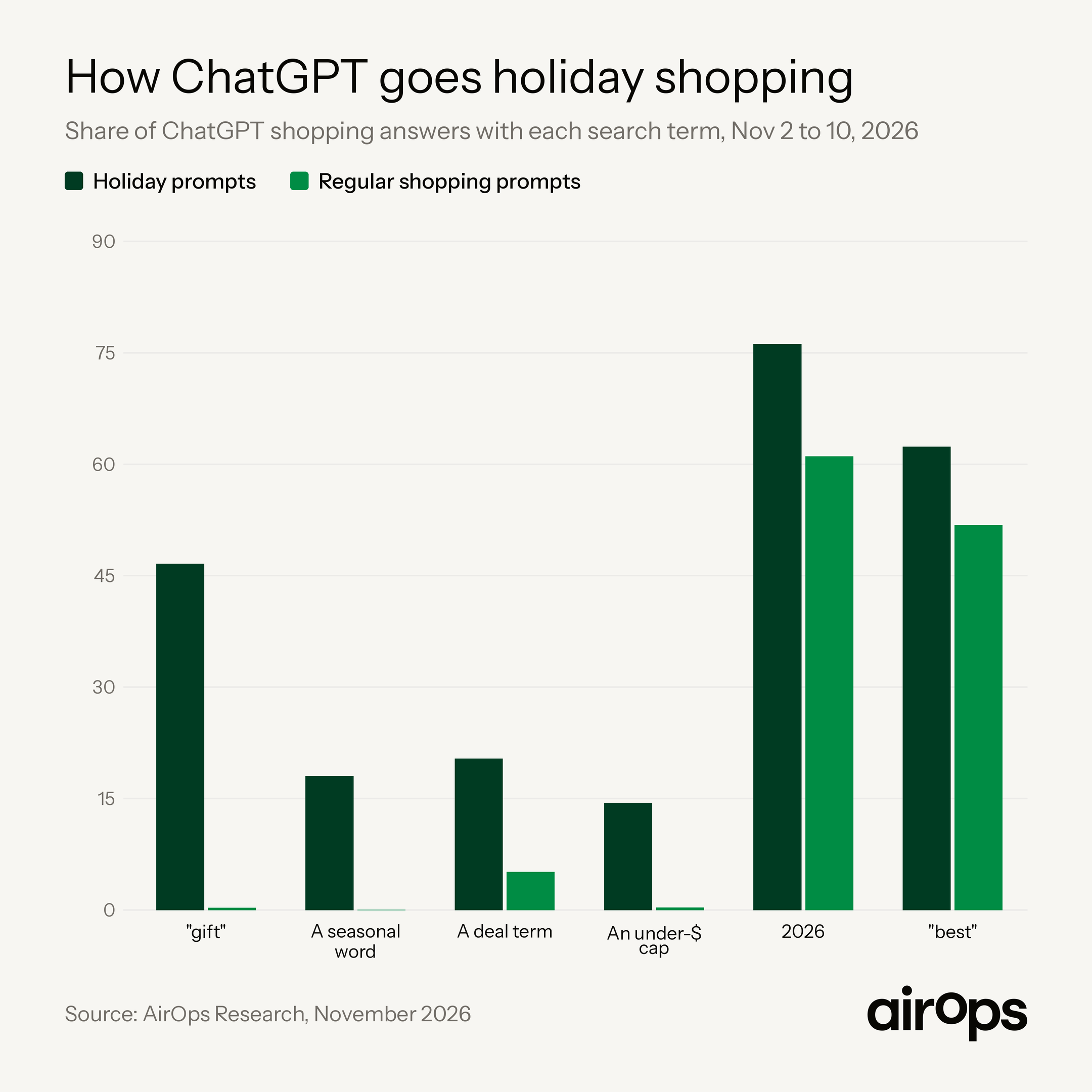
ChatGPT translates the occasion into search terms, building holiday answers on gift guides, deal pages, and price-capped lists. A product page written for the regular question is less likely to be found.
From: AI, To: ???
Giving a good gift requires knowing who you are buying your gift for.
Across answers AirOps tracked from Nov 1 to 10, gift answers named who the purchase was for in 31.8% of ChatGPT answers, against 1.5% of regular shopping answers. Gemini was 30.0% versus 1.7%, and AI Mode 23.8% versus 1.8%.
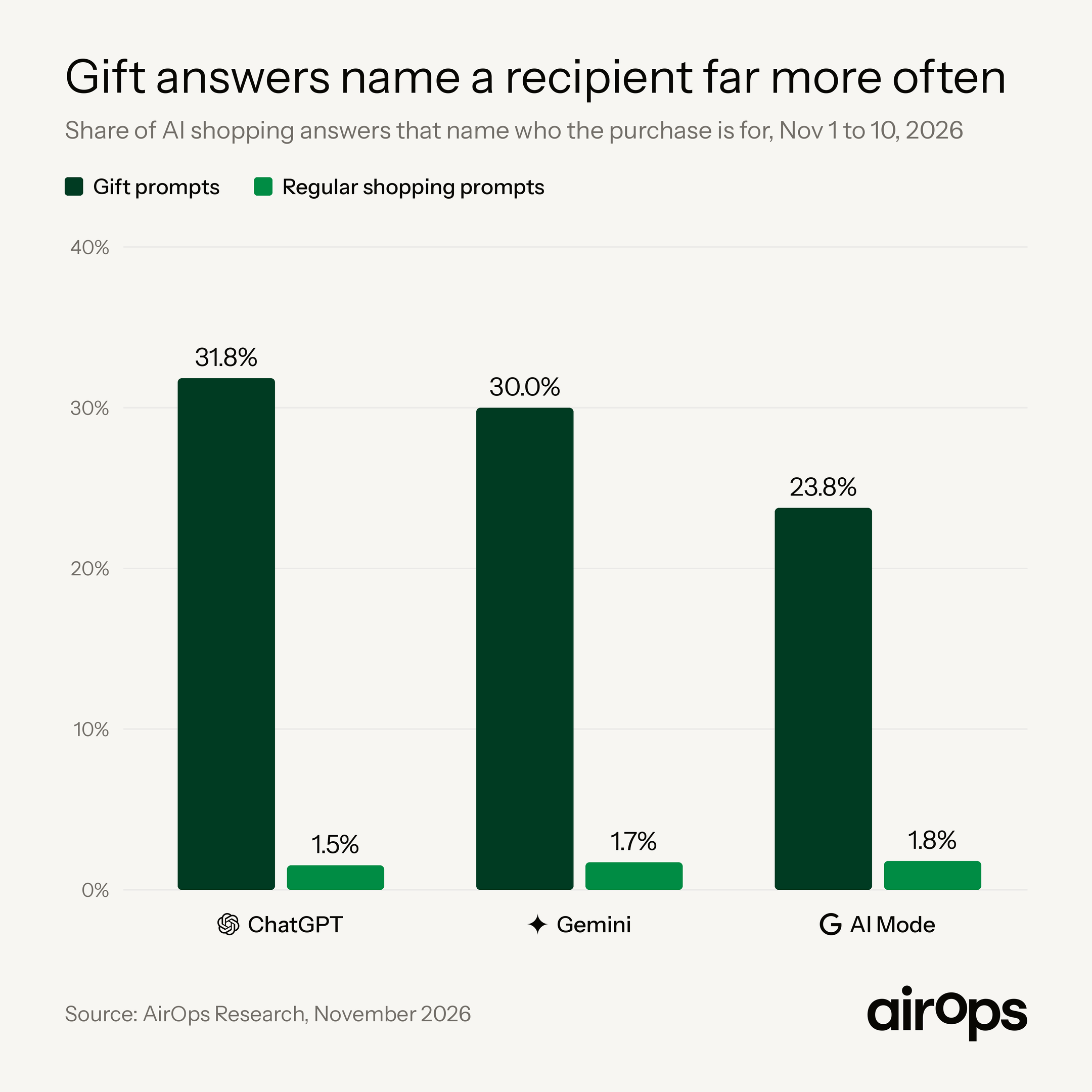
For comparison, deal answers almost never do this (0.7% to 1.2%). Gift questions uniquely name a recipient.
Follow-up questions ask about the person more too: on ChatGPT, 11.9% of holiday answers that asked one brought up the recipient, versus 3.7% on regular questions.
AI search rebuilds the recipient's preferences on the shopper's behalf. A product description that never says who it suits gives the engine less to work with.
Holiday answers name the store
The second part of gift giving, finding the right thing, also requires knowing where to buy it.
47.5% of gift answers and 45.7% of deal answers named a retailer, versus 30.6% of regular shopping answers. And, it is so important to know where to shop that a store was mentioned before any named brand in 28.2% of gift answers and 22.9% of deal answers, versus 14.5% on regular answers.
Regular shopping answers lead with the product. Holiday answers more often lead with the shop. And, deal prompts push that store shift toward one kind of retailer.
On ChatGPT, big-box retailers held 46.5% of named-merchant product cards on deal-seeking prompts, versus 27.0% on shopping prompts without deal language.
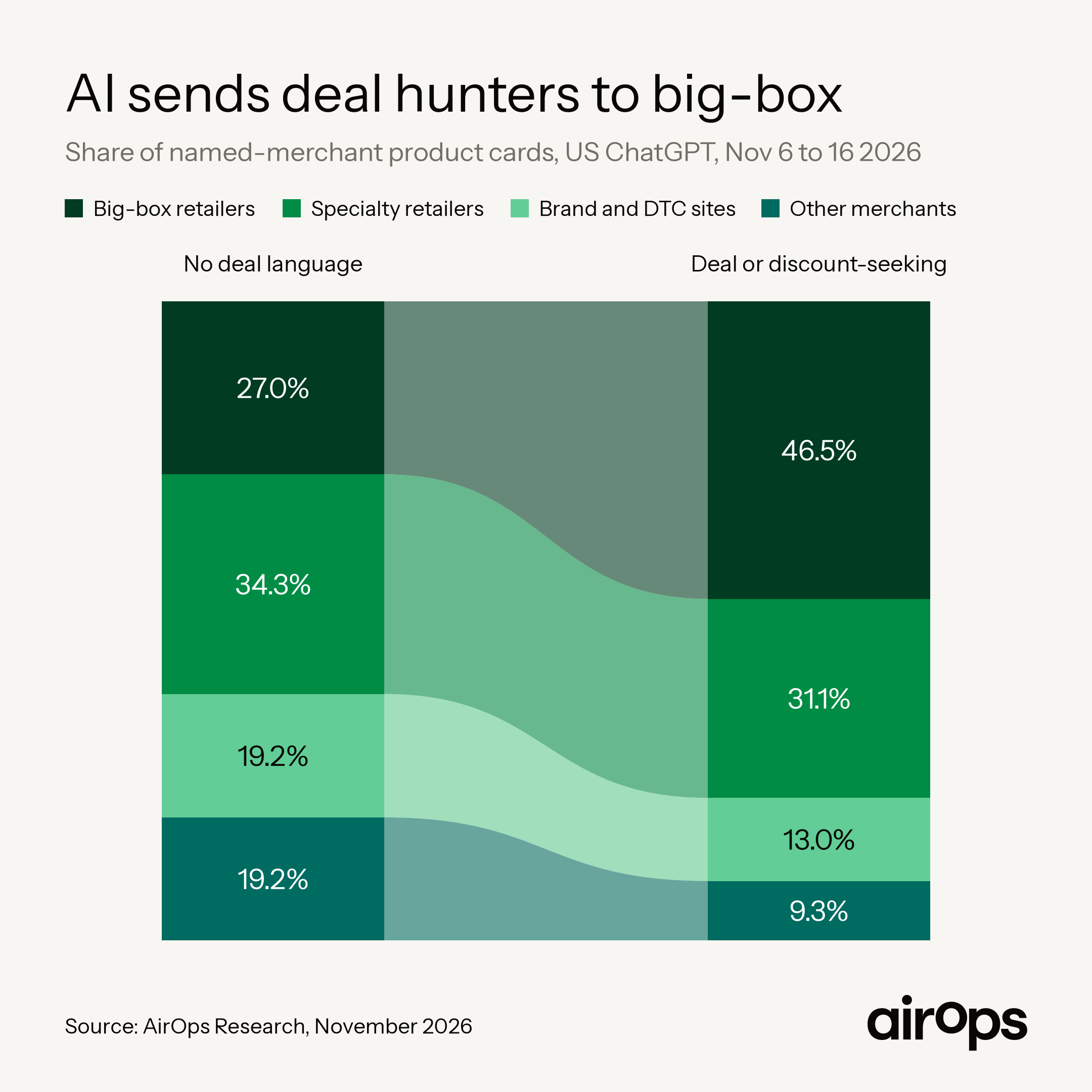
Ask for a deal and ChatGPT still shows product cards about as often (58.1% of deal answers versus 56.2%). Whose cards change, though... Big-box stores jump to 46.5% of named-merchant cards from 27.0%, and brand and DTC sites slip to 13.0% from 19.2%. Mention a deal and AI search heads straight for the big stores.
Holiday answers mind the price
AI is mindful of the third part of holiday shopping, the budget. Holiday answers put price on the page more often.
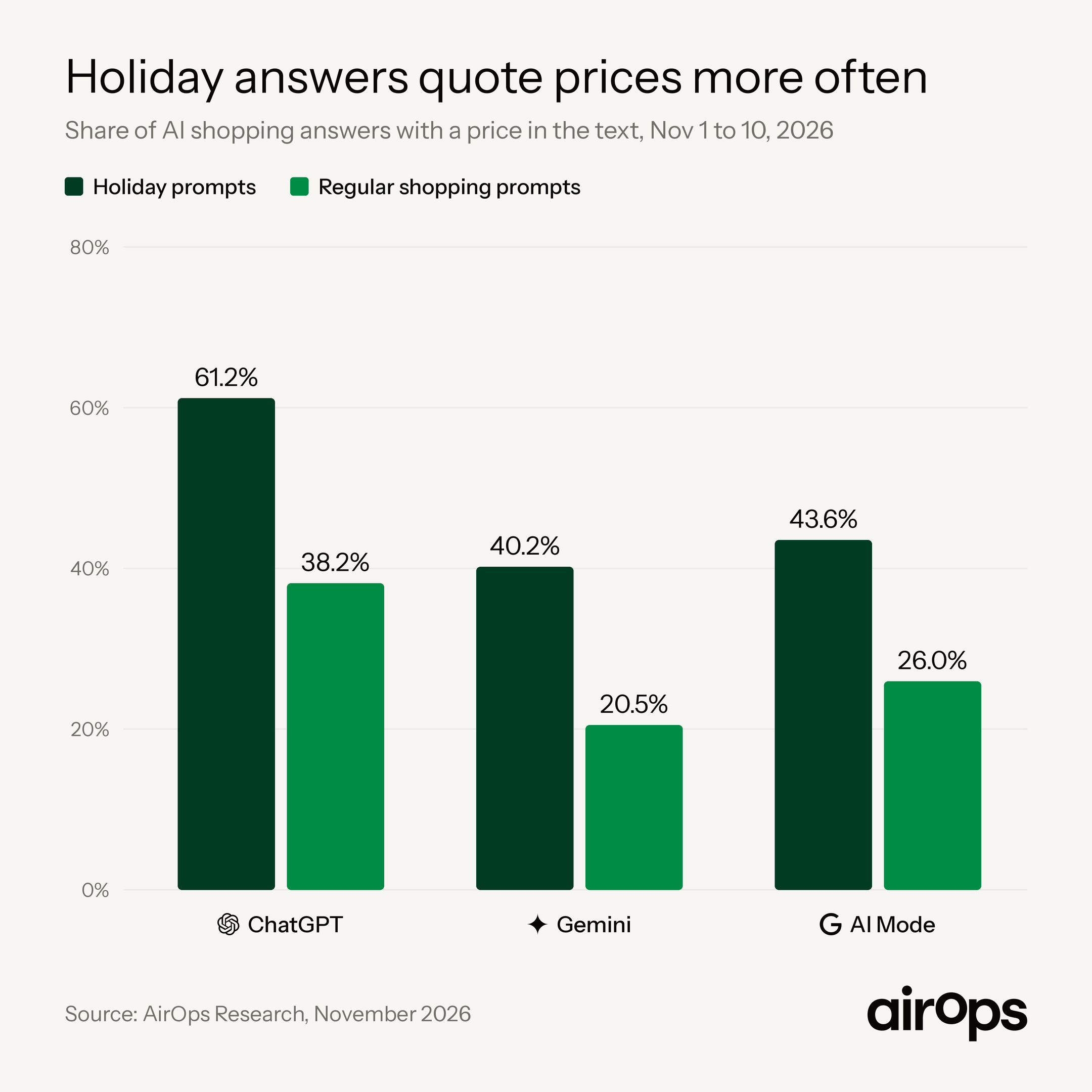
In a predictable turn, answers to deal questions quote a price most frequently, in 72.4% to 76.7% of answers on all three engines.
Follow-ups ask about budget
AI’s focus on price isn’t just driven by the initial ask either. Among answers that asked a follow-up, 21.6% of ChatGPT holiday answers raised budget, versus 8.2% of regular ones. Gemini was 30.3% versus 11.9%, and AI Mode 43.1% versus 22.5%.
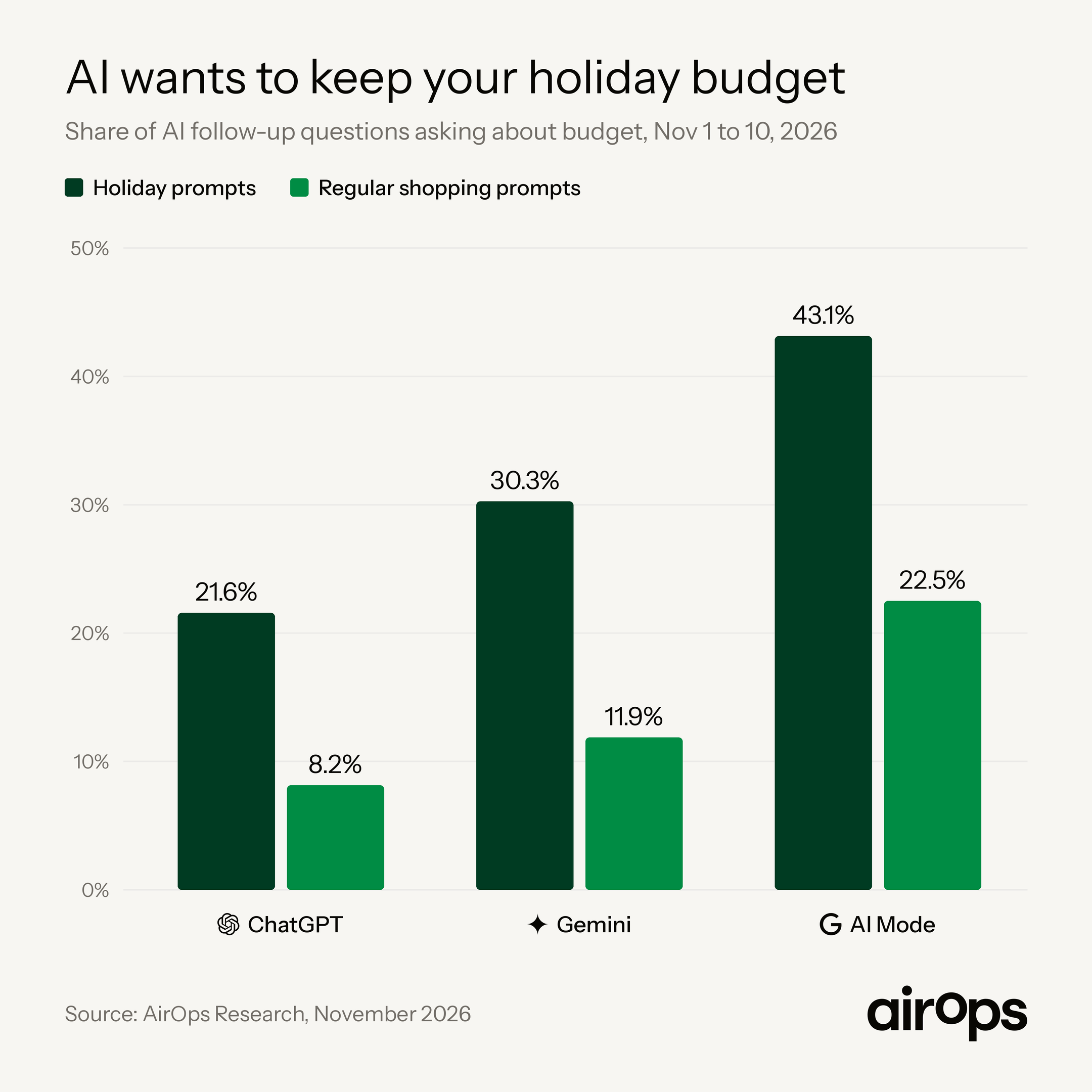
The lift is driven by gift prompts; deal prompts look like regular ones here (6.9% on ChatGPT). One reading is that a deal prompt already states a price goal, while a gift shopper brings a person and an occasion leaving the engine to ask for the number.
AI changes spending habits during the holidays
Whether it knows it has to buy a lot of gifts or is Scrooge-ian, AI serves product cards (the in-answer format showing specific products) at a lower price point during the holidays.
Across answers on ChatGPT, about 41% of holiday products sat between $25 and $100, versus 26% of regular ones. Products at $500 and up nearly halved.
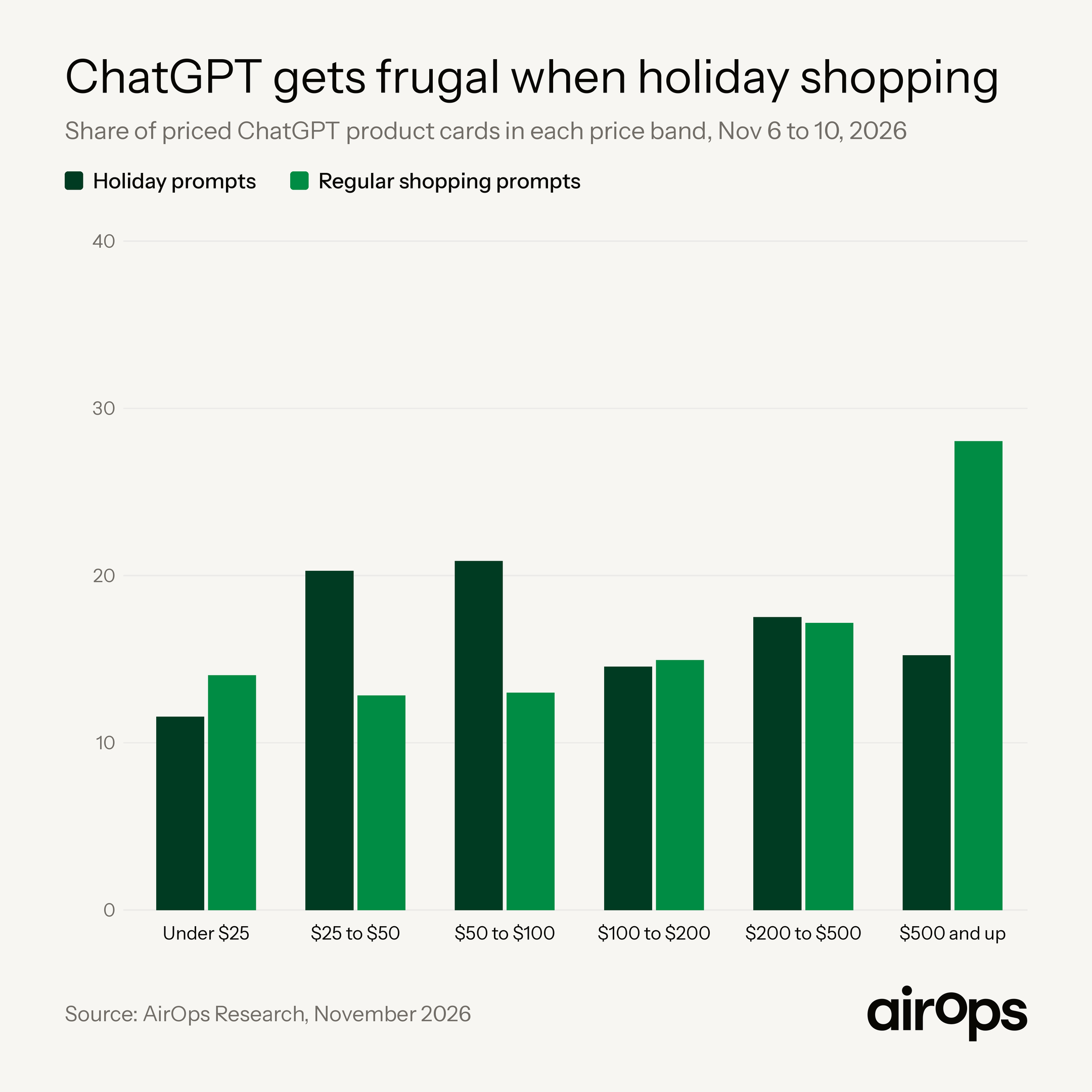
The median price was $100 for gift prompts, $180 for deal prompts, and $190 for regular ones. Gift and deal cards also carried a price more often: 80.9% and 64.1% of cards, versus 57.8%.
The cheaper shelf comes from gift prompts. Surprisingly, deal answers list prices close to regular ones once category is matched, but they do show the price more often. One caveat is that the products show listed prices, and may not always measure discounts.
Speaking of discounts…
AI treats Black Friday as a black sheep
Even in mid-November we still aren't seeing Black Friday unless you ask for a deal.
Across answers AirOps tracked through Nov 16, deal-seeking answers mentioned Black Friday or Cyber Monday in 5.8% of Gemini answers, 3.4% on ChatGPT, 2.8% on AI Mode, 1.9% on AI Overviews and 0.8% on Perplexity. Gift and other shopping prompts mentioned Black Friday in 0.3% or less of answers on every engine.
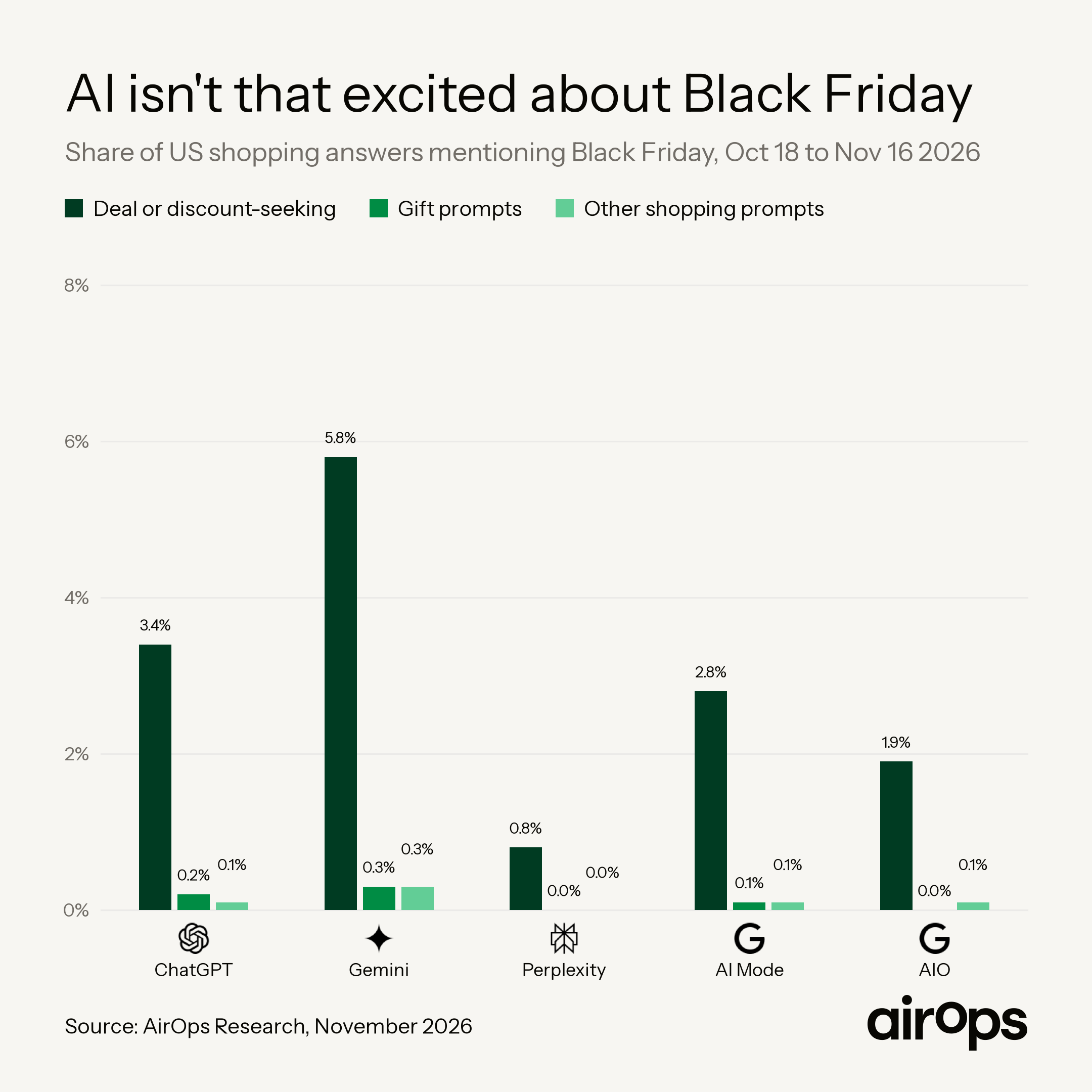
Even as your inbox floods with early access to Black Friday offers, AI largely ignores it as a part of holiday shopping.
AI shops like the rest of us
Turns out AI is a holiday shopper too.
Hand it a gift question and it starts acting like one of us. It wants to know who the gift is for, it checks the budget, and it heads to the big stores to hunt for a deal.
It even gets a little frugal. Holiday product cards skew cheaper, and prices land on the page far more often.
And Black Friday? AI search shrugs until you ask for a deal. Your inbox may be counting down to the doorbusters, but AI search is in no rush.
So the holiday playbook for AI search looks a lot like the one for people.
Takeaways for brands and retailers
- Say who it's for. Gift answers named a recipient in up to 31.8% of answers, versus under 2% on regular shopping questions. Gift content that names the person, and why the product suits them, gives AI search what it is looking for.
- Put the price on the page. Holiday answers quoted a price in 61.2% of ChatGPT answers, versus 38.2% on regular questions, and about 41% of priced product cards sat between $25 and $100. Clear prices and budget tiers match how AI search shops.
- Get on the big shelf for deals. On deal prompts, big-box retailers held 46.5% of ChatGPT named-merchant cards, versus 27.0% without deal language. Deal pages and big-box availability decide whose offer gets shown.
- Save Black Friday for deal hunters. Black Friday showed up in at most 5.8% of deal answers and 0.3% or less of everything else. Point that content at deal-intent prompts, and lead with gifts and prices everywhere else.
Methods
Engines. The five-engine reads (retailer mention, store-first, citations, Black Friday) cover ChatGPT, Gemini, Perplexity, Google AI Mode and AI Overviews. The earlier holiday reads (recipient, price in text, budget follow-ups, Amazon mentions) cover ChatGPT, Gemini and AI Mode. Search terms and product cards are ChatGPT only.
Prompt types. Gift is gift-intent language (gift, presents for, stocking stuffers, secret santa, registry, and similar). Deal is deal or discount language (Black Friday, Cyber Monday, deal, sale, discount, coupon, clearance, under $N, cheap, budget, best value, and similar) and not gift. Seasonal is holiday timing language only. Regular is every other tracked product shopping prompt for the same kits. Groups are exclusive in the order gift, deal, seasonal, regular. "Holiday" pools gift, deal and seasonal and is compared with regular prompts on the same kits.
Categories. U.S. kits in retail, consumer technology, and home categories; non-branded prompts across all four funnel stages of the buyers’ journey about physical products.
Caveats. Prompts are tracked, not a direct sample of what consumers type.