Which credit card is right for me?
Someone with a new job, a little balance on an old card, and a trip booked for spring asks an AI engine, “Which credit card is right for me?” The answer arrives in seconds and sounds like it did a speedrun through their financial history. It suggests a travel card for the trip and a few words about protecting their credit score.
But, mention your credit score of 640 and the answer changes. So does asking for cash back instead of miles. So does saying you’re a student or expecting to change jobs or might move soon… the list goes on. This makes sense, choosing a credit card is personal.
AI builds its recommendations on evidence that changes with what the shopper asks for. Almost every answer leans on NerdWallet, Bankrate, The Points Guy, a credit bureau, or another third party. Personalizing advice requires determining which sources matter most.
AI card advice works like advice from your favorite points-maxxing friend (we all have one): tailored to you, but still built on what they remember or can read from what other sources have written. And the issuer that only tailors its own pages to each persona misses most of what the friend reads.
There is no one right card
Ask the same question with a different credit score and AI often names a different card. Against the plain question, a stated score of about 640 or 560 changed the most common pick on 35 of 40 questions, and Capital One led most of those. At about 810 or 760, the pick changed on 12 and 13 questions. Wells Fargo takes the most with 5 at each score. Chase kept the overall lead at both scores, with about 23% of top picks. An asker with weaker credit is shopping a different market on almost every question.
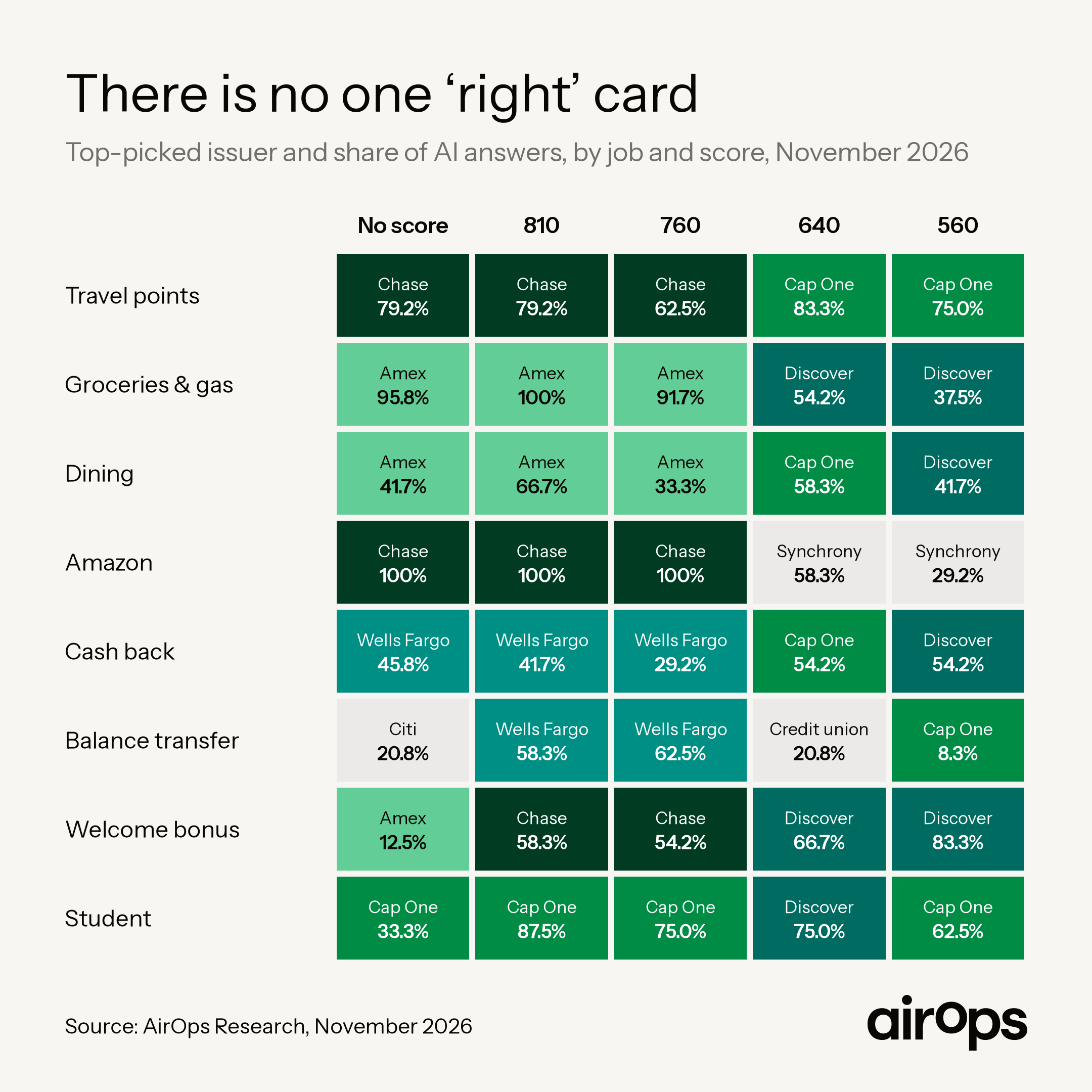
Two persona traits have the most impact: the asker’s credit score and the rewards they want.
By credit score
With no stated score, Chase was the top pick in 25.1% of answers and Capital One in 6.4%. At a score of about 640, Capital One rose to 48.1% and Chase fell to 3.2%. At about 560, Discover rose from 4.0% to 26.4% of top picks, and American Express dropped out. At 760 or 810, Chase stayed close to its no-score share. Repeat runs of the same question on the same engine named the same top pick 64% to 70% of the time. For plain questions, without a score, the most common pick differed between repeat runs 17.5% of the time. On the same split, a score of about 640 or 560 changed it on 35, roughly five times the baseline. A score of about 810 or 760 changed it on 14 to 15, about twice the baseline.
By goal
Ask for a travel card and Chase was the top pick in 61.0% of answers, most often the Sapphire Preferred. Ask for cash back and no issuer dominated: Wells Fargo led at 20.1% and American Express followed at 19.6%. Low interest and 0% APR questions went to Wells Fargo in 32.7% of answers, most often for the Reflect card. Store and brand rewards are their own market: Chase took 95.8% of Amazon picks with the Prime Visa, Bilt took every pick for paying rent, and Citi took 66.7% for Costco. Nine different issuers (and they’re different products) won a recommendation across 37 need-specific questions.
Unsurprisingly, combining shopper attributes, such as credit score and stated goal, result in even more personalized answers. Travel questions with no stated score went to Chase in 73.6% of top picks, and the same questions at a 640 score went to Capital One in 77.8%, mostly to secured cards. At a 760 score, Chase took 59.7% of travel top picks and Capital One 20.8%. At 640, Chase fell to 5.6%. The competitive set depends on who is asking.
AI (mostly) prefers credit card loyalty
If the AI engine knows you already hold a specific card, the recommendations tilt toward the existing issuer. AI has a loyalty premium at roughly 3:1. With no reason given, after a move, or after a change in spending, the existing issuer stayed the top pick in 32% to 35% of answers.
But, when the asker said they were not so sure that their existing card was still worth it, that fell to 21.9%, and advice to replace the card rose to 29.0%.
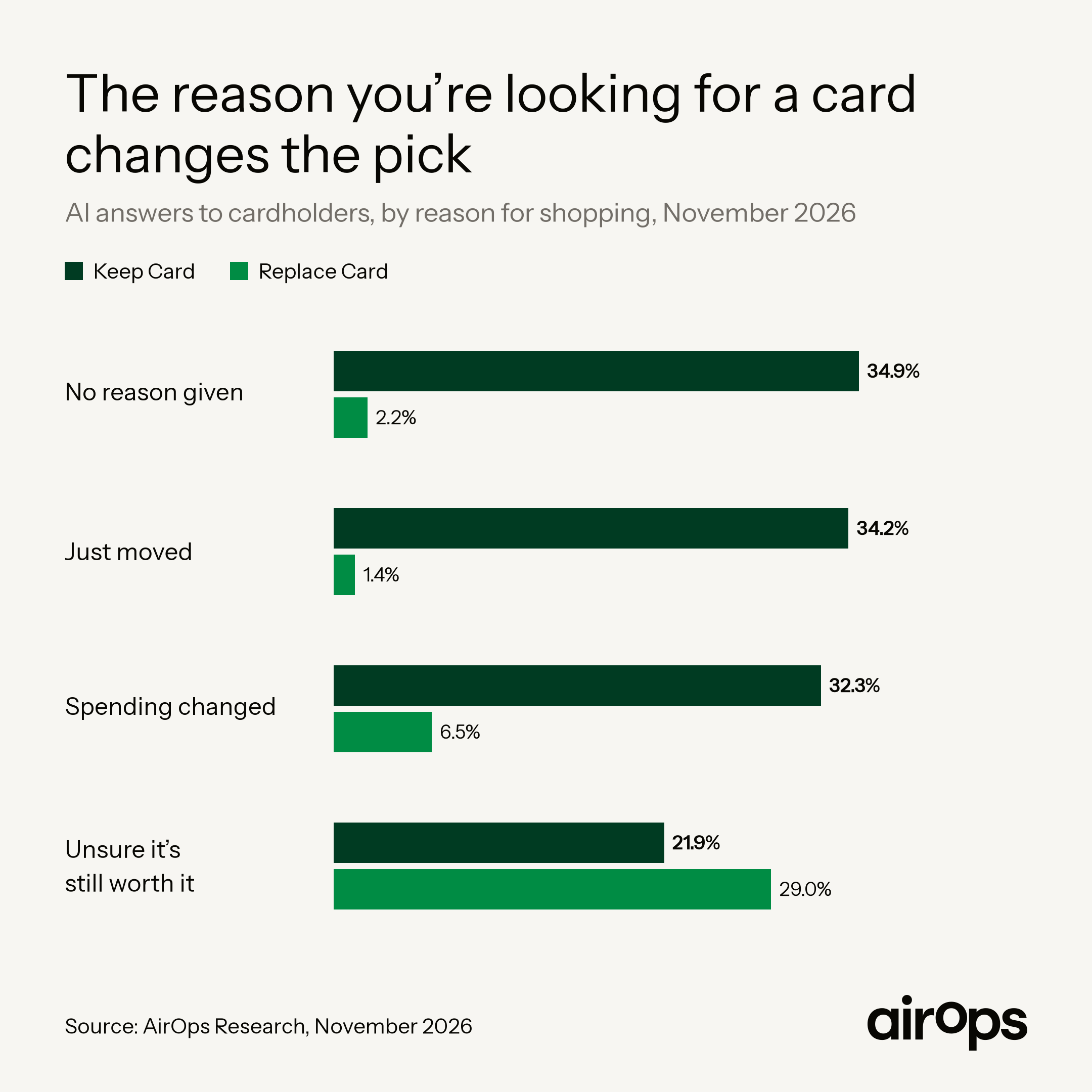
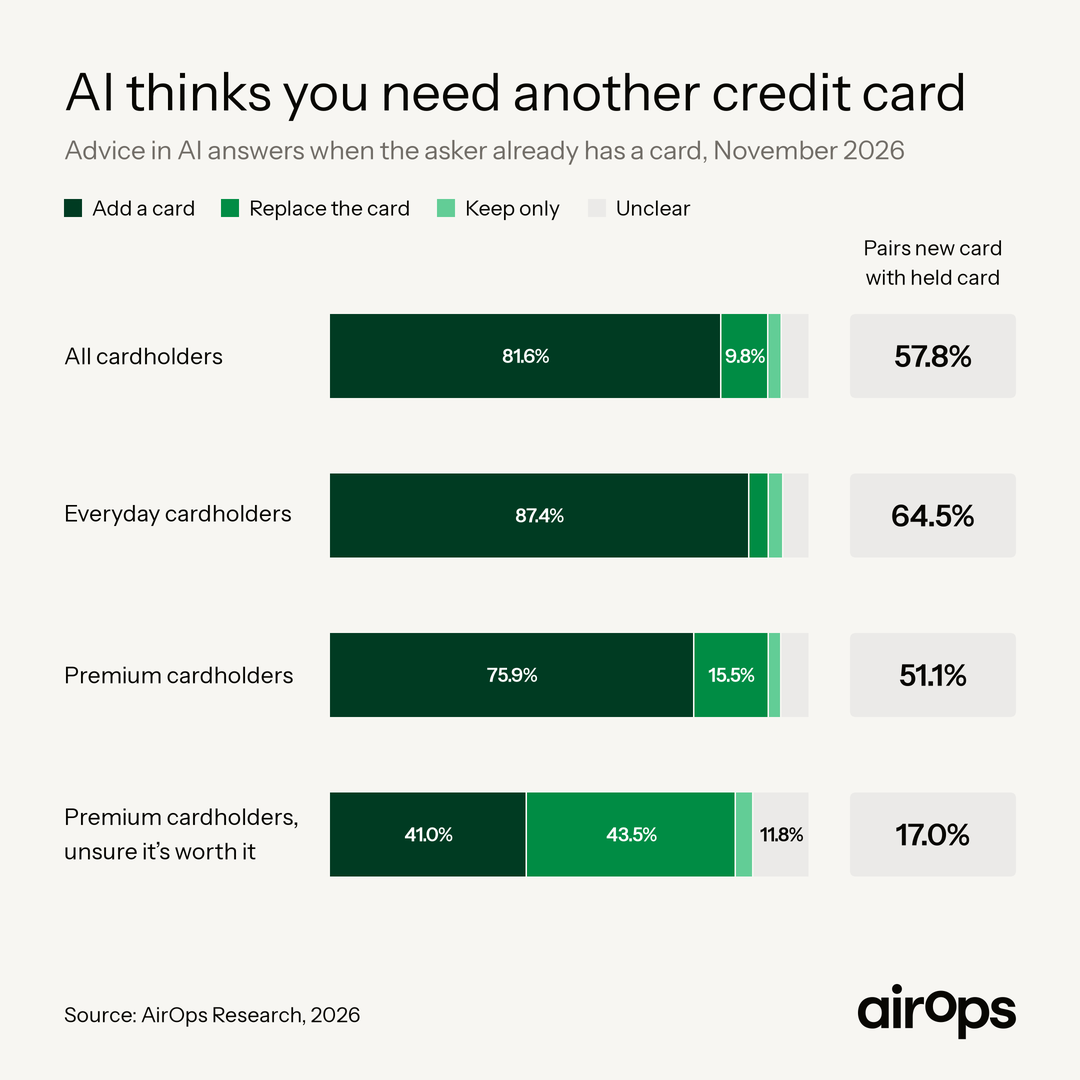
Even when AI thinks you should change what’s in your wallet, the most common suggestion is to add a card, not to swap one. Again, the exception comes from premium cardholders who were unsure their card was still worth it: 43.5% of those answers advised replacing it.
The evidence comes from third parties
Third parties supply nearly all of the evidence behind AI’s personalization (both specifically for credit cards and for general answers).
In our panel, 98.8% of answers that cited a source cited at least one third-party site. Third-party domains made up 87.3% of the sites the average answer cited, and 63.7% of answers cited only third party sources and no issuers at all. On the AirOps platform in September, 70.5% of card answers on ChatGPT, Gemini and AI Mode cited an affiliate or review site, against 36.0% citing an issuer.
Which third parties get cited depends on what the asker needs.
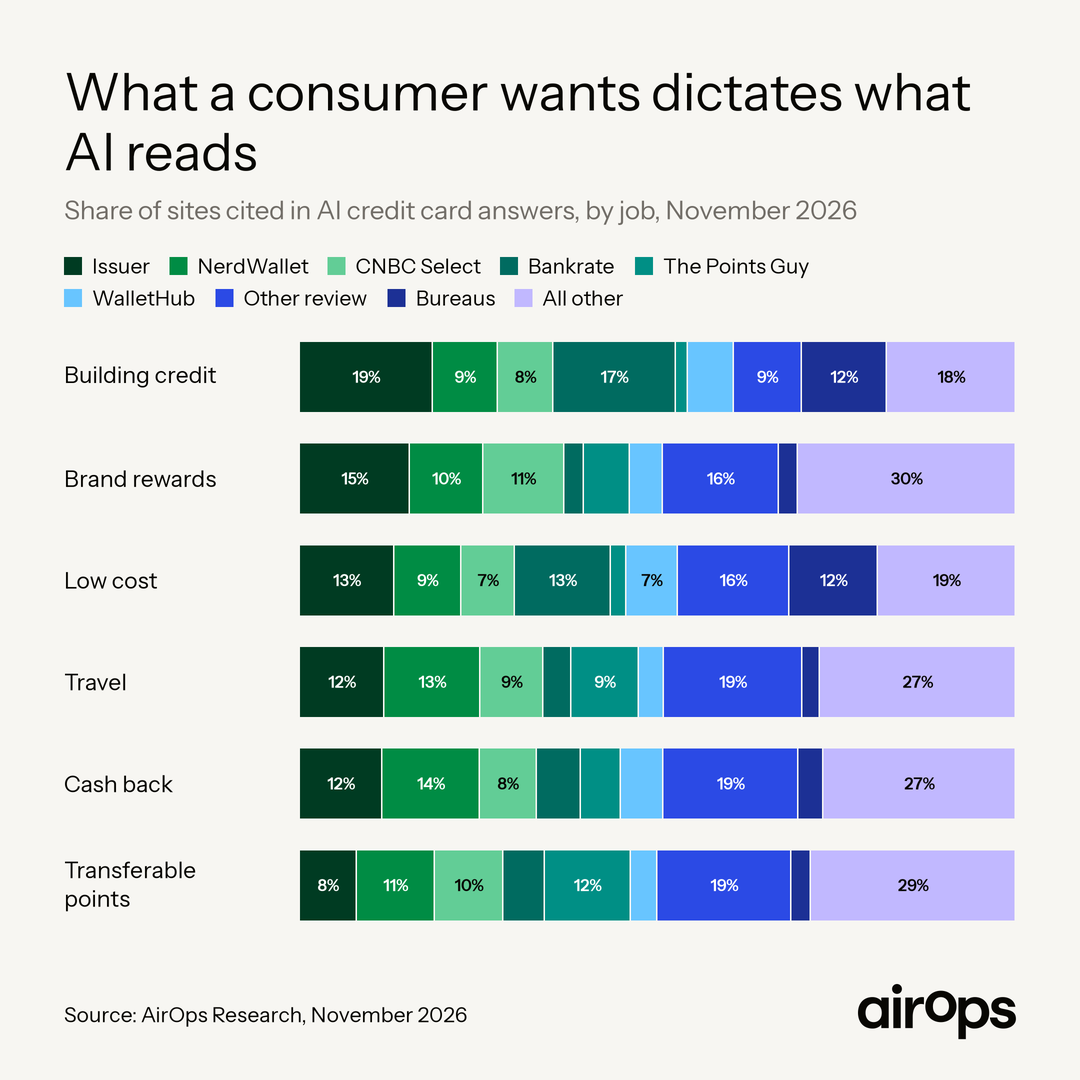
The only user need that has issuers as the most cited source is credit building. Bankrate also rises to about 17% of cited sources for building credit and holds 13% for low-cost cards; two often adjacent areas. The Points Guy peaks at 12% for transferable points and 9% for travel. NerdWallet and CNBC Select stay large across every need.
Each need, in effect, gets its own reading list. A card that points and travel publishers cover well reaches the traveler. The person building credit hears more from Bankrate.
ChatGPT now sends shoppers to the issuer
One engine has started pointing past the reviews to the issuer itself.
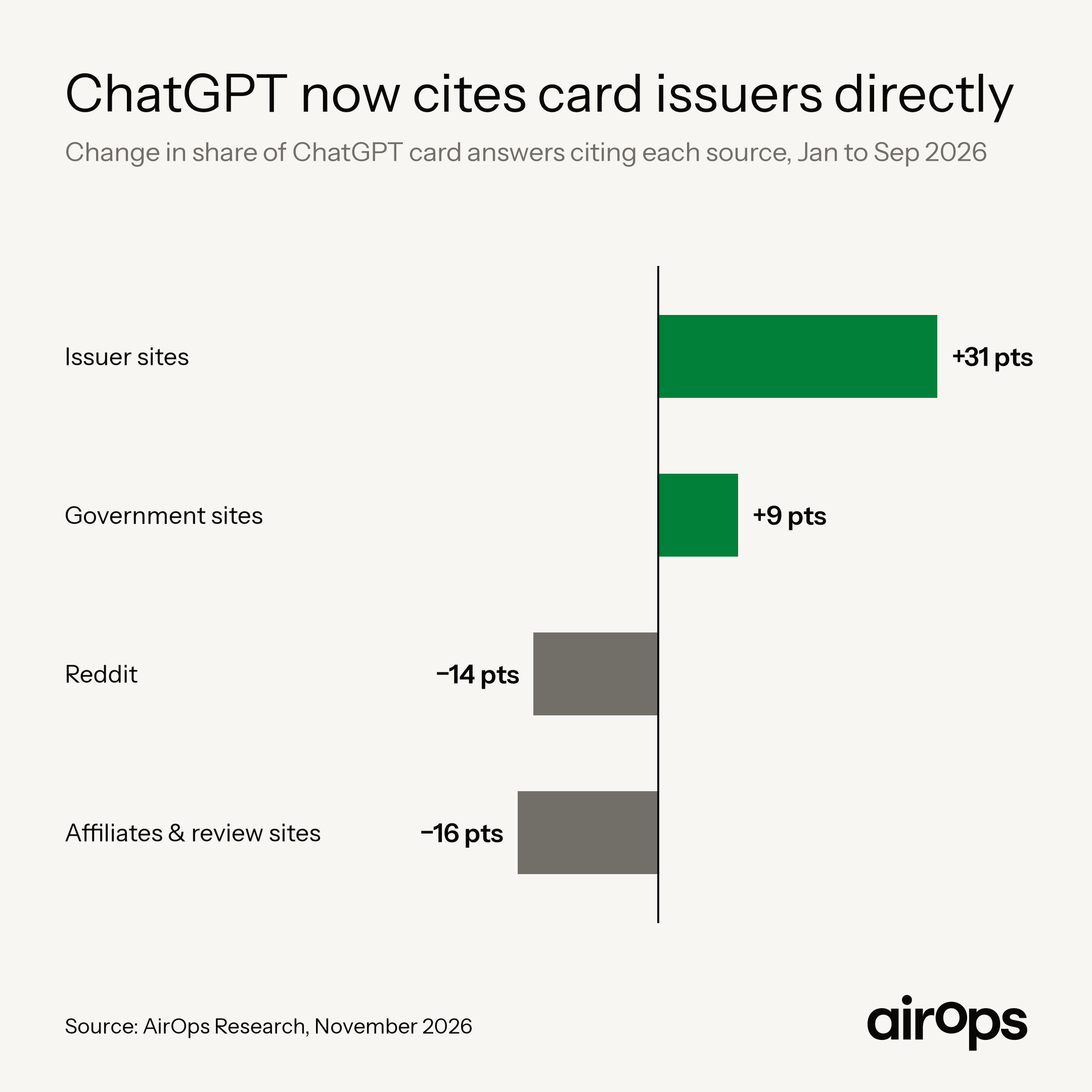
On the AirOps platform, the share of ChatGPT card answers citing an issuer site rose from 9.7% in January to 39.7% in September. Government sites rose from 1.0% to 13.4%. Reddit fell from 14.2% to 0.2%, and affiliates and review sites fell from 77.3% to 63.7%.
Our November panel shows the same habit at the moment of recommendation. When ChatGPT made a top pick, it cited that issuer’s own site 56.8% of the time. Gemini, Perplexity and AI Mode did so in 10.3% to 14.9% of their picks.
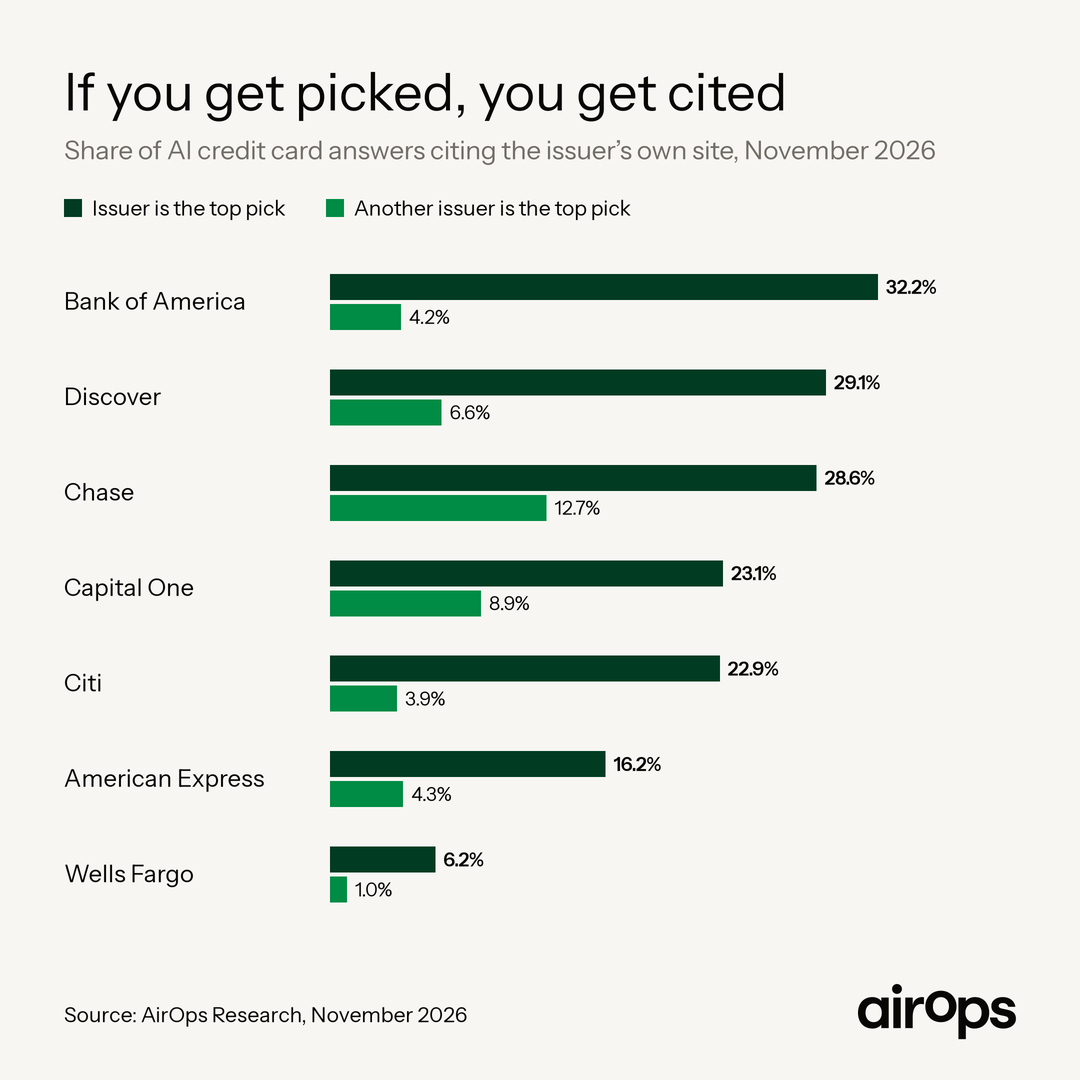
This happens for every major issuer. Across all four engines, answers that picked an issuer cited that issuer’s own site 2 to 8 times as often as answers that picked a rival. Chase’s site appeared in 28.6% of its own picks and 12.7% of other picks, and Bank of America’s in 32.2% against 4.2%. This is an association, and we cannot say which comes first.
Seed the evidence to win the wallet
Picking a credit card used to be a research project for every buyer. Open ten tabs, skim a few comparison sites, squint at the fine print on issuer pages, ask a friend... and eventually apply.
Now, it increasingly happens in one chat. Tell AI search your score, your goals, and the card already in your wallet, and it hands back a shortlist with reasons in seconds. All that poking around still happens. AI search just does it for you, pulling from the third-party sites it trusts and tailoring the answer to who is asking.
So the playbook changes.
Takeaways for card issuers
- Seed third-party evidence. 98.8% of answers that cited a source cited at least one third-party site, and 63.7% cited only third parties with no issuer at all. Get your proof onto the points blogs, personal finance explainers and comparison sites AI search already reads.
- Make your evidence persona-l. A stated score of about 640 or 560 changed the most common pick on 35 of 40 questions, versus 12 and 13 at about 810 or 760. Build evidence for each persona you want to win, because the answer depends on who is asking.
- Every engine is different; know where your buyers ask. When ChatGPT made a top pick, it cited that issuer’s own site 56.8% of the time, versus 10.3% to 14.9% on Gemini, Perplexity, and AI Mode. Clear owned pages pay off on ChatGPT, and third parties carry the weight everywhere else.
- Don’t take AI loyalty for granted. The existing issuer stayed the top pick in 32% to 35% of answers, but that fell to 21.9% when the asker doubted the card was still worth it. Build the evidence that gives holders a reason to stay, before they start asking.
Methods
Source and scope. AirOps Research. The same credit-card questions asked on ChatGPT, Gemini, Perplexity, and Google AI Mode, in the U.S. These charts describe what consumers ask and what AI recommends and cites.
Persona panel. AirOps own-prompt set. Framings use only self-stated credit score, income, student status, and wording.
Loyalty panel. A separate AirOps own-prompt set, where the asker already held one of 12 cards (an everyday and a premium card from each of American Express, Bank of America, Capital One, Chase, Citi, and Wells Fargo), gave a reason for shopping, and asked a need question. The no-card baseline is that issuer’s top-pick share for the same need in the persona panel when no held card is stated.
Platform data. U.S. answers to consumer credit-card prompts on the AirOps platform (business, corporate, merchant, and acceptance prompts excluded) from January to September 2026.