How to build an AI content audit workflow
- An AI content audit workflow pulls SEO and AI search data for every page, scores each page on a fixed set of signals, and routes pages that need work to a review queue.
- Track five signals: traffic and rankings, AI citation rate, mention rate, content age, and competitor citation gains.
- Score every page with a simple Impact, Confidence, Ease model, then sort pages into urgent, scheduled, and monitor tiers.
- AI handles the data pulls, scoring, and first drafts. Editors approve every change before it ships.
- Measure across SEO and AI visibility after a 30-day window, then feed results back into the scoring model.
An AI content audit workflow pulls performance and AI search data for every page, scores each page on a fixed set of signals, and routes the pages that need work to a refresh queue with human review. It is built for content and SEO teams responsible for hundreds or thousands of pages, where a manual spreadsheet audit takes weeks and is out of date by the time it ships.
Freshness now decides a large share of AI visibility. AirOps research found that over 70% of pages earning citations in ChatGPT were updated within the past 12 months, and 53.4% were refreshed within six months. An audit that runs once a year cannot keep up with that pace. An audit workflow can.
What's the right way to build an AI content audit workflow at scale?
The right way to build an AI content audit workflow at scale is to connect your data sources once, score every page against the same signals on a fixed schedule, and send only the pages that cross a threshold to people for review. The system does the inventory and math. Editors decide what changes.
The workflow runs in four steps:
- Pull the audit inputs: traffic, rankings, AI citation rate, mention rate, content age, and competitor citation data for every URL.
- Score and prioritize every page: combine the signals into one priority score and sort pages into tiers.
- Route pages to refresh, rewrite, or retire: match each tier to an action.
- Draft updates with human review: AI drafts the changes, editors approve them, and the workflow logs what shipped.
Teams build this kind of pipeline in platforms like AirOps, where workflows connect search data, AI analysis, and human review steps without code. For more patterns, see the AI workflows and automation hub.
Auditing 10,000+ pages
For a site with 10,000 or more pages, the right way to run an AEO content audit is to segment before you score. Group URLs by template or content type (blog, product, docs, glossary), audit the groups that drive pipeline first, and run the full library on a rolling schedule instead of all at once. Score at the page level, but make fixes at the template level when the same gap shows up across hundreds of pages, such as missing FAQ sections or flat heading structure.
Step 1: Pull the audit inputs
A modern audit tracks five signals. The first is familiar. The other four account for AI search visibility and show whether your pages earn citations or get passed over. This is also how to run an AEO audit on existing content: add AI visibility signals to the SEO data you already pull.
Signal 1: Declining organic traffic and rankings
Google Search Console remains the starting point. Look for falling impressions, lower average positions, and declining click-through rates. These signals still matter. They no longer tell the whole story, because a page can rank in the top three in Google and still earn no citations from AI engines.
Signal 2: Falling AI citation rate
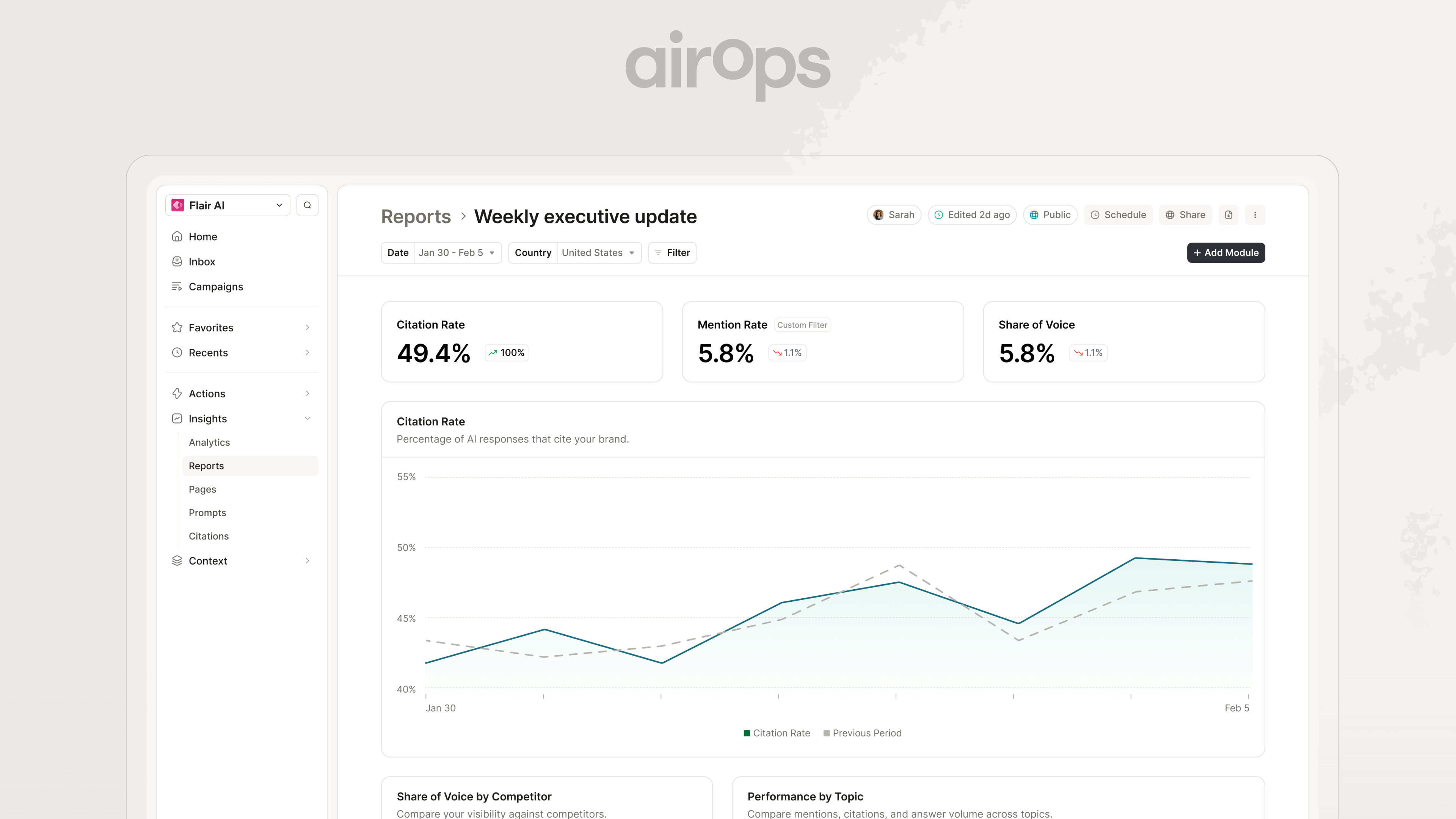
Citation rate measures how often AI engines cite your page when answering relevant prompts. A decline often means another source now gives a stronger answer. This is one of the clearest signs of content decay in AI search.
"You need to track citations and mentions separately. A citation means the AI linked to you. A mention means it talked about you. Both matter, but they're different signals." (Alex Halliday, AirOps webinar recap)
Signal 3: Low or declining mention rate
AI engines may mention your brand without citing a specific URL. A mention without a citation means the brand has awareness, but the page lacks enough authority or structure to earn a link. That is a fixable content problem.
Signal 4: Content age and freshness gaps
Pages that go unrefreshed lose ground in AI search. In the same AirOps research, pages not updated within a year were more than twice as unlikely to earn citations as pages updated in the past 12 months. Flag every page by last meaningful update date, not last publish date.
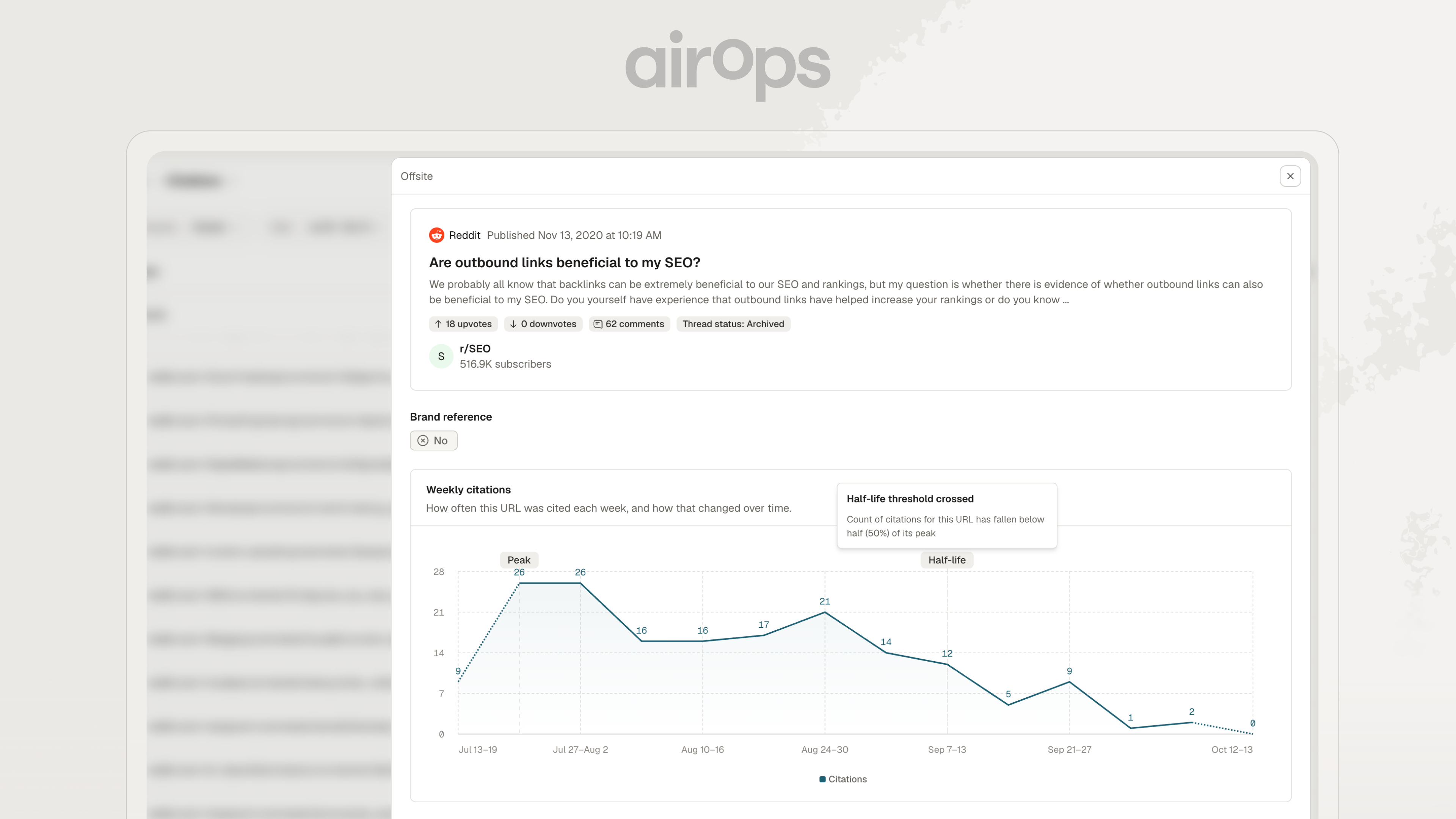
Citations decay on a curve, and the curve applies to third-party sources too. The example below tracks a Reddit thread, not an owned page, but it shows the pattern an audit should watch for: a citation peak followed by a steady decline.
Signal 5: Competitor citation gains
Competitor citation growth is an early warning. If competitors start earning citations your page used to capture, they likely improved coverage, added original insight, or refreshed outdated information.
| Signal | Traditional audit | AI-era audit |
|---|---|---|
| Visibility | Rankings and impressions | Rankings plus AI citation rate |
| Brand presence | Branded search volume | Mention rate in AI answers |
| Freshness | Publish date | Last meaningful update date |
| Competition | Competitor rankings | Competitor citation gains on your prompts |
Analytics in AirOps brings these signals together for each page, with filters like "Losing AI Visibility" and "Losing Clicks" so teams can find pages that need attention.
Step 2: Score and prioritize every page
To know which blog posts to refresh first, combine the five signals into one priority score. A simple Impact, Confidence, Ease (ICE) model works well:
- Impact: traffic potential plus AI citation potential. Pages with high search demand and high citation opportunity score highest.
- Confidence: data quality. Pages with 90 days of trend data score higher than pages with spotty tracking.
- Ease: size of the content gap. A page that needs a new FAQ section is easier than a page that needs a full rewrite.
Then weight by business value and competitive risk. Pages that support core products or high-value conversions come before informational pages, and pages where competitors recently gained ground move up the list.
Sort pages into three tiers:
| Tier | Score | Action |
|---|---|---|
| Urgent | 8 to 10 | Full rewrite with competitive analysis |
| Scheduled | 5 to 7 | Targeted updates: new data, restructured headings, an FAQ |
| Monitor | 1 to 4 | No action yet; re-score next cycle |
AirOps prioritizes pages for AI visibility by pulling citation, mention, and traffic data from Insights into a workflow that applies your weighted scoring logic. Grids hold the scored page list, so the team works from one prioritized view instead of building a new spreadsheet each quarter.
From quarterly audits to a monthly rhythm
AirOps workflows change the quarterly audit by making it continuous. The data pull and scoring run on a schedule, monthly or weekly, and only pages that cross a threshold land in the review queue. Content decay grows over time, so catching it early means smaller fixes. The quarterly meeting becomes a review of trends instead of a scramble to build the list.
Step 3: Route pages to refresh, rewrite, or retire
Each tier maps to an action. Refresh pages whose topic still matches search intent and that hold existing links or citations. Rewrite pages whose angle no longer fits how people search. Redirect or retire pages that overlap with a stronger page or no longer serve a business goal, and point the redirect at the page that now owns the topic.
For more, see the content refresh strategy guide.
Every refresh should include a structure pass for AI engines:
- Use clear H2 and H3 headings that match the questions your audience asks.
- Lead each section with a direct answer in the first sentence.
- Break long sections into focused chunks that each answer one question. See AEO content structure for patterns.
- Structure pays off: AirOps research found that a clear, sequential heading structure correlates with 2.8x higher citation rates.
Step 4: Draft updates with human review
Once a page is routed, the workflow drafts the update and people approve it. Keep the stages simple:
- Brief: the workflow writes a refresh brief from the audit data: which signals fired, what competitors cover, which prompts the page should answer.
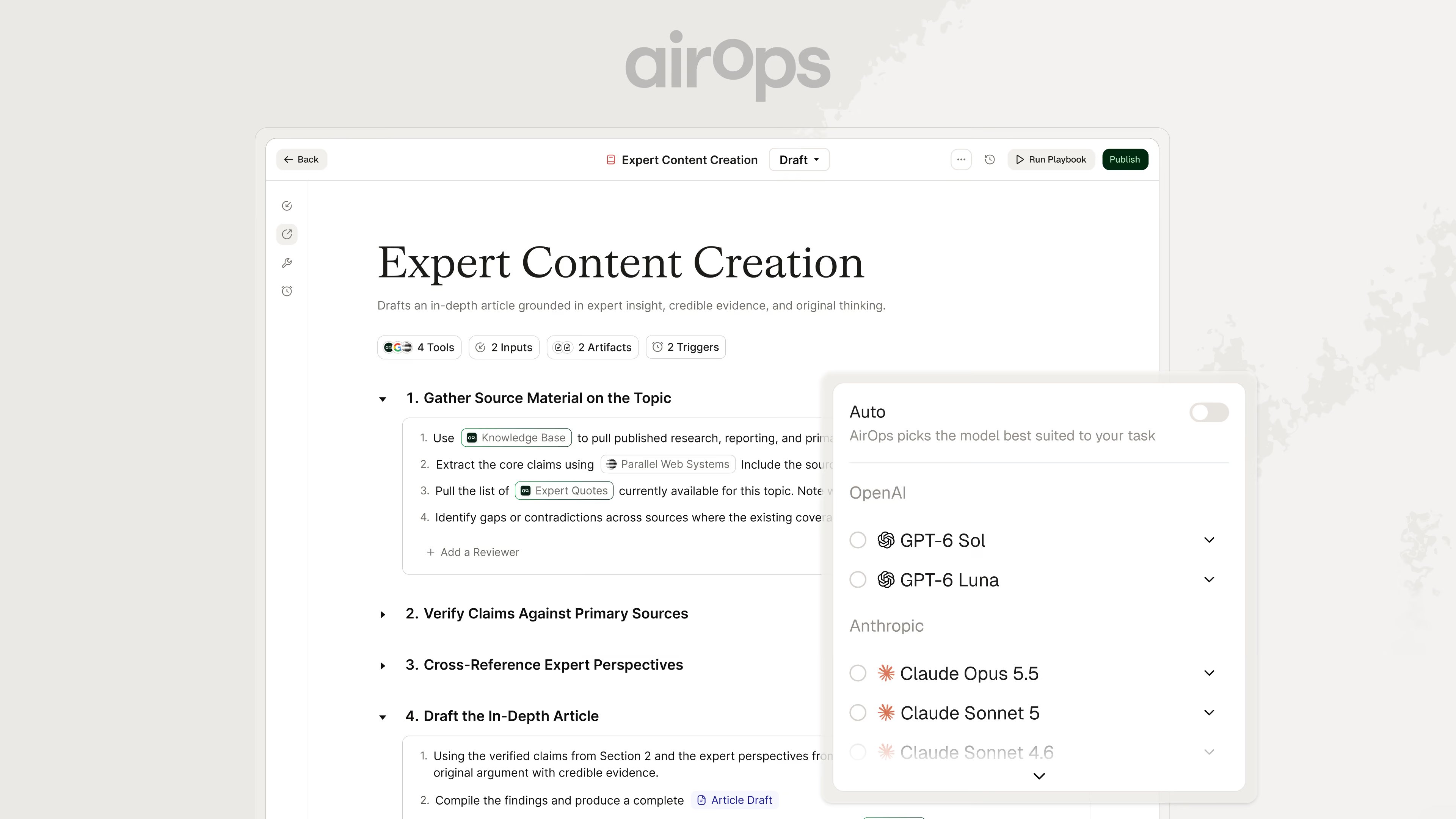
- Draft: AI drafts the changes using your Brand Kit and content standards.
- Check: automated checks run claims, links, and structure.
- Review: an editor approves, edits, or rejects the draft. Nothing publishes without this step.
- Log: the workflow records what changed and when, so measurement can tie results to the update.
Batch refreshes into sprints of 10 to 15 pages per cycle. Ship weekly and measure monthly. In AirOps, run refresh Playbooks with your Brand Kit and competitive insights as context, while your team owns strategy, prioritization, and final review.
How is an AI content refresh different from a regular content audit?
An AI content refresh is different from a regular content audit because the audit finds the problem and the refresh fixes it. A regular content audit inventories pages and flags issues, usually once a quarter or once a year, and ends with a spreadsheet. An AI content refresh connects that audit to action: it flags decaying pages from live performance data, drafts targeted updates, and routes them to human review, then measures the result.
The audit also changes. A traditional audit looks at traffic and rankings. An AI-era audit adds citation rate, mention rate, and competitor citation gains, because a page can hold its Google ranking while disappearing from AI answers.
How to measure the audit workflow
Track results across SEO, AI visibility, and operations after every refresh cycle.
| Category | Metrics |
|---|---|
| SEO | Impressions, average position, clicks |
| AI visibility | Citation rate, mention rate, share of voice on tracked prompts |
| Operations | Pages audited per cycle, time from flag to publish, editor revision rate |
Start with a 30-day measurement window. AI engines need time to discover, evaluate, and cite updated content, and looking too early can make a working refresh look ineffective. Capture a baseline before the first cycle so every later result has a comparison point.
The loop compounds when it runs consistently. AirOps' own full-funnel content refresh grew citations 20% by running the same process each cycle: find opportunities, prioritize, publish, and measure.
Content publish tracking in AirOps logs every refresh in Insights, so teams can see how updates line up with changes in traffic, citations, and visibility over time.
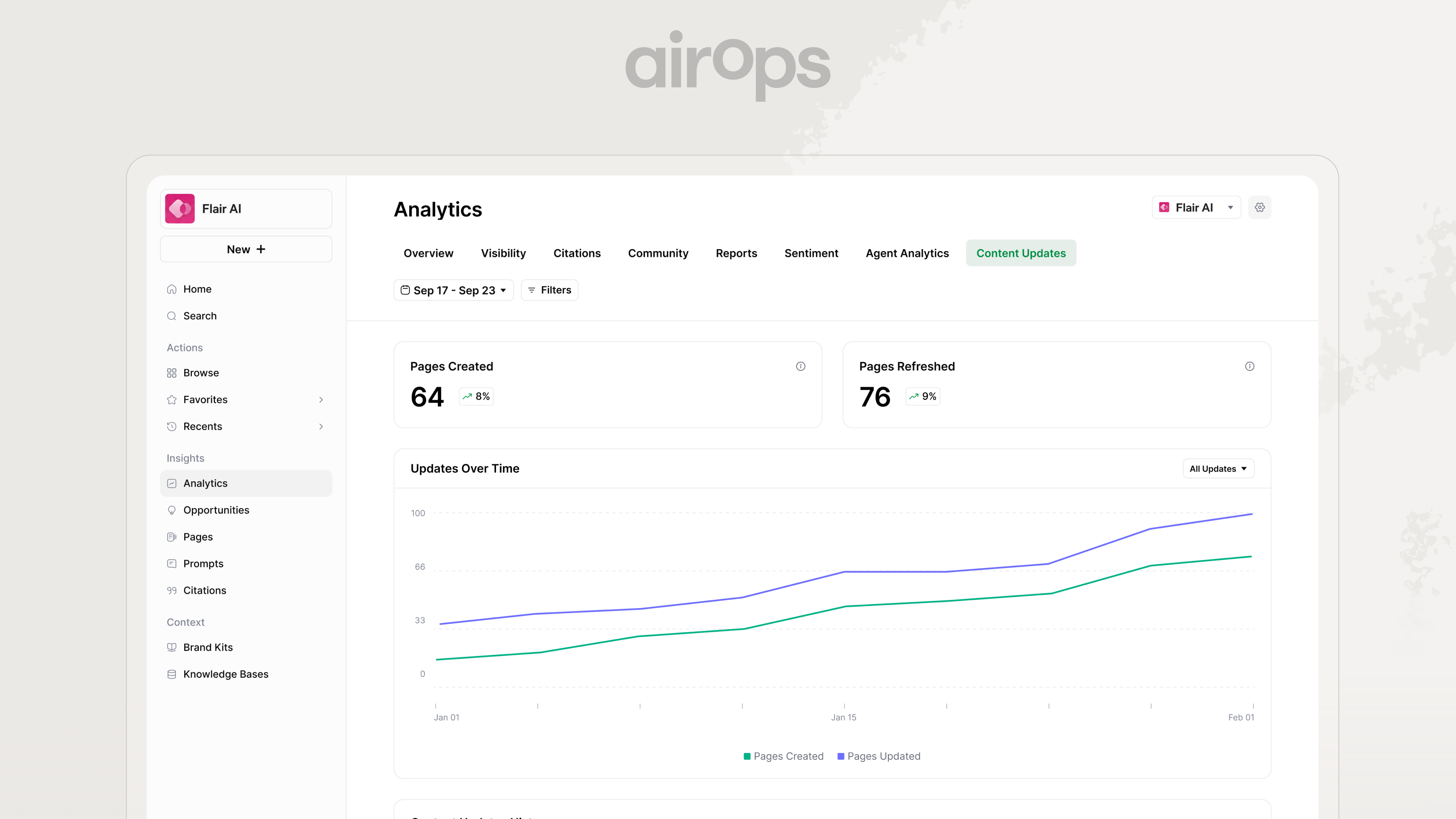
Feed results back into the scoring model. Which pages improved fastest? Which updates produced the largest citation gains? Which content types beat expectations? Those answers make the next cycle sharper. Planning teams can then pull audit output into AI workflows for content planning, so refreshes and new content share one calendar.
Build an audit system, not an audit project
AI engines keep re-evaluating which sources deserve citations, and competitors keep publishing. An audit system gives your team a repeatable way to respond: the same signals, the same scoring, the same review gates, every cycle.
AirOps is an enterprise AEO platform and expert partner for marketing leaders, connecting AI search intelligence, coordinated action across channels, and measurement tied to growth.
Book a call to see how AirOps connects audit, action, and measurement in one loop.
Frequently asked questions
How often should you run a content audit for AI search?
Run the data pull and scoring monthly, and review high-value pages every three to six months. Investigate large citation drops right away instead of waiting for the next cycle.
Can AirOps flag low-performing pages automatically?
Yes. AirOps workflows monitor traffic, rankings, and AI citation signals and flag pages that cross the decay thresholds you set. Your team reviews a prioritized queue instead of auditing every page by hand.
Can AirOps detect content decay across LLMs automatically?
Yes. AirOps Insights tracks citation and mention rates for your tracked prompts across AI answer engines, so a decline on a page shows up as a signal in the audit workflow rather than something your team has to spot manually.
Can AI automate the entire audit and refresh process?
No. AI can pull data, score pages, analyze competitors, and draft updates. Human review stays essential for accuracy, expertise, and brand voice.
What if traffic drops after a refresh?
Short-term swings are normal. Watch performance for several weeks before making more changes, and check whether citation rate moved in the other direction.