- Manual planning gave way to connected systems that move ideas from research to calendar without copy-paste work
- Brand knowledge became required input for AI planning, cutting revision cycles
- Human editors stayed responsible for tone, angle, and positioning
- Performance tracking expanded beyond rankings to include AI search citations and visibility
Content teams that still plan manually keep falling behind. While they spend hours on keyword research, competitor analysis, and brief creation, other teams ship more content with fewer handoffs and fewer mistakes.
This guide shows how to build AI workflows for content planning and ideation, from setting up topic discovery to measuring performance in AI search. You'll learn what to automate, where humans stay in control, and how to create optimized content workflows that scale without losing your brand voice.
What is an AI workflow for content planning?
An AI workflow for content planning links the steps that move content from idea to publication. After you define the rules, the system carries context forward so teams don't rebuild the same information at every stage.
AI workflow: A sequence of automated tasks where one step triggers the next
Content planning: Choosing what to create, when to publish, and how each piece supports business goals
A single AI tool speeds up one task. A connected system reduces planning friction across the full content lifecycle.
Some teams build these planning workflows with partners like AirOps, connecting SERP data and keyword inputs to LLM-powered drafting steps that run without engineering help.
Why content teams need AI planning workflows
Spreadsheet planning breaks down as content volume grows. Teams redo research because no shared system shows what already exists. Brief quality depends on who writes them, and approvals drift across inboxes.
AI search volatility makes those gaps harder to ignore. AirOps research shows that only 30% of brands stay visible from one answer to the next in AI search, and just 20% remain visible across five consecutive runs. Industry leaders point to intent monitoring, refresh discipline, and off-site authority as the levers that now shape visibility.
This shift changes how teams plan. Publishing once no longer protects performance. Content systems must revisit topics, refresh aging pages, and adjust priorities based on what AI search surfaces week to week. AI integration in publishing workflows means teams now plan for multiple discovery surfaces, not just traditional search.
Where automation saves time
AI workflows handle the predictable work that eats hours every week:
Pulling search and performance data
Drafting first-pass briefs
Populating editorial calendars
With AI workflows, every brief follows the same structure. Every piece passes through the same checks. That standard matters more as your team grows.
Core components of an AI content planning workflow
Designing a multi-step AI content planning workflow starts with five core components that move content from idea to published page. Each system looks different, but most strong setups include five layers.
Topic discovery engine: Surface ideas from search trends, audience behavior, and keyword gaps so teams start with data instead of a blank doc.
Research aggregation: Pull search volume, competitor coverage, industry updates, and internal performance data into one shared place.
Calendar automation: Group content by theme, assign deadlines, and populate your editorial calendar without spreadsheet maintenance.
Brief creation: Generate structured briefs with keywords, intent, and suggested headings so writers start with direction.
Feedback loops: Route performance data back into planning so results shape the next round of topics.
How to automate content ideation and topic research
Planning systems work best when they balance new ideas with content that already exists.
Monitor trends and trigger alerts
Connect your system to sources like Google Trends, Reddit threads, review platforms, and industry publications. Set alerts around priority topics so ideas surface without manual checks.
Brand mentions across third-party platforms now influence whether AI systems retrieve and cite your pages, which is why many teams factor off-site visibility signals into planning alongside search demand.
"Automating the monitoring of intent shift over all of your content is a massive opportunity. PAA data shows the zeitgeist around any search term, and now we have cheap ways to connect tools like Screaming Frog, AlsoAsked, and ChatGPT to check real-time search intent across an entire site." — Mark Williams-Cook
This approach keeps ideation tied to live user behavior rather than waiting for performance drops.
Automate competitor content analysis
AI can scan competitor websites on a schedule, identify top-performing content, and flag gaps that affect visibility. Feeding those competitor gaps into your content workflow automation turns one-off audits into a repeatable input for your editorial calendar.
Generate topic clusters from seed keywords
Start with a seed keyword and let AI expand it into related topics that build topical authority.
Validate ideas against search intent and business goals
AI checks whether a topic matches user demand and connects to your products or services.
Score by impact and freshness
Freshness now plays a direct role in AI visibility. AirOps research found that pages not updated quarterly are three times more likely to lose AI citations than recently refreshed pages. Separately, research on content structure shows that pages with clean heading hierarchy and FAQ sections earn 2.8 times more AI citations than poorly structured pages.

Planning should surface aging pages alongside new ideas so refresh cycles remain part of day-to-day work rather than cleanup projects.
How to choose AI content planning tools
Choosing the right AI-enhanced content planning tools starts with understanding your team's gaps. Before comparing features, define what you want the system to replace. Most teams want fewer handoffs, fewer revisions, and better planning visibility.
As automation becomes more common, teams wrestle with how much of their process to hand over to systems. The question isn't whether to automate content creation, but how to do it without losing editorial control — a tension that comes up often when evaluating SEO content automation strategies.
Workflow automation capabilities
Look for tools that support triggers, conditional logic, and multi-step sequences. The best tools let you build workflows visually without writing code, so your team can modify them as processes evolve.
Data integration and CMS compatibility
Your AI tools connect to your existing CMS, analytics platform, and marketing stack. Without native integrations, you'll still copy data manually between systems, which defeats the purpose of automation.
Brand knowledge and customization options
Generic AI output wastes time on revisions. Tools that learn your brand voice, terminology, and audience produce content your team can actually use. AirOps, for example, combines brand-specific knowledge with AI to generate on-brand content without extensive editing.
How to connect your AI workflow to your CMS for publishing
Publishing automation is the step that turns a content workflow into a full pipeline by pushing finished drafts straight into your CMS. Without it, teams still copy and paste outputs between tools, which breaks structure and adds unnecessary review cycles.
The handoff from draft to published page is where most workflows break down. Paste an output into a new editor and formatting shifts, FAQ schema flattens into plain text, and rich text loses its headings. That rework cancels out the time you saved upstream.
Fix this by mapping workflow output fields directly to CMS fields, so plain text, rich text, and FAQ schema each land in the right place. FAQ schema exports as structured JSON your CMS can render correctly. Define the field mappings once and every future export follows the same rules.
Keep human control in the loop by sending reviewed drafts back as unpublished drafts. Editors approve inside the CMS before anything goes live.
AirOps connects to Webflow, WordPress, Contentful, and Sanity so you can export without switching tools. An AirOps webinar with Oyster showed how teams benefit from building one connected workflow from import to publish instead of stitching together disconnected tools.
Good publishing automation covers these areas:
Field mapping between workflow outputs and CMS fields so structure survives export
One-click export from your workflow grid directly to your CMS
Draft status on export so editors keep final approval inside the CMS
Support for multiple content types like FAQs, glossaries, and long-form pages
Publish tracking so you can tie workflow changes to performance over time
How to build an implementation roadmap for AI content workflows
An implementation roadmap for AI content workflows breaks the rollout into phased steps so your team builds confidence before scaling. Start with one high-impact workflow, prove the value, then expand.
Phase 1 (weeks 1-2): Foundation. Audit your current content process and identify the bottleneck that wastes the most time. For most teams, that is research aggregation or brief creation. Build one workflow that automates that step, connect it to your CMS, and run it against five existing pages to validate results.
Phase 2 (weeks 3-4): Pilot. Expand to a full planning cycle. Add AEO tools integrating with content creation workflows so your planning outputs include structure targets that AI search engines can parse. Include human review checkpoints at ideation and draft stages.
Phase 3 (weeks 5-8): Scale. Roll the workflow out to your full content calendar. Add refresh triggers so stale pages that lose up to 3x their AI citations get flagged automatically instead of slipping through the cracks. Measure velocity, revision rate, and citation growth against your pre-automation baseline.
How to maintain content quality and brand voice
Automation only works when humans stay in control.
Defining the human-AI balance for your team
AI handles research, first drafts, SEO tagging, and scheduling well. Humans handle final editing, brand voice refinement, strategic decisions, and expert commentary. The right balance depends on your team's capacity and quality standards.
AI handles:
Research and data collection
Pattern detection
First-pass drafts
Scheduling
Humans handle:
Voice and tone
Creative angles
Strategic positioning
Expert insight
Creating AI-ready brand guidelines
Document your brand voice, tone, terminology, and examples in a format AI tools can reference. This documentation becomes the foundation for consistent output. Include specific examples of what your brand sounds like and what it doesn't sound like.
Building editorial review checkpoints
Insert human review steps at key points in your workflow: after ideation, after drafts, and before publishing. These checkpoints catch errors and off-brand content before it goes live. Editorial review checkpoints are how teams maintain editorial control in automated workflows. They ensure that speed gains from automation never come at the cost of accuracy or brand consistency.
Training AI on your unique brand knowledge
Feed AI tools your existing content, style guides, and product information. The more context AI has about your brand, the better its output matches your standards.
How AI planning workflows support answer engine optimization
Answer Engine Optimization (AEO) focuses on structuring content so AI-powered search tools like ChatGPT, Perplexity, and Google Gemini can easily retrieve and cite it. The way your planning workflow is designed determines whether those systems surface your pages or skip them.
Structuring content for AI crawlability
AI systems parse pages based on headings, schema, and predictable formatting. AirOps analysis shows that pages with clean structure earn 2.8 times more citations than poorly structured pages.
Treat structure as a planning input. Briefs should specify heading frameworks, schema requirements, and question-based sections so writers build pages AI systems can actually read.
Building authority signals into your workflow
Include steps that add expert quotes, citations, and original research to every piece. Authority signals increase the likelihood that AI systems cite your content over competitors covering the same topics.
Creating citation-worthy content at scale
Automated workflows help teams produce authoritative content consistently. When every piece follows the same quality standards, you increase your chances of earning AI citations across your entire content library rather than just a few standout pieces.
How to measure AI content workflow performance
Measurement keeps automation honest. Tracking speed and cost alone doesn't show whether planning changes visibility in AI search or affects revenue.
Use a small set of metrics that connect planning activity to outcomes. Tracking content performance across AI-powered workflows requires connecting planning velocity to citation growth, not just traffic.
Track how quickly ideas become published pages. Monitor revision rates to spot process drift. Tie content performance to traffic, leads, and citation growth.
How to use fan-out queries as a content planning input
Fan-out queries are the sub-queries AI engines generate when processing your target prompts. Each one represents a potential content planning input that reflects what AI systems actually search for when answering questions in your category.
As one speaker explained in a recent AirOps webinar, "the sub-queries AI engines generate from your target prompts are essentially a ready-made content plan." Run your priority prompts through ChatGPT, Perplexity, or Gemini and capture the sub-queries each platform generates. These queries map directly to content gaps your team can fill.
This approach is one of the most effective best practices for AI content planning workflow design because it grounds your editorial calendar in real AI search behavior rather than assumptions about what users ask. Feed fan-out queries into your quarterly planning sprints alongside keyword research and competitive analysis to build a planning system that adapts to how AI search evolves.
Turning planning signals into action inside one system
Once teams track velocity, quality, and AI search visibility, the next challenge is acting on those signals without bouncing between tools.
Cadence plays a direct role here. Teams that revisit pages once a year fall behind faster than they expect, which is why many now plan how often content needs to be updated with the same rigor as new production. Structured guidance on how often content needs to be updated helps protect visibility over time.
Teams that run quarterly content audits through automated workflows catch decay signals before they compound. One enterprise team saw 25-30% ranking and citation uplift after building systematic refresh triggers into their planning cadence.
This is where a content engineering platform changes the shape of planning.

Instead of exporting reports and rebuilding briefs by hand, teams can connect content insights directly to creation and refresh actions.
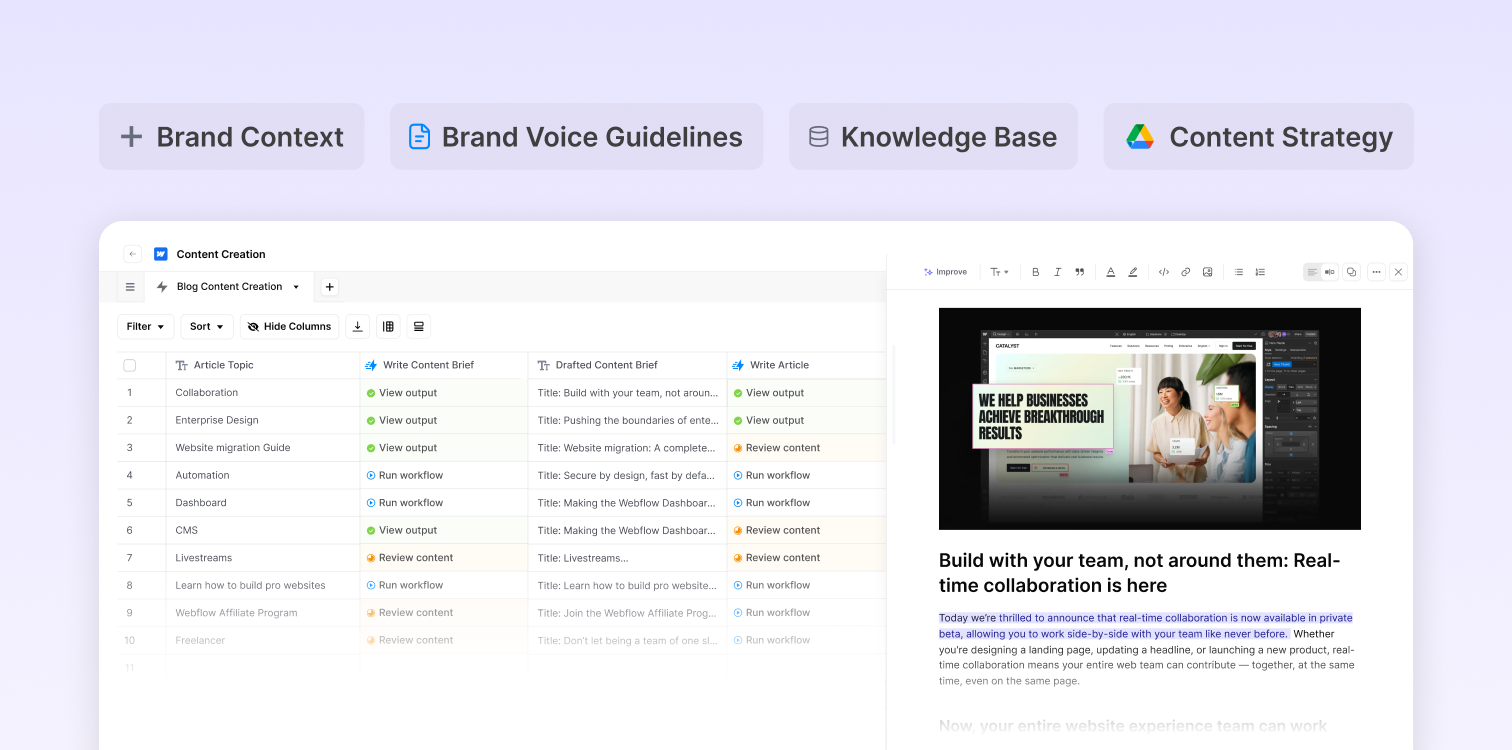
AirOps supports this loop by combining content insights, planning logic, and brand governance in one workspace. Teams can spot pages losing citations, route them into refresh cycles, and generate updated briefs grounded in their own brand knowledge. Writers start with context instead of blank documents, and editors review drafts that already follow agreed standards.
AirOps is the partner brands bring in for this shift, combining the platform, the media mix, and a team that builds and runs the strategy alongside your own, then ties the work back to pipeline and revenue growth.
Common AI workflow mistakes and how to avoid them
Teams often over-automate creative decisions, skip brand training, or remove review steps to chase speed. Each shortcut increases revision work later.
Over-automating creative decisions
AI handles execution well but struggles with strategic and creative decisions. Keep humans in the loop for tone, angle, and positioning choices. Automating everything leads to generic content that sounds like everyone else's.
Neglecting brand voice training
Skipping brand training leads to generic, off-brand content that requires heavy revision. Invest time upfront to teach AI your voice. The initial setup pays off in reduced editing time later.
Skipping quality control checkpoints
Publishing AI content without review creates quality and accuracy risks. Build mandatory review steps into every workflow, even if they slow things down slightly.
The shift from AI assistants to AI agents for content
AI agents act across multiple steps without constant prompts. They monitor trends, generate briefs, and update calendars on their own. Teams move from writing prompts to supervising systems.
This shift changes the role of the content strategist from executor to system designer.
What is the difference between static and dynamic AI workflows?
A static AI workflow runs the same fixed steps every time you trigger it, while a dynamic AI workflow adapts its next step based on data, conditions, or signals it detects. Both have a place in content workflow automation, and knowing when to use each determines how much value you get from your system.
Static workflows work best for repeatable tasks. Brief generation, FAQ creation, and meta description updates follow predictable patterns that rarely change. You define the inputs, configure the steps, and let the workflow run without variation.
Dynamic workflows respond to live signals. They route pages into different paths based on what they detect. For example, a dynamic workflow moves a page into a refresh only when citations drop or search intent shifts.
Most content teams start with static workflows. Once you trust the outputs, you add conditional branches that adjust behavior based on performance data. Dynamic, always-on workflows are where an AI agent captain like Quill operates, monitoring pages and triggering actions without manual prompts.
Use this breakdown to choose the right approach for each task:
Use static workflows for high-volume repeatable tasks like brief generation, FAQ creation, and glossary builds
Use static workflows when the output format stays consistent across every run
Use dynamic workflows when you need to route content based on performance signals or priority changes
Use dynamic workflows for refresh systems that act only when decay triggers fire
Start static and add dynamic branches after you trust workflow outputs at scale
From manual planning to content systems that perform
Content planning now lives inside connected systems that link ideation, briefs, and performance signals. Teams that adopt this model move faster, protect brand voice, and build visibility in AI search.
Book a demo to see how AirOps helps content teams turn planning into a repeatable system that earns citations, strengthens discovery, and drives revenue.
Frequently Asked Questions
How do you prevent AI content planning tools from suggesting the same topics as competitors?
Configure your workflow to weight proprietary data sources like customer support tickets, sales call transcripts, and product usage data alongside public search trends. This approach surfaces unique angles and questions that competitors relying solely on keyword tools will miss entirely.
What skills does a content team need to manage AI planning workflows effectively?
The most critical skill is systems thinking and understanding how to design triggers, conditions, and handoffs rather than executing individual tasks. Teams benefit from having at least one person comfortable with workflow logic and data connections, though most modern platforms require no coding knowledge.
How do you handle seasonal or trending content in an automated planning system?
Build separate workflow branches for evergreen and time-sensitive content, with different approval speeds and freshness thresholds for each. Set up automated alerts for trending topics in your space that can fast-track relevant ideas through an expedited planning process while maintaining quality checkpoints.
How do you design a multi-step AI content planning workflow?
Design it as five connected stages: topic discovery, research aggregation, calendar automation, brief creation, and feedback loops. Each stage passes context to the next, so writers start with direction instead of a blank document. Add human review checkpoints at ideation and draft stages to protect tone and accuracy.
How do you optimize your content workflows?
Optimize content workflows by connecting each stage so context carries forward without copy-paste work. Standardize briefs, automate research and calendar tasks, and route performance data back into planning. Keep human review on tone, angle, and positioning so speed never costs quality.
What are advanced AI techniques for content creators to optimize their workflow?
Advanced AI techniques for content creators include fan-out query mining, automated competitor analysis, and topic clustering from seed keywords. Pair these with refresh triggers that flag aging pages before they lose AI citations. Each technique feeds one connected system rather than a set of disconnected tools.
How do enterprise SEO teams automate brief creation with AI?
Enterprise SEO teams automate brief creation with AI by connecting keyword and SERP data to a workflow that outputs a structured brief for every topic. Each brief includes the target query, search intent, suggested headings, and internal link recommendations. An editor approves the brief before writing starts, so strategy stays human-led while production scales across large teams.
How do you automate a content calendar using AI?
You automate a content calendar using AI by connecting your topic pipeline to a workflow that groups topics by theme, assigns publish dates, and updates the calendar as priorities shift. This removes spreadsheet maintenance from your planning process. Your team keeps a steady publishing cadence without manual date tracking or last-minute reshuffling.
Get the latest on AI content & marketing
