AI marketing agents that ship content, not dashboards
- AI marketing agents are software that take a marketing goal, pull the data they need, and complete a task with a person approving the output.
- Monitoring agents report what AI search engines say about you, and execution agents write, refresh, and publish the pages that change it.
- AirOps Workflows, Playbooks, and Grids run execution agents for content marketers, SEO and AEO teams, product marketers, and SaaS marketing teams.
- Every agent run pulls from one Brand Kit and stops at a human review step before anything goes live.
- Start with one agent tied to one metric, then add the next once the first one ships work you approve.
AI marketing agents are AI systems that take a marketing goal, gather the data they need, and complete the work, with a person approving each step. The useful ones ship content: briefs, refreshes, internal links, and published pages. AirOps is an enterprise AEO platform and expert partner for marketing leaders, connecting AI search intelligence, coordinated action across channels, and measurement tied to growth. Its agents are built to do the work, not only report on it.
When a competitor takes your spot in an AI answer, an AirOps agent drafts the page update that wins it back, routes it to your editor, and publishes it once approved. This guide covers how AI marketing agents work, how they help with search engine optimization (SEO) and answer engine optimization (AEO), and what they look like for four teams.
Watch Alex Halliday's opening keynote, The Age of Agents, for the bigger picture on AI agents in marketing.
What are AI marketing agents?
AI marketing agents are programs that plan and complete multi-step marketing tasks using large language models (LLMs), your data, and connected tools. An agent can run a full sequence on its own: it pulls Search Console data, reads your Brand Kit, writes a draft, checks it against your rules, and hands it to a reviewer.
AEO is the practice of structuring content so AI search engines like ChatGPT, Perplexity, and Google AI Mode can find, trust, and cite it. A citation is a link to your page inside an AI answer. Share of voice is the percentage of tracked AI answers that mention your brand compared with competitors.
AI marketing agents fall into two groups:
| Agent type | What it does | Output | Where it stops |
|---|---|---|---|
| Execution agent (AirOps Workflows, Playbooks, Grids) | Writes, refreshes, links, and publishes content | Briefs, drafts, page updates, published pages | At a human approval step, then publishes |
| Monitoring agent | Tracks prompts, citations, and sentiment | Reports, alerts, summaries | At the report |
You need both, and AirOps runs both in one system. AEO tracking and Analytics in AirOps Intelligence find the gap, and Workflows and Grids close it, with Human Review checkpoints before anything ships.
What is an AI content workflow?
An AI content workflow is a connected sequence of steps, some run by AI and some by people, that turns an input like a keyword, prompt, or transcript into a finished piece of content.
Agents are what run those workflows: they decide the next step, call the right tool, and pass context forward, so a team supervises the system instead of moving files between tools.
Which parts of the content lifecycle suit AI automation?
The parts of the content lifecycle that suit AI automation are the repeatable, data-heavy ones: research, briefs, first drafts, internal linking, structure checks, decay detection, and CMS publishing. The parts that stay with people are strategy, positioning, final voice, claim approval, and anything a customer said.
Why should agents ship content instead of only reporting?
Agents should ship content because a report does not change what an LLM says about you, and a published page can. AI engines build answers from the pages they retrieve. If your page is stale, thin, or missing, the answer goes to someone else.
Reporting agents create a to-do list. Someone still has to write the brief, update the page, add the links, and push it live. That handoff is where weeks disappear.
Here is how AI visibility insights can trigger targeted content updates automatically. AirOps agents close the loop in one place:
- AEO tracking in AirOps Intelligence flags a prompt where your citation rate dropped.
- Page360 shows the page that used to win it and its Search Console trend.
- A Workflow drafts the refresh using your Brand Kit and Knowledge Base.
- An editor reviews the draft at a Human Review step in a Grid and approves or edits it.
- The Grid publishes the approved page to your connected content management system (CMS), such as Webflow, WordPress, Contentful, or Sanity.
- Campaigns measure the result against a baseline captured before the change.
For a deeper look at the refresh side, read our guide to AI agents for content monitoring and refresh.
How do AI agents help SEO?
AI agents help SEO by finding pages that are losing traffic or citations, drafting the fixes, and shipping approved updates faster than a manual audit cycle. They connect to Google Search Console and Google Analytics 4 (GA4), spot decline early, and turn that signal into a ready-to-review change. The same agents help AEO, because the pages that earn rankings are the pages AI engines retrieve and cite.
Here is where agents help SEO and AEO teams most:
- Content decay detection: agents watch clicks, impressions, and position by page and flag declines.
- Refresh drafting: agents rewrite outdated sections, update facts, and add missing questions an AI answer covers.
- Internal linking: agents find related pages and suggest links with descriptive anchor text.
- Brief generation: agents turn a target keyword and prompt into a brief with headings, sources, and FAQs.
- AEO gap filling: agents find prompts where competitors get cited and you don't, then draft content to answer them.
Agents do the repetitive work. Your team owns strategy, final judgment, and anything that touches pricing, product claims, or legal review.
What is an example of an agentic AI workflow for content creation?
An example of an agentic AI workflow for content creation is an AirOps Workflow that runs across a Grid of target keywords, chaining data, AI steps, and human review so one trigger produces a publish-ready page:
- Input: a row in a Grid with a target keyword, target AI prompt, and URL (new or existing).
- Research: the Workflow pulls the current top results and AI answers for the prompt.
- Context: it loads your Brand Kit for voice, rules, and positioning, plus your Knowledge Base for product facts.
- Brief: it writes an outline with answer-first H2s, an FAQ block, and internal link targets.
- Draft: it writes the article against the brief.
- Checks: it scores the draft for readability, claim support, SEO, and AEO.
- Human Review: an editor approves, edits, or sends the row back with notes.
- Publish: the Grid pushes the approved draft to your CMS.
Run it across hundreds of rows and the same quality bar holds on every one, because every row reads from the same Brand Kit. Playbooks package the same steps so a team can rerun them with one click. The AI workflows and automation hub has more examples.
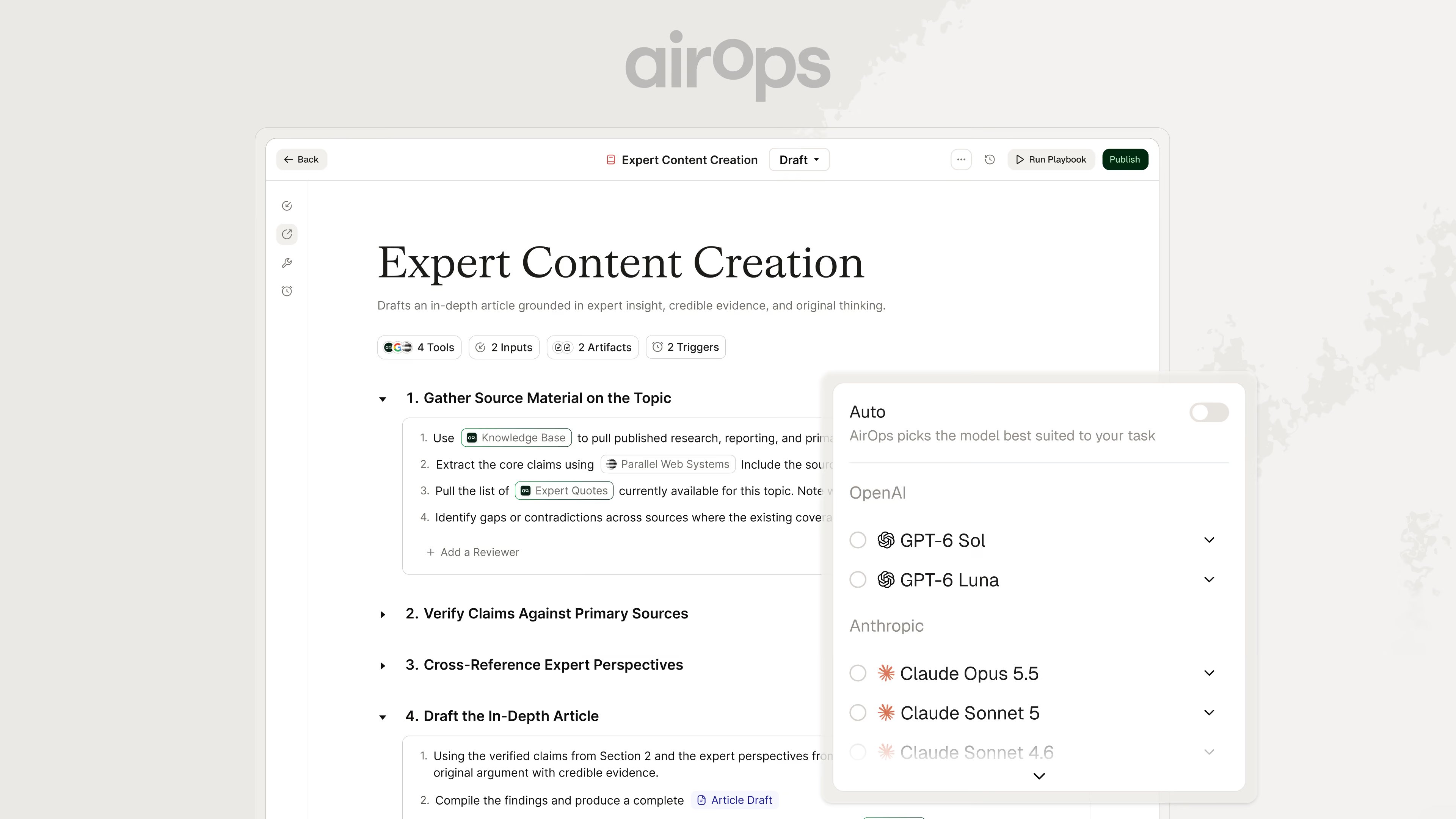
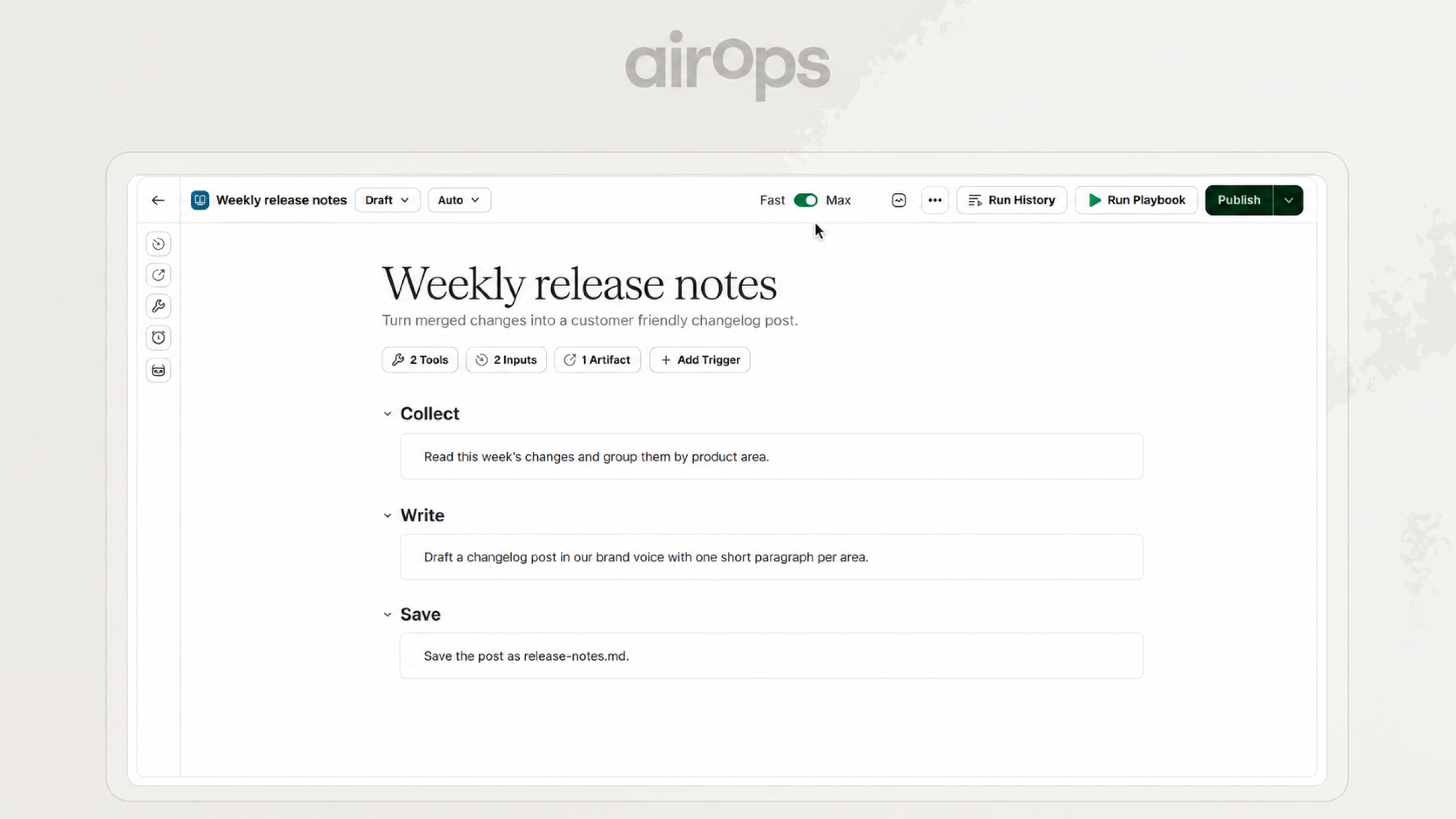
Watch Josh Spilker and Saven show how AirOps uses AirOps to build content workflows for AI search and AEO.
AirOps workflow use cases in content ops
Common use cases for AirOps workflows in content ops include:
- Refreshing pages that lost traffic or AI citations
- Writing briefs for a full topic cluster in one Grid run
- Turning webinars and SME interviews into drafts
- Building integration, use case, and comparison pages from product docs
- Adding internal links and FAQ blocks across a library
- Publishing approved drafts to the CMS and syncing status to project tools
AI marketing agents for content marketers
AI marketing agents help content marketers keep a large library fresh and on-brand without adding headcount to the review queue. The job shifts from writing every draft to directing and approving work.
What can agents take off a content marketer's plate?
- Refreshing posts that lost traffic or AI citations, using Search Console data inside the Grid
- Turning webinar transcripts and SME interviews into drafts, with quotes kept exactly as spoken
- Building briefs for a full topic cluster in one Grid run
- Rewriting intros so they answer the core question in the first two sentences
How should large content teams orchestrate AI content workflows?
Large content teams should orchestrate AI content workflows around one shared source of truth and clear ownership at each stage. Put voice, rules, and positioning in one Brand Kit that every run reads. Assign an owner to each workflow, not each draft. Use a Grid as the shared queue so writers, editors, and SEO leads see the same status. Sync that status to Asana, ClickUp, Monday.com, or Airtable so the work shows up where the team already plans.
Where should a person stay in the loop?
Keep a human on final voice, quote accuracy, and anything a customer said. Agents draft and check. Editors decide what ships.
AI marketing agents for SEO and AEO teams
AI marketing agents help SEO and AEO teams turn citation and ranking data into shipped page changes, so wins in AI search don't wait on the next audit. This is where execution matters most, because AI answers shift week to week.
Which agents should an SEO or AEO team run first?
| Agent | Trigger | What it ships |
|---|---|---|
| Citation gap agent | A tracked prompt cites competitors but not you | A new section or page that answers the prompt |
| Refresh agent | Clicks or citation rate drop on a page | An updated draft with new facts and FAQs |
| Internal link agent | A new page goes live | Link suggestions from related posts, with anchor text |
| Structure agent | A page lacks answer-first sections | Rewritten H2 openers and FAQ blocks |
To see what makes a page worth citing, read how to be an authoritative source in agentic AI tools. For the strategy behind it, start at the AEO content hub.
AI marketing agents for product marketers
AI marketing agents help product marketers keep positioning consistent across every page AI engines read about the product. When a launch changes pricing or messaging, old claims on old pages keep feeding AI answers until someone updates them.
How do agents keep positioning current?
- Find every owned page that still uses old pricing, feature names, or claims, and draft the corrections
- Update comparison and alternatives pages with current, factual differences
- Draft launch FAQs from the questions buyers ask AI engines about your category
- Pull product facts from a Knowledge Base so every draft matches the latest release notes
Monitoring shows you how AI engines describe your product. Execution agents update the pages those descriptions come from. Product marketers approve the claims before anything publishes.
AI marketing agents for SaaS marketing teams
AI marketing agents help software-as-a-service (SaaS) marketing teams cover feature pages, integrations, use cases, and comparisons at the pace the product ships. SaaS buyers ask AI engines detailed questions about integrations, pricing tiers, and alternatives, and each question needs a page that answers it.
What should a SaaS team automate?
- Integration pages: one Grid row per integration, drafted from product docs.
- Use case pages: one page per job your product does, with answer-first intros.
- Comparison pages: factual, sourced differences, reviewed by product marketing before publishing.
- Release-driven refreshes: a Workflow that updates affected pages when a feature ships.
How do you pick an AI marketing agent platform?
Pick a platform that can find the opportunity, do the work, and prove the result in one system. Ask these questions in every demo:
- Does the agent publish approved work, or does it stop at a report?
- Does every run read from one shared brand source, like the AirOps Brand Kit?
- Can you set human review checkpoints before anything goes live?
- Does it connect to Google Search Console, GA4, and your CMS?
- Does it measure change against a baseline captured before the work?
AirOps answers yes to each. See the AirOps platform for how Intelligence, Page360, Brand Kit, Workflows, Playbooks, and Grids fit together, or learn the basics in the AirOps Foundations course.
Start with one agent and one metric
Pick one metric you care about, like citation rate on your top 20 prompts. Run one agent against it for four weeks, approve every output, and measure the change. Add the next agent once the first one ships work your team trusts. Owned content is one of five AI discovery channels AirOps covers, alongside external content, AI ads, influencer and social, and community, so the same approach extends past your own site. The score moves when approved work ships.
Book a call to see how AirOps agents ship content your team approves.
Frequently asked questions
How much human review do AI marketing agents need?
Put a Human Review step before anything publishes, and add more for pricing, product claims, legal language, and customer quotes. In AirOps, a reviewer can approve, edit, or reject an output with a comment before the Workflow continues.
Which CMS platforms can AirOps agents publish to?
AirOps Grids import from and export to Webflow, WordPress, Contentful, and Sanity. AirOps Workflows also have steps for ContentStack, Ghost, and Strapi.
What is the difference between monitoring agents and execution agents?
Monitoring agents track prompts, citations, and sentiment and report on them. Execution agents write, refresh, and publish content to change those results. AirOps runs both in one platform.
Do AI marketing agents replace content teams?
No. Agents handle research, drafting, and checks. Your team sets strategy, approves claims and quotes, and decides what publishes.
Can AI marketing agents update Asana or ClickUp?
Yes. AirOps Workflows sync content status to Asana, ClickUp, Monday.com, and Airtable as work moves through each stage.