- AI tools favored pages that introduced new data, expert insight, or firsthand experience rather than recycled explanations
- Citations came from sources with visible attribution and named experts that models could trust
- Single-topic resources replaced fragmented posts as the preferred format for AI answers
- Question-based headings and short answer blocks shaped what models lifted into responses
- Brands that published on a consistent refresh cadence gained lasting visibility in AI search
Tools like AirOps Insights identify citation and mention patterns that correlate with authoritative source recognition across agentic AI tools like Perplexity and ChatGPT.
AI answer engines like ChatGPT and Perplexity now decide which sources appear in their answers. Your content either earns a citation or disappears from the response entirely.
This guide explains how agentic AI tools evaluate authority, which signals shape citation decisions, and how to structure content so models can reuse your work.
What makes content authoritative to agentic AI tools
Agentic tools like ChatGPT, Perplexity, and Claude retrieve and judge information on their own. When they cite your page, they treat your content as a trusted reference. This evaluation process sits at the core of answer engine optimization (AEO), the practice of structuring content so AI retrieval systems can find, trust, and cite it.
They tend to evaluate authority across four factors:
Demonstrated expertise: Firsthand experience, original research, or insight that does not exist elsewhere
Verifiable claims: Statements with citations or named sources
Comprehensive coverage: One resource answers the full scope of a topic
Clear structure: Information appears in formats models can extract and reuse
Demonstrated expertise and original research
Agentic AI tools reward content that adds new information to the web. Original research, interviews with subject matter experts, and first-party data give models something they cannot generate on their own.
Generic content that repeats common facts keeps losing ground because models already produce passable summaries. They cannot invent firsthand experience or brand-specific data.
If your content could exist without your team or your research, AI has little reason to cite it. As Aja Frost (HubSpot) shared in a recent AirOps webinar, LLMs attribute third-party statistics to the original publisher. First-party benchmarks, case studies, and customer outcomes are the data that earns your brand the citation.
Verifiable claims and cited sources
AI agents judge trust through attribution. Pages that cite research, link to primary sources, or quote named experts send a strong reliability signal.
Vague statements force models to look elsewhere. Clear sourcing tells them they can reuse your information without spreading errors.
This also applies to your own data. First-party research still needs context so models understand why it deserves trust.
Comprehensive topic coverage
AI tools favor resources that answer a question completely in one place. A single, cohesive article reduces the need to reconcile conflicting sources.
That does not mean writing longer pieces for the sake of length. It means answering natural follow-ups and removing filler.
Depth outperforms volume, and specificity drives stronger citation signals than surface-level coverage.
Clear structure and direct answers
Agentic AI tools extract specific answers from your page. Clear headings and self-contained answer blocks make that work easier.
A direct answer block is a short paragraph that fully answers one question. Models can lift these blocks as-is, which raises your chance of citation.
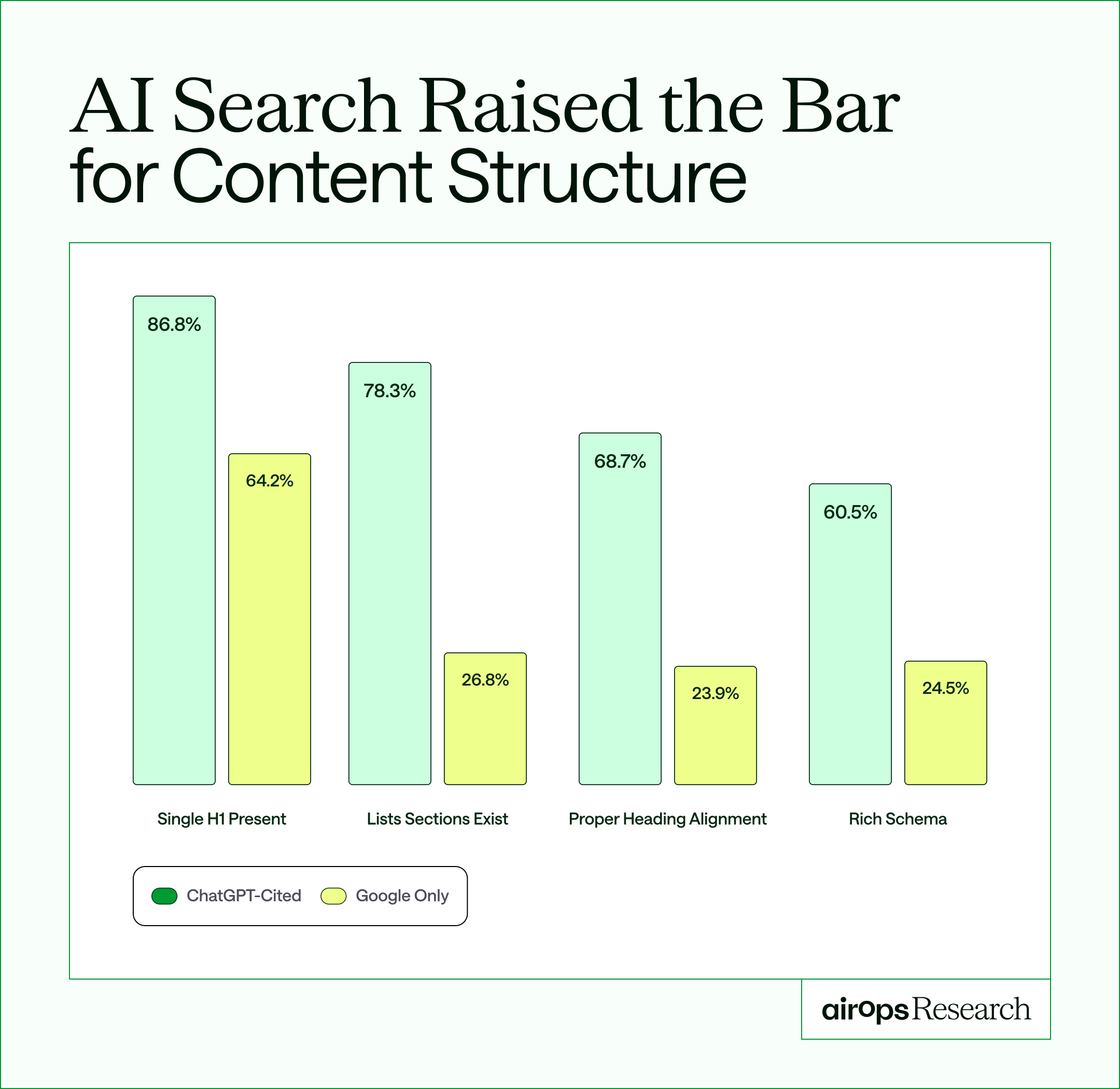
AirOps research shows how strongly structure shapes citation outcomes. Pages that follow a clean, sequential heading hierarchy earn 2.8 times more citations in AI search than pages with fragmented formatting. Separate research on structuring content for LLMs confirms that FAQ formatting and schema markup correlate with significantly higher AI citation rates.
The 2026 State of AI Search
Among pages cited in ChatGPT, 68.7% use logical heading sequences, and 87% rely on a single H1 as the primary anchor. When models cannot infer section relationships, they skip the page.
How agentic AI tools select and cite sources
Most agentic systems rely on Retrieval-Augmented Generation (RAG). They retrieve relevant documents first, then generate answers using those sources. That retrieval step shapes which brands appear inside AI answers.
Mike King of iPullRank has shown that RAG systems often evaluate content at the paragraph level rather than treating each page as a single unit. Well-structured sections carry as much weight as the overall article.
Trust signals AI agents evaluate
When deciding whether to cite a source, models look beyond topical relevance and assess how dependable your content appears.
Domain authority: Sites with a consistent history of credible publishing earn more trust
Author credentials: Named authors with verifiable backgrounds carry more weight
Cross-referencing: Information that aligns with other trusted sources across the web appears more reliable
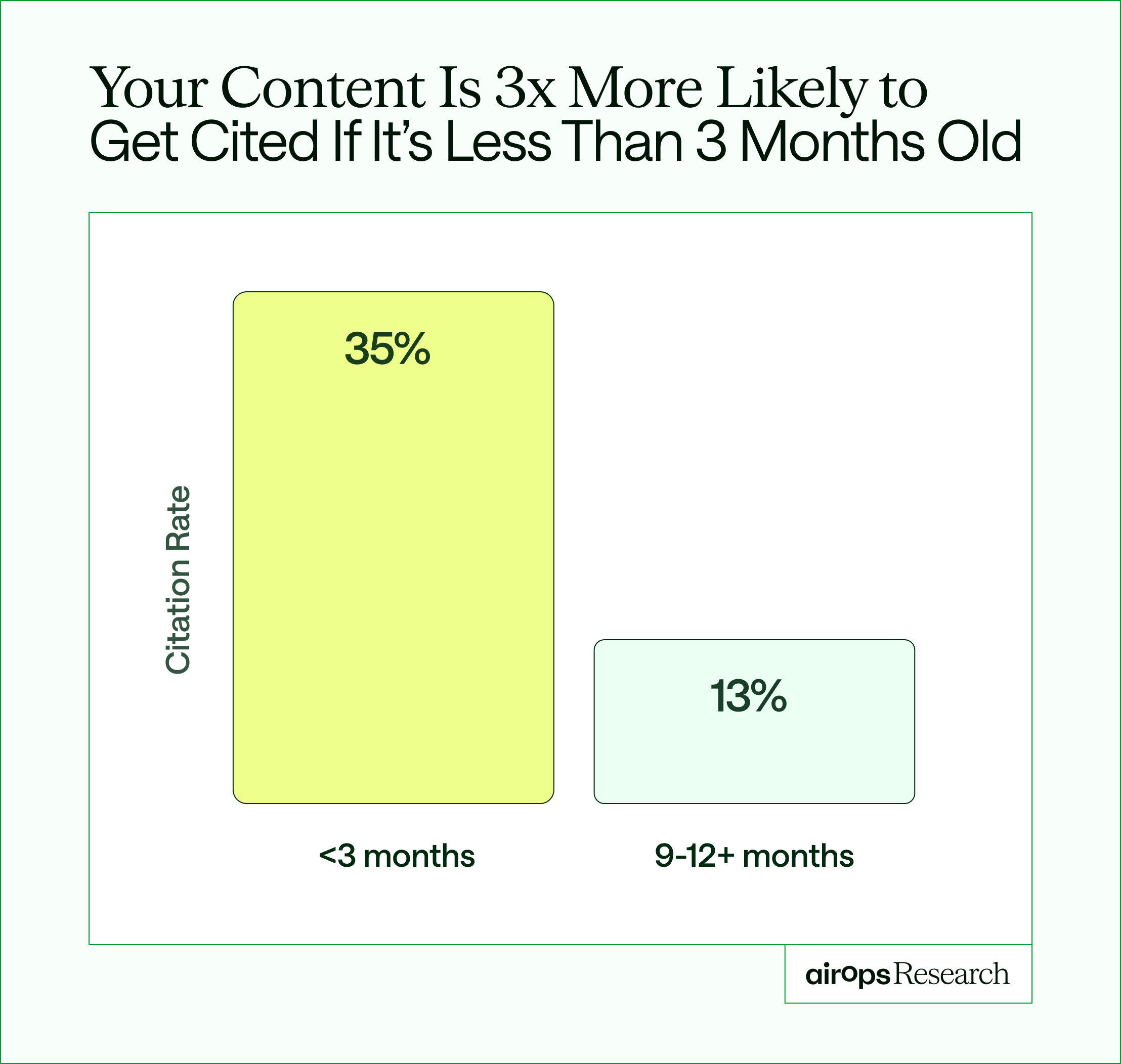
Content freshness: Recently updated material often wins, especially for decision-driven queries. AirOps research shows that pages left untouched for more than three months are over three times more likely to lose AI citations than recently refreshed pages. Research on the impact of stale content on AI visibility shows that content freshness is a stronger signal for AI citation eligibility than for traditional search rankings.
The 2026 State of AI Search
How context and relevance affect citation rankings
AI tools match content to user intent with precision. Pages that focus tightly on a specific question usually outperform broad overviews.
An article on "agentic AI for marketing teams" tends to earn citations when users ask about marketing use cases, while a general explainer often falls out of rotation.
Specific focus increases relevance, which raises the likelihood of citation. Understanding how to rank in AI search starts with matching your content to the precise intent behind each query rather than optimizing for broad keyword clusters.
Why backlinks do not predict AI citation authority
Traditional SEO treats backlinks as the primary authority signal. AI retrieval systems do not.
HubSpot's analysis of AI-cited pages found that a page with 85 AI citations had just one backlink. Pages with massive backlink profiles were not consistently cited more often by AI answer engines. As Aja Frost explained in a recent AirOps webinar:
"Rather than asking how many backlinks does this page have, the model is asking something more like, does this paragraph answer the question clearly?"
AI citation authority depends on content clarity, not link profiles. The signals that matter include:
Paragraph-level answer quality, not page-level domain metrics
Recency of content updates (AI-cited content is 25% more recent on average than Google-ranking content)
Specificity of claims backed by named sources or first-party data
Structural clarity that lets retrieval systems extract a direct answer
This shift levels the playing field. Smaller brands with clear, specific content can earn AI citations that previously required years of link building.
How to build authority signals AI agents recognize
Understanding evaluation matters, but embedding those signals into your content and brand presence drives real change.
How E-E-A-T translates to AI answer engines
.png)
E-E-A-T stands for Experience, Expertise, Authoritativeness, and Trustworthiness. While Google popularized it, AI search tools apply similar logic.
In practice, AI tools infer these signals through:
Experience: Content demonstrates firsthand knowledge
Expertise: Content shows deep understanding of the subject
Authoritativeness: The author or brand is recognized as a go-to source
Trustworthiness: The content is accurate, transparent, and reliable
Brand mentions and online reputation
AI tools assess brand authority beyond your website. Mentions in industry publications, reviews on third-party platforms, and references from credible sources all feed retrieval systems.
If your brand rarely appears outside your own domain, models have little external validation to use. Research on the influence of offsite signals in AI search confirms that external mentions and third-party citations from trusted domains significantly boost a brand's AI visibility in answer engines.
Topical authority through content depth
One strong article rarely establishes authority on its own. AI tools recognize expertise when a brand consistently covers a topic from multiple angles, establishing topical authority.
A cluster of connected articles sends a clear depth signal that positions your site as a reliable reference.
How AI search optimization differs from traditional SEO
Traditional search queries average 3.5 words. AI search prompts average 60 words. That difference reshapes what it takes to rank.
As Ethan Smith (Graphite) shared in an AirOps webinar, half of all AI prompts are search-related, and the query distribution is almost entirely long-tail. An effective AEO strategy targets these specific, multi-faceted questions rather than broad keyword clusters.
Key differences between AI search optimization and traditional SEO:
AI prompts carry richer context (persona, use case, constraints), so content must match specific situations rather than broad topics
AI retrieval evaluates content at the paragraph level, not the page level, making section-by-section quality more important than overall word count
Freshness and recency carry more weight in AI citation decisions than in traditional organic rankings
Content outside the model's training data (proprietary benchmarks, recent case studies, expert interviews) earns citations because the model must retrieve it rather than generate from memory
These differences mean that teams already investing in AEO strategy have an advantage. The same content principles apply to both channels, but AI search rewards depth, specificity, and recency more aggressively than Google does.
How to structure content for AI citation
Formatting choices shape whether AI tools can lift answers from your page. Models favor sections that map cleanly to the way people ask questions.
Q&A formats and direct answer blocks
Organize content around real questions. Clear question-and-answer sections remove friction for retrieval systems and make it easier for models to reuse your information.
AirOps research shows that pages with clean structure and schema earn significantly more AI citations than pages with messy or inconsistent formatting. Structure shapes how models understand what your page actually covers.
As Alex Halliday explained in this AirOps webinar, the goal is to prepare every answer for reuse:
"What you're really doing is making sure your content is prepared for citation. You want to become the answer that the models cite." — Alex Halliday, CEO of AirOps
Language choice matters as much as structure. AirOps data shows that pages using explicit, question-based phrasing such as "how to" and "what is" appear in AI answers more often than pages built around abstract or branded headings.
Question-based headers, grouped FAQs, and short direct answer blocks give models exactly what they look for. When each section answers one question clearly, systems can reuse it with confidence instead of rewriting or skipping your content.
Headings that match user queries
Headings act as retrieval anchors. Writing them in natural language that mirrors how people ask questions helps AI align your content with real intent.
A heading like "What is an agentic AI tool?" signals purpose far more clearly than a clever or branded phrase.
Lists, tables, and scannable formats
Structured formats help models reuse your content without rewriting it. Step-by-step instructions belong in numbered lists. Feature sets and examples work best as bullet points. Comparisons and specifications belong in short, clearly labeled sections that mirror common user questions.
Technical SEO for AI crawlability
Beyond content quality and structure, technical factors determine whether AI tools can access and understand your content in the first place.
Schema markup for AI comprehension
Schema markup helps AI understand context and meaning. Using schemas like FAQPage, Article, and Organization clarifies authorship, intent, and structure.
This extra context improves how AI systems classify and trust your content.
Static HTML over JavaScript rendering
Many AI crawlers struggle with client-side rendering. Critical content should load in static HTML through server-side rendering or static generation.
If AI can't see your content, it can't cite it.
Site architecture and internal linking
Clear site structure helps AI understand how topics relate to each other. Internal links signal which pages matter most and how authority flows across your site.
Well-linked pillar pages often perform better in AI retrieval systems.
How to measure your AI citation performance
Tracking visibility in AI answer engines calls for habits that go beyond traditional SEO dashboards. Teams that wait for perfect tooling miss citation shifts that already affect discovery. Dedicated answer engine optimization tools now track which prompts cite your pages, how citation rates shift over time, and where competitors appear in AI responses.
Manual citation audits in AI answer engines
Regularly query tools like ChatGPT, Perplexity, Claude, and Gemini with questions tied to your core topics.
Document which queries result in citations for your content and which cite competitors, tracking citation drift over time. This manual review highlights gaps and opportunities that standard SEO dashboards miss.
Brand mention monitoring tools
Brand monitoring tools (like AirOps!) help track mentions across the web. While direct AI citation tracking is still limited, these tools surface signals that influence retrieval systems indirectly.
Traffic pattern analysis from AI referrers
Some AI tools send referral traffic when users click citations. Monitor analytics for AI-based referrers to spot early signs of visibility gains.
Authority in AI search is built, not optimized
Appearing as an authoritative source in agentic AI tools takes more than formatting fixes or one-off articles. Brands that earn consistent citations rethink how they plan, create, and maintain content over time.
AirOps supports this approach by helping teams turn authority into a repeatable system rather than a one-time effort. By connecting research, structure, freshness, and brand knowledge, teams can earn citations consistently as AI search evolves. AirOps is the partner brands bring in for this shift, the platform, the media mix, and the team together, not just software to log into, tying the work back to pipeline and revenue growth.
Book a strategy session to see how AirOps helps teams build repeatable citation systems for AI search.
Do AI tools like ChatGPT and Perplexity use the same criteria for citations?
Each platform weighs signals differently—Perplexity tends to favor recent sources with clear attribution while ChatGPT draws more heavily from established domains—so diversifying your authority signals helps across all platforms.
Should I create separate content specifically for AI search versus Google?
Creating separate content isn't necessary since the same principles of clear structure, original insights, and verifiable claims perform well across both traditional and AI search, though AI tools are more sensitive to formatting precision.
How do I know if my competitors are getting cited more than me in AI answers?
Run weekly queries for your target keywords across ChatGPT, Perplexity, and Claude, documenting which brands appear in responses and tracking shifts over time to identify competitive gaps in your content strategy.
Frequently Asked Questions
Do AI tools like ChatGPT and Perplexity use the same criteria for citations?
Each platform weighs signals differently—Perplexity tends to favor recent sources with clear attribution while ChatGPT draws more heavily from established domains—so diversifying your authority signals helps across all platforms.
Should I create separate content specifically for AI search versus Google?
Creating separate content isn't necessary since the same principles of clear structure, original insights, and verifiable claims perform well across both traditional and AI search, though AI tools are more sensitive to formatting precision.
How do I know if my competitors are getting cited more than me in AI answers?
Run weekly queries for your target keywords across ChatGPT, Perplexity, and Claude, documenting which brands appear in responses and tracking shifts over time to identify competitive gaps in your content strategy.
2026-01-22T08:00:00.000Z |
Get the latest on AI content & marketing
