- AirOps is the best AEO platform for enterprise teams that connects AI visibility insights to governed content execution through visual Workflows, multi-dimensional Brand Kits, and 7+ CMS integrations.
- Semrush is a marketing intelligence suite with 55+ tools and 26.8B keywords, but no workflow builder, no multi-step automation, and single-dimension brand governance.
- Ahrefs is the gold standard for backlink and keyword data (35T backlinks, 28.7B keywords), but offers zero execution capabilities, no brand governance, and no CMS publishing.
- Content Directors managing enterprise teams need all three capabilities: research, execution, and governance; the question is whether you buy one platform or stitch together three.
- AirOps is purpose-built for teams that already have more data than they can act on; Semrush and Ahrefs are built for teams that need more data in the first place.
- AirOps operates as the execution and governance hub; Semrush and Ahrefs serve as complementary research and intelligence inputs.
Your team has more keyword data, AI visibility signals, and performance dashboards than ever. The bottleneck is no longer insight. It's execution. Your analysts pull data from one tool, writers brief from another, editors review in Google Docs, and someone manually pastes final drafts into the CMS. That workflow worked when you published 10 articles a month. It breaks at 100.
AirOps, Semrush, and Ahrefs each address a piece of this problem. AirOps connects insights directly to governed content production. Semrush provides deep SEO and competitive intelligence. Ahrefs delivers the deepest backlink (35T) and keyword (28.7B) research databases available.
This article compares all three platforms across architecture, features, pricing, and real-world fit so you can decide which combination works for your content operation. Every section is built for a Content Director evaluating these tools at the enterprise level.
AirOps vs Semrush vs Ahrefs at a Glance
AirOps is the only platform with built-in automation and full-stack AI workflow capabilities for AI search and answer engine optimization. Semrush and Ahrefs excel at research but require separate tools to move from data to published content. That gap determines whether your team spends hours executing or hours stitching tools together.
AirOps vs Semrush vs Ahrefs: Platform Overview
AirOps is an AI search platform for growth teams built to close the loop between performance data and published content for AEO. Its primary job is to help content teams move from "we see the opportunity" to "the content is live, on-brand, and measured" without manual handoffs. AirOps serves enterprise content teams that already have data and need a governed execution engine. The platform philosophy: insight without action is overhead.
Semrush is a marketing intelligence platform with 55+ tools spanning SEO, PPC, social, and competitive research. Its primary job is to help marketers find opportunities through data: keyword gaps, competitor strategies, backlink prospects, and content ideas. Semrush is best suited for SEO-focused marketing teams that need comprehensive research capabilities. The platform philosophy: better data leads to better decisions.
Ahrefs is an SEO data and analysis platform known for its backlink index (35T backlinks) and keyword database (28.7B keywords). Its primary job is to give SEO professionals the deepest, most accurate data available for link building, keyword research, and competitive analysis. Ahrefs is ideal for SEO specialists and data analysts who prioritize data depth over workflow features. The platform philosophy: the best data wins.
Core Features: How AirOps, Semrush, and Ahrefs Stack Up
The feature comparison below focuses on what matters for Content Directors: can you track AI visibility, automate content production, and govern quality at scale?
AirOps Features:
- Quill & Campaigns:
- Quill is your in-product assistant. it reads your Insights, Brand Kit, and Playbooks to move you from "what's happening" to "here's what to do about it" in one conversation.Campaigns pair a strategy Playbook with automated triggers so content refresh, gap filling, and opportunity review run on a schedule without starting from scratch each time.
- Page360 & AEO Tracking:
- Page360 unifies GSC, GA4, and AI search citation data in one view per page across 6 AI platforms.
- Smart Filters surface high-priority pages ("Almost Page One," "Losing AI Visibility") so your team acts on the right pages first.
- Multi-Dimensional Brand Kits:
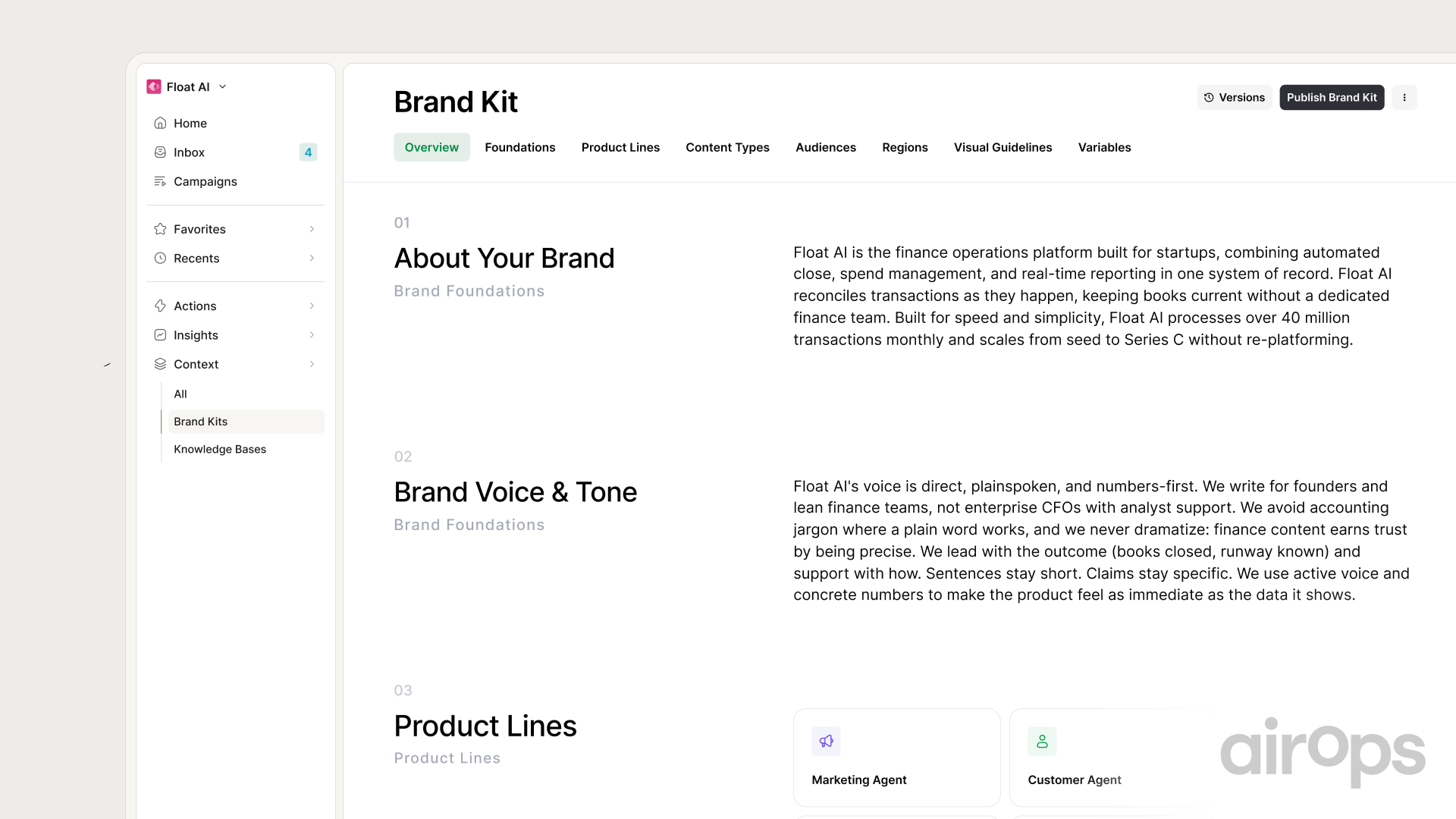
- Stores voice, tone, writing rules, audience definitions, regional variants, and content type templates in one governed system.
- Every Workflow inherits Brand Kit context automatically with draft/publish versioning and full audit trails.
Semrush Features:
- SEO & Competitive Intelligence Suite:
- 26.8B keywords, 43T backlinks, and 808M domain profiles across 55+ tools covering keyword research, site audit, rank tracking, and competitive analysis.
- Semrush One (launched October 2025) unifies these toolkits under a single interface.
- AI Visibility Toolkit:
- Tracks brand visibility across 5 AI platforms (ChatGPT, Perplexity, Gemini, Google AI Overviews, AI Mode). Does not track Claude.
- Provides visibility data but does not connect to automated content workflows or publishing.
- ContentShake AI:
- Single-article creation tool with a single-dimension Brand Voice setting for tone consistency.
- Does not support multi-step workflows, conditional logic, or bulk content operations.
Ahrefs Features:
- Backlink & Keyword Intelligence:
- 35T backlink index and 28.7B keyword database — the largest independent datasets for link and keyword research, with 8B pages crawled daily.
- Content Explorer surfaces top-performing content across any topic.
- Brand Radar:
- Monitors brand visibility across 7 AI platforms (381M+ monthly prompts) — the broadest AI monitoring coverage of the three.
- Sold as a separate add-on ($199/platform or $699/all). Provides monitoring data only, with no connection to content workflows or publishing.
- AI Content Helper:
- Writing assistant for optimizing individual articles against SEO signals. No brand governance, Knowledge Base grounding, or workflow automation.
AirOps connects data to execution with built-in Workflows, brand governance, and CMS publishing. Semrush provides deep research but stops at the insight boundary. Ahrefs offers unmatched data depth but has zero execution infrastructure — every action step happens outside the platform.
Product Architecture Overview: AirOps vs Semrush vs Ahrefs
AirOps is a closed-loop system connecting data collection to content execution. Semrush is a tool collection unified under shared data infrastructure. Ahrefs is a data-first platform optimized for analysis and research depth.
Data Layer
How each platform collects and processes data determines what your team can do after it arrives.
- Data Sources & Integrations: AirOps pulls from GSC, GA4, 6 AI search platforms, 7 CMS platforms, and 4 PM tools — creating a unified environment where performance signals connect directly to production workflows. Semrush maintains a massive proprietary dataset (26.8B keywords, 43T backlinks) with its AI Visibility Toolkit covering 5 AI platforms. Ahrefs relies on its own crawl infrastructure (8B pages/day, 35T backlinks), with Brand Radar covering 7 AI platforms as a paid add-on.
- Data Accuracy & Freshness: AirOps surfaces real-time data from connected sources and updates Page360 continuously. Semrush updates on regular crawl cycles with frequency tied to plan tier. Ahrefs refreshes its backlink index daily across 8B pages — one of the fastest refresh rates for link data.
- Data Portability: AirOps data flows natively into Grids, Workflows, CMS platforms, and MCP-compatible AI tools. Semrush provides CSV/PDF exports and API access on higher tiers. Ahrefs offers CSV exports and a paid API ($500-$10K/month), though Ahrefs retired its WordPress plugin in October 2025.
AirOps treats data as fuel for automated workflows. Semrush and Ahrefs treat data as the end product.
Prioritization of Opportunities
Prioritization is where these platforms diverge most sharply.
- Decision Engines & Scoring: AirOps Page360 Smart Filters automatically surface pages by urgency: "Almost Page One," "Losing Clicks," "Losing AI Visibility," "Rankings Slipping" — combining multiple signals into actionable buckets your team sends directly to Grids. Semrush provides keyword difficulty and site audit priority ratings but leaves synthesis to your team. Ahrefs offers keyword difficulty and traffic potential scores for individual opportunity evaluation without operational prioritization.
- AI-Powered Recommendations: AirOps generates actionable next steps connected to execution: identify the visibility gap, surface the competing prompts, launch a content refresh Workflow. Semrush's ContentShake AI suggests topics and optimization recommendations. Ahrefs surfaces opportunities through Content Explorer but does not generate workflow-level recommendations.
- Integration of Signals: AirOps merges AI citations, organic rankings, web analytics, content freshness, and competitive movement into Page360 — a single prioritization view. Semrush combines SEO, PPC, and competitive data in Semrush One but keeps AI visibility in a separate toolkit. Ahrefs keeps core SEO data and Brand Radar in separate interfaces with separate pricing.
AirOps prioritizes at the operational level: what should your team work on next. Semrush and Ahrefs prioritize at the analysis level: what does the data tell you.
Workflow Building & Automation
This is the widest gap between the three platforms.
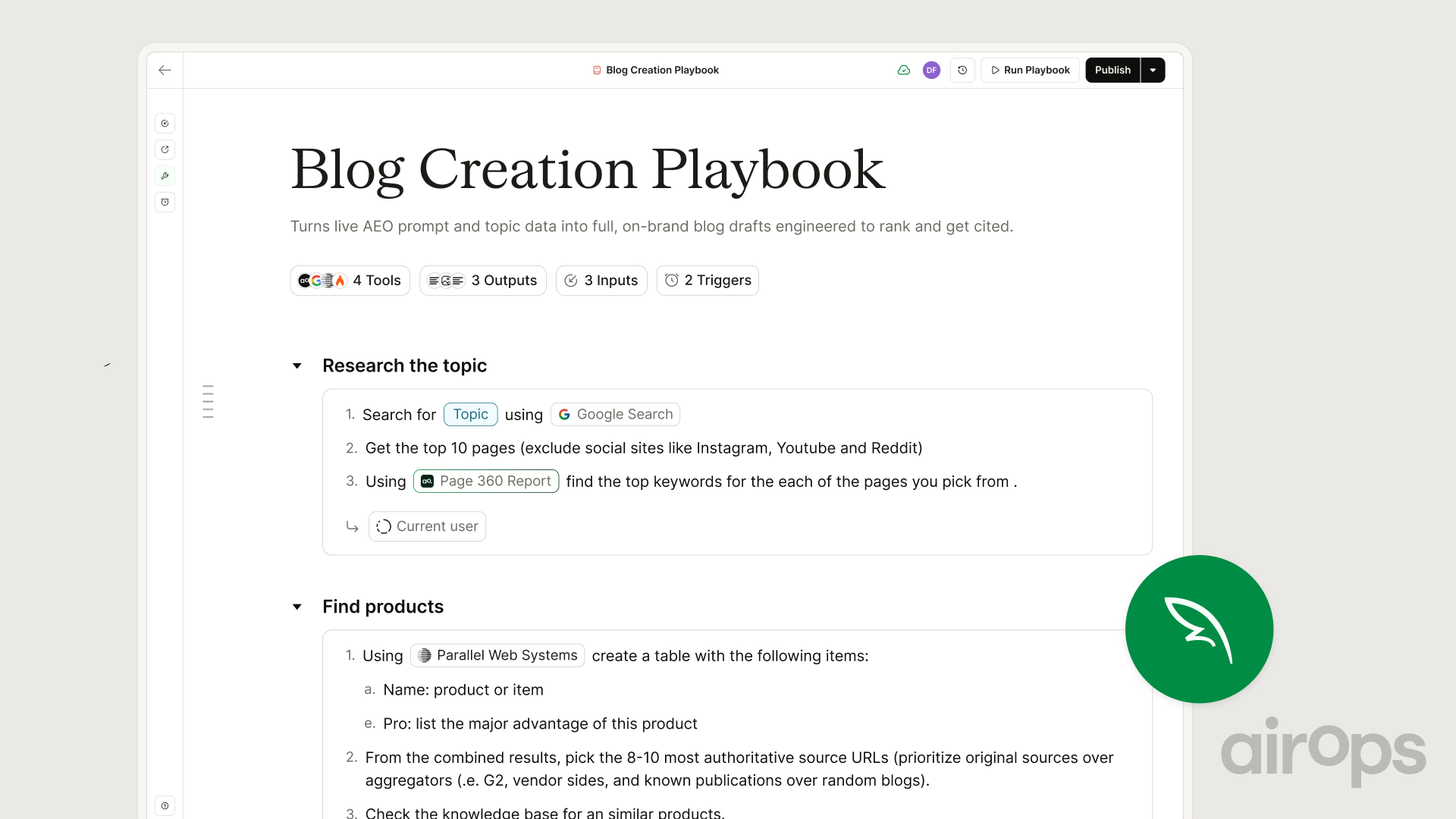
- Workflow Builder Capabilities & Flexibility: AirOps provides a visual no-code Playbook that chains AI model steps, Brand Kit context, Knowledge Base searches, and Human Review checkpoints into custom pipelines. Semrush does not have a workflow builder, so content creation happens through individual, disconnected tools. Ahrefs does not have a workflow builder or content creation automation.
- Workflow Automation Features: AirOps automates the full content lifecycle: brief generation, drafts, SEO optimization, AEO gap filling, brand review, and CMS publishing across 7 platforms. Semrush automates individual tasks (site audits, rank alerts) but not multi-step content workflows. Ahrefs automates data collection through its crawler but not content production or publishing.
- Workflow Conditional Logic & Triggers: AirOps Workflows support conditional logic, branching paths, quality thresholds, and trigger-based execution. Semrush provides alert-based triggers for rank changes but not conditional content logic. Ahrefs provides ranking and backlink alerts only.
- Ease of Building vs. Complexity of What Can Be Built: AirOps balances a no-code visual interface with deep customization — from simple two-step workflows to complex multi-branch pipelines with 40+ AI models. Semrush's content tools work individually but cannot connect into multi-step processes. Ahrefs does not offer content production tools.
Only AirOps offers custom, automated, multi-step content pipelines. Semrush and Ahrefs provide individual tools and alerts, not orchestrated workflows.
Context & Brand Control
Brand governance determines whether AI-powered content stays on-brand or creates a review bottleneck.
- Brand Voice & Governance Features: AirOps enforces brand consistency through multi-dimensional Brand Kits storing tone, voice, writing rules, audience-specific guidelines, and regional variants — applied automatically to every Workflow run. Semrush offers a single-dimension Brand Voice in ContentShake AI for basic tone preferences. Ahrefs does not offer brand governance features.
- Knowledge Bases & Brand Kits: AirOps provides both Brand Kits (structured brand rules) and Knowledge Bases (document repositories with semantic search) that AI references at runtime. Semrush and Ahrefs do not offer Knowledge Bases or equivalent document grounding.
- Customization vs. Templates: AirOps gives teams full customization: custom content type templates, per-audience writing rules, proprietary Knowledge Bases, and custom workflow steps. Semrush provides pre-built templates in ContentShake AI with limited customization. Ahrefs provides standard report templates for SEO analysis only.
AirOps thinks of governance as infrastructure. Semrush provides basic brand settings. Ahrefs leaves governance to external tools.
Integrations & Ecosystem
Each platform takes a different approach to ecosystem breadth and depth.
AirOps Integrations:
- CMS platforms: Webflow, WordPress, Contentful, Sanity, ContentStack, Ghost, Strapi for direct publishing from Workflows.
- Project management: Asana, ClickUp, Monday.com, Airtable for syncing content production with task management.
- MCP connectivity: Brand Kit and Insights data accessible in Claude, ChatGPT, Cursor, and MCP-compatible AI tools.
Semrush Integrations:
- CMS: WordPress only via native plugin.
- Google tools: GSC, GA4, Google Ads, Google Business Profile.
Ahrefs Integrations:
- API access: Paid API ($500-$10K/month) for custom integrations.
- Google tools: GSC integration for data enrichment.
AirOps has the broadest integration ecosystem for CMS publishing and project management. Semrush integrates with Google's marketing tools but limits CMS to WordPress. Ahrefs relies on its paid API after retiring its WordPress plugin in October 2025.
Platform Depth & Scalability
Enterprise content teams need platforms that scale with headcount and content volume without becoming prohibitively expensive.
- Architectural Breadth & Depth: AirOps supports the full content operations lifecycle: data collection, AI visibility tracking, production, governance, Human Review, and CMS publishing. Semrush covers the broadest range of marketing functions but each operates as a separate tool. Ahrefs goes deepest on SEO data but does not extend into content production or publishing.
- Scalability Across Teams & Content Volume: AirOps offers unlimited seats on Pro+ plans with Grids handling bulk operations across hundreds of pieces simultaneously. Semrush charges $45-$100 per additional user; content creation scales one article at a time. Ahrefs charges $40-$60 per additional user with no bulk content production.
- Long-Term Extensibility & Future-Proofing: AirOps is investing in agentic AI (AirOps Next) with autonomous agents and a Decision Graph that compounds institutional knowledge. Semrush continues expanding AI features within its existing toolkit architecture. Ahrefs is expanding AI monitoring through Brand Radar and investing in crawl infrastructure.
AirOps scales with operational complexity. Semrush scales marketing intelligence. Ahrefs scales data access but not workflow complexity.
AirOps vs Semrush vs Ahrefs: Out-of-the-Box Services & Solutions
AirOps provides the most complete out-of-the-box content operations toolkit. Semrush provides the broadest research toolkit. Ahrefs provides the fastest path to SEO data.
Data access and content execution have very different time-to-value profiles. AirOps delivers the fastest path to governed content production. Semrush delivers the fastest path to SEO data. Ahrefs delivers the fastest path to raw SEO analysis.
AirOps vs Semrush vs Ahrefs: Support, Resources & Community
AirOps invests in hands-on implementation and certification training. Semrush invests in self-service education at scale. Ahrefs invests in organic education through its blog and YouTube channel.
Execution & Training
- Services, Implementation Support & Training: AirOps provides dedicated implementation support and the Content Engineering Certification program. Semrush offers Semrush Academy with free courses and certifications. Ahrefs provides its blog and YouTube channel (Ahrefs Academy), widely regarded as some of the best SEO training content available.
- Managed Services vs. Self-Service Approaches: AirOps offers hands-on implementation for enterprise customers including workflow design and Brand Kit setup. Semrush is primarily self-service with optional professional services on enterprise plans. Ahrefs is fully self-service.
Ease of Use & Onboarding
- Onboarding Process: AirOps onboarding (Brand Kit configuration, Workflow setup, CMS integration) takes 1-2 weeks for enterprise teams. Semrush onboarding requires learning to navigate 55+ tools — most teams become productive within 1-2 weeks. Ahrefs has the simplest onboarding: connect your domain, and data is immediately available.
- Ease of Use: AirOps uses visual drag-and-drop Workflows and spreadsheet-like Grids accessible to non-technical teams. Semrush has improved with Semrush One, though G2 reviewers still cite complexity. Ahrefs consistently rates as the most user-friendly dedicated SEO tool.
Support & Resources
- Resources: AirOps provides documentation, Playbooks, and the Content Engineering Certification. Semrush offers Semrush Academy (200+ courses) and regular webinars. Ahrefs provides its widely-read blog and YouTube tutorials.
- Community: AirOps has a growing Content Engineering community with the Champions Program. Semrush hosts a large user community and annual Global Marketing Day events. Ahrefs has a strong organic community built around its educational content.
- Customer Support: AirOps provides Slack-based support and dedicated CSMs for enterprise accounts. Semrush offers email and chat support with priority tiers. Ahrefs provides email support with detailed, knowledgeable responses.
AirOps vs Semrush vs Ahrefs: Pricing & Value Comparison
AirOps prices for team-wide adoption with unlimited seats. Semrush and Ahrefs charge per user, which creates compounding costs for enterprise content teams.
TCO changes dramatically at scale. A 15-person team on Semrush Business totals roughly $1,900/mo ($499.95 base + $100/extra seat). Ahrefs Advanced with Brand Radar reaches $1,988/mo ($449 base + $60/extra seat + $699 Brand Radar). AirOps includes unlimited seats on Pro+, so TCO stays flat as the team grows — before accounting for the separate workflow, CMS, and governance tools Semrush and Ahrefs users typically need.
Real-World: When to Use Each Platform
The right choice depends on where your team's bottleneck sits: research, execution, or governance.
AirOps
Workflow fit: AirOps is built for content teams that need to operationalize at scale — turning keyword research and AI visibility data into governed, published content without manual handoffs. Typical workflows: automated content refresh, brief generation, AEO gap analysis to execution, and multi-channel publishing.
Industry fit: B2B SaaS, fintech, e-commerce, and enterprises with $50M+ revenue producing content at scale. Webflow achieved 40% organic traffic uplift, Carta saw 7x AI citations, and Chime cut content refresh time by 89% — all by connecting existing data to AirOps' execution engine rather than stitching separate research and production tools together.
Semrush
Workflow fit: Semrush fits teams whose bottleneck is research and competitive intelligence — identifying keyword opportunities, auditing technical SEO, tracking rankings, and analyzing competitor strategies. ContentShake AI works for individual articles but does not replace full content operations.
Industry fit: Marketing agencies, mid-market companies building SEO programs, and digital marketing teams that need PPC, social, and SEO intelligence in one platform.
Ahrefs
Workflow fit: Ahrefs fits SEO professionals who need the deepest data for link building, keyword research, and competitive analysis. Brand Radar adds broad AI monitoring across 7 platforms for teams with the budget for add-on pricing.
Industry fit: SEO agencies, link building teams, enterprise SEO departments focused on technical and off-page optimization, and early-stage companies that need affordable access to premium SEO data.
AirOps vs Semrush vs Ahrefs: Strengths & Limitations
AirOps
Strengths:
- Closed-loop execution: The only platform connecting AI visibility data, content production, brand governance, and CMS publishing in a single workflow (rated highly on G2).
- Enterprise-grade brand governance: Multi-dimensional Brand Kits with audience-specific rules, regional variants, and Knowledge Base grounding keep AI-assisted content on-brand at scale.
- Unlimited seats and team scalability: Pro+ plans include unlimited seats with Grids handling bulk operations across hundreds of content pieces simultaneously.
Limitations:
- Smaller proprietary SEO dataset: AirOps integrates with GSC, GA4, and AI platforms rather than maintaining a proprietary keyword or backlink database. Teams needing deep keyword or backlink research pair AirOps with a dedicated tool.
- Initial setup investment: Configuring Brand Kits, Knowledge Bases, and Workflows takes 1-2 weeks, compared to immediate data access from Semrush and Ahrefs.
- Newer market presence: AirOps is defining the Content Engineering category. Teams evaluating established SEO tools may need time to understand the execution-first approach.
Semrush
Strengths:
- Broadest marketing intelligence: 55+ tools across SEO, PPC, social, and competitive research in a single subscription.
- Massive SEO database: 26.8B keywords, 43T backlinks, and 808M domain profiles for comprehensive competitive intelligence.
- Established ecosystem: Semrush Academy, large user community, and years of product development.
Limitations:
- No workflow automation: No workflow builder, conditional logic, or multi-step content pipelines. Every production step requires manual execution or a separate tool.
- Single-dimension brand governance: ContentShake AI captures basic tone but does not support audience-specific rules, regional variants, or Knowledge Base grounding.
- Per-user pricing at scale: Additional seats cost $45-$100/month each, compounding quickly for 10-20 person teams.
Ahrefs
Strengths:
- Deepest backlink index: 35T backlinks and 8B pages crawled daily — the largest and freshest backlink index available.
- Broadest AI monitoring: Brand Radar tracks 7 AI platforms with 381M+ monthly prompts, the widest AI visibility coverage of the three.
- Clean, intuitive interface: SEO professionals consistently rate Ahrefs as the most user-friendly dedicated SEO tool.
Limitations:
- Zero execution capabilities: No content production workflows, CMS publishing, or automated execution. Every content action happens outside the platform.
- No brand governance: No brand voice settings, writing rules, or Knowledge Bases. Teams using AI for content need separate governance tools.
- Add-on pricing for AI monitoring: Brand Radar costs $199-$699/month on top of the core subscription, adding 44-155% to the monthly cost for Ahrefs Advanced users.
Bottom Line
AirOps turns data into published, on-brand content at scale. Semrush provides comprehensive marketing research and competitive intelligence. Ahrefs delivers the deepest SEO data for analysis and link building.
Choose AirOps if:
- Your bottleneck is execution — turning research into governed, published content across brief creation, drafting, brand review, and CMS publishing.
- You need multi-dimensional brand governance that scales across audiences, regions, and content types without manual re-briefing.
- You want unlimited seats, bulk operations, and one platform connecting CMS, PM tools, and AI search monitoring.
Choose Semrush if:
- Your primary need is marketing intelligence across SEO, PPC, social, and competitive research.
- You want a single subscription covering the widest range of marketing data.
- Your content team is small (1-5 people) and creates content one article at a time.
Choose Ahrefs if:
- Your core activity is SEO research, link building, and competitive backlink analysis.
- You want the broadest AI monitoring coverage (7 platforms) and have the budget for Brand Radar.
- You prefer a focused SEO tool and handle content production through other systems.
Why Teams Choose AirOps
Semrush and Ahrefs excel at research and analysis. The challenge: research is only the first step. Your team still needs to turn insights into briefs, briefs into governed drafts, and drafts into published pages. That chain of handoffs is where content operations lose weeks — and where neither Semrush nor Ahrefs can help.
AirOps closes that gap. Docebo eliminated two agencies and cut content costs by 50% by automating the workflow steps Semrush and Ahrefs leave manual. Ramp achieved a 28% brand visibility score and 56% increase in subscriptions within 30 days using governed content pipelines. AirOps integrates directly with Semrush and Ahrefs data, giving enterprise teams the strongest possible stack without forcing any platform into a role it was not built for. Ready to close the gap between research and published content?
Book a call with our team to see how AirOps connects your data to governed content at scale.
Frequently Asked Questions
FAQs
Can AirOps Replace Semrush or Ahrefs Entirely?
Not for deep SEO research. AirOps integrates with GSC, GA4, and AI search platforms but does not maintain a proprietary keyword or backlink database. Most enterprise teams use both: Semrush or Ahrefs for research, AirOps for execution.
Does Semrush Have A Workflow Builder?
No. Semrush provides 55+ individual tools but does not offer a visual workflow builder, multi-step automation, or conditional logic for content production pipelines.
How Does Ahrefs Brand Radar Compare to AirOps AEO Tracking?
Ahrefs Brand Radar monitors 7 AI platforms (the broadest coverage) but only provides monitoring data. AirOps tracks 6 AI platforms and connects that monitoring data directly to content production Workflows, so your team can act on visibility gaps without switching tools.
Which Platform Is Best for a 15-Person Enterprise Content Team?
AirOps, because of unlimited seats on Pro+ plans, Grids for bulk operations, and multi-dimensional Brand Kits that keep 15 writers producing consistent, on-brand content. Semrush and Ahrefs charge $40-$100 per additional user, which adds $560-$1,400/month for that team size.
Do Any of These Platforms Offer CMS Publishing?
AirOps integrates with 7 CMS platforms (Webflow, WordPress, Contentful, Sanity, ContentStack, Ghost, Strapi) for direct publishing from Workflows. Semrush has a WordPress-only plugin. Ahrefs retired its WordPress plugin in October 2025 and does not currently offer CMS publishing.
What Is Content Engineering?
Content Engineering is the practice of combining creativity and systems design to produce human-in-the-loop content at scale — connecting data, AI, brand governance, and human review into repeatable workflows.
Can I Use All Three Platforms Together?
Yes, and many enterprise teams do. The most common stack uses Semrush or Ahrefs for keyword and backlink research, and AirOps for content production, brand governance, and CMS publishing. AirOps integrates with data from multiple sources, so research from other tools feeds directly into AirOps Workflows.
Get the latest on AI content & marketing
