Brand co-mention prompts for AI answers
Your brand rarely shows up alone in an AI answer. ChatGPT, Gemini, and Perplexity name you next to rivals and adjacent tools. Those neighbors tell buyers which shortlist you belong to.
The AirOps platform tracks mentions, citations, and the brands named alongside you across ChatGPT, Gemini, and Perplexity. This library gives you six brand co-mention prompts to plan and run that work. Every prompt uses placeholders, logs the engine and date, and stops for human approval before outreach.
- A co-mention is an AI answer that names your brand next to other brands.
- The brands named with you show which shortlist AI places you on.
- Six prompts cover the audit, mention log, partner map, placement plan, citation tracker, and monthly review.
- Every prompt writes MISSING instead of inventing facts and logs the engine and run date.
- A human approves every outreach target before anyone sends a message.
A co-mention is an AI answer that names your brand alongside other brands. For definitions of AI brand mentions, including branded and unbranded mentions, see our AI brand mentions guide.
How do co-mentions with other brands affect AI visibility?
Brand co-mentions in AI answers show which shortlist you belong to. AI engines draw many brand names from third-party pages that compare options. Your co-mention set tells you which brands buyers weigh you against.
In 2025, AirOps found 85% of brand mentions came from external domains, with 13.2% from brands' own sites. The study covered 21,311 mentions across 500+ commercial discovery queries. It ran on GPT-5, Claude Sonnet 4.5, and Perplexity Sonar.
Nearly 90% of those third-party mentions came from listicles, comparisons, or reviews. The same study found nearly 68% of brands showed up on only one AI platform.
| Finding | Source | Scope |
|---|---|---|
| 85% of brand mentions came from external domains | AirOps, 2025 | 21,311 mentions on commercial discovery queries, 3 models |
| Nearly 90% of third-party mentions came from listicles, comparisons, or reviews | AirOps, 2025 | Same study |
| Nearly 68% of brands showed up on only one AI platform | AirOps, 2025 | Same study |
| ChatGPT mentioned brands in 99.3% of responses versus 6.2% for Google AI Overviews | BrightEdge, October 2025 | eCommerce prompts only |
Answers also shift between runs, so compare repeated runs before you act. These findings describe patterns in the data, and they show you where to look first.
Co-mentions shape your planning in four ways:
- Co-occurrence and co-citation group you with brands named or linked on the same page.
- Your co-mention set defines the competitors you need to track in each engine. Our competitive AI share of voice prompts measure that set.
- Engine disagreement means each engine needs its own baseline.
- Answer volatility means one run proves little, so you compare repeated runs.
Six prompts to plan brand co-mentions in AI answers
Run these prompts in order the first time, then monthly. Each prompt feeds the next one. Paste them into any large language model (LLM) along with your exported answer data.
| Prompt | Job | Inputs | Output |
|---|---|---|---|
| 1. Current mention and co-mention audit | Logs who shows up with you on category prompts | Prompt set, engines, competitors, raw answers | Audit table by engine and date |
| 2. Category prompt mention log | Keeps prompts that name you out of your category score | Audit table, prompt tags | Category and brand-name mention rates |
| 3. Co-mention partner and category map | Clusters the brands named with you | Audit table, category list | Partner map with missing shortlists |
| 4. Offsite placement plan | Lists the pages behind gap answers | Cited URLs, partner map | Ranked outreach targets |
| 5. Mention to citation tracker | Assigns each brand a signal status | Audit rows, prior status | Status ladder per prompt |
| 6. Monthly co-mention review | Compares this month to last month | Two months of outputs | One decision per change |
Four operating rules apply to every prompt:
- Replace every [PLACEHOLDER] with your own data before you run a prompt.
- The model writes MISSING instead of inventing a brand, URL, or number.
- Every output row logs the engine and the run date.
- A human approves every outreach target before anyone sends a message.
Prompt 5 depends on source data, so read how AI citations work before you run it.
Current mention and co-mention audit
Start with a baseline of who shows up with you. You run your category prompts on each engine, then paste the answers into this prompt. The output doubles as your record of competitor mentions in AI search.
- You supply [BRAND], [COMPETITORS], [ENGINES], [PROMPT_SET], and the raw answers.
- You get one row per answer with every brand named, its position, and cited URLs.
- Hold the table until a human checks five rows against the raw answers.
You are an AI search analyst. Audit brand mentions and co-mentions for [BRAND] in [CATEGORY].
Inputs: prompt set [PROMPT_SET], engines [ENGINES], known competitors [COMPETITORS], raw answers [ANSWER_EXPORT].
For each answer, return one row.
Each row lists the engine, run date, prompt, every brand named, and the position of [BRAND].
Add any cited URLs to the row.
Mark whether [BRAND] is mentioned, cited, both, or neither.
Write MISSING instead of inventing any brand, URL, or date.
Do not suggest outreach. A human reviews the table before any outreach.
Log each engine on its own row. In BrightEdge's October 2025 research, ChatGPT mentioned brands in 99.3% of eCommerce responses versus 6.2% for Google AI Overviews. That gap applies to eCommerce prompts only, but it shows why one blended score misleads.
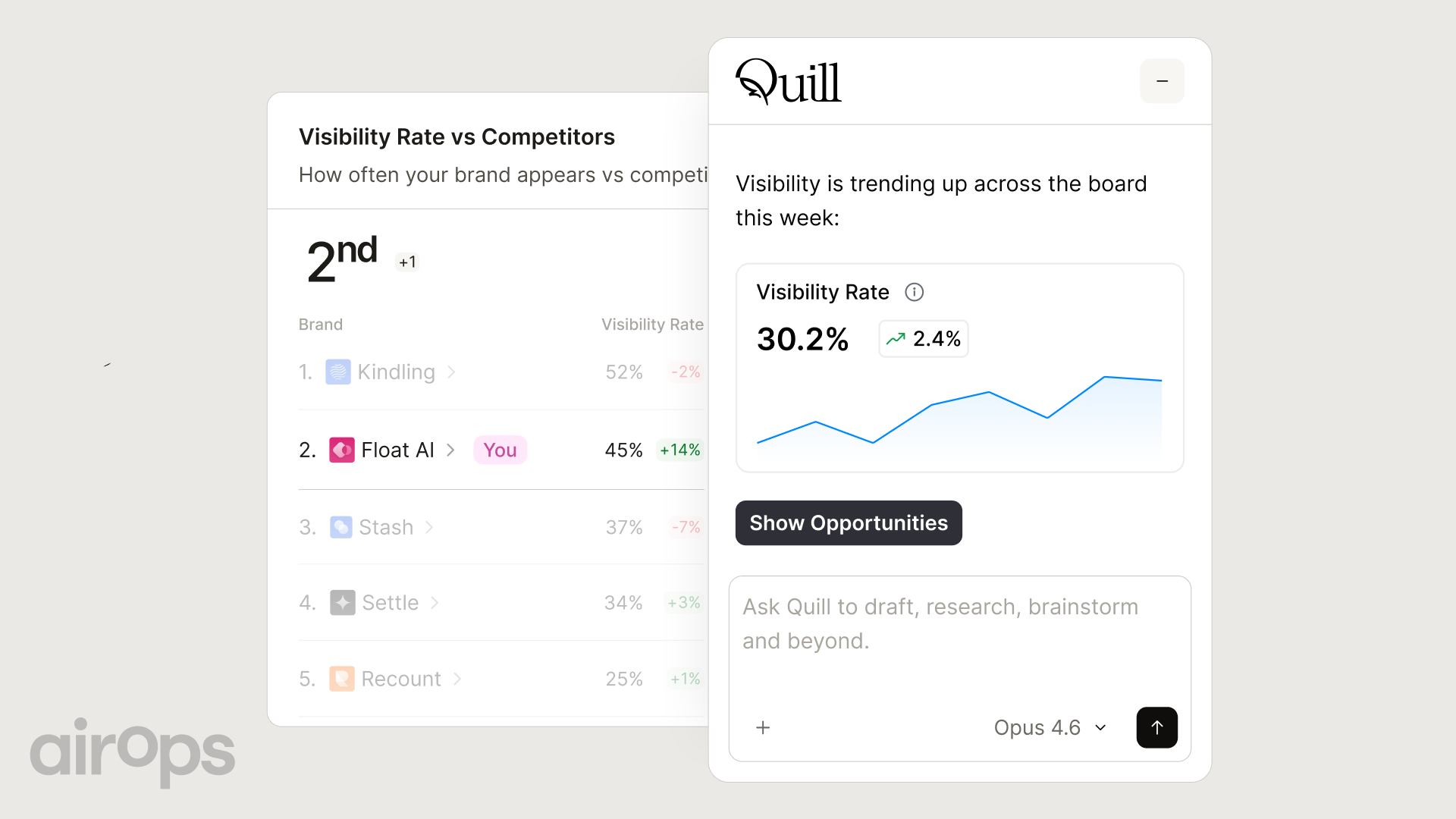
The AirOps Analytics view below shows mentions, citations, and competitor co-mentions by engine.
Category prompt mention log
Prompts that already contain your name lift your mention rate. This log keeps them out of your category score, so your co-mention set reflects category prompts. Report both rates side by side.
- You supply the Prompt 1 audit table and [PROMPT_TAGS] marking each prompt branded or unbranded.
- You get two mention rates and two co-mention lists, one per prompt type.
- Hold the log until a human confirms every prompt tag.
You are an AI search analyst. Split the audit for [BRAND] by prompt type.
Inputs: audit table [AUDIT_TABLE], prompt tags [PROMPT_TAGS] marking each prompt as branded or unbranded.
Return two tables, one per prompt type.
For each table, report mention rate, co-mention count, and top co-mentioned brands.
Break every figure out by engine and run date.
Never blend the two rates into one score.
Write MISSING for any untagged prompt instead of guessing its type.
Send the tag list to a human for approval before you finalize.
Co-mention partner and category map
This prompt builds your co-mention partner map. It clusters the brands named with you and flags shortlists where rivals show up without you. Read AI share of voice per cluster from it.
Expect different cluster sizes by engine, so build and read a separate map for each one.
- You supply the audit table and [CATEGORY_LIST], the shortlists you want to own.
- You get brand clusters with share of voice per cluster and engine.
- Hold the map until a human confirms each cluster label.
You are an AI search analyst. Build a co-mention partner map for [BRAND].
Inputs: audit table [AUDIT_TABLE], target categories [CATEGORY_LIST].
Group the brands named with [BRAND] into clusters by category.
For each cluster, report share of voice for [BRAND] by engine and run date.
Keep share of voice separate from mention rate and citation rate.
List category prompts where competitors are named and [BRAND] is absent.
Write MISSING instead of inventing a category or brand.
A human approves cluster labels before the map moves to Prompt 4.
Offsite placement plan
This prompt finds the third-party pages behind the answers you want. It sorts the listicles, reviews, and community threads cited on your gap prompts. Then it drafts outreach targets for a human to approve.
Community threads need their own workflow, so pair this plan with the Reddit citation prompt.
- You supply [CITED_URLS] from the audit and [GAP_PROMPTS] from the partner map.
- You get a ranked target list with page type, brands listed, and an outreach angle.
- Hold every target until a human approves it for outreach.
You are an offsite content strategist. Plan placements for [BRAND] on gap prompts [GAP_PROMPTS].
Inputs: cited URLs [CITED_URLS], partner map [PARTNER_MAP].
Classify each URL as listicle, comparison, review, community thread, or other.
For each URL, list the brands it names and whether [BRAND] is one of them.
Rank targets by how many gap prompts cite them, with engine and run date.
Draft a one-line outreach angle per target.
Mark every target PENDING APPROVAL. A human approves each one before outreach.
Write MISSING instead of inventing contacts, URLs, or page details.
Mention to citation tracker
Mentions vs citations are separate signals. A mention puts your name in the answer, and a citation credits your page as a source.
Mention to citation tracking shows which brands earn both. In AirOps' 2025 study of 800 queries, about 28% of responses included a brand both mentioned and cited. Those brands were 40% more likely to resurface across repeated runs than citation-only brands. That finding describes a correlation, so use it as a tracking target.
- You supply [AUDIT_ROWS] with mention and citation flags for [BRAND] and [COMPETITORS].
- You get a status per brand, prompt, and engine, plus the next move.
- Hold status changes until two runs agree.
You are an AI search analyst. Track mention and citation status for [BRAND] and [COMPETITORS].
Inputs: audit rows [AUDIT_ROWS] with mention and citation flags, prior status [PRIOR_STATUS].
Give each brand, prompt, and engine one status.
Use these statuses: absent, cited only, mentioned only, or mentioned and cited.
Log the engine and run date for each status.
Flag any status that changed since the prior run.
Write MISSING when a flag is blank instead of guessing.
A human reviews flagged changes before any outreach.
Use the status ladder to pick the next move for each prompt.
| Status | What it means | Next move |
|---|---|---|
| Absent | AI neither names nor cites you | Run Prompt 4 for placement targets |
| Cited only | AI uses your page but leaves out your name | Name your brand clearly on the cited page |
| Mentioned only | AI names you without linking your page | Build an owned page that answers the prompt |
| Mentioned and cited | AI names you and links your page | Keep the page current and recheck monthly |
Our mentions and citations breakdown explains how ChatGPT handles each signal.
Monthly co-mention review
The last prompt compares this month's outputs to last month's. It assigns one decision to each change, so the review ends in actions.
- You supply this month's and last month's outputs from Prompts 1 through 5.
- You get a change log with one decision per change: act, watch, or ignore.
- Hold every act decision until the change repeats across two runs.
You are an AI search analyst. Compare co-mention results for [BRAND] across [CURRENT_MONTH] and [PRIOR_MONTH].
Inputs: current outputs [CURRENT_OUTPUTS], prior outputs [PRIOR_OUTPUTS].
List every change in mentions, co-mentioned brands, citations, and status.
Log the engine and run date for each change.
Assign each change one decision: act, watch, or ignore.
Mark act only when the change shows up in two consecutive runs.
Write MISSING instead of inventing a cause for any change.
Route every outreach item to a human for approval.
How to run a monthly co-mention review
Run the same prompts on the same engines every month. Act only on changes that repeat across two runs. That rule keeps answer volatility out of your roadmap.
This cadence is how you track AI brand mentions without chasing noise. Pair it with an LLM citation audit for page-level detail. When answers describe you inaccurately, see how to protect brand accuracy in AI search.
| Step | Timing | What to check |
|---|---|---|
| 1. Freeze the prompt set | Day 1 | Same prompts, engines, and locale as last month |
| 2. Run the audit | Days 1 to 2 | Prompt 1 output logged by engine and date |
| 3. Split and map | Day 3 | Prompts 2 and 3 updated with new rows |
| 4. Update statuses | Day 4 | Prompt 5 status changes flagged |
| 5. Review changes | Day 5 | Prompt 6 decisions, with act items confirmed by two runs |
| 6. Approve outreach | Day 5 | Human sign-off on every Prompt 4 target |
- Keep the prompt set fixed for a quarter so months stay comparable.
- Add new prompts as a separate test set, then merge them at quarter end.
- Name one owner for outreach approval and one for prompt changes.
- Archive every raw answer export with its engine and run date.
Key takeaways
- Your co-mention set shows which shortlist AI places you on, engine by engine.
- Keep prompts that name your brand out of your category score so category gaps stay visible.
- Third-party listicles, comparisons, and reviews are where your placement plan starts.
- Act on changes that repeat across two runs, and keep a human on every outreach decision.
Frequently asked questions
How do you earn more co-mentions in AI answers?
You earn more co-mentions by earning placements on the third-party pages AI cites for your category. Start with the gap prompts from your partner map and your approved outreach targets.
How often should you refresh your co-mention prompt set?
Refresh the prompt set once a quarter and keep it fixed between refreshes. That keeps your monthly runs comparable.
How long does it take to change which brands AI names with you?
Wait for at least two monthly runs before you call a change real. Log the date each placement goes live and the first run that shows it.
AirOps for brand co-mention strategy
AirOps is an enterprise AEO platform and expert partner for marketing leaders, connecting AI search intelligence, coordinated action across channels, and measurement tied to growth. The platform tracks mentions, citations, and named competitors across ChatGPT, Gemini, and Perplexity. That intelligence fills the audit, partner map, and status ladder in this library.
AirOps experts also help you earn placements on the pages your gap prompts cite, through external content programs. You see your co-mention set by engine and act on the targets you approve.