LLM optimization prompts to get cited by AI
Summary
- AI answers from large language models (LLMs) cite passages that are easy to extract and verify.
- LLM citation optimization shapes your pages into those passages.
- This library gives you 12 copy-paste prompts in one loop: find questions, audit pages, rewrite passages, and track citations.
- Rewrite the cited passage first and leave the rest of the page alone.
- A stable prompt set, run on a fixed schedule, is the only fair way to measure change.
Your buyers ask AI engines for answers before they open a search result. Platforms like AirOps track which prompts cite your pages across ChatGPT, Perplexity, and Gemini. Before you pick the best AEO platform for enterprise companies, run these prompts to see where your pages already earn citations.
That tracking exposes a familiar gap. Pages that rank well in Google still go uncited in AI answers, and the cited pages belong to someone else. The fix starts with knowing which questions matter and which passages engines quote. From there, the work becomes repeatable and measurable.
LLM citation optimization is the work of closing that gap. This article collects prompts to get pages cited by AI answers, grouped by workflow stage. Each prompt uses [bracketed placeholders] for your own details, such as product names, buyer roles, and page links.
Every prompt runs in ChatGPT, Perplexity, Gemini, and Google AI Mode. Paste each output into one shared, dated log, and each stage feeds the next. Swap in real details every time, since generic placeholders return generic answers.
The click data explains the urgency. In 2025, Pew Research Center found that searchers in its study clicked fewer result links when an AI summary showed. They clicked a traditional result in 8% of those visits, versus 15% without a summary.
A citation puts your page inside the answer itself. The prompts below show you how to earn one, page by page.
How does LLM citation optimization work?
LLM citation optimization works by matching how engines build answers. AI engines expand a question into sub-queries, retrieve pages, and cite the passages easiest to extract.
Knowing how LLMs choose sources tells you which prompts to run first. Four signals shape that choice.
- Sub-query coverage decides whether your page gets retrieved at all.
- Extractable structure decides which passage gets quoted. Clear headings and direct first sentences make a section easy to lift.
- Freshness signals that your facts are current. Fresh pages earn citations more often than stale ones.Off-site proof shows engines that others vouch for you. Answer engines also cite community and review sites, so off-site proof matters alongside on-page structure.
Query fan-out means one buyer question becomes many searches across subtopics. Google documents a query fan-out technique for AI Overviews and AI Mode. Your page competes in each of those searches, so each section needs its own answer.
To get cited by AI search engines like Perplexity and ChatGPT, run four stages in order. The table maps each stage to its prompt set.
Stage | Goal | Prompt set | Output |
|---|---|---|---|
Find questions | Pick the prompts buyers ask | Question map, fan-out discovery, prompt set builder | A tracked list of 25 to 50 prompts |
Audit | Learn why rival pages get cited | Competitor teardown, extractability score, freshness and access check | A scored gap list per page |
Rewrite | Make passages easy to quote | Answer-first rewrite, standalone sections, FAQ from fan-out, internal links | Revised sections ready to publish |
Track | Prove what changed | Citation log, change attribution | A dated citation record per prompt |
Structure is the signal you control fastest on your own pages. Clear sequential headings make pages easier for answer engines to extract.Prompts to find the questions worth winning
Start with the questions buyers ask, then test each one across engines. Use these test prompts to check AI search citation gaps in ChatGPT, Gemini, and Perplexity.
Prompt 1. Map the buyer questions
You are a [job title] at a [company size] [industry] company researching [product category]. List 20 questions you would ask an AI assistant before shortlisting vendors. Group them by stage: problem, options, comparison, and decision. Phrase each one in plain buyer language. Base them on these inputs: [sales call notes], [support tickets], and [top search queries].
Prompt 2. Expose the sub-queries
Answer this question as you normally would: [buyer question]. Then list the sub-queries you searched to build that answer. For each sub-query, name the sources you cited and quote the passage you used.
Engines report their own sub-queries imperfectly. Run Prompt 2 in several engines and keep the sub-queries that repeat.
Prompt selection is the first step in answer engine optimization (AEO), the practice of earning placement in AI answers. Pick the wrong prompts, and every later stage measures noise.
Prompt 3. Lock your tracked prompt list
Here are [number] candidate prompts: [paste list]. Remove duplicates and near-duplicates. Keep the 25 to 50 prompts with the clearest buying intent for [product]. Tag each one by topic, funnel stage, and persona. Return a table I can rerun every week without edits.
Four habits keep this stage clean. Each one protects the baseline you measure against later.
- Run each discovery prompt in at least three engines, since each engine favors different sources. Per the 2026 State of AI Search, Perplexity references community platforms in more than 90% of answers. Gemini does so in as few as 7%.
- Use a fresh, logged-out session so past chats do not shape the answers.
- Add [competitor names] to a few prompts to see who engines cite in your place.
- Freeze the wording once the list is final, because a stable prompt set only works when wording holds.
Prompts to audit why a page is not cited
Compare your page against the pages engines already cite for the same prompt. The gap between them becomes your rewrite brief.
An AI citation audit finds what the cited page offers that yours lacks. This audit stays cross-engine by design. For Google-specific steps, pair it with our Google-only citation framework.
Prompt 4. Tear down a competitor citation
To improve your chances of being cited in Perplexity, start with its source list. Perplexity shows sources beside each answer, which makes a teardown fast.
Here is an AI answer for [prompt], with its cited sources: [paste answer and sources]. Here is my page: [paste page text]. Compare the cited passages with my closest matching section. List what the cited pages include that mine lacks, such as direct answers, data, or definitions. Rank the gaps by how much each one blocks a citation.
Prompt 5. Score extractability
Act as a retrieval system choosing a passage to quote for [prompt]. Read this page: [paste page text]. Give each H2 section a score of 1 to 5 on two checks. Check for a direct answer in the first sentence and meaning that stands alone. Quote the single passage you would cite. Explain why the other sections fall short.
Crawler rules differ by engine. Perplexity says PerplexityBot surfaces and links sites in its search results and does not crawl for foundation model training.
Prompt 6. Check freshness, schema, and crawler access
Review [page link] for citation readiness. Report the visible last-updated date and any stale statistics or product names. List the schema types in the page code. Flag any schema that does not match visible content. Then read [robots.txt link] and flag rules that block OAI-SearchBot, PerplexityBot, or Googlebot.
Score each finding in the AI citation audit scorecard below. Fill one row per signal for every priority page.
Signal | What to check | Benchmark | Source | ||||
|---|---|---|---|---|---|---|---|
Heading order | One H1 and sequential H2 and H3 levels | Sequential H2 and H3 levels help answer engines extract clean answersFreshness | A visible update date within 12 months | Visible update dates and recent refreshes support citation readinessAnswer position | A direct answer in each section's first sentence | A score of 4 or 5 in Prompt 5 | Your extractability audit |
Schema match | Structured data that matches visible content | Google says structured data should match visible content | |||||
Off-site proof | Mentions on community and review sites | Community and review sites often appear in AI answers; build off-site proof into your planThe freshness and off-site benchmarks come from AirOps research on pages cited by AI, published in December 2025. Both describe correlations across that sample. |
Low scores on structure and freshness point to rewrites. Low off-site scores point to work beyond your own site.
Prompts to rewrite pages for LLM citation optimization
You can improve AI citation rates without publishing new content. Rewrite the passages engines need, starting with the gaps your audit found.
These prompts structure content for AI extraction one section at a time. The goal is a passage an engine can quote whole.
Prompt 7. Rewrite the section answer-first
Rewrite this section so the first sentence answers [question] in under 25 words: [paste section]. Keep every fact, number, and claim from the original. Follow these style rules: [paste voice rules]. Return the rewrite and a list of anything you removed.
Prompt 8. Make each section stand alone
Read this section: [paste section]. Replace pronouns and phrases like “as mentioned above” with the named subject. Add a one-sentence definition for any term a new reader needs. Return a version that makes sense when quoted alone.
Pages that get cited by AI answers share one trait: each section reads like a finished answer. Our guide to content structure for AEO covers heading and format patterns in more depth.
Prompt 9. Build an FAQ from fan-out
A frequently asked questions (FAQ) block catches the sub-queries your sections miss. Prompt 9 turns your fan-out list into those questions.
Here are sub-queries from my fan-out research: [paste list]. Pick the five that my page at [page link] does not answer. Write a question and answer for each, with a one or two sentence answer. Use only facts from [source notes].
Prompt 10. Suggest internal links
Internal links help AI models and crawlers find the pages that support your claims. They also show how your topics connect.
Here is my page: [page link]. Here is my page list: [paste sitemap or list]. Suggest five internal links from this page to related pages. For each, give a two to five word anchor and the sentence where it fits. Skip pages I already link to.
Evidence supports targeted rewrites. In 2024, Aggarwal and colleagues published research on generative engine optimization (GEO). They reported visibility gains of up to 40% in generative engine responses, with results varying by domain.
Apply four rules to every rewrite you ship. They keep each edit traceable once tracking starts.
- Keep one idea and one direct answer per section.
- Tie every fact to a named source on the page.
- Publish each rewrite with a visible updated date.
- Log the publish date so your tracking prompts can compare before and after.
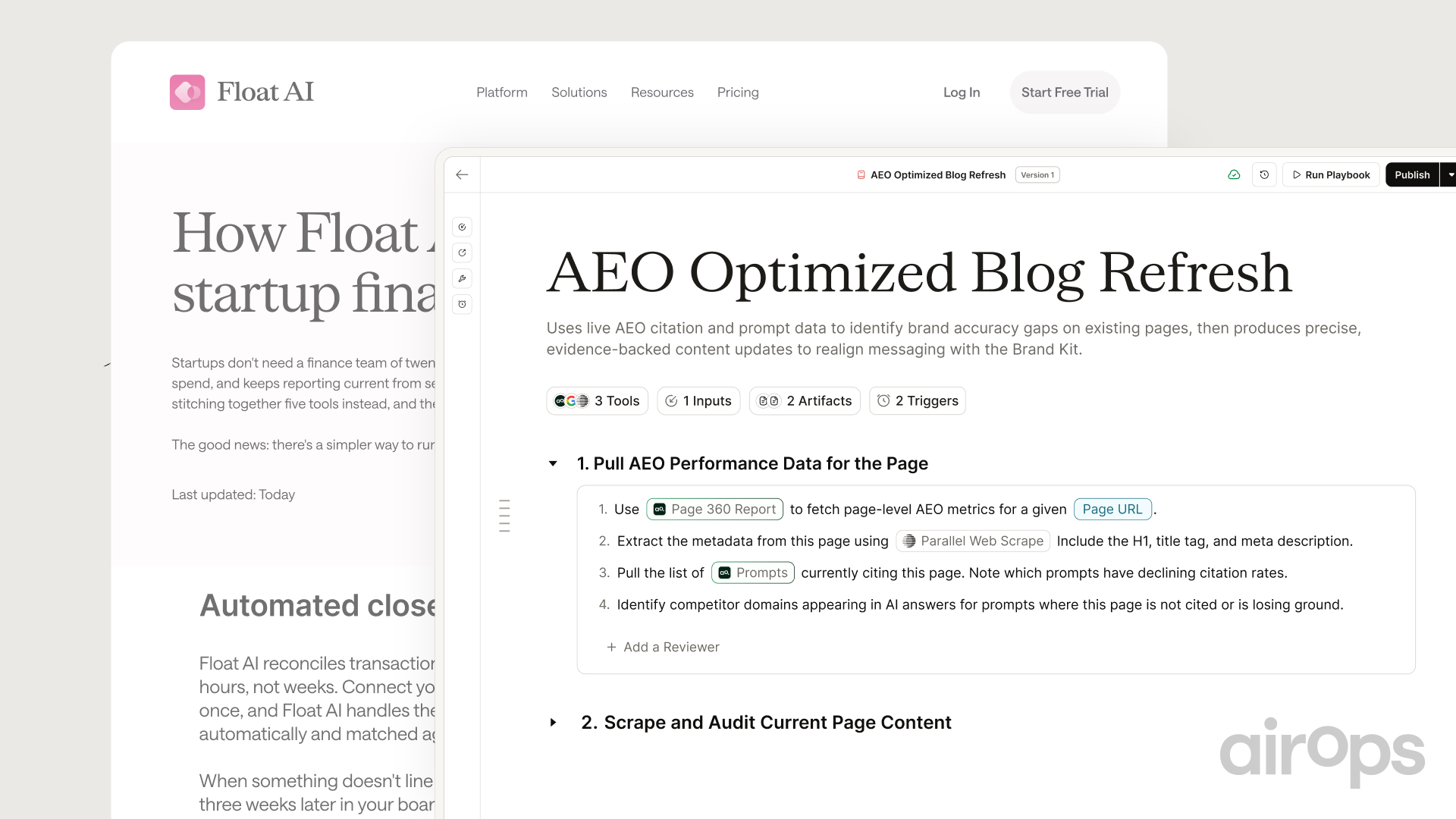
The screenshot below shows the AirOps content refresh view. You review page rewrites there before publishing.
Prompts to track and measure LLM citations
Run the same prompt set on a fixed schedule and log every citation. Fixed wording and timing let you measure LLM citations over time. Pick one weekday and one time window for every run.
Single checks mislead because answers shift between runs. AI answers shift between runs. Track citations over fixed windows rather than a single snapshot.Prompt 11. Log citations per prompt
Answer this prompt: [prompt]. List every source you cite, with its full link and the passage you used. State whether [brand] is mentioned, cited, or both. Return the result as one table row with today’s date.
Prompt 12. Attribute a change
Here are two citation logs for [prompt set]. Before [publish date]: [paste log]. After [publish date]: [paste log]. List prompts where [page] gained or lost a citation. Flag shifts that also hit competitor pages, since those point to engine-wide changes. Count mentions and citations separately.
To measure whether AEO changes increased citations in ChatGPT and Perplexity, compare runs before and after publishing. Track these five metrics in your log.
Metric | Definition | Why it matters |
|---|---|---|
Citation rate | Share of runs where an engine links your page for a prompt | Shows whether a rewrite earns source links |
Mention rate | Share of runs where the answer names your brand | Tracks brand presence apart from links |
Citation share | Your citations as a share of all citations in the prompt set | Shows your position against competitors |
Run-to-run consistency | Share of consecutive runs that keep your citation | Separates durable wins from noise |
Cited passage | The section an engine quotes from your page | Shows which rewrite earned the citation |
Keep citations, mentions, and citation share as separate columns. Our guide to brand citation tracking covers how to set up that log at scale.
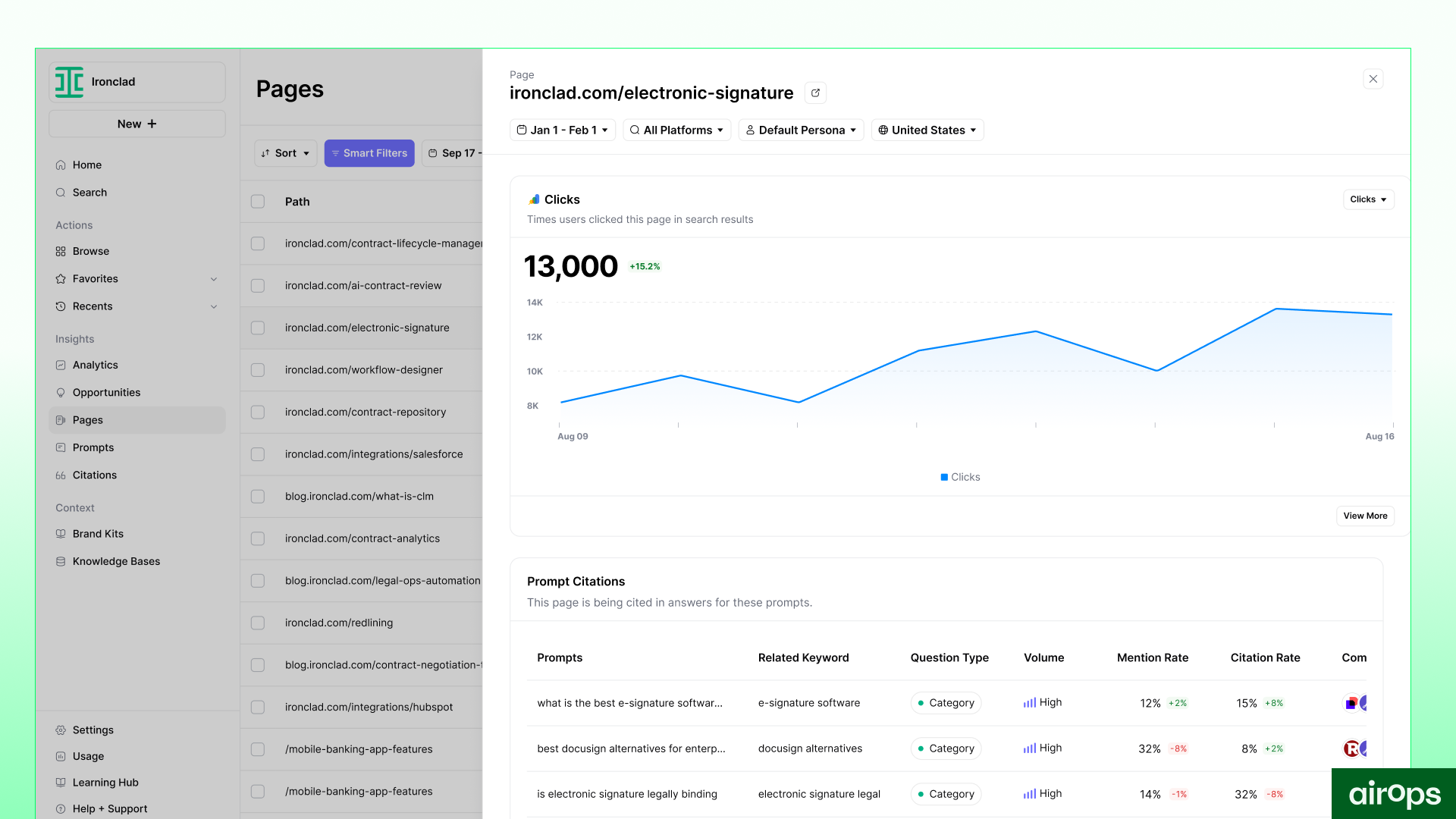
The screenshot below shows Page360. It puts performance data for each page in one view.
Common mistakes that block AI citations
The costliest mistakes break the link between audit, rewrite, and tracking. Each one has a direct fix.
Mistake | Why it fails | Fix |
|---|---|---|
Changing prompt wording each week | You lose a clean baseline | Freeze the prompt set and version any change |
Checking one engine only | Perplexity and Gemini cite community sources at very different rates | Run every prompt in ChatGPT, Perplexity, Gemini, and Google AI Mode |
Rewriting whole pages at once | You cannot tell which edit earned the citation | Change one section per prompt and log the date |
Judging from a single run | Answers shift between runs | Compare several runs before you call a win |
Blocking search crawlers by accident | Engines cannot retrieve the page | Allow OAI-SearchBot and PerplexityBot in robots.txt |
Adding schema that skips the visible page | Google asks for markup that matches visible content | Mark up only what readers see |
Google asks for unique, non-commodity content and structured data that matches the page. Its AI search guidance sets the bar for appearing in AI features, and citation-worthy content clears it.
Run the audit prompts again after any template or schema change. A template edit touches every page at once, so one error spreads fast. Spot-check five priority pages in two engines before and after each site release.
Key takeaways
- Freeze your prompts first, then move the pages.
- Choose prompts from real buyer language and confirm each one across several engines before you track it.
- Audit against the pages engines already cite, one prompt at a time, and let the gaps write your brief.
- Citation-worthy content pairs specific, sourced facts with clean structure and recent updates.
- Judge results across many runs, and keep mentions, citations, and citation share in separate columns.
Frequently asked questions
Does blocking AI training crawlers stop AI citations?
Not on its own, because AI training crawlers and AI search crawlers use separate controls in your robots.txt file. OpenAI's crawler settings let you allow one while blocking the other.
- OAI-SearchBot governs whether ChatGPT can surface your pages in its search results.
- GPTBot governs crawling for model training.
Do I need special optimizations for Google AI Overviews?
No. Google's guidance on AI Overviews and AI Mode, linked earlier, lists no extra requirements beyond standard Search eligibility. Indexable pages, crawlable links, and accurate structured data still matter.
How many prompts should I track?
Start with 25 to 50 prompts tied to revenue topics, tagged by product line. Add new prompts in dated batches so your baseline stays clean.
What is the difference between a mention and a citation?
A mention names your brand inside the answer text. A citation links your page as a source, so you track the two as separate metrics.
How often should I refresh pages for AI citations?
Review priority pages every quarter and refresh any page that loses citations. Our content refresh strategy guide covers how to rank pages for refresh.
AirOps for LLM citation optimization prompts
The prompt sets in this article give you a manual loop you can run this week. It covers question discovery, audits, rewrites, and change attribution. AirOps Insights runs the tracking stage at the prompt level across ChatGPT, Perplexity, Gemini, Claude, and Google AI Overviews. It records citation rate and citation share for every prompt you track.
- Insights shows which tracked prompts cite your pages and which cite competitors.
- Page360 shows page-level gaps next to search and AI data, so you know which sections to rewrite first.
- Brand Kit keeps each rewrite in line with your voice and writing rules.
AirOps experts work alongside you to set the prompt set and rank pages by revenue impact. You keep control of the prompts and the final edits. Each tracked result then feeds the next round of page priorities.