Prompts to build content ROI reports for leadership
Summary
- These prompts to build content ROI reports for leadership run as an eight-step sequence in your approved AI tool.
- Each prompt names the inputs you paste in, so every output rests on your own numbers.
- A leadership report fits five blocks on one page, and supporting detail moves to an appendix.
- AI search earns its own leading-indicator block, measured over fixed windows because answers shift between runs.
- One base prompt serves the CEO, CFO, and board, with a short modifier line changing the framing.
Your CFO wants to know what content returns this quarter. A traffic chart no longer answers that question, and AI search now shapes how buyers find you.
Answer engine optimization (AEO) spend faces the same scrutiny. Before you fund the best AEO platform for enterprise companies, finance asks what your current content already pays back.
The prompts below turn raw exports into a one-page report leadership can act on. The sequence mirrors how AI search partner AirOps connects citation intelligence to pipeline for enterprise brands.
What should content ROI reports for leadership include?
A content ROI report for leadership fits five blocks on one page. Each block answers one question your CEO or CFO asks every quarter.
Report section | What it answers | Example metric |
|---|---|---|
Business outcome | What did content return this quarter? | Content-sourced and content-influenced pipeline |
Investment | What did content cost? | Production, refresh, and tooling spend |
Efficiency | Is each dollar working harder than last quarter? | Pipeline per dollar of content spend |
Leading indicators | What predicts next quarter's pipeline? | AI search citation rate and share of voice |
Decisions | What changes next quarter? | Budget shifts and pages to refresh |
Lead the page with the business outcome block. Your CFO reads the first number and decides how much of the rest to trust.
That first number then lands on a finance desk with very little budget room. Gartner's 2026 CMO Spend Survey put marketing budgets at 7.8% of company revenue, up from 7.7% in 2025.
That survey covered large enterprises in North America, the UK, and Europe. In the same survey, 56% of CMOs said they lack the budget to deliver their 2026 strategy.
Flat budgets change the question your CFO asks. The question becomes which programs earn the next dollar, and content competes on pipeline per dollar.
Keep the executive page clean. Move these items to the appendix:
- Raw traffic and page views with no pipeline connection
- Channel vanity counts such as social impressions
- Full attribution model math, which finance reviews on request
- Page-level detail, which belongs in your content ROI dashboard for leadership
Each block needs one agreed source of truth. Pipeline numbers come from your customer relationship management (CRM) system, and cost numbers come from finance. Lock both sources before the first report ships.
This structure also answers the attribution gap directly. CMI's 2025 benchmark report, fielded in 2024, found 56% of B2B marketers cite difficulty attributing ROI to content. That figure covers B2B marketers who measure content, mostly in North America.
Attribution doubt is the first objection you will hear in the room. So the appendix shows your method, and finance checks it before the meeting. A visible method turns that objection into a short discussion.
Put the attribution model, cost inputs, and data sources on one appendix page. Date every export so finance can trace each figure to its system. Keep the format and definitions identical each quarter so quarterly trends stay comparable.
Send the appendix with the pre-read a day before the meeting. Your CFO arrives with fewer open questions, and the meeting time goes to decisions.
That steady rhythm builds trust with finance over several quarters. A one-page format backed by a detailed appendix fits how you run a modern marketing org, with revenue questions first.
Prompts to build content ROI reports for leadership, step by step
Run these eight prompts in order, in one conversation, so each output feeds the next. They work as ChatGPT prompts for CMOs and run the same way in Claude or Gemini.
Step | Prompt | Inputs you paste in | Output |
|---|---|---|---|
1 | Define leadership questions | Board deck goals, notes from the last review | Five ranked questions the report must answer |
2 | Clean and summarize data | Analytics export, CRM export, AI citation data | One clean table with flagged gaps |
3 | Pick the attribution model | Sales cycle length, cleaned table, self-reported answers | One model with a plain-language rationale |
4 | Calculate content ROI | Costs, attributed pipeline, win rate | ROI split by refreshed and net-new pages |
5 | Show compounding value | Twelve months of page-level data | Cohort view of returns by publish quarter |
6 | Write the executive summary | Outputs of Steps 1 through 5 | A 150-word summary for one audience |
7 | Pressure-test like a CFO | Draft report | Ten objections with scores and fixes |
8 | Set next-quarter decisions | Final report, budget options | Three ranked decisions with costs |
Measurement remains a live problem. CMI's 2026 trends report, fielded in 2025, found 33% of B2B marketers rank measuring content effectiveness a top-three challenge. A fixed sequence with named inputs gives you a repeatable method.
Step 1. Define the questions leadership is asking
This prompt anchors the report to decisions your executives face this quarter.
You are a B2B marketing analyst preparing a content ROI report for [AUDIENCE: CEO, CFO, OR BOARD]. Here are our company goals for [QUARTER]: [PASTE GOALS]. Here are notes from the last leadership review: [PASTE NOTES]. List the five questions this audience will ask about content performance. Rank them by how directly each ties to revenue. For each question, name the metric that answers it and the data source we own.
- Paste goals from your latest board deck or operating plan
- Add verbatim questions from past reviews when you have them
- Cap the list at five so the report stays on one page
Step 2. Clean and summarize your performance data
This prompt turns messy exports into one clean table that later steps reuse. Page360 in the AirOps platform gives you page-level intelligence on traffic and AI citations, shown below.
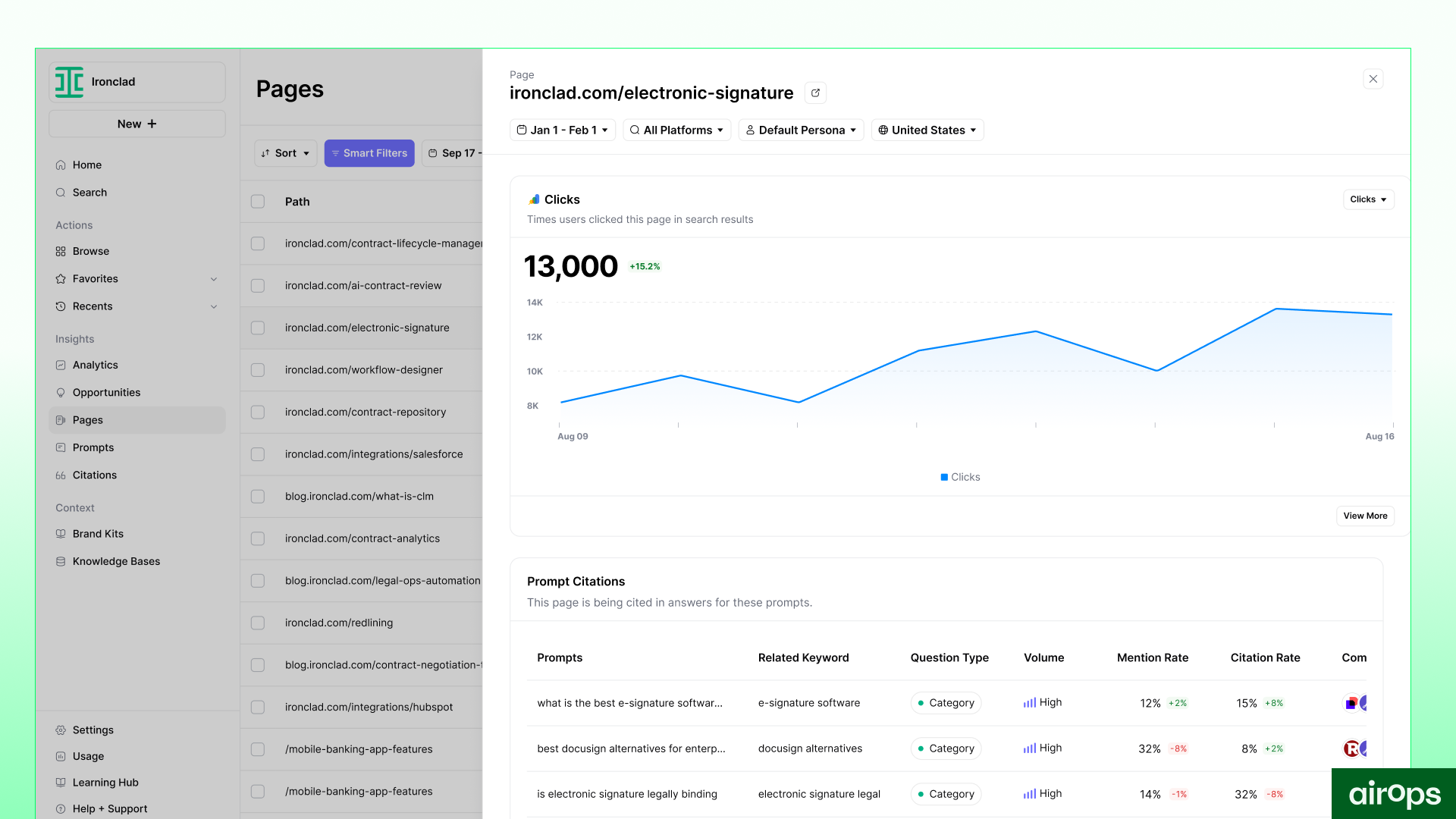
Page360 shows traffic and AI citation data for each URL you include in the report.
Act as a data analyst. Below are three exports: [PASTE ANALYTICS EXPORT], [PASTE CRM OPPORTUNITY EXPORT WITH NAMES REMOVED], and [PASTE AI CITATION DATA]. Join them by page URL and month. Flag missing values, duplicate rows, and metrics that changed definition mid-period. Return one table with columns for URL, sessions, AI citations, sourced pipeline, and influenced pipeline. Do not estimate missing numbers.
- Strip names, emails, and phone numbers from CRM exports first
- Run the prompt only in your company's approved enterprise AI tool
- Save the cleaned table, because Steps 3 through 8 reuse it
Step 3. Pick and explain the attribution model
This prompt settles first-touch vs multi-touch attribution before finance raises it.
Compare first-touch, last-touch, and linear multi-touch attribution for our content, using the cleaned table. Our average sales cycle is [DAYS] days, and deals involve [NUMBER] stakeholders. Show how much pipeline each model credits to content. Recommend one model for leadership reporting. Explain the choice in three sentences a CFO would accept. Cross-check the result against these self-reported answers: [PASTE “HOW DID YOU HEAR ABOUT US” RESPONSES].
- Pick one model and keep it for at least four quarters
- Show the model comparison once, then move it to the appendix
- Use self-reported answers to catch AI search and word-of-mouth influence
Step 4. Calculate content ROI with the formula shown
This prompt applies the content marketing ROI formula and splits refresh work from net-new work.
Calculate content ROI with this formula: (attributed revenue minus content cost) divided by content cost, times 100. Estimate attributed revenue as [ATTRIBUTED PIPELINE] times our win rate of [WIN RATE]. Content cost includes [PRODUCTION SPEND], [REFRESH SPEND], [TOOLING SPEND], and [TEAM HOURS TIMES HOURLY RATE]. Show the math line by line. Report ROI and pipeline per dollar in two rows: refreshed pages and net-new pages.
- Include team hours, or the ROI figure overstates returns
- Compare refreshed and net-new rows on pipeline per dollar spent
- Label pipeline-based revenue as an estimate in the final report
Step 5. Show compounding value over time
This prompt shows that content keeps returning after its publish month.
Group our pages into cohorts by publish quarter using this data: [PASTE 12 MONTHS OF PAGE-LEVEL DATA]. For each cohort, show sourced pipeline and AI citations by month since publish. Name the top cohorts by return per dollar. Explain what they share in topic or format.
- Use at least 12 months of data for a credible cohort view
- Give refreshed pages their own cohort
- Ask for a table, then build the chart yourself
Step 6. Write the executive summary
This prompt turns Steps 1 through 5 into the paragraph your CEO reads first.
Write a 150-word executive summary for [AUDIENCE] using only the numbers above. Open with content ROI for [QUARTER] and the change from last quarter. Name one driver of the result and one risk. Close with the decision you need from leadership. Never introduce a number that is absent from the data.
- Hold the summary to 150 words so it fits above the fold
- Swap the [AUDIENCE] value using the modifiers in the tailoring section below
- Save each version as part of your library of AI prompts for executive summaries
Step 7. Test the report like a CFO
This prompt finds the weak spots before your CFO does.
Act as a skeptical CFO reviewing this content ROI report: [PASTE DRAFT]. List the ten toughest questions you would ask. Score how well the report answers each one, on a scale of 1 to 5. Flag every claim that rests on correlation, an estimate, or a single data point. Suggest the specific fix or added data for each gap.
- Fix every item scored 3 or lower before you send the report
- Keep the question list for meeting prep
- Run the prompt again after edits to confirm the gaps closed
Step 8. Turn the report into next-quarter decisions
This prompt converts findings into budget moves leadership can approve.
Based on the final report, propose three decisions for [NEXT QUARTER]. Options include shifting budget between refresh and net-new content or expanding high-citation topics. For each decision, state the expected impact, the cost, and the metric we will watch. Rank them by return per dollar. Keep each under 40 words.
- Tie every decision to a metric already in the report
- Attach a cost to every option you bring
- Review these decisions at the top of next quarter's report
How to add AI search metrics to content ROI reports
Report AI search as a leading-indicator block next to pipeline. AI search means buyers asking tools such as ChatGPT or Perplexity for answers and recommendations.
Forrester's 2025 Buyers' Journey Survey, published January 2026, found 94% of business buyers report using AI in the buying process. The AirOps Analytics view below tracks the citations and mentions that feed this block.
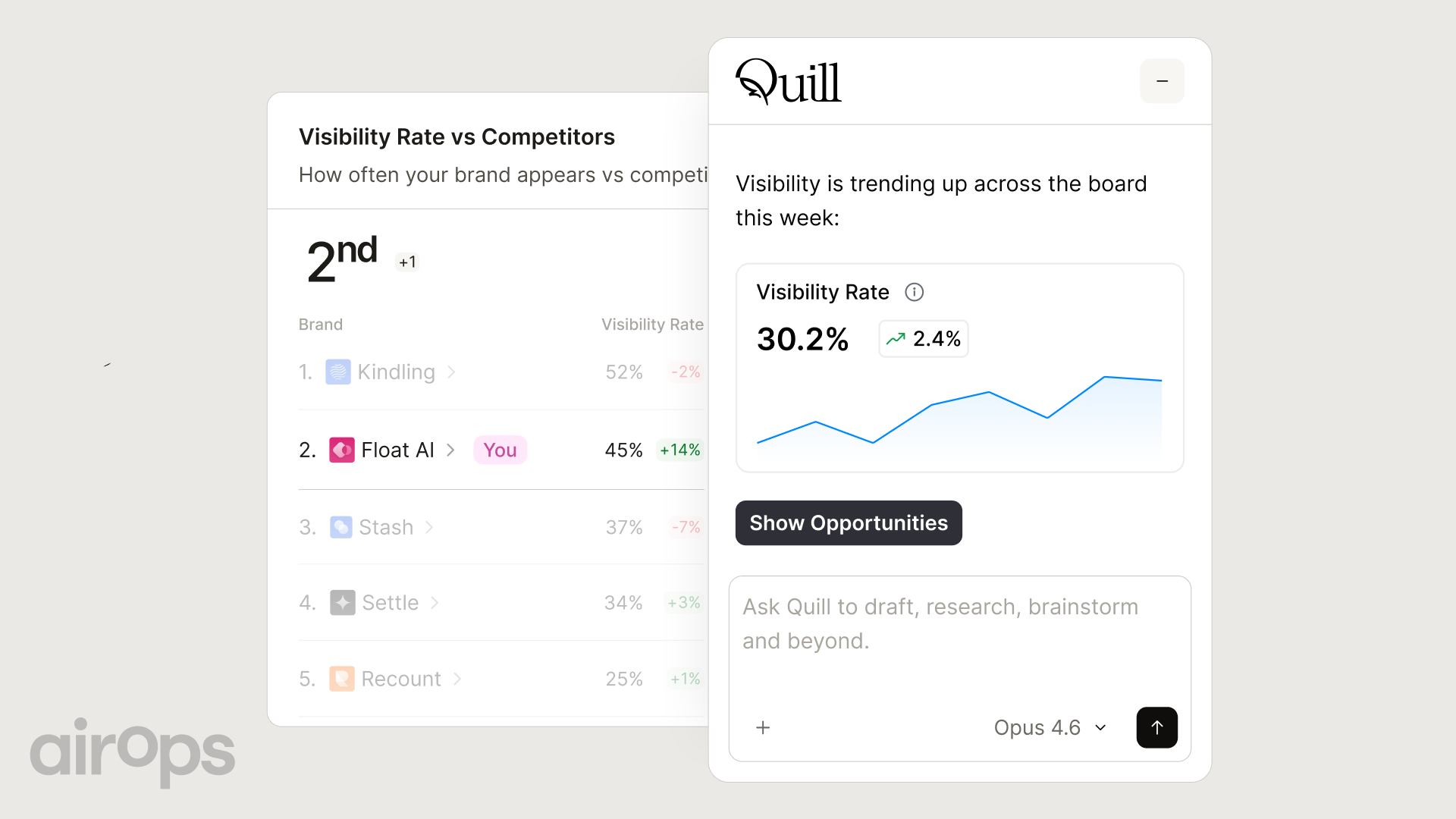
AirOps Analytics charts citation and mention metrics for your tracked prompts over time.
AI search metrics in content ROI reports need their own rows. Keep citations, mentions, and share of voice separate, because each one measures something different.
Metric | Definition | Why leadership cares | Reporting cadence |
|---|---|---|---|
Citation rate | Share of tracked AI answers that link to your pages | Shows AI answers rely on your content as a source | Monthly, over a 30-day window |
Mention rate | Share of tracked AI answers that name your brand | Shows your brand reaches AI shortlists | Monthly, over a 30-day window |
Share of voice | Your brand mentions as a share of all brand mentions in tracked answers | Shows your position against named competitors | Quarterly |
AI referral sessions | Site visits that arrive from AI platforms | Shows AI answers send buyers to your site | Monthly |
AI-influenced pipeline | Pipeline from accounts with AI referral sessions or self-reported AI discovery | Connects AI search activity to revenue | Quarterly |
Single snapshots mislead, because AI answers shift between runs. AI answers shift between runs, so a single snapshot is incomplete. So report every AI search metric over a fixed window.
Step 9. Build the AI search block
This bonus prompt turns raw AI search data into the leading-indicator block of your report.
Here is AI search data for [BRAND] across [NUMBER] tracked prompts. The window is [30-DAY WINDOW]. The metrics are [PASTE CITATION RATE, MENTION RATE, SHARE OF VOICE, AND AI REFERRAL SESSIONS]. Compare each metric with the prior window and with [TOP TWO COMPETITORS]. Keep citations, mentions, and share of voice as separate metrics. Match AI referral sessions to this pipeline data: [PASTE PIPELINE BY ACCOUNT]. Report the result as AI-influenced pipeline. Label every link between AI metrics and revenue as correlation.
- Use the same tracked prompt set in every window
- Report AI-influenced pipeline apart from sourced pipeline
- Add self-reported AI discovery from Step 3 as a cross-check
This block covers reporting only. For the full method behind AEO returns, read our guide to outcome-based AEO measurement.
How to tailor content ROI prompts for the CEO, CFO, and board
Use the same data and change the framing for each reader. This is how to report content marketing ROI to leadership with one dataset and one prompt base.
Audience | What they decide | Lead metric | Prompt modifier |
|---|---|---|---|
CEO | Where to invest for growth | Content-sourced pipeline trend | Frame results as growth against plan. |
CFO | Whether content spend earns its budget | ROI and pipeline per dollar | Show every formula and label estimates. |
Board | Whether the strategy protects market position | Share of voice against named competitors | Summarize in three bullets with one risk. |
Append one of these modifier lines to the Step 6 prompt:
- Write for a CEO and lead with pipeline growth against plan.
- Write for a CFO and show the formula behind each number.
- Write for the board in three bullets, including one risk.
- Write for a board member new to AI search and define each metric once.
The board also asks whether buyers find you before sales does. G2's 2026 Buyer Behavior Report found 82% of software buyers sourced recommendations from AI chatbots in the prior 24 months. Review sites (38%) edged out AI chatbots (37%) as the top shortlist influence for those buyers.
Key takeaways
- A content ROI report earns trust when pipeline comes first and every estimate carries a clear label.
- The sequence of prompts to build content ROI reports for leadership works because every step reuses the Step 2 table.
- AI search belongs in the report as a leading indicator. Measure it over fixed 30-day windows, outside the ROI formula.
- The CFO pressure test in Step 7 closes gaps in private, before finance finds them in the meeting.
Frequently asked questions
Should AI search metrics count as ROI or as leading indicators?
Report them as leading indicators and keep them outside the ROI formula. Connect them to revenue through AI-influenced pipeline, and label that connection as correlation. Our guide to measuring AI search performance covers the tracking setup.
Can I paste CRM data into ChatGPT or Claude?
Paste CRM data only into the enterprise AI tool your company approves. Remove names, emails, and other personal details first, since consumer accounts fall outside your data agreements.
How often should I send a content ROI report to leadership?
Send a monthly content ROI report to your marketing leadership group. Send a quarterly version to the CEO, CFO, and board, matched to budget cycles. The quarterly view also smooths short-term swings in AI search metrics.
How long does content take to show ROI?
Judge new pages by cohort over at least 12 months, as Step 5 does. Refreshed pages start with existing authority, so Step 4 reports them in their own row.
AirOps for content ROI reporting
The prompt sequence gives you a report structure, and the AI search block gives leadership a forward signal. AirOps partners with you on the intelligence behind both, with enterprise reporting support that ties citations to pipeline.
AirOps experts help you run the CFO pressure test against real numbers before the meeting. You walk in with answers to finance's toughest questions already drafted.