The CMO's Guide to AI Search & Discovery
The question has changed for marketing leaders
AI search has moved up the marketing agenda faster than teams have learned to measure it.
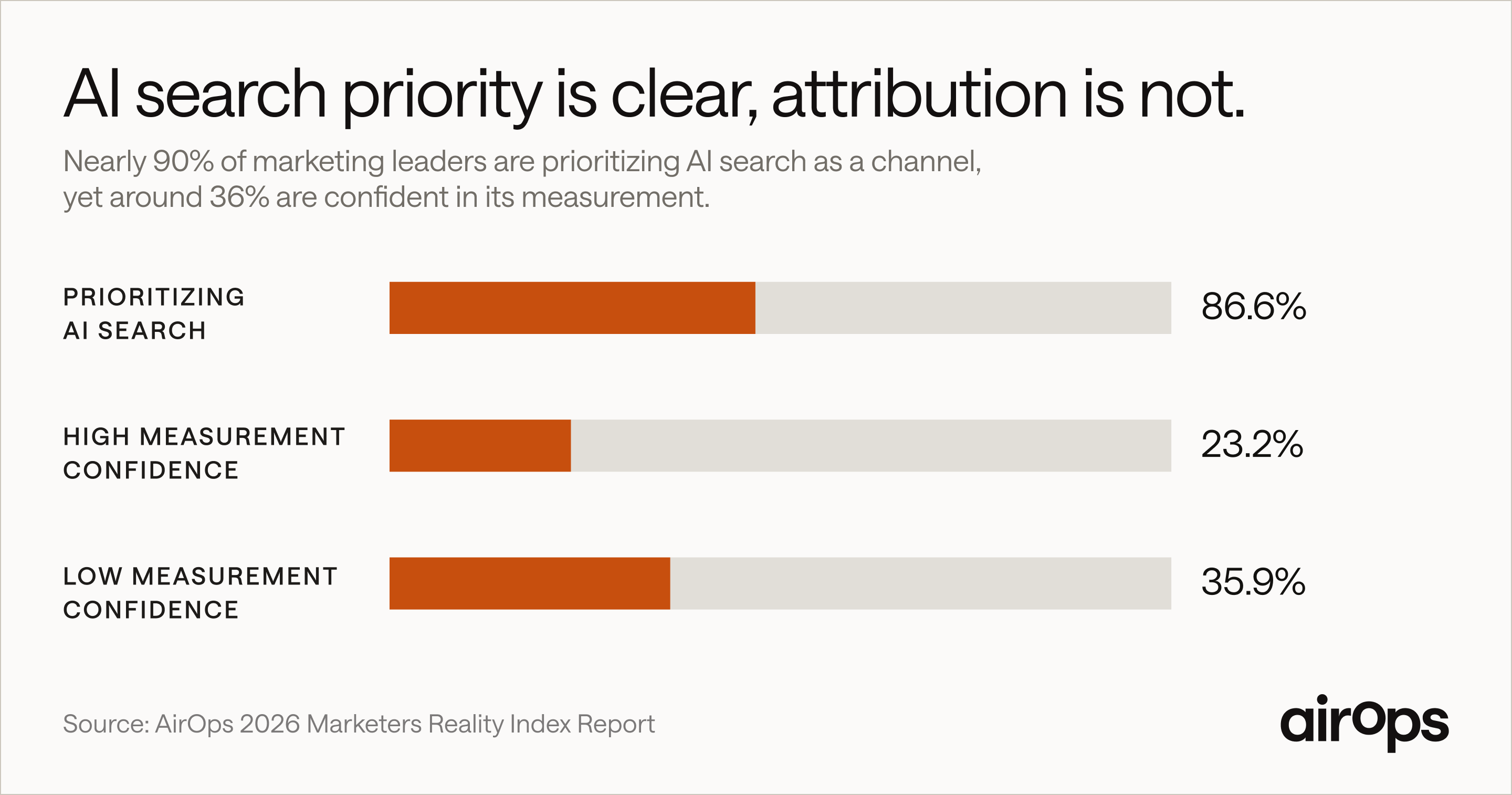
In AirOps’ Marketing Leaders Reality Index, 86.6% of marketing leaders said AI search was important or a top priority. Only 23% felt confident measuring its impact. Meanwhile, 75.4% faced higher revenue or pipeline targets, but just 43% had more budget.
That leaves CMOs with a difficult allocation decision. The answer a buyer sees can draw on company pages, reviews, publishers, communities, and paid placements. It can also change when the same question is asked again. Before deciding where to spend, marketing leaders need to know which buyer questions matter, how their brand appears in the answers, and which sources are influencing them.
1. Find the questions your dashboard misses
A broad category prompt is only the beginning of a buying journey.
AirOps analyzed more than 245,000 prompts brands were tracking. The prompts peaked at six to seven words, leaving longer, more specific questions underrepresented.
In related research, 32.9% of pages cited by ChatGPT appeared only in search results for a follow-up query generated from the original prompt. A brand can monitor the obvious question and miss the research that helps form the answer.
The CMO decision: Choose the topics and buying situations most closely tied to growth. Ask search, product marketing, sales, customer success, and research teams for questions they hear in buyers’ own words. Cover discovery, comparison, evaluation, and purchase, including the practical constraints that change a recommendation.
Start with a focused set of prompts. Those are more useful than a long list of generic prompts.
2. See the answer before choosing the channel
For each priority question, inspect the whole answer. Is your brand named? Is the description accurate? Which competitors appear? Which URLs are cited? What kind of source is each URL? A missing citation, an absent brand mention, and an inaccurate description call for different responses.
The answer engine matters, too. A source that influences one answer engine may have little reach in another. Aggregate visibility can hide gaps in the specific engines and buying stages that matter to your customers.
AirOps' 2026 State of AI Search found that only 30% of brands stayed visible from one answer to the next, and just 20% remained present across five consecutive runs. A single answer is an example, not a reliable benchmark. Review repeated answers and look for persistent patterns.
The CMO decision: Establish a baseline by topic, stage, and answer engine. Separate three questions in the report: Are we present? Are we described accurately? What evidence is shaping the answer? That turns a vague visibility score into a list of actions.
3. Build the evidence across channels
An AI discovery strategy needs a coordinated channel mix. The right mix depends on the questions buyers ask and the sources that appear in their answers.
The evidence base supports a broader view than the company website alone. In AirOps' 2026 research, 85% of brand mentions studied originated from third-party pages. That figure describes the analyzed sample; it is a reason to audit external influence, not a universal budget allocation rule.
External content is where most teams overreach. Ali McCarty, VP and GM of Managed Services at AirOps, described the sharper approach on an AirOps webinar:
"We are very laser-focused on where are the third-party sites and specific URLs that LLMs are actually referencing or citing when they're answering the prompts you care about winning, and then how do we work with those publishers to make sure that we can get your brand included. It's more of a scalpel than a sledgehammer."
Prioritize the specific URLs already shaping answers to your priority questions over broad outreach to high-traffic publications.
Freshness also deserves an operating owner. The same research found that pages going more than three months without an update were over three times as likely to lose AI citations as recently refreshed pages.
Sam Page, Head of AEO/SEO Services at AirOps, put a cadence on that finding: "If you update your content every 3 to 6 months, it depends a little bit on the niche. I know B2B SaaS is more rewarded for fresh content." Start with pages where accuracy changes quickly, especially product facts, comparisons, pricing, and commercial claims. An update should improve the answer for a buyer, not simply change a timestamp.
Paid now belongs in the conversation as well. AirOps reported that ChatGPT ad appearances in the industries it monitored rose from zero to more than half of observed answers over three months. That is a measured change in those tracked answers, not a forecast for every category. It gives performance teams a reason to coordinate with brand, content, and AEO leaders as they test the channel.
The CMO decision: Assign one owner to the overall strategy and named owners to each active channel. Fund the work where your answer audit shows a real gap, rather than assuming every channel needs the same investment.
4. Replace the single score with a measurement stack
Rankings and traffic still matter. They answer different questions than AI visibility does. A useful CMO view connects leading signals to business outcomes without pretending that every mention caused a conversion.
That instinct, to stop grading every individual page and instead grade the program, echoes what Krithika Shankarraman, who leads marketing at Thrive Capital and previously built marketing functions at Stripe, Retool, and OpenAI, described on an AirOps webinar with AirOps CMO Christy Roach:
"I really like more of a program-level CAC methodology, rather than thinking about, okay, every piece of content that we put out for AI SEO, how is it doing for us? What granular topic is really performing for us? Rather, think of topic clusters, areas and keywords of interest that your companies and your customers are thinking through and caring about. Making sure that you're ranking there, but at the same time, thinking about AI search as a bucket to optimize, and that will mature as a portfolio kind of approach over time, rather than over-indexing to high-accuracy measurement of any one thing."
Review the leading signals frequently enough to catch movement. Evaluate commercial impact over a longer period and alongside other channel data. Keep a record of changes, dates, priority prompts, and external events so the team can judge what likely contributed to a shift.
The measurement standard is honest progress. A citation can show that a source was used. A brand mention can show that you entered the answer. Neither proves that a buyer chose you.
The CMO decision: Evaluate overall program-level progress using leading signals and a tracked record of strategy changes, rather than over-indexing on precise attribution or the individual performance of single pages and tactics.
5. Run a 90-day program
Days 1–30: Establish the baseline. Choose priority topics and buyer questions. Audit repeated answers across the relevant engines. Record mentions, citations, descriptions, competitors, and influential sources. Identify the few gaps most closely tied to buying decisions.
Days 31–60: Improve the evidence. Refresh the most consequential Owned Content. Correct unclear product facts and outdated comparisons. Pursue appropriate External Content opportunities, strengthen review coverage, and turn subject matter expertise into useful Community and Influencer & Social contributions. Design a focused AI Ads test where there is observable activity and a clear reason to participate.
Days 61–90: Measure and adjust. Recheck the same question groups. Look for sustained changes across repeated answers, verify how the brand is described, and compare demand signals with the baseline. Keep, expand, or stop each workstream based on what the team learned.
This cadence gives leadership a way to invest while the channel is still changing. It also creates an evidence trail for the next budget conversation.
The mandate for the next planning cycle
AI discovery reaches across the marketing organization. Search and content teams make your facts easy to find and understand. Communications and partnerships build credible external evidence. Community and social teams participate in the questions buyers actually ask. Performance teams test paid placements. Analytics connects those efforts to the outcomes the business cares about.
The CMO's job is to make those teams work from the same buyer questions and the same view of the answer. Start with the decisions you want to influence. See how your brand appears today. Invest in the evidence that will make the next answer more accurate, useful, and likely to include you.