The 2026 State of AI Search: How Modern Brands Stay Visible
The way people discover information has shifted with the rise of the answer-first web. Instead of scanning a list of links, millions now ask AI assistants for direct answers. That changed how categories form, how options are evaluated, and how brands earn visibility in search.
AI search does not behave like a traditional results page. There is no fixed ranking, no predictable position drops, and no stable “page one.” Visibility moves according to signals that update in real time. Brands drift in and out of answers based on freshness, authority, community validation, and how clearly their content can be interpreted as relevant and trustworthy.
Understanding these patterns gives teams an advantage. This report brings together research from AirOps and Kevin Indig to map the signals that mattered most in 2025 and show where brands need to invest to stay visible and competitive.
Fresh, Up-to-Date Content Drives Visibility in AI Search
AI models prioritize fresh, accurate content when generating answers. Models treat recency as a key signal of trust, especially when users compare options or make decisions. Maintaining fresh, up-to-date content is now non-negotiable for earning visibility in AI search.
Pages Not Updated Quarterly Are More Than 3× as Likely to Lose AI Citations
Stale pages fall out of rotation quickly. Once a fresher alternative is available, older content loses ground and rarely regains visibility without a direct update.

- Quarterly updates reduce citation loss: Pages that go more than three months without an update are over 3× more likely to lose visibility compared with recently refreshed pages.
- Annual updates mark the minimum bar: More than 70% of all pages cited by AI have been updated within the past 12 months.
- Six-month updates reflect an accelerating norm: More than 50% of pages earning citations were refreshed within six months.
Commercial Search Demands a Higher Bar for Freshness
For buying-intent queries, freshness becomes a necessity, not a negotiable. When users compare options, models prioritize pages that reflect the latest pricing, features, and claims.
- Commercial queries favor recent updates: About 83% of commercial citations come from pages updated within the last year.
- Six months defines competitive freshness: More than 60% of commercial citations surface pages refreshed within six months.
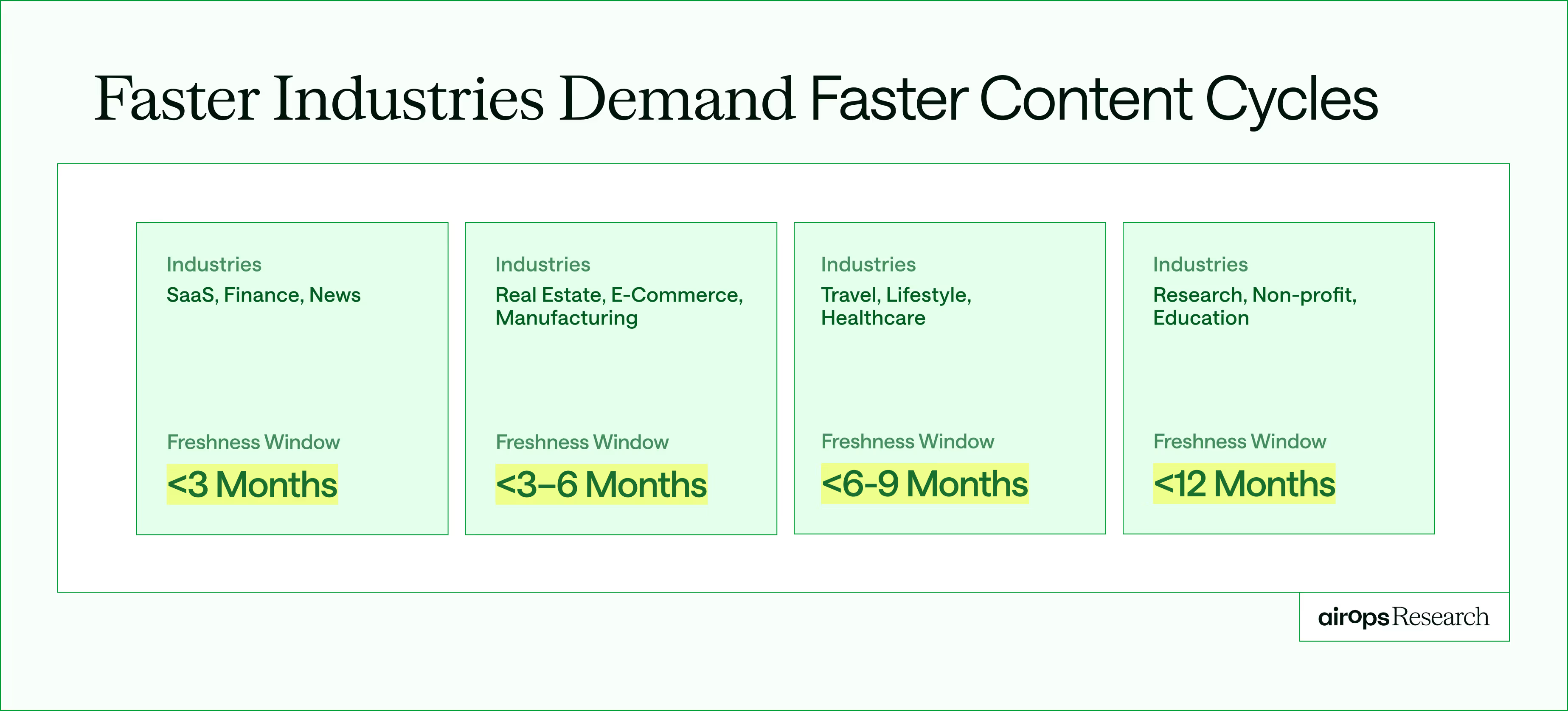
- Fast industries have <3-month windows: In SaaS, finance, and news, pages older than three months see steep drops in citation likelihood.
Freshness shapes visibility across every category, but the expectation tightens as intent becomes more commercial. Pages that stay current remain inside the window models rely on when evaluating trust and relevance, while stale content quickly loses ground to fresher competitors.
Where to Start With Refreshing Your Content
- Refresh pages that are losing visibility or showing declining citations, traffic, and conversion.
- Update outdated claims, pricing, features, and examples to reflect up-to-date positioning and messaging.
- Prioritize updates across commercial and comparison pages that influence conversion and high-intent searches.
- Strengthen thin or outdated sections with updates that match evolving user search intent.
Maintaining fresh and up-to-date content provides users and LLMs strong signals of trust and relevance, while improving your brand visibility in both traditional search and AI-generated answers.
Structured Content Shows Up More Consistently in AI Search
AI models cite pages they can interpret quickly and accurately. Well-structured content with clear headings, rich schema, and organized lists gives AI systems strong relevance cues, making those pages more likely to appear in answers.
Sequential Heading Structures Correlate With 2.8× Higher Citation Likelihood
Heading clarity shapes how models understand what a page covers. Pages that follow a clean, sequential hierarchy are cited far more often than pages with fragmented or inconsistent structure.
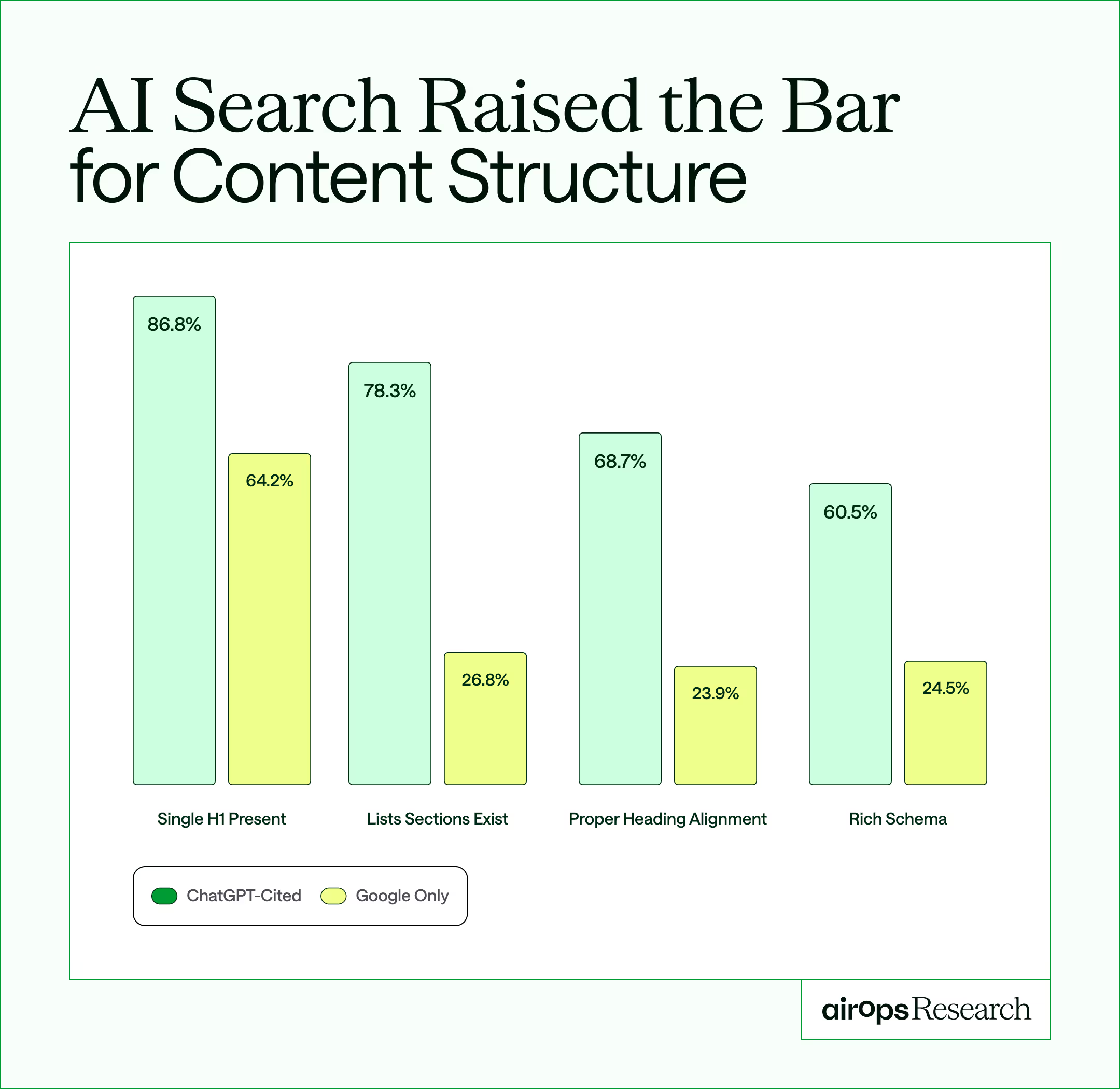
- Sequential headings correlate with visibility: 68.7% of pages cited in ChatGPT follow logical heading hierarchies.
- Single H1 strengthens structure: 87% of cited pages use a single H1 as the primary anchor.
- Poor hierarchy reduces interpretability: Skipped levels or multiple H1s make it harder for models to understand section relationships.
Well-Structured Content Improves User & Model Readability
Well-structured content helps both users and LLMs understand what a page covers. Schema clarifies meaning and intent, while lists make information easier to scan and extract. Pages that combine both show significantly higher citation rates.
- Schema provides strong relevance cues: About 61% of cited pages use three or more schema types, and pages with 3+ schema types have a 13% higher likelihood of being cited.
- FAQ and QA schema improve relevance signals: FAQ schema appears in 10.5% of cited pages, helping search engine indexation and models map answers to queries more directly.
- Ordered and non-ordered lists enhance user and model readability: Nearly 80% of pages cited within ChatGPT include lists to structure key information.
Together, these patterns show that structure is a core retrieval signal. Pages built with clear hierarchy, richer schema, and consistent list organization give LLMs the strongest cues to interpret content accurately and cite it more often.
Where to Start With Structuring Your Content
- Use a single H1 and follow a clean, sequential heading hierarchy.
- Add multiple schema types that reflect the page’s purpose and content.
- Break dense sections into short lists and scannable chunks.
- Include FAQ schema when your page answers direct user questions.
These actions help your pages stay clear, scannable, and easier for models to understand. Structured pages give both users and LLMs clearer signals, improving readability and increasing the likelihood that your content is understood and cited.
Community and User-Generated Channels Have Become the Trust Layer of AI Search
Community and user-generated channels now act as a core trust layer in AI search. Models look to user-generated domains like Reddit, LinkedIn, YouTube, Wikipedia, and other community spaces to understand what people experience, recommend, and question about brands.
User-Generated & Community Content Influence 48% of AI Search Results
Instead of relying primarily on brand-owned pages, AI systems often cite UGC domains where people compare options, share outcomes, and validate claims in public.

- Community platforms drive nearly half of citations: About 48% of AI search citations come from user-generated and community sources.
- A concentrated set of UGC domains anchor validation: Reddit, LinkedIn, Wikipedia, YouTube, and arXiv are among the most cited for brand mentions across models.
- Models vary widely in how much they lean on community: Perplexity references community platforms in more than 90% of answers, while Gemini does so in as few as 7%.
Reddit Serves as a Signal of Peer Validation During Answer Generation
When people want firsthand comparisons or challenges to claims, models often treat Reddit as a credible reflection of peer insight.

- Appears in roughly 1 in 5 AI answers: Models treat Reddit as a proxy for authentic user experience.
- Shapes early category exploration: About 88% of Reddit citations come from category-level queries.
- Guides deeper brand evaluation: For branded queries, one-third check features, one-third ask how to use something, and one-quarter seek factual detail.
YouTube Citations Support Learning and Category Evaluation
LLLMs favor YouTube for its ability to help users understand concepts, processes, and category differences in multimodal contexts.
- A main UGC source across LLMs: YouTube is the #2 most-cited source in Gemini and Perplexity and #3 in Google AI Mode.
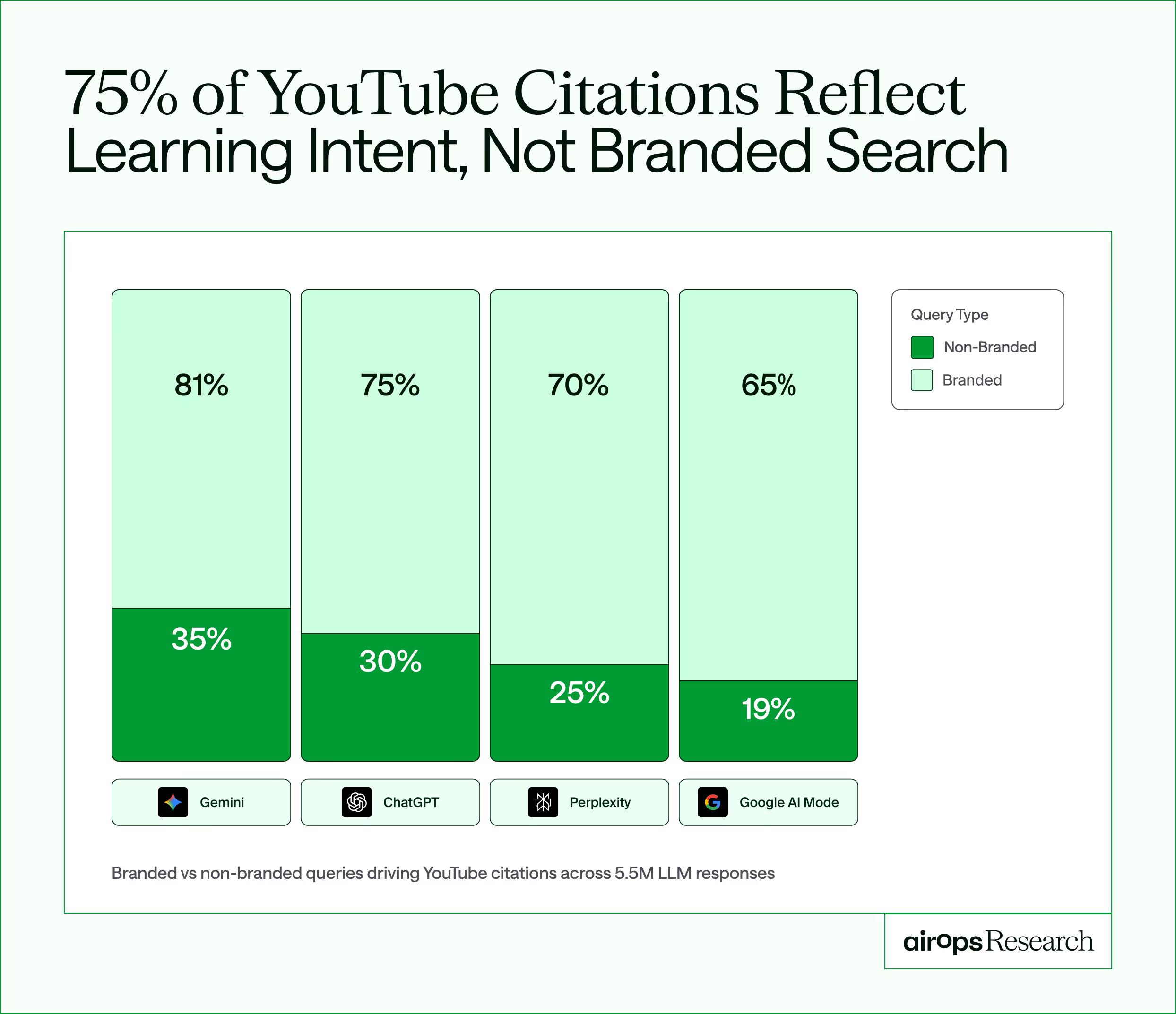
- Queries driving visibility to YouTube support educational intent: 75% come from non-branded queries where users want explanations, tutorials, or conceptual clarity.
- Supports category evaluation: For non-branded queries, 59% of citations seek factual detail and 34% focus on how-to guidance.
Community and user-generated platforms now shape how models understand trust, experience, and evaluation across categories. Participate in forums, Q&A platforms, and niche communities where your audience asks questions—engage authentically by answering questions and providing context, not just promoting. A brand's off-site presence increasingly influences how users discover, learn, and compare options inside AI search.
Off-Site Presence Influences Early Brand Discovery in Commercial Search
Visibility in AI search is shaped by how the wider web talks about a brand. During early discovery, models lean on third-party pages that define categories, compare options, and reflect consensus—not just what brands publish on their own sites.
Brands Are 6.5× More Likely to Be Cited Through Third-Party Sources Than Their Own Domains
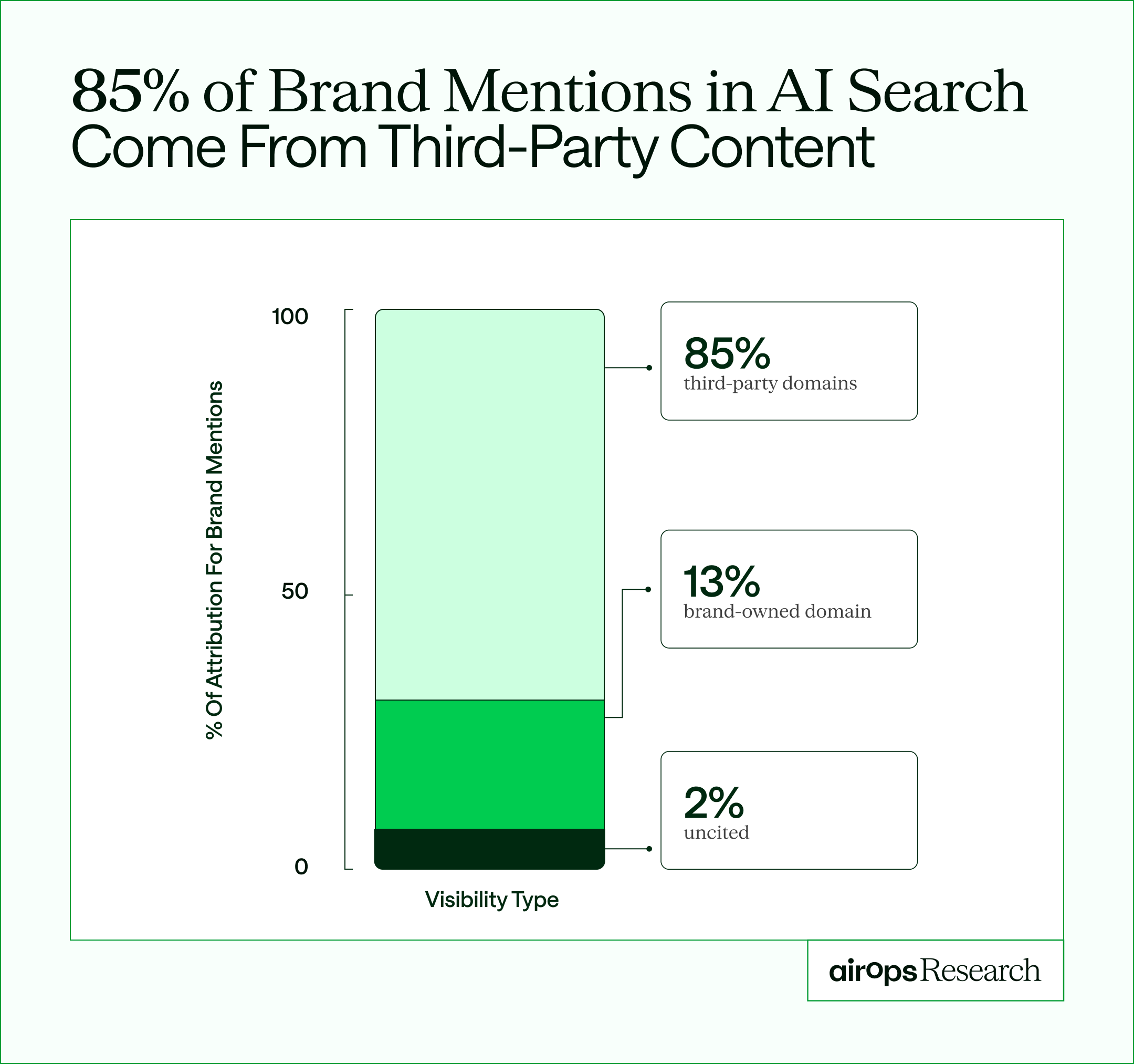
For early brand discovery in commercial search, about 85% of brand mentions come from external domains. Brands that invest in a strong off-site presence are 6.5× more likely to earn visibility in AI search than through their owned content.
- Structured formats are a source of credibility: Nearly 90% of third-party mentions originate from listicles, comparison pages, and review roundups.
- Placement inside third-party content matters: Roughly 80% of mentioned brands appear within the first three positions of the page.
- Owned domains appear later in the journey: First-party mentions show up in roughly 25% of generated answers–primarily when users shift from broad exploration to verification.
Nofollow and Image Backlinks Correlate as Strongly With AI Visibility as Dofollow Links
AI models treat links and visual references as signals of recognition, making off-site presence more important than link type alone.
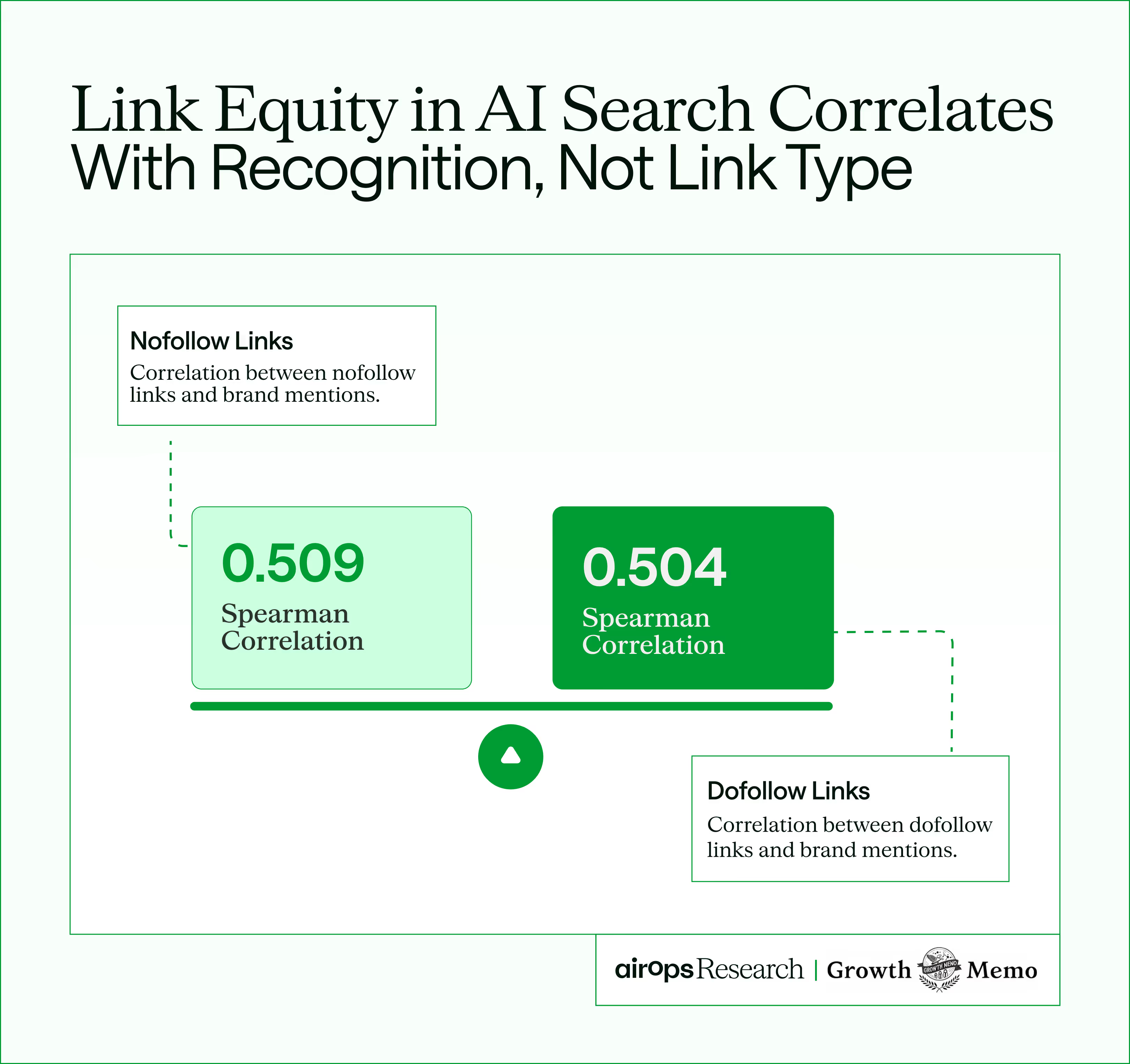
- Nofollow links show similar correlation strength: Nofollow links (0.509 Spearman) nearly mirror dofollow links (0.504 Spearman).
- Visual assets expand brand reach: Charts, infographics, and product images generate image-based links that correlate strongly with AI mentions.
- Breadth of recognition matters most: Content cited across many domains appears more often than content with a narrow off-site footprint.
Off-site environments teach models which brands define a category well before they reference owned domains. Brands that invest in both on-site clarity and broad off-site recognition gain stronger visibility in AI search.
Visibility in AI Search is in Constant Fluctuation
Visibility in AI search shifts continuously as models rebuild answers from scratch. The recurring patterns behind these shifts show how brands cycle in and out of results and which signals help them stay present.
Brands That Are Mentioned & Cited Have a 40% Higher Likelihood of Consistent Visibility
LLMs rebuild the answer from scratch each time, reassessing which pages best match the query. That reconstruction drives continual reshuffling, which often contributes to visibility appearing unstable at the single-answer level.
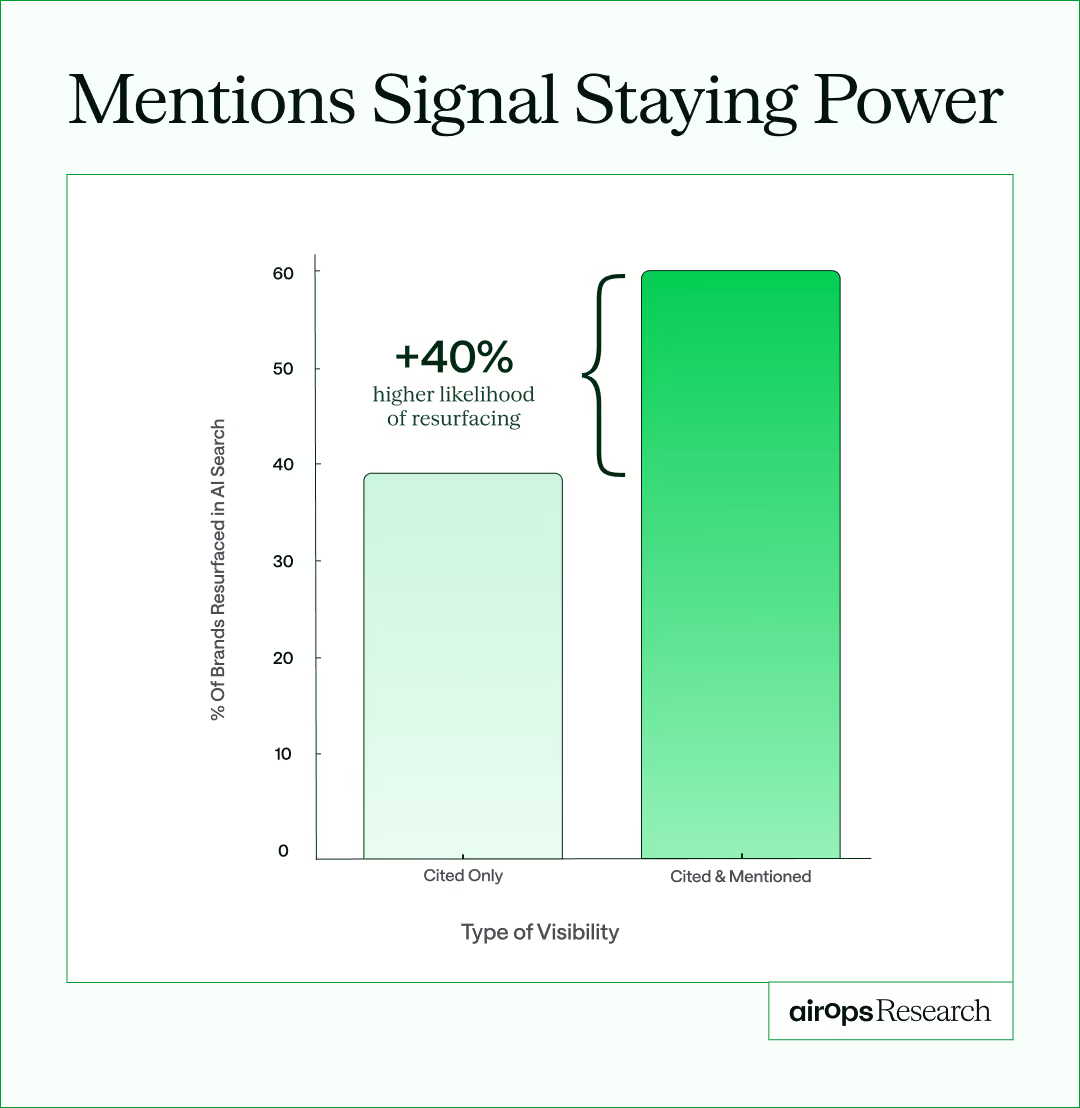
- Dual signals improve recurrence: Brands that earn both a mention and a citation are 40% more likely to resurface across consecutive runs than citation-only brands.
- Most brands disappear between answers: Only 30% of brands stay visible across back-to-back answers, making single snapshots unreliable indicators of performance.
- LLMs rarely cite & mention the brand: Only ~28% of answers include brands that are both mentioned and cited, making dual-signal visibility a high-impact but relatively uncommon pattern.
Around 50% of Brands That Lose Visibility Resurface Quickly
Most visibility loss isn’t permanent. Brands rotate in and out as models rebalance for diversity, freshness, and category coverage, and strong signals help them re-enter quickly.
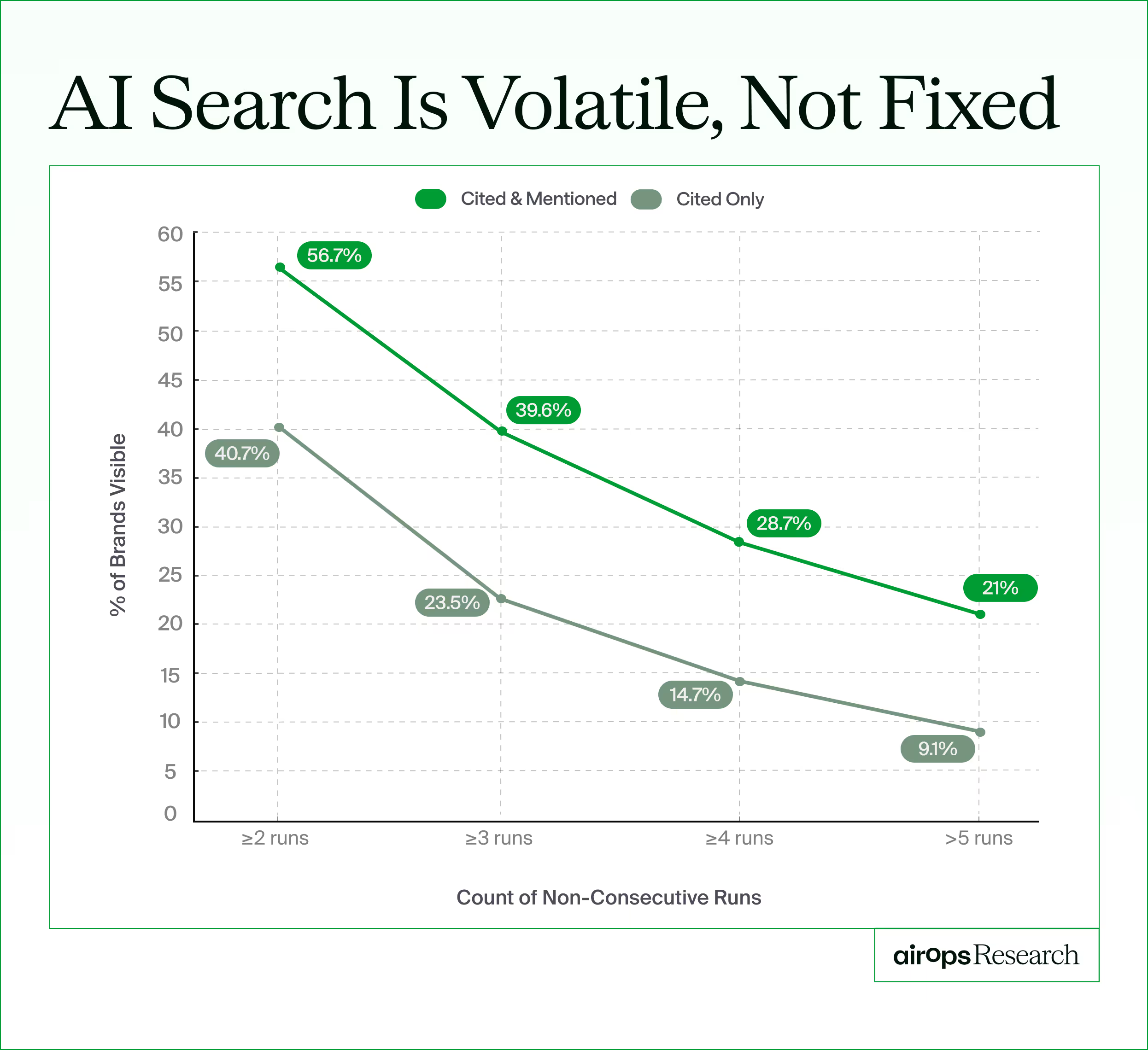
- Disappearance is often temporary: More than 50% of brands that drop from an answer resurface within two runs.
- Short gaps are the norm: Across repeated runs, most brands reappear in results within one to three answers as models diversify their source mix.
- Fast return correlates with stronger signals: Brands that reappear quickly tend to have fresher content, deeper citation presence, and clearer off-site validation compared with those that stay absent longer.
These patterns show that visibility is less about staying present in every answer and more about building signals that help models bring the brand back quickly. Brands should focus on earning both mentions and citations—strengthen on-site clarity through structured content while building off-site validation through community participation and earned media. This dual-signal consistency helps models confidently resurface your brand when rebuilding answers.
The Impact of Zero-Click Search on User Behavior
AI Overviews changed both user behavior and traffic distribution. Zero-click interactions increased as more answers resolved directly in the Overview, while non-AIO queries continued to drive the most website visits.
Google’s Role in Accelerating Zero-Click Search
The rollout of AI Overviews shifted more user behavior into zero-click interactions by making it easier to complete tasks directly inside the results page without visiting a website.
- Zero-click activity rose after AIO launch: Google searches ending without a click, have increased by 2.5x since the initial rollout of AI overviews.
- Google usage shifted toward quicker task completion: From May 2024 to February 2025, US visits to Google increased ~9% while time-on-site and pages-per-visit declined, reflecting faster resolution through AIOs.
- AIO citations are more diverse but far fewer overall: Google surfaces a wider mix of sites in Overviews, yet only about 23% as many URLs appear in AIOs as in traditional results, which concentrates user attention inside the Overview and reinforces zero-click behavior.
Page Views From AI Overviews Rose ~22% After Launch
AI Overviews continue to reshape how users engage with search results. AIOs resolve more questions directly on the page, which increases zero-click interactions while still contributing meaningful exposure and early discovery for brands surfaced inside the Overview.

- Most AIO citations come from pages outside traditional rankings: About 59.6% of AI Overview citations come from URLs not ranking in the top 20 organic results.
- AIO-triggering queries are driving stronger engagement: Page views from AI overviews grew 21.5% since the May 2024 rollout, compared with just 1.3% growth for non-AIO searches.
- AIOs prioritize top funnel searches: AIOs appear mostly on informational, top-funnel queries that resolve on the page, while non-AIO queries drive ~2× more traffic by capturing higher-intent users.
These shifts make it clear that AI Overviews influence early understanding, while traditional SERPs remain the primary source in driving higher-intent traffic. Prioritize visibility in both layers: strengthen your presence in AI Overviews to build awareness, while securing traditional SERP positions to capture high-intent traffic downstream.
The Shifts in Search That Defined 2025
2025 marked a clear turning point in how people search and how brands are surfaced in AI answers. From zero-click behavior to multimodal prompts, new patterns shaped the way categories form and how decisions begin.
Here are several key shifts that took place:
- AI Overviews went mainstream: Google’s launch of AI Mode and expansion of AI-generated overviews increased the share of queries resolved inside the results page, pushing traditional organic links further down.
- Google reinforced E-E-A-T as a core signal: Experience and trustworthiness became stronger retrieval cues across both AI answers and traditional SERPs as Google emphasized human expertise over scaled AI content.
- Models competed on three fronts: Open-source challengers grew fast, frontier models pushed deeper reasoning, and major platforms fought to control the answer layer across search, browsers, and productivity tools.
- Search became conversational and multimodal: AI Mode, Deep Research, and new AI browsers moved users from link-scanning to asking, chatting, and uploading images for instant answers.
- Off-site sources shaped brand visibility: Reddit, YouTube, comparison pages, and reviews guided which brands models considered credible, with citations appearing more directly inside answers.
- Freshness became table stakes: Google continued to roll out core updates that prioritized recent, high-quality content and reduced the visibility of outdated or low-value AI-generated pages.
- Crawling and licensing tightened: LLMs.txt entered the conversation, and major AI data licensing deals plus stricter crawler controls gave publishers more leverage over how AI systems access and use content.
These changes reflect a broader move toward real-time, answer-driven search that blends models, signals, and user behavior in new ways.
The AI Search Content Playbook
With these trends reshaping user behavior and answer generation, visibility increasingly depends on a specific set of signals that models rely on.
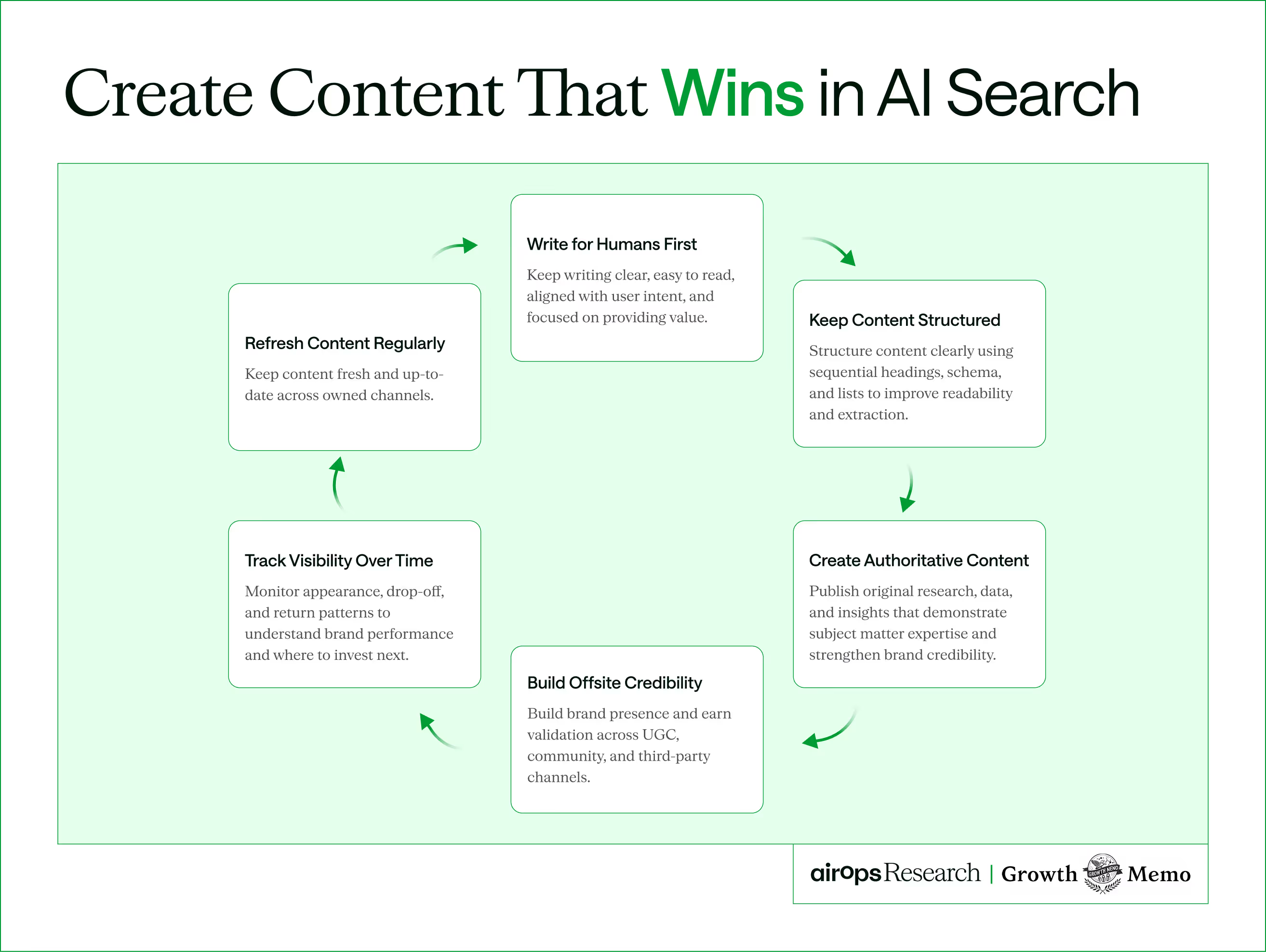
This playbook gives teams a clear guide for strengthening visibility across traditional search and AI answers:
- Refresh content quarterly: Update key pages every three months so models treat your information as current, accurate, and aligned with how people search.
- Keep content well-structured: Maintain sequential heading hierarchies with a single H1, add schema types that clarify page purpose, and make sure each section aligns with the user’s search intent so content is easily understood by both readers and search engines.
- Create unique, authoritative content: Publish original research, proprietary data, and expert explanations that add real value and reflect your brand’s subject-matter expertise. Keep product and feature pages current so your information remains accurate, trustworthy, and easy for search engines and third-party sites to reference.
- Write for clarity and extraction: Lead with direct answers and use concise lists so content is easy for users and models to read, interpret, and reuse.
- Engage in real community conversations: Participate in subreddits, forums, and third-party channels where your users ask questions, share experiences, and provide unfiltered feedback.
- Track visibility patterns over time: Monitor how often your brand appears across models and identify patterns in when you show up, drop out, and return so you can understand how your visibility shifts and where to prioritize improvements.
As AI search reshapes how people discover and compare options, the teams that build upon these habits will be the ones positioned to win in 2026.
Ready to turn visibility into measurable growth? Book a demo to learn how AirOps helps teams manage onsite content, build offsite credibility, and track visibility in AI search with our all-in-one platform.