9 Best Generative Engine Optimization (GEO) Tools in 2026
Generative engine optimization (GEO) tools track and improve how your brand shows up in AI search engines like ChatGPT, Gemini, Perplexity, and Google AI Overviews.
The category splits into three tiers: monitors (track mentions), trackers (analyze citations and sources), and platforms (monitor + optimize + publish + measure).
AirOps is the strongest fit for teams that need the full loop from insight to execution to measurement.
Fewer than 10% of sources cited by AI engines rank in the top 10 organic results. GEO requires different tools than traditional SEO.
AI search query volume grew 340% year-over-year, making GEO non-optional for competitive brands.
How We Evaluated These Generative Engine Optimization Tools
We tested each tool against seven criteria that matter for real marketing teams:
- AI platform coverage: How many AI engines does the tool track? ChatGPT, Gemini, Perplexity, Google AI Overviews, Claude, and Grok are the minimum bar.
- Citation tracking depth: Does the tool distinguish between brand mentions and actual source citations? Can it track citation rates over time?
- Actionability: Does the tool tell you what to fix, or does it stop at showing you the data?
- Content optimization capability: Can the tool help you create or update content based on what it finds?
- Integration: Does it connect to your CMS, Google Search Console (GSC), Google Analytics 4 (GA4), or existing SEO stack?
- Pricing transparency: Is pricing published and clear? Are there hidden per-query costs?
- Onboarding speed: How fast can a team go from signup to first useful insight?
What Is Generative Engine Optimization (GEO)?
Generative engine optimization (GEO) is the practice of improving how your brand appears in AI-generated search results. Traditional search engine optimization (SEO) focuses on ranking web pages in Google's organic listings. GEO focuses on earning citations, mentions, and positive sentiment in AI-powered answers from engines like ChatGPT, Gemini, and Perplexity.
The distinction matters because AI search behaves differently than traditional search. 64.82% of Google searches now end without a click. AI search query volume grew 340% year-over-year. Buyers are making decisions inside AI-generated answers before they ever visit your site.
Platforms like AirOps track citation rates across ChatGPT, Gemini, and Perplexity. This gives marketing teams visibility into a channel that traditional SEO tools cannot measure. GEO also differs from answer engine optimization (AEO), which focuses specifically on featured snippets and knowledge panels. GEO covers the full spectrum of AI-generated responses, including multi-turn conversations and source attribution.
What Makes a Great Generative Engine Optimization Tool?
The GEO tool market is growing fast. Here is what separates useful tools from noise. The best AI search optimization tools go beyond dashboards to connect what they find to the content you publish.
- Multi-engine coverage: Your tool needs to track more than one AI engine. Buyers use ChatGPT, Gemini, Perplexity, and Google AI Overviews interchangeably. Single-engine tracking gives you a partial picture.
- Citation vs. mention distinction: A mention means the AI named your brand. A citation means it linked to your content as a source. These are different signals that require different responses.
- Actionable recommendations: Dashboards are table stakes. A great GEO tool tells you which content to update, which pages to create, and which topics to target.
- Content execution capability: The gap between knowing what to do and doing it is where most teams stall. Tools that connect insight to content production save months.
- Performance measurement: You need to tie content changes back to citation and mention rate movement. Without this, you are optimizing blind.
GEO tools fall into three tiers. Understanding which tier you need prevents overspending or underpowering your stack.
Only 30% of brands maintain consistent visibility from one AI answer to the next. That volatility is why the difference between monitoring and executing matters so much. Teams that build content refresh workflows recover lost citations faster than those relying on periodic audits.
What metrics do the best generative engine optimization tools track?
The best generative engine optimization tracking tools measure how often AI engines cite, mention, and represent your brand. These signals replace rankings and clicks as the numbers that matter in AI search.
- Citation rate: how often AI engines link to your content as a source.
- Brand mention rate: how often AI answers name your brand, cited or not.
- Share of voice: your visibility against competitors for the prompts you track.
- Sentiment: whether AI answers describe your brand positively, neutrally, or negatively.
- Prompt coverage: which buyer questions surface your brand and which leave you invisible.
AirOps treats the Brand Visibility Score, mentions divided by total relevant answers, as the north-star metric for AI search. Citations and mentions compound, and brands that earn both are 40% more likely to resurface across AI answers than brands cited alone.
Volatility makes these metrics worth tracking continuously. Only 30% of brands stay visible from one AI answer to the next, so a single audit tells you little.
The 9 Best Generative Engine Optimization Tools in 2026
The best generative engine optimization software ranges from free monitors to full execution platforms. AirOps leads these best GEO tools for teams that need insight, execution, and measurement in one place.
1. AirOps: Best for Enterprise Teams That Need Insight-to-Execution for GEO & AEO
AirOps is a full-loop generative engine optimization platform built for enterprise marketing teams. It connects AI visibility tracking directly to content execution and performance measurement. No other tool in this list closes the gap between "here is where you stand" and "here is what you ship" as completely. See our full AEO tools comparison for a deeper look at how AirOps compares to competitors.
AirOps pairs its software with a hands-on team that plans your media mix and runs your GEO strategy alongside your own team, so you get both the platform and the people who operate it in a single engagement.
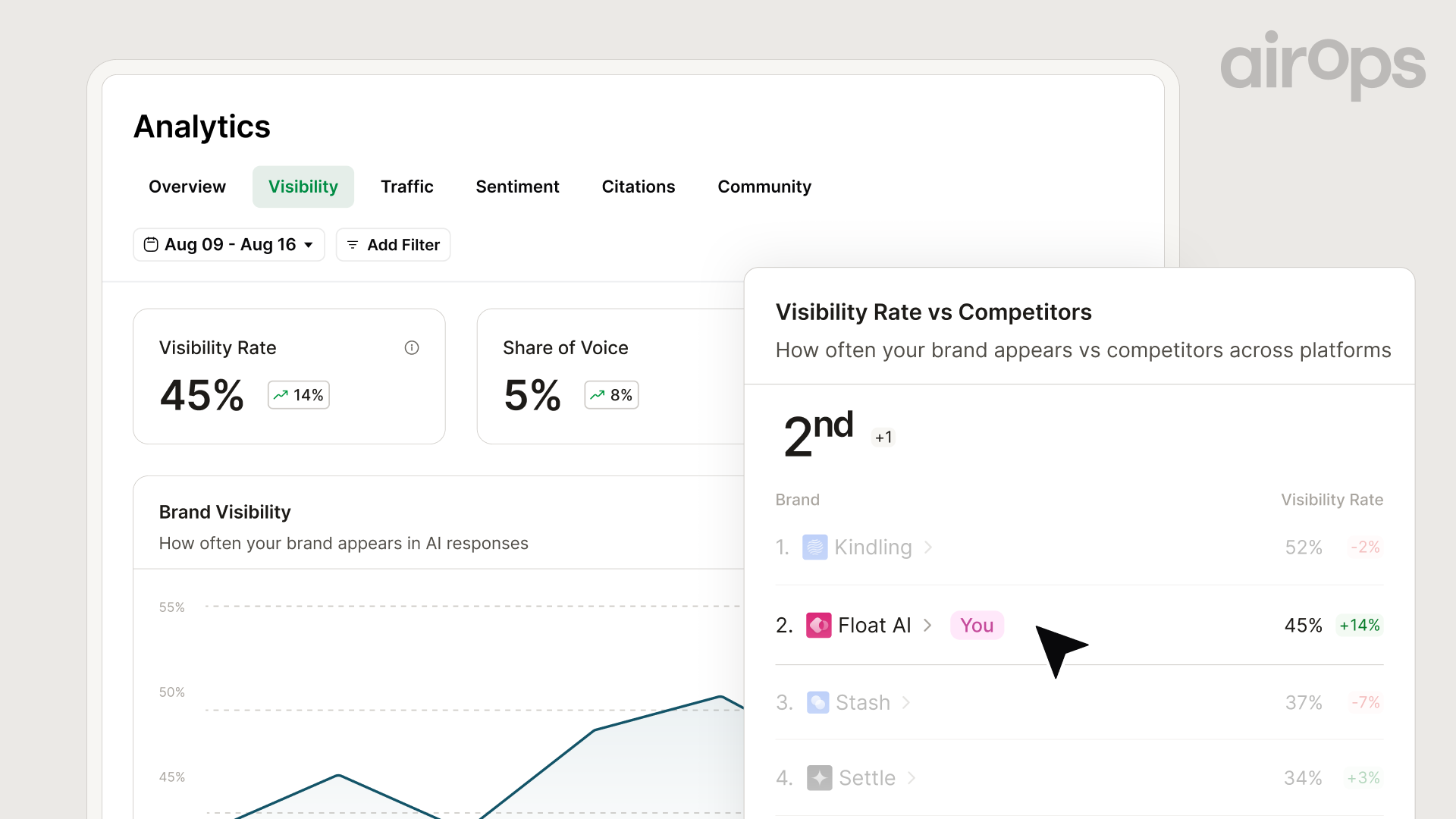
Insights surfaces citation rate, mention rate, sentiment, and competitive positioning across AI engines. You see which prompts your audience asks, which competitors show up, and where your brand gets cited or overlooked. Page360 connects that AI visibility data to GSC and GA4 metrics. You can tie a content change to a citation rate shift, then trace it through to organic traffic and conversions.
Quill, AirOps' AI agent, acts on the gaps Insights surfaces. It handles content creation, refresh, and optimization across your entire site. Your team sets the strategy. Quill runs the execution.
Prompt Discovery surfaces the questions your audience asks AI search engines using panel data. This is distinct from keyword research. These are the queries buyers type into ChatGPT and Perplexity before they ever reach Google.
The core value of AirOps is the closed loop: insight leads to action, action leads to measurement, and measurement feeds back into better insight. That loop compounds over time. Teams that run it consistently build a structural advantage in AI search.
- Best for: Enterprise teams running content at scale that need AI visibility insights tied directly to content execution and measurement.
- Not ideal for: Teams that need basic mention monitoring and nothing more.
- Pricing: Custom. Book a demo to see pricing for your team.
2. Semrush AI Toolkit: Best for SEO Teams Adding AI Visibility
Best for: SEO teams already using Semrush that want AI search tracking added to their existing workflow.
Key features:
- AI search tracking: Monitors brand visibility across ChatGPT, Gemini, AI Overviews, Claude, Grok, Perplexity, and Deepseek.
- Keyword-level AI visibility: Shows which keywords trigger AI answers and whether your brand appears.
- Integration with Semrush SEO suite: AI data sits alongside your organic keyword and backlink data.
Pros:
- Broadest AI engine coverage of any tool in this list (seven engines).
- Familiar interface for existing Semrush users.
- Strong keyword-to-AI-answer mapping.
Cons:
- No content creation or optimization engine built in.
- AI toolkit is an add-on, not a standalone product.
Pricing: $99/mo per domain on top of existing Semrush subscription.
Who it is best for: Mid-market SEO teams that want AI visibility added to their current Semrush workflow without switching platforms.
3. SE Ranking / Visible: Best for Combining SEO and GEO
Best for: Teams that want traditional SEO and GEO tracking in one dashboard.
Key features:
- Unified SEO + GEO dashboard: Organic rankings and AI visibility in the same view.
- Prompt-based tracking: Monitor how your brand appears for specific prompts across ChatGPT, Gemini, AI Overviews, and Perplexity.
- Competitive analysis: Side-by-side comparison of your AI visibility against competitors.
Pros:
- Clean combined view of SEO and GEO metrics.
- Affordable entry point for mid-market teams.
- Strong prompt tracking at $189/mo for 450 prompts.
Cons:
- No content execution or optimization capabilities.
- AI engine coverage is narrower than some competitors.
Pricing: $189/mo for 450 prompts. Higher tiers available.
Who it is best for: Mid-market teams already using SE Ranking for SEO that want GEO added to the same platform.
4. AthenaHQ: Best for On-Page GEO Scoring
Best for: Teams focused on optimizing content structure for AI citation eligibility.
Key features:
- GEO scoring: Page-level score that predicts citation likelihood in AI answers.
- Schema automation: Generates and applies structured data markup to improve AI readability.
- Entity tagging: Identifies and tags entities on your pages to help LLMs understand your content.
Pros:
- Unique focus on the structural factors that drive AI citations.
- Automated schema generation saves technical SEO time.
- Broad LLM coverage.
Cons:
- Narrower focus than full-platform tools.
- No content creation capabilities.
Pricing: $295/mo.
Who it is best for: Technical SEO teams that want to optimize content structure specifically for AI citation eligibility.
5. Scrunch AI: Best for Multi-Turn Conversation Mapping
Best for: Teams that want to understand how AI engines handle follow-up questions and conversation flows.
Key features:
- Conversation mapping: Tracks how AI answers evolve across multi-turn queries.
- Hallucination detection: Flags when AI engines generate inaccurate claims about your brand.
- Customer journey mapping: Maps the path from AI query to brand interaction.
Pros:
- Unique multi-turn analysis that other tools lack.
- Hallucination detection protects brand reputation.
- Strong conversation-level insight.
Cons:
- Higher price point at $300+/mo.
- No content creation or optimization tools.
Pricing: $300+/mo.
Who it is best for: Brand and reputation teams that need to monitor how AI engines represent their brand across extended conversations.
6. Otterly AI: Best for GEO Beginners
Best for: Teams new to GEO that want simple, affordable mention tracking.
Key features:
- Mention tracking: Monitors when AI engines mention your brand by name.
- Sentiment analysis: Tracks whether mentions are positive, negative, or neutral.
- Competitor comparison: Basic side-by-side view of your brand vs. competitors in AI answers.
Pros:
- Simplest interface in this list.
- Affordable starting price at $29/mo.
- Good first step for teams exploring GEO.
Cons:
- No citation tracking (mentions only).
- No content optimization or creation features.
Pricing: From $29/mo.
Who it is best for: Small teams or solo marketers taking their first step into AI search visibility tracking.
7. Peec AI: Best for Clean Citation Analytics
Best for: Teams that need precise citation data with clear distinction between source citations and visibility mentions.
Key features:
- Source vs. visibility distinction: Separates when your content is cited as a source from when your brand name appears.
- Citation rate tracking: Monitors citation frequency over time across AI engines.
- Clean reporting: Focused dashboards without feature bloat.
Pros:
- Best citation-vs-mention distinction in the market.
- Clean, focused interface.
- Good data quality for the price point.
Cons:
- Narrower feature set than platform-tier tools.
- No content execution capabilities.
Pricing: From €89/mo.
Who it is best for: Analytics-focused teams that want precise citation data without paying for features they will not use.
8. HubSpot AEO Grader: Best Free AI Visibility Check
Best for: Teams that want a quick, free snapshot of their AI search presence.
Key features:
- Brand visibility grading: Categorizes your brand as Leader, Challenger, or Niche Player in AI search.
- Competitive positioning: Shows where you stand relative to competitors in AI answers.
- Free access: No cost, no credit card required.
Pros:
- Completely free.
- Fast setup (minutes to first result).
- Good starting point for GEO awareness.
Cons:
- Snapshot only. No ongoing tracking or trend data.
- No actionable recommendations.
Pricing: Free.
Who it is best for: Marketing leaders who need a fast, free gauge of AI search visibility before investing in a paid tool.
9. Ahrefs Brand Radar: Best for Existing Ahrefs Users
Best for: Teams already using Ahrefs that want AI citation data inside their current workflow.
Key features:
- Cited Domains report: Shows which domains AI engines cite most for your tracked keywords.
- Cited Pages report: Identifies specific pages earning AI citations.
- Integration with Ahrefs SEO data: AI citation data sits alongside backlink and keyword data.
Pros:
- No additional cost for existing Ahrefs users.
- Strong domain and page-level citation tracking.
- Familiar Ahrefs interface.
Cons:
- Limited AI engine coverage (primarily ChatGPT and AI Overviews).
- No content optimization or creation features.
Pricing: Included with Ahrefs plans starting at $129+/mo.
Who it is best for: SEO teams already invested in Ahrefs that want AI citation data without adding another tool to their stack.
How to Choose the Right GEO Tool for Your Needs
AI citations are volatile. Brands see 40-60% monthly variance in AI citations. That makes your tool choice a strategic decision, not a purchasing formality. Here is how to match your needs to the right tier.
- If you are starting GEO for the first time, prioritize simple mention tracking. Otterly AI or HubSpot AI Search Grader gives you a baseline without a large investment.
- If you need competitive intelligence, prioritize citation depth and sentiment analysis. Profound, SE Ranking / Visible, or Peec AI give you the data to build strategy.
- If you have content to optimize but no system to do it, prioritize platform-tier tools with content execution. AirOps connects insight to action so your team ships instead of stalls.
- If you already run Semrush or Ahrefs, prioritize native add-ons first. Semrush AI Toolkit and Ahrefs Brand Radar add AI visibility without changing your workflow.
- If you need to prove ROI to leadership, prioritize measurement capabilities. AirOps ties every content action back to citation and traffic movement. That gives you the data for a board-level conversation.
- If content structure is your bottleneck, prioritize on-page optimization. AthenaHQ scores your pages for citation eligibility and automates schema markup.
The right tool depends on where your team is in the GEO maturity curve. Start with monitoring, move to tracking, and scale into a full platform when you are ready to execute.
Why off-site signals shape AI search visibility
Most AI citations come from pages you do not own. Off-site sources like Reddit, review sites, and industry listicles shape a large share of how AI engines describe your brand.
Off-site presence is one of the biggest levers in AI search. AirOps research shows off-site alone can drive up to 85% of top-of-funnel AI influence, and 85% of brand mentions come from third-party pages rather than owned domains, with about 48% of citations coming from community platforms like Reddit and YouTube.
This changes how you judge generative engine optimization software. Strong GEO tools measure both on-site and off-site visibility, so check for these capabilities.
- Off-site coverage: does the tool surface citation opportunities on third-party sites, not just your domain?
- Source-level detail: can you see which external pages AI engines cite for your topics?
- Competitive share: does it show where competitors earn off-site citations you could win?
AirOps for Generative Engine Optimization
Most GEO tools stop at monitoring. They show you where your brand stands in AI search. That is valuable. It is also insufficient.
The gap between seeing a problem and fixing it is where teams lose months. AirOps closes that gap with a system that connects AI visibility insights directly to content execution and performance measurement. Insights tells you where to focus. Quill runs the execution. Measurement confirms what moved.
Prompt Discovery surfaces the questions your audience asks AI search engines. These are not keywords. These are the prompts real buyers type into ChatGPT and Perplexity. That signal feeds directly into your content strategy.
For teams ready to turn generative engine optimization into a repeatable system, AirOps is the platform that makes it happen. Behind that software, a hands-on AirOps team runs strategy through execution alongside your team and ties the work back to pipeline and revenue.
Book a demo to see how AirOps turns generative engine optimization into a repeatable system.
Frequently Asked Questions
FAQs About Generative Engine Optimization Tools
What Is the Difference Between GEO and SEO?
SEO optimizes web pages for ranking in traditional search engine results. GEO optimizes your brand's presence in AI-generated answers from engines like ChatGPT, Gemini, and Perplexity. The key difference: SEO is about ranking links. GEO is about earning citations and mentions inside AI responses. Fewer than 10% of sources cited by AI engines rank in the top 10 organic results, so GEO requires a distinct strategy.
Do I Need a Separate Tool for GEO, or Can I Use My Existing SEO Tool?
Most traditional SEO tools do not track AI search visibility. Some tools like Semrush and Ahrefs have added AI tracking features, but these are add-ons to their core SEO functionality. Dedicated GEO tools provide deeper citation tracking, sentiment analysis, and content optimization features that general SEO tools do not offer.
How Often Do AI Search Citations Change?
AI citations are significantly more volatile than organic rankings. Research shows 40-60% monthly variance in AI citations. Brands that do not update content regularly are 3x more likely to lose citations without quarterly updates. Consistent monitoring and content optimization are essential.
Can Content Structure Affect AI Citations?
Yes. Content with sequential headings earns a 2.8x citation boost compared to unstructured content. Pages with rich schema are 13% more likely to earn citations. Structured, well-organized content makes it easier for LLMs to extract and cite your information.
What Is the Minimum Budget for Getting Started With GEO?
You can start for free with HubSpot AI Search Grader to get a baseline snapshot. Paid monitoring starts at $29/mo with Otterly AI. Full-platform tools with content execution start at custom pricing (AirOps) or $99/mo per domain (Semrush AI Toolkit). Your budget should match your team's GEO maturity: monitoring costs less, execution costs more, and the ROI scales with commitment.
What are the best generative engine optimization tools?
The best generative engine optimization tools in 2026 are AirOps, Semrush AI Toolkit, SE Ranking, AthenaHQ, Scrunch AI, Otterly AI, Peec AI, HubSpot AI Search Grader, and Ahrefs Brand Radar. AirOps leads for enterprise teams because it connects AI visibility insights to content execution and performance measurement in one loop. Your best fit depends on GEO maturity, so monitoring tools cost less while full platforms drive more results.
Is AirOps or Profound better for generative engine optimization?
AirOps is the better fit for teams that want to turn AI visibility into published content, because it connects insight, execution, and measurement in one platform. Profound is a strong monitoring and analytics option for teams that mainly need cross-engine visibility tracking. Choose AirOps when you need to act on the data, and Profound when monitoring alone is enough.
Do generative engine optimization tools integrate with your CMS?
Some do, and CMS integration is worth checking before you buy. AirOps connects to your CMS along with Google Search Console and Google Analytics 4, so you can publish and measure changes in one place. Many monitoring-only tools track visibility but leave publishing to a separate workflow.
Do GEO tools charge overage or per-query fees?
Some do. Many GEO tools price by the number of prompts or queries you track, and going over that limit can add per-query charges. Check whether pricing is flat or metered, and confirm any overage rate before you commit.
Get the latest on AI content & marketing
