- AI answers are replacing clicks: Tools like ChatGPT, Perplexity, Gemini, and Google AI Overviews now satisfy many queries without driving traffic—your brand must be cited in the answer or it vanishes from the customer journey.
- Citations beat rankings: LLMs surface fresh, structured, expert content that leads with the key fact; keywords and backlinks alone no longer guarantee visibility.
- Automate to stay visible: AirOps shows where your brand is (and isn’t) cited, flags the gaps, and triggers updates to keep you showing up while competitors fade.
There’s a big shift marketing leaders, SEOs and content marketers are only now starting to understand about search. The information gathering that used to happen on your website is now happening in AI search conversations.
Here is the key data:
AI Search Adoption Is Surging: More than 36 million U. S. adults will use generative AI as their primary search tool by 2028— a surge that puts answer engine optimization (AEO) at the center of every content strategy—up from 15 million in 2024.
Gen Z Leads the Shift: Gen Z is 54% more likely than the average consumer to use chatbots like ChatGPT for online information.
Outdated content is slowly erasing you from AI results
Zero-click searches dominate: More than 60% of Google searches now end without a click, a zero-click search trend that forces brands to earn visibility inside the answer itself.
What’s the impact? Discovery no longer occurs on the SERP, but instead its ChatGPT, Gemini, Perplexity, Google AI Overviews, and a growing number of in-app assistants that are the discovery engines.
AI search is replacing SERPs with single answers and cutting brands out of the conversation entirely.
How AI Search is Different
AI search is any discovery experience where LLMs decides what to show the user and which sources deserve credit. Instead of listing ten links, the system assembles a single narrative answer, then attaches citations or brief source cards. AI search engine optimization requires a fundamentally different playbook than traditional SEO.
The shift is already visible in Google.
A Semrush study of ten million U. S. desktop queries found that AI Overviews appeared in 13% of searches in March 2025, up from 6% just two months earlier.
To succeed at AI search optimization, you need to understand this three-step process:
Understand the query: The model interprets the user’s question using both training data and real-time snapshots of the web. It analyzes intent, phrasing, and context—far beyond traditional keyword matching.
Generate an answer: Using semantic search, the AI retrieves relevant data, scores its trustworthiness, and blends multiple sources into a single narrative response in natural language.
Attach citations: If the product supports it (like ChatGPT, Perplexity, or Google AI Overviews), the model cites its sources inline so the user can verify the information.
Visibility is no longer measured in blue-link positions but is earned in the form of inline citations and brand mentions across dozens of AI surfaces that update continuously.
So how exactly does AI search differ from classic SEO? These are the seven shifts that matter most.
SEO vs. AI Search: 7 Core Differences
The AEO vs SEO comparison comes down to seven fundamental shifts.
1. Search Behavior: From Keywords to Full Questions
The biggest shift from traditional SEO to AI search starts with how people ask questions.
Old search behavior revolved around short, specific keywords like:
“email marketing tool”
“best CRM for startups”
“project management pricing”
These were navigational or transactional, and easy to optimize with page-level SEO tactics.
But with AI engines like ChatGPT, Perplexity, and Gemini, search has evolved into something much deeper.
For instance, instead of typing:“email marketing tool, they ask:
“I run a small ecommerce brand. What’s the best email marketing platform for automations, low send volume, and built-in product recommendations?”
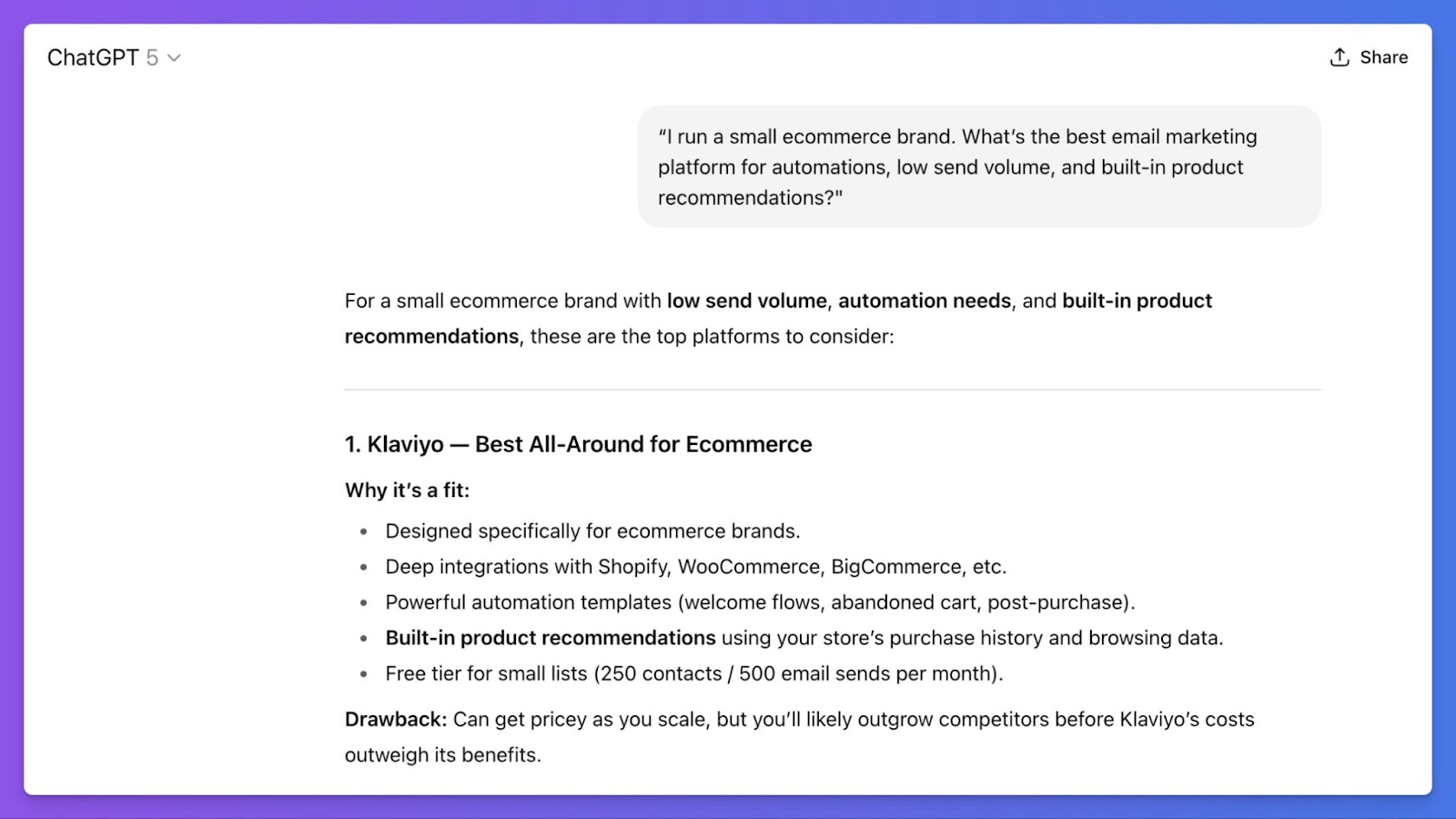
These prompts are multi-step, problem-focused, and often personalized. They require understanding context and not just keywords.
What to do:
Rebuild your keyword strategy around real user questions.
Use those questions as prompt seeds in ChatGPT to see whether your content is cited or ignored.
2. Query Handling: From One Query to Many Intents (Fan-Out)
In traditional search, a single query led to a single results page.
AI search takes a different approach. It breaks each prompt into multiple sub-questions (a technique called query fan-out), then assembles an answer from multiple sources.
Example:
A user asks:
“What’s the best email marketing tool for small businesses?”
AI search splits this into:
Best tools for automation workflows
Platforms with strong segmentation features
Pricing comparisons for low-volume senders
Recommendations for ecommerce integrations
It then pulls chunks from different sites to stitch together a complete response.
What to do:
Create hub-and-spoke content that addresses each micro-intent.
Instead of one broad “Best Email Marketing Tools” page, publish tightly focused assets like:
“Best Email Marketing Tools for Ecommerce Automation”
“Email Marketing Pricing Comparison for Low-Volume Senders”
“Top Email Platforms for Advanced Segmentation”
This increases your odds of being cited for each specific need.
3. Optimization Target: From Page-Level to Passage-Level
SEO teams traditionally optimized at the page level: meta titles, headers, keyword density.
AI engines don’t care about the whole page. They scan for small, self-contained passages that answer precise questions.
You could have a 2,000-word blog post reviewing email marketing software, but only one paragraph comparing automation features might be cited by ChatGPT or Google AI Overviews.
What to do:
Make every paragraph fact-rich, self-contained, and directly answer a likely question.
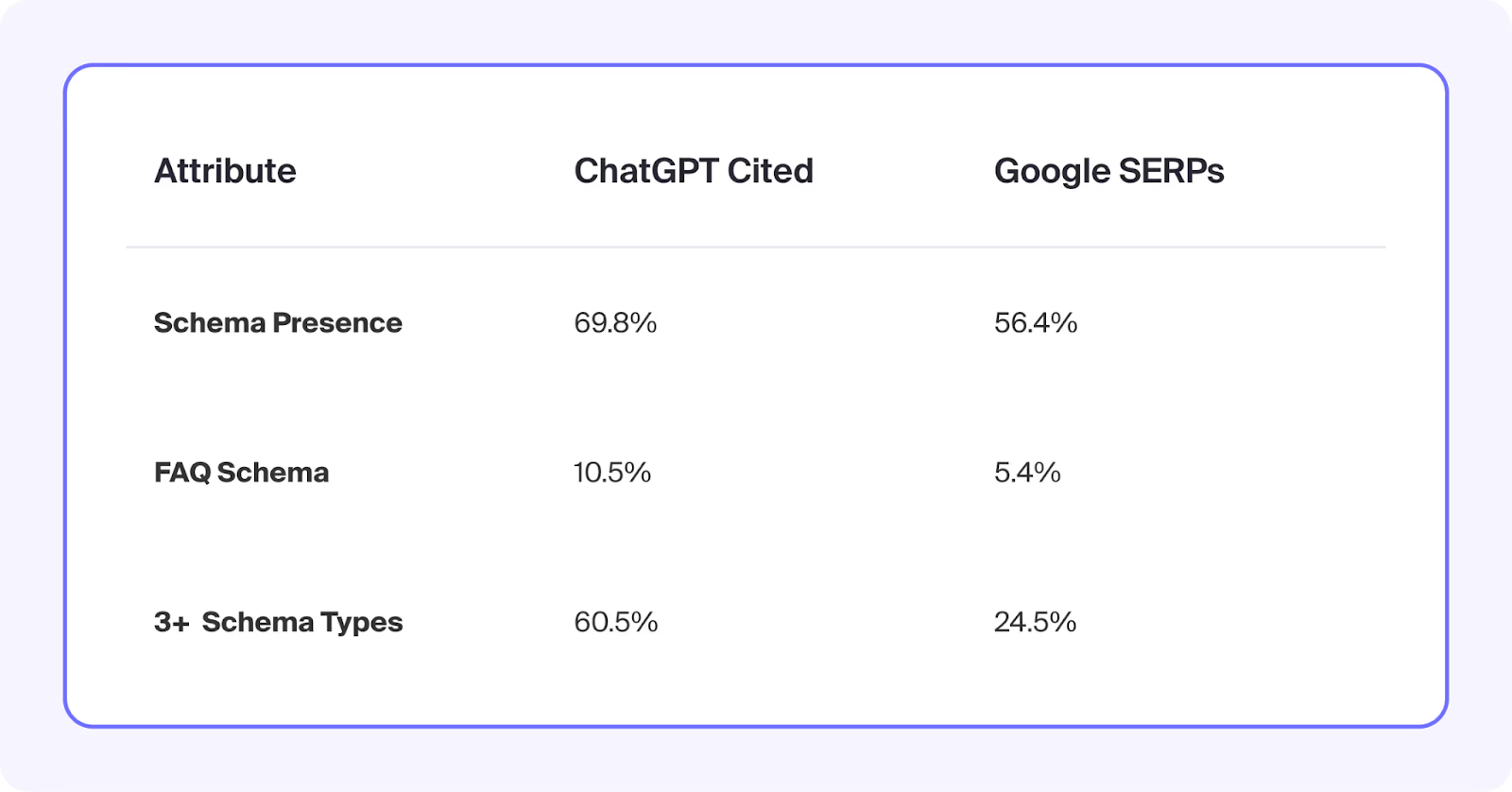
Use subheadings, bullet points, and schema to make those answers easy to extract.
Bonus: This also improves your odds of winning featured snippets.
Source: Structuring Content for LLMs
4. Authority Signals: From Backlinks to Structure & Freshness
Backlinks still matter, but AI engines use a broader trust model. Instead of only counting links, they prioritize:
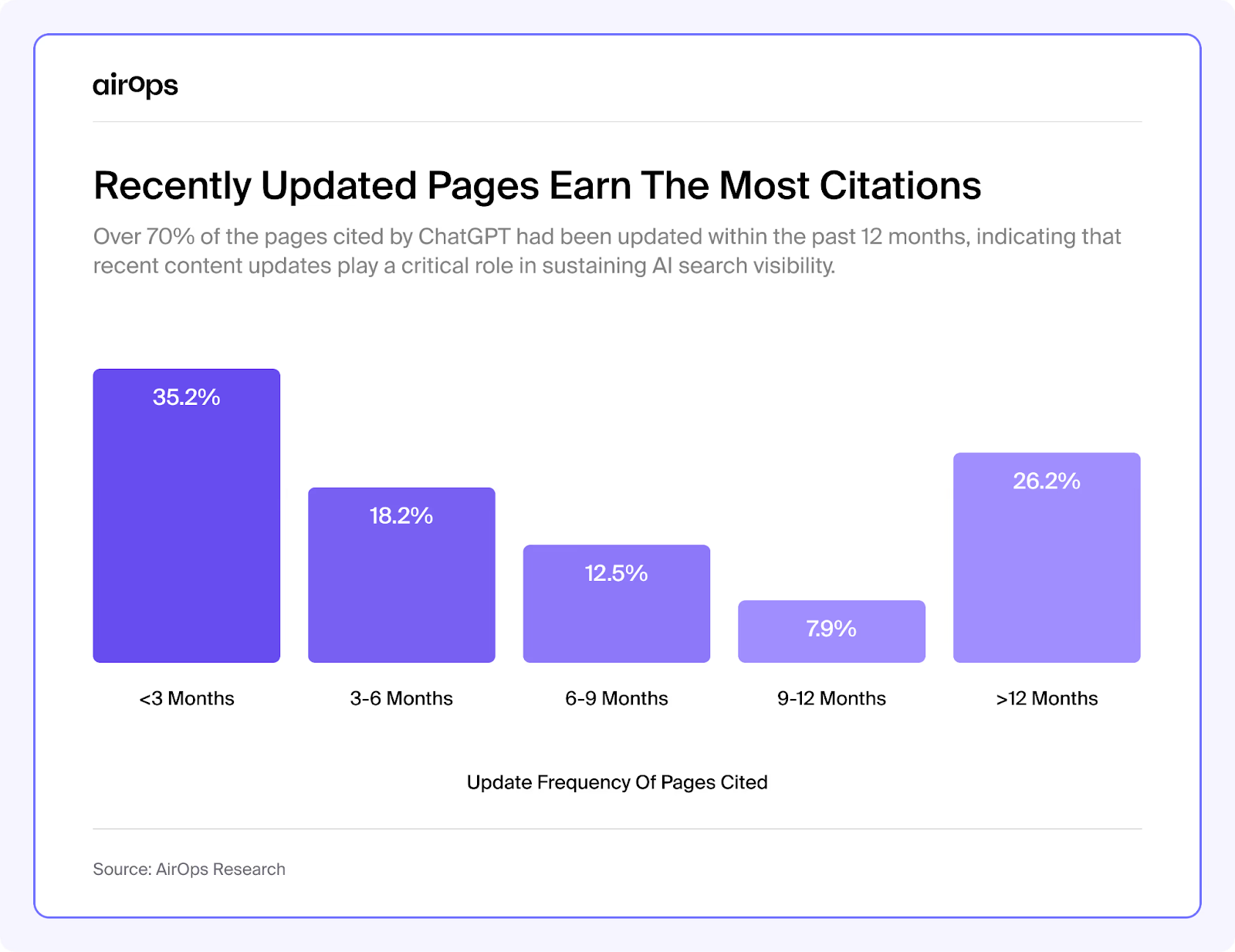
Fresh content with recent timestamps
Clear author attribution and bio links
Structured data like FAQ or How-To schema
Consistent claims across all channels
What to do:
Update content every 4–6 weeks to keep timestamps fresh.
Add author schema and detailed bios to build credibility.
Use structured data (FAQ, How-To) to signal clarity.
Keep facts consistent across your website, blog, social posts, and press releases.
Source: The Silent Pipeline Killer: How Stale Content Costs You AI Citations (and Customers).
5. Results Format: From 10 Blue Links to 1 Synthesized Answer
Old Google results gave users a buffet of links.
AI search gives them one answer, stitched together from trusted sources. If your content isn’t cited in that answer, your brand doesn’t appear—no matter how well you rank in Google. This is the zero-click search reality: the AI generates one answer and most users never scroll past it.
What to do:
Focus on clarity, structure, and extractability.
Use tools like the AirOps FAQ Schema Generator to create machine-readable sections.
Lead with the answer, then provide supporting details.
6. User Experience: From Browsing SERPs to Receiving Narratives
AI-generated answers are narrated explanations, not link lists.
What to do:
Write in a narrative structure: lead with the direct answer, then explain.
Use bullet points, headings, and schema so your content can be woven easily into AI-generated summaries.
7. Search Platforms: From Blog Posts to Blogs + Social + Community
Google primarily indexed websites.
AI models now pull from:
Blogs and websites
Reddit comment threads
YouTube video transcripts
LinkedIn posts and bios
Thanks to licensing deals, LLMs have direct access to these platforms. OpenAI reportedly used over one million hours of YouTube video to train GPT-4, and Reddit’s data licensing now accounts for roughly 10% of its revenue.
What to do:
Go beyond your blog.
Post clear, valuable responses on Reddit.
Script YouTube videos so they are easy to transcribe and extract.
Add author information to LinkedIn profiles and posts.
Treat every platform as a potential AI discovery surface.
The Actions That Matter for AI Search
Traditional SEO rewarded checklists: links, keywords, meta descriptions, and click-through data.
AI content optimization demands freshness, structure, and credibility, updated continuously, not quarterly.
Here is what has changed and what to do about it.
1. Create Trust with Structured Data & Expertise
Classic SEO rewarded backlinks and domain authority. Large language models do not “crawl and rank” in the traditional sense. They generate answers based on recency, clarity, and extractability.
Models favor content that is:
Recently updated
Written by a clearly identified expert
Consistent across all channels
Schema helps models match queries with exact passages. Structured pages are 2–3x more likely to earn citations. Pages with rich schema are 13% more likely to earn AI citations, and pages with clean, sequential headings are nearly three times more likely to be cited.
What to do:
Add author bios and clear attribution
Use structured data on every applicable page
Keep timestamps fresh
Make your expertise machine-readable
2. Lead with Your Answer
LLMs lift direct, concise statements. Don’t bury your insight. Evidence placed early in content improves trust signals and extractability.
What to do:
Open with the direct answer, stat, or takeaway
Keep it concise, then expand with supporting details
Review high-value pages to ensure key facts are positioned up front
3. Keep Your Content Fresh with Regular Updates
Most SEO programs still operate on a monthly or quarterly update cycle.
AI search engines move faster.
Models like ChatGPT, Claude, and Gemini retrain continuously on live web snapshots
Google AI Overviews refresh content in near real time
From January to March 2025, Google queries showing an AI Overview doubled
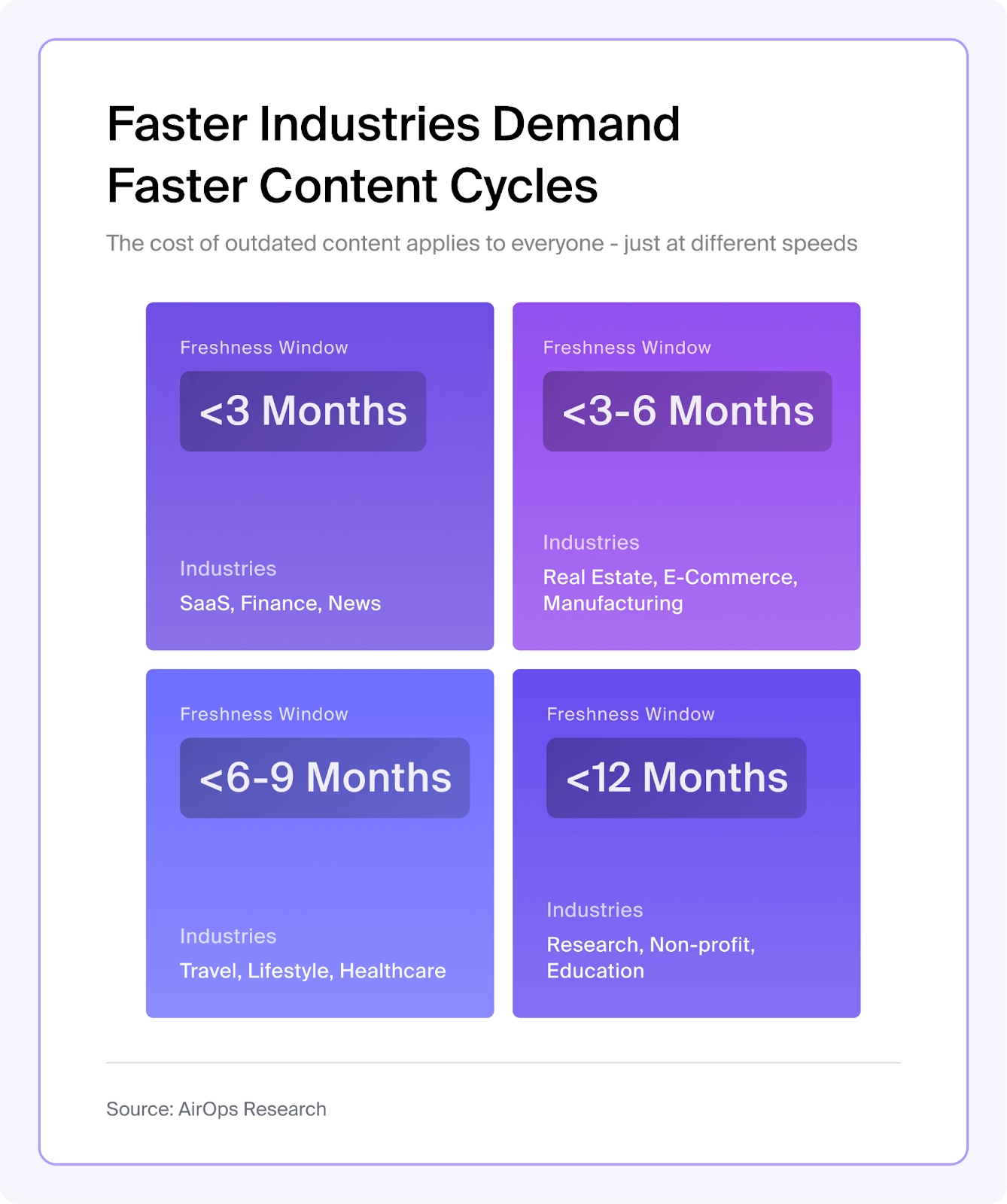
Content that is even slightly out of date can vanish from AI results. Pages updated every 4–6 weeks are far more likely to be cited. Even minor edits and a fresh timestamp help models prioritize your content.
Source: The Silent Pipeline Killer: How Stale Content Costs You AI Citations & Customers
What to do:
Shift to light, frequent updates
Even a minor revision plus a fresh timestamp can keep your content in a model’s active memory
Refresh your content every 90 days like Shopify and other top-tier brands
4. Add Primary Evidence
First-party data, proprietary visuals, and original research differentiate your content from commodity sources and strengthen authority in model scoring.
AI search engines favor content that is factually accurate, up to date, well-structured, and authoritative. Proprietary data and visuals check all those boxes.
What to do:
Include proprietary charts, survey results, or original photos
Use HTML tables instead of images for better extraction
Add alt text and captions to all visuals
Highlight original data in bullet points or block quotes
Pair data with structured schema, author credentials, and visible timestamps
5. Create Content With Specificity
Covering narrowly defined questions in depth helps models match your content to specific user intents without introducing irrelevant details.
What to do:
Target tightly scoped topics instead of trying to cover everything in one post
Organize content so each page cleanly maps to a distinct intent
Remove unrelated sections that dilute topical focus
6. Be Consistent in Your Message Across Channels
Mismatched facts across platforms kill trust. Contradictory claims, numbers, or dates weaken trust signals and can push models toward other sources. AI looks for alignment.
What to do:
Align terminology across your website, blog, social posts, press releases, and partner content
Audit regularly to catch inconsistencies
Maintain a central reference for approved stats and messaging
7. Optimize with Continuous AI Workflow Loops
Traditional SEO is checklist-driven:
Fix meta tags
Rework headers
Refresh old blogs
What to do:
LLM optimization is not a one-time project. Teams that learn how to optimize for AI search treat it as a continuous loop:
Track where your brand is cited or not across ChatGPT, Gemini, Perplexity, and Google AI Overviews
Identify gaps such as outdated timestamps, missing schema, or no author attribution
Update or create content to close those gaps
Re-prompt models and test if visibility improves
Repeat this cycle until your content earns consistent citations, then start again. This is less like traditional SEO and more like product development:
Regular updates keep you relevant
Structured feedback identifies where you are missing
Ongoing investment ensures you stay visible wherever AI engines look for answers
How to combine AEO and SEO into one strategy
Traditional SEO targets short keyword queries. Answer engine optimization targets the longer, conversational prompts users type into ChatGPT, Perplexity, and Gemini. Most teams treat them as separate channels, but the highest-performing pages rank for both.
The gap between traditional queries and AI prompts is smaller than it looks. Ethan Smith of Graphite found that the average Google search is about 3.5 words, while the average AI prompt is about 60 words. Both start from the same user intent. The AI version just adds more context.
Start with four moves that serve both surfaces:
Audit your top 20 organic pages for AI citability. Run each page’s primary keyword as a conversational prompt in ChatGPT and Perplexity. If your page ranks on Google but is absent from AI answers, the content needs restructuring.
Expand thin pages into comprehensive answers. A 500-word blog post that ranks for a single keyword will not earn AI citations. Add structured data, direct answer-lead sentences, and supporting evidence.
Build entity coverage across channels. AI models pull from Reddit, YouTube, and LinkedIn. Consistent, structured mentions of your brand across these platforms strengthen both your organic authority and your AI citation rate.
Refresh on a 4-to-6-week cycle, not quarterly. Freshness is a ranking signal for Google and a citation signal for AI models. Pages updated within 3 months are 3x more likely to be cited (AirOps Research).
The teams seeing the strongest results from AI search are the ones connecting it to revenue. Kyle Poyar found that AI search now drives 10 to 15% of pipeline for early adopters, with 2x to 6x higher conversion rates than traditional organic. A unified AEO and SEO strategy captures that value without doubling your content workload.
How to measure AEO and SEO performance together
You need AI visibility metrics alongside your existing SEO KPIs. Rankings and click-through rates still matter, but they do not capture whether your brand appears in AI-generated answers.
Track these five metrics across both surfaces:
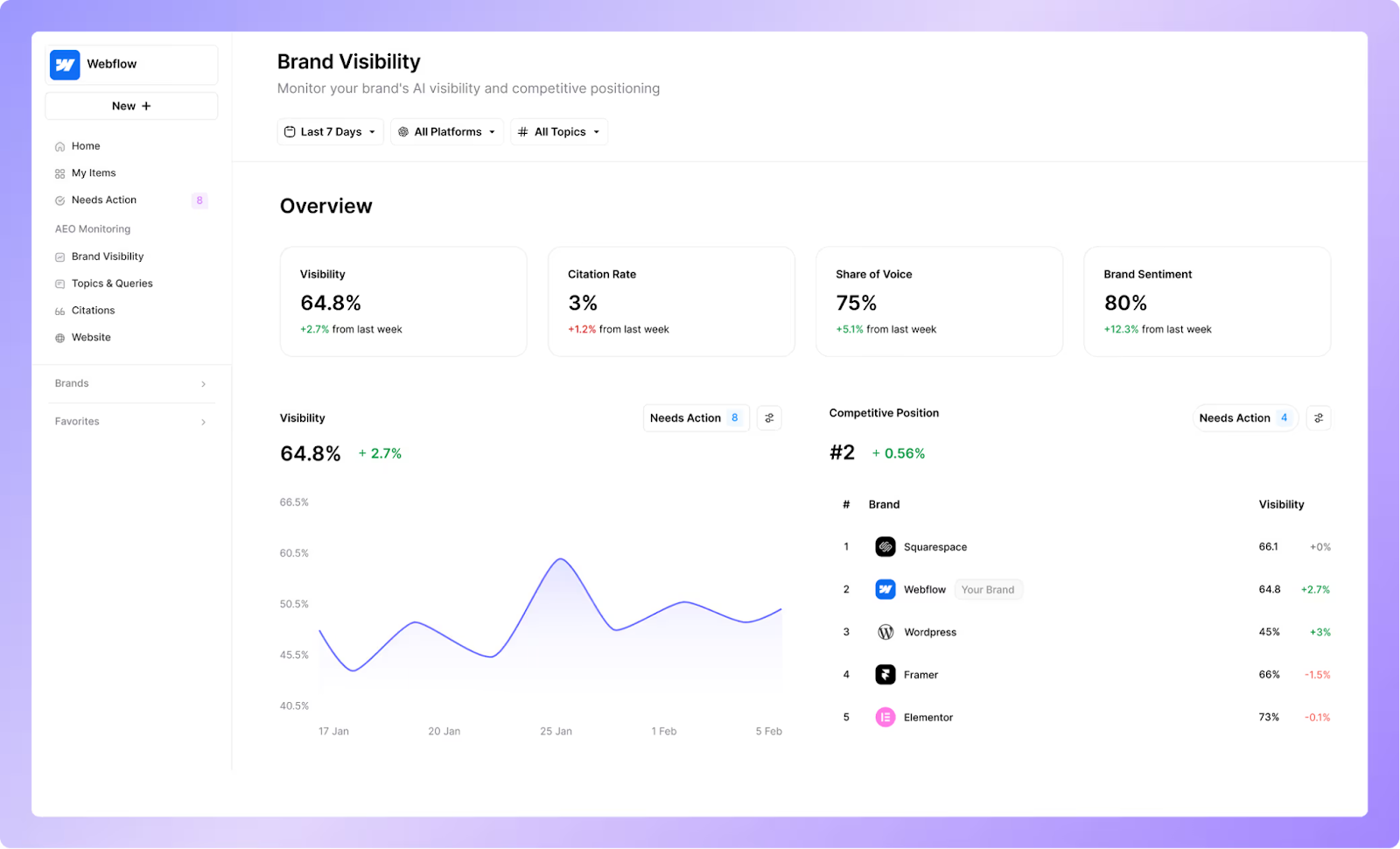
Citation rate: The percentage of tracked prompts where your page is cited. Less than 10% of the same content is cited after 5 consecutive runs of the same prompt (AirOps Research), so this metric must be monitored weekly.
Mention rate: How often AI models name your brand when answering questions in your category. 85% of top-of-funnel B2B brand mentions come from third-party content (AirOps Research).
Share of voice: Your brand’s citation share compared to competitors across ChatGPT, Perplexity, Gemini, and Google AI Overviews.
Content freshness score: Pages updated within 3 months are 3x more likely to be cited (AirOps Research). Track how many of your top pages fall outside that window.
LLM referral traffic: Direct visits from ChatGPT, Perplexity, and other AI engines. George Bonacci (VP Growth, Ramp) reports 7 to 10% of conversions now come from ChatGPT referrals for B2B.
AI overviews in SEO results add another dimension to track. Google queries showing an AI Overview doubled from January to March 2025. Monitor which of your pages appear in those overviews alongside your traditional SERP positions.
Sydney Sloan (G2) shared that 51% of B2B buyers now use and trust AI tools during their research. If your measurement stack only tracks Google rankings, you are missing half the picture. AirOps Insights unifies AI visibility metrics with GSC and GA4 data in a single view, so you can see exactly where your content earns citations and where it falls short.
Build this review cadence:
Weekly: Review citation rate and mention rate for your top 20 pages.
Monthly: Benchmark share of voice against your top 3 competitors.
Quarterly: Connect AI visibility trends to pipeline and conversion data.
Search Is Still Here, Just In a New Form
Search behavior is changing, but the demand for answers is not.
As Wil Reynolds of Seer Interactive explained in a recent AirOps webinar:
“People still have these questions. Just because you’re not getting the same amount of traffic doesn’t mean that people have dropped in their number of questions. They’re just asking them in new places.”
Win AI Search with AirOps
AirOps is the only all-in-one platform that shows you exactly where your brand appears (or doesn’t) across ChatGPT, Perplexity, Google AI, and more—then tells you what to fix, which queries to target, and brings the team that takes action alongside you by updating content, earning citations, and joining high-visibility conversations. Traditional backlink authority does not automatically translate into AI citations. As Aja Frost (HubSpot) shared in a recent AirOps webinar, the pages earning AI citations are not always the ones with the most backlinks. They are the ones with the clearest, most structured answers. AirOps Insights tracks exactly which pages earn citations and which prompts drive them, so you can focus your updates where they count.
Book a live AirOps demo to make content ops your unfair advantage to win the AI answer box before your competitors even notice it’s gone.
Get the latest on AI content & marketing
