AI search is rewriting the rules of discovery. Buyers now find brands through conversational prompts and synthesized answers, not just keyword searches.
In this AirOps webinar, Aja Frost, Senior Director of Global Growth and Paid Advertising at HubSpot, joined Josh Spilker, Head of Search Marketing at AirOps, to share what HubSpot's research reveals about Answer Engine Optimization (AEO). This recap covers the biggest findings, the content patterns that drive citations, and the practical steps teams can take in the next 30 days.
Top 5 takeaways
1. Blog content still matters in AI search
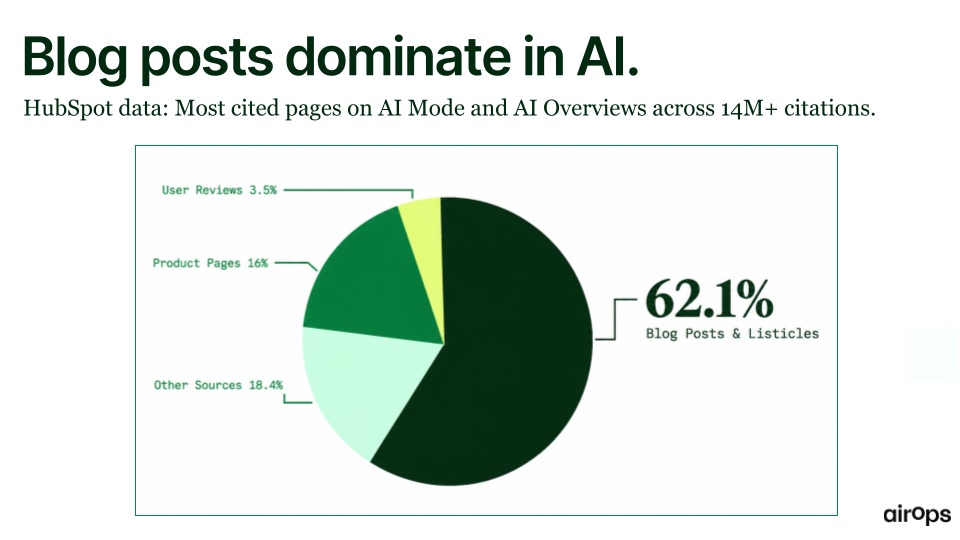
HubSpot's research found blogs and listicles remain the most-cited page type in AI answers. Your blog still teaches answer engines about your brand and products, even as the search landscape shifts.
2. AEO rewards context, not just keywords
Persona pages and use-case pages match the long, detailed prompts buyers type into tools like ChatGPT far better than broad category pages do. Context-rich content wins citations.
3. Structure is now a visibility lever
Question headers, FAQ sections, proprietary stats, and visible updates help answer engines extract and cite your content. Structure makes your insights easier to find and reference.
4. Backlinks matter less than consensus signals
LinkedIn, Reddit, and YouTube help answer engines validate your brand across multiple trusted sources. Off-site presence now carries as much weight as traditional link building.
5. AEO reporting has to become directional
Mentions and citations shift fast, so teams should track trends over time instead of reacting to one-day snapshots. Directional measurement beats point-in-time panic.
Best practices and key learnings
Aja's message was clear: AI visibility doesn't come from one trick. Teams win when they publish specific content, structure it clearly, and track progress the right way.
Think of AI search as a discovery and reporting shift
AI search changes how buyers find brands, so content leaders need new reporting habits now. Separate awareness signals from direct-response signals before you set goals or report progress.
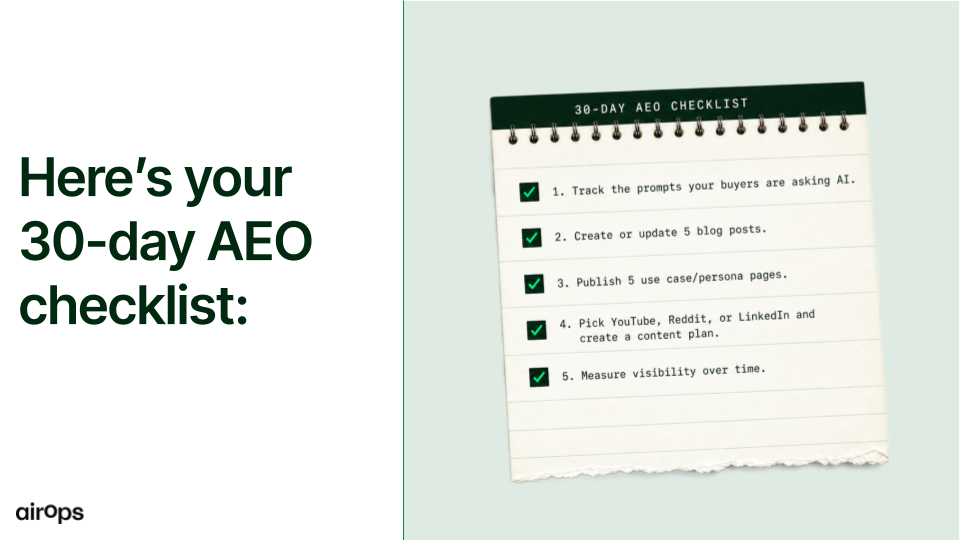
Track mentions and citations for brand awareness and direct traffic potential. Ask buyers how they heard about you so you can catch AI-assisted discovery earlier. Report weekly and monthly trend lines instead of checking visibility once and making a big call.
Keep investing in blog content, but write for buyer context
Your blog still plays a major role in AI visibility, even if organic traffic looks softer than it did before. The difference now is that broad keyword pages no longer do enough on their own.
Use blog posts to publish product details, pricing updates, benchmarks, and explanations you want AI tools to learn. Build content around real buyer situations—industry, persona, and use case. Start prompt research with buyer questions from sales calls, support tickets, and customer interviews.
"As more and more people adopt LLMs, search is going from keywords to context." — Aja Frost
Structure pages so answer engines can cite them
Answer engines prefer pages that make facts easy to find, extract, and repeat. Clear structure gives your content a better shot at citation without changing your core topic strategy.
- Turn H2s, H3s, and H4s into direct questions that match likely buyer prompts.
- Add FAQ sections and FAQ schema based on likely follow-up questions and query fan-out.
- Include proprietary stats, customer outcomes, external references, a TL;DR, and a visible last-updated date.
You simply frame your H2s, H3s, and H4s as questions." — Aja Frost
Refresh existing content before you chase net-new volume
Freshness now carries more weight in AI search than many teams expect. A real refresh can move an older page back into the citation mix faster than a net-new post can.
Update high-intent pages first—pricing, comparison, product, and testimonial-adjacent content. Replace stale stats, examples, and screenshots with current information and expert input. Keep the same URL in most cases, then show a visible last-updated date when you make meaningful changes.
Build brand consensus on LinkedIn, Reddit, and YouTube
Answer engines don't only evaluate your website. They look for repeated signals across trusted platforms to decide whether they should trust and mention your brand.
Activate employees, executives, and advocates on LinkedIn with posts and articles that discuss real problems and customer outcomes. Join relevant Reddit communities through a company or expert account and answer questions where buyers already ask them. Publish YouTube demos, comparisons, walkthroughs, and customer stories, then optimize titles, descriptions, and transcripts.
"Answer engines tend to look for consensus on LinkedIn, Reddit, and YouTube." — Aja Frost
Follow a 30-day AEO plan that serves more than one audience
Aja closed with a practical plan that content teams can start right away. Her framework keeps teams focused on tactics that help humans, Google, and answer engines at the same time.
Upload buyer prompts into your AEO workflow, then map content to real questions instead of broad keyword buckets. Refresh 5 existing blog posts and publish 5 persona or use-case pages with stronger structure and fresher proof points. Pick one off-site channel first if your team lacks time, then build momentum before you expand.
How to put these AEO insights into practice
AI search changes both content strategy and performance measurement. If your team still relies on broad keyword pages, backlinks alone, and traffic-only reporting, you'll miss how buyers now discover brands through detailed prompts and synthesized answers.
Start small and stay focused. Refresh a handful of high-intent pages, publish a small set of persona-specific assets, and build a simple visibility report that tracks mentions and citations over time. Keep the tactics that help more than one audience, and cut the ones that only create noise.
Win AI visibility before it becomes table stakes
HubSpot's research points in one clear direction: keep your blog, get more specific, structure pages for extraction, and build trust beyond your site. Teams that act now can improve AI visibility before these patterns become expected.
How AirOps helps content teams win AI searcg visibility
As one of the best AEO tools for enterprise companies, AirOps helps content and SEO teams turn AEO insights into repeatable workflows. You can use AirOps to find prompt-driven opportunities, refresh pages faster, publish persona-specific content, and track visibility trends with more confidence.
AirOps is the partner brands bring in for this shift: the platform, the media mix, and the team together, not just software to log into, building and running the strategy alongside your team and tying it back to pipeline and revenue.
- Discover high-value buyer prompts, query fan-out opportunities, and citation gaps.
- Build and refresh content with clearer structure, stronger proof points, and faster production.
- Track mentions and citations over time so you can show progress without overreacting to daily swings.
Ready to see how that works? Book a strategy call.
Get the latest on AI content & marketing
