
At AirOps’ EMEA launch in London, Alex Halliday, Co-Founder and CEO, shared early findings from the company’s research into how European buyers use AI to discover, evaluate, and choose products. The takeaway: AI search runs on evidence, and marketers need to build that evidence deliberately.
Buyers now use AI to fact check, compare options, and decide what to purchase. Before recommending a product, AI tools assess evidence from trusted sources across the web and this behavior is already happening at enormous scale. As Alex noted, Google’s AI Overviews reach 2.5 billion users, while AI Mode has surpassed one billion. This recap explores where AI finds that evidence and what your marketing team can do this quarter to influence it.
Top Takeaways
- AI Answers are Highly Selective: One answer can draw on dozens of pages and still recommend one brand, so every trusted source carries weight.
- Third Parties Hold Most of the Evidence: Your domain supplies a small share of what AI reads, putting publishers and reviews at the center.
- Each Market Has Its Own Evidence Diet: The sources a model reads change with location and language, so global plans need local inputs.
- Accurate Evidence Can Be Built on Purpose: Corrections, funded research, disclosed sponsored content, and customer reviews all shift what models say about your brand.
- Agents Favor Products With Proof Online: New assistants that shop and book for users can help the better product win when accurate evidence exists.
Best Practices and Key Learnings
Alex grounded each point in AirOps research and customer work across the US and Europe, with named brands and specific numbers. The five questions here follow his argument, starting with how AI picks a brand and ending with agents that buy on a user's behalf.
How Does AI Search Turn 65 Sources into one Recommendation?
An AI search tool starts with a fan-out query, breaking one question into a batch of related sub-searches. It gathers pages, evaluates the evidence, and narrows the results. In Alex’s example, 65 sources produced just three citations and a single recommendation. Most of what the model reads never reaches the buyer.
- Owned content made up 5% of the evidence AI read across European markets, leaving 95% on competitor websites, communities, and other sites.
- About 86% of European citations came from third parties, so off-site mentions shape most of what buyers see.
- YouTube appeared in as many as 56% of AI Mode answers, which puts video in your evidence plan next to written content.
"When AI is looking to make a recommendation, it uses trusted evidence across the web to figure out if a product or service is right for that user. So as marketers and brand leaders, it's our job to make sure we invest in the right evidence across the web, make sure it's accurate and timely, and ultimately set our brands up to be represented in AI search the right way." - Alex Halliday
Why do Locale and Language Change what AI Reads?
AirOps data shows that every market has a distinct “evidence diet”, meaning the mix of sources a model uses to form an answer. Language reshapes that mix further, meaning buyers in Paris and London can ask the same question and receive answers built from entirely different local sources.
- Build buyer journeys one locale at a time, and list the local third-party sites that influence answers in each market you sell into.
- Google's AI rollout keeps spreading across Europe, and France was the final domino to fall with AI Mode.
- ChatGPT model builds have pulled Reddit in and out of favor quickly, so read AI search volatility as a trend line.
Where Should You Invest in Evidence across the Web?
Alex expects evidence across the web to become a major new line item in the marketing budget a year from now. He described four ways to build it: correcting errors, funding research, placing disclosed sponsored content, and earning coverage through product quality.
- A US customer received its banking license while the internet still said it was not a bank, which kept models from recommending it.
- ChatGPT accepts disclosed sponsored content and verifies its facts, which makes it a strong way to announce a new product.
- Business-to-business (B2B) brands can grow review content on G2, and every brand earns evidence when customers talk about its product.
"That's a huge blocker to models recommending them, particularly to lower-income customers. So understanding all the places your products and services are being mentioned incorrectly, and asking publishers to update them, is a really fantastic way to shift the consensus of the models to a more accurate place." - Alex Halliday
How Much Does Your Own Website still Matter?
Alex called your own website a core part of the evidence base, even with 95% of evidence living elsewhere, and urged continued investment. Two AirOps customers show how targeted evidence, on owned pages and on the sites models read, changes how AI describes a brand.
- Asana wrote for each local market with local proof points and doubled its AI citations, as the Asana localization story details.
- Models linked Airbnb with stays and missed its newer offering, so the project placed Airbnb Experiences on pages about Paris walking tours.
- That work lifted Airbnb Experiences to number one in Paris, ahead of GetYourGuide and Tripadvisor, in a recent AirOps project.
How Should You Prepare for Agent Buyers?
Assistants such as Meta's Muse, Instinct, Grok, and Pulse from ChatGPT work overnight and push recommendations in the morning. Consumers use them to book travel and validate past purchases, so your brand needs a clear stance on how agent buyers reach your site.
- Amazon blocked Meta's Muse outright and Walmart partnered with it, two opposite responses to the same shift in buyer behavior.
- Patrick Collison, CEO of Stripe, made the case in a recent tweet that agents can act as an equalizer for better products.
- AirOps is rolling out tracking for agent activity by the end of the year, so brands can measure how agents use their business.
"Asterisk: if the evidence exists. So this is going to be a very disruptive time for many industries, and many of you in this room are going to do fantastically well because of it, because you have fantastic products." - Alex Halliday
How to Put AI Search Evidence Into Practice
Alex closed with a heat map showing every web page AI services read about a US bank that the internet still claims is not a bank. Each red square represented an inaccuracy an AI agent could cite. The goal = turn the map green.
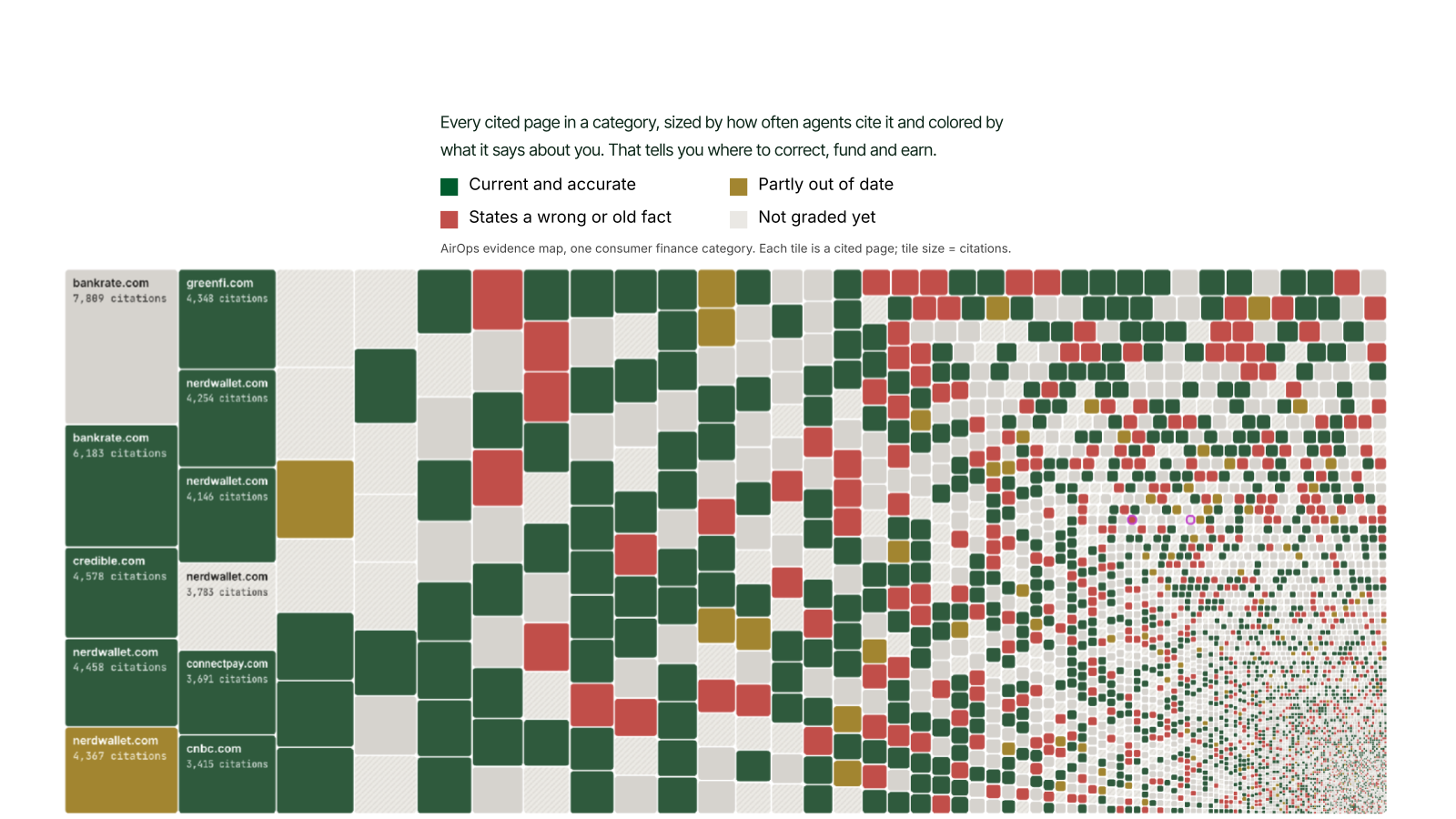
AirOps approaches AI search as a channel your team can manage through three repeatable steps: plan, place, and improve.
This quarter, start by identifying where AI learns about your brand in each priority market, and which claims are inaccurate or outdated. Place corrections, original research, and customer reviews in the sources AI trusts. Then strengthen your owned pages with a consistent content refresh strategy.
Finally, connect each placement to pipeline. Proving its return on investment helps secure the next round of funding, and shows you where to invest with greater precision.
Why Evidence Will Decide the Next Wave of AI Search
Agents like Pulse and Instinct will continue collapsing research, comparison, and purchase into a single answer delivered on a user’s behalf. In that moment, a strong product is not enough. Brands need accurate, credible evidence across the web that gives agents a reason to recommend them. The best products will win when the proof is easy for AI to find.