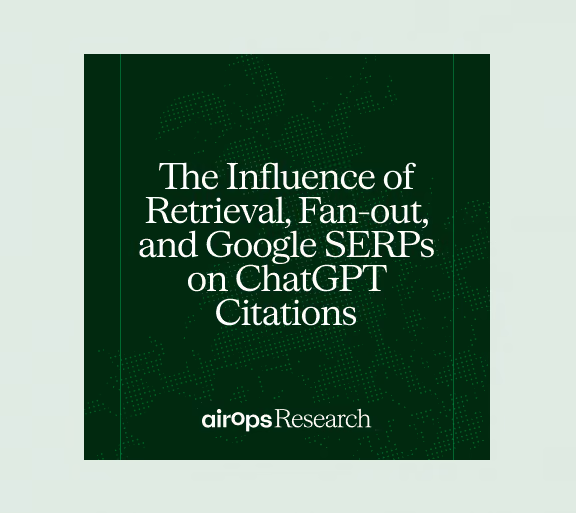
ChatGPT runs dozens of searches per query. Most brands only optimize for one.























What you'll walk away with
Discovery is not visibility
A third of citations come from internal searches you can't see
Pages ranking #1 in Google Search Results are cited 3.5x more often
Mid-authority sites are outperforming the top tier
Pages whose titles aligned with ChatGPT's search query saw a 2.2x increase in citation likelihood.
"We were able to focus our energy on the highest-value initiatives for the business in a matter of weeks."
SVP of Growth, Chime

“We set out to change the narrative around Sanity in AI search, not just show up more often. Staying the brand the models name most, and climbing in the categories that matter, is exactly the signal we were after, and we can see it happening week to week.”
Principal, Agentic Operations & Growth Marketing, Sanity
“If we wanted to 10x the growth we were starting to see, we needed a system that handled SEO, AEO, content production, all of it. AirOps was the first to actually deliver results.”
Head of Growth, Venn
Built for the teams optimizing for AI search
SEO and content leaders adapting strategy for AI search
Growth and demand gen teams building pipeline from AI channels
Marketing agencies advising clients on AEO
CMOs and VPs evaluating how AI search changes their content investment
Your competitors
are already adapting.
Are you?
Frequently Asked Questions
What is the fan-out query?
What is the fan-out query?
When a user sends a query to ChatGPT, the model doesn't answer from memory alone. It issues its own web searches, called fan-out queries, to gather sources, then selects a small fraction to cite. On 89.6% of prompts in this study, ChatGPT generated two or more follow-up searches, expanding 15,000 starting queries into 43,233. This report maps the full pipeline from prompt to fan-out to retrieval to citation, across 548,534 retrieved pages.
What are the biggest findings?
What are the biggest findings?
85% of pages ChatGPT retrieves are never cited. Discovery alone is not enough. 32.9% of cited pages were found only through fan-out queries, not the original prompt. Google rank is the strongest citation predictor. Pages at #1 are cited 43.2% of the time, 3.5x more than pages outside the top 20. Domain authority is not the gatekeeper most brands assume: sites with DA 20–40 earned more citations than sites with DA 80–100.
Who should read this?
Who should read this?
Content, SEO, and growth leaders who need to understand what drives visibility in AI search. If you're making decisions about content strategy, page structure, or refresh cadence, this research gives you the data to prioritize what actually moves citation rates.
Does traditional SEO still matter?
Does traditional SEO still matter?
Google rankings carry a direct citation advantage -- pages at #1 are cited 3.5x more often than those outside the top 20.
How is this different from other AI search research?
How is this different from other AI search research?
Scale and depth of pipeline coverage. This study analyzed 15,000 queries across 8 intent types, evenly split between informational and commercial. ChatGPT expanded those into 43,233 total searches and retrieved 548,534 pages. Instead of stopping at "what gets cited," the report maps every stage: fan-out generation, retrieval selection, Google SERP influence, title alignment, domain authority, readability, and query intent, with controlled comparisons at each step.
What should teams do with this data?
What should teams do with this data?
Three things. Track fan-out coverage, not just primary keywords. A meaningful share of citations comes from follow-up searches. Audit pages ranking in Google positions 10-20 for high-intent queries, where small ranking improvements translate into outsized citation gains. And use content refreshes to expand coverage around the adjacent questions ChatGPT explores while building an answer, rather than creating entirely new pages.