- Most AEO tools track whether AI mentions your brand but stop short of connecting that visibility to revenue
- AEO attribution tools bridge the gap between citation tracking and pipeline impact by integrating with GA4, CRMs, and self-reported attribution
- The best AEO attribution tools combine prompt monitoring, citation tracking, and revenue attribution in one workflow
- AirOps connects AI visibility data directly to prioritized content actions, closing the loop between insight and execution for AEO
What makes an AEO attribution tool different from a visibility tracker
AEO attribution tools connect your brand's AI search visibility to measurable business outcomes like pipeline and revenue. Standard visibility trackers tell you if AI engines mention your brand. Attribution tools tell you whether those mentions drive actual deals.
That distinction matters because AI search traffic is growing fast. AI referral visits reached 1.13 billion in June 2025, a 357% increase year over year. But most of those visits appear as "direct" or "branded search" in Google Analytics. Your pipeline might grow while your analytics show flat organic traffic. Without attribution, you can't prove the connection.
AirOps tracks both citations and mentions across ChatGPT, Gemini, Perplexity, and AI Overviews, then connects that visibility data to prioritized content actions. That insight-to-action loop separates attribution platforms from simple monitoring tools.
The practical difference comes down to three tiers of measurement:
- Visibility signals: prompt share of voice, citation frequency, and mention presence across AI engines
- Demand signals: branded search lift, direct traffic to deep pages, and self-reported attribution from prospects
- Revenue signals: CRM pipeline connected to AI-influenced touchpoints, closed-won attribution, and customer acquisition cost from AI channels
Best AEO attribution tools compared
The AEO tool market expanded quickly in 2025 and 2026. But most tools still focus on visibility tracking alone. The tools below stand out because they connect AI visibility to business results through analytics integration, CRM connections, or content action workflows.
1. AirOps
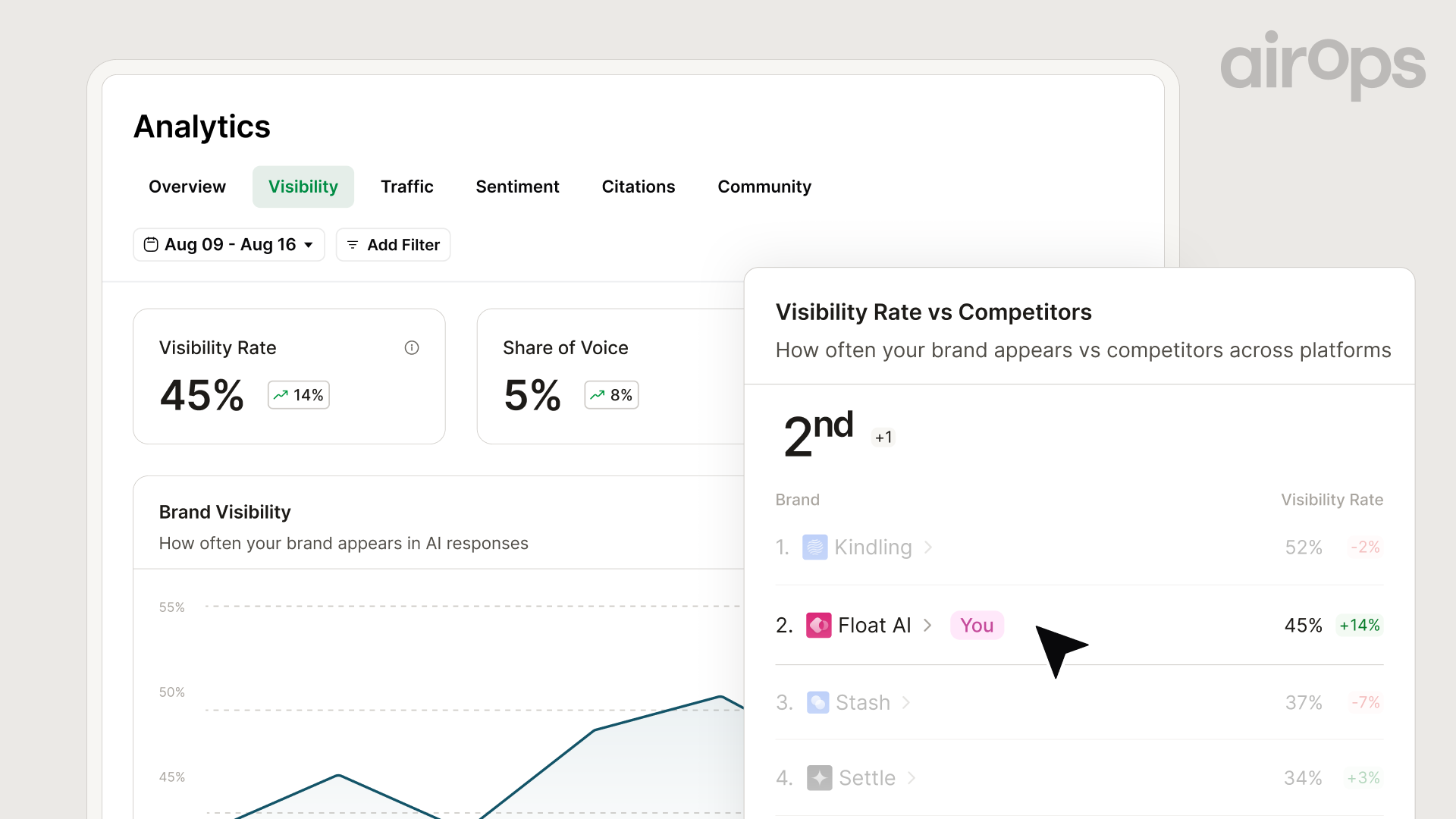
AirOps is the only AEO partner for enterprise teams that connects AI visibility insights directly to content actions. The Insights dashboard tracks citations, mentions, and share of voice across ChatGPT, Gemini, Perplexity, and Google AI Overviews. Action Grids let you prioritize which pages to refresh based on citation performance. Content workflows then execute those updates at scale.
That closed loop from insight to action to measurement sets AirOps apart. You don't just see where you appear in AI answers. You act on it, track the results, and iterate. AirOps research found that pages not updated quarterly are 3x more likely to lose AI citations, making that content refresh workflow a direct attribution advantage.
2. HubSpot AEO
HubSpot's AEO features sit inside the Marketing Hub, giving existing HubSpot users a native path to AI visibility tracking. The CRM connection means you can track which contacts entered your pipeline after AI-influenced discovery without building custom integrations.
The trade-off is depth. HubSpot's AEO capabilities are newer and less specialized than purpose-built tools. But if your CRM is already HubSpot, the attribution plumbing comes pre-built.
3. Goodie
Goodie (formerly known in the market as higoodie) tracks every AI session, conversion, and dollar from ChatGPT, Perplexity, Gemini, and Claude. Their 2026 AI Search Traffic Report found that ChatGPT's B2B referral share dropped from 89% to 63%, making multi-engine tracking critical.
Goodie's attribution feature connects AI visibility to revenue with session-level tracking. The platform also includes prompt research, optimization actions, and a content studio.
4. Scrunch
Scrunch takes a technical approach to AEO. Rather than tracking citations after the fact, Scrunch analyzes your content structure, schema markup, and crawlability to improve your chances of appearing in AI answers. It's more of a visibility optimization tool than an attribution platform.
Scrunch works best when paired with a dedicated attribution tool for revenue tracking.
5. Conductor
Conductor brings AI visibility tracking into its enterprise content intelligence platform. The tool connects content performance to business outcomes across organic and AI search channels. Enterprise teams get workflow automation, competitive monitoring, and reporting that spans both traditional SEO and AEO.
The enterprise pricing model makes Conductor a better fit for large organizations with existing content operations budgets.
6. Dreamdata
Dreamdata isn't an AEO tool in the traditional sense. It's a B2B attribution platform that tracks the full customer journey from first touch to closed deal. Where Dreamdata adds AEO value is in connecting CRM journey data to AI-influenced touchpoints.
If a prospect discovers your brand through an AI answer, visits your site through branded search, and later converts, Dreamdata can stitch that journey together. The platform works best alongside a dedicated AEO visibility tool.
7. Peec AI
Peec AI offers affordable AEO monitoring with competitive analysis. The tool tracks how your brand and competitors appear in AI-generated answers. At $49/month, it's the most accessible entry point for teams testing AEO measurement.
Peec AI's attribution depth is limited compared to full-stack platforms, but it covers the visibility and competitive benchmarking basics.
8. Semrush AI Visibility Toolkit
Semrush added AI Visibility as a premium add-on for tracking how brands appear in AI search results. If you already use Semrush for SEO, the add-on extends your existing workflow. It tracks appearances in AI Overviews and ChatGPT responses.
The toolkit provides position tracking and trend data but doesn't include CRM pipeline attribution or content action workflows. Consider it a visibility extension to your SEO stack, not a standalone attribution solution.
How to evaluate AEO attribution tools for your stack
Choosing the right AEO attribution tool depends on your current measurement maturity, CRM setup, and how many AI engines you need to track. AI search is fragmenting quickly. ChatGPT dropped from 89% to 63% of B2B AI referrals in just eight months. Any tool that only tracks one engine leaves a growing blind spot.
Match the tool to your attribution maturity level:
- Starter (visibility first): Begin with prompt monitoring and citation tracking. Peec AI or Scrunch cover the basics at an accessible price point.
- Intermediate (analytics connected): Add GA4 integration and branded search lift tracking. Goodie connects visibility data to website analytics.
- Advanced (full pipeline attribution): Connect AEO data to your CRM, add self-reported attribution, and build content action workflows. AirOps and HubSpot AEO deliver this level of integration.
Key takeaways
- AEO attribution tools bridge the gap between "AI mentions your brand" and "AI drives your pipeline"
- AI search traffic is fragmenting across four major engines, and your attribution tool needs to track all of them
- The best tools connect visibility data to content actions, not just dashboards and reports
- Self-reported attribution remains the most reliable signal for zero-click AI influence
- Start with visibility tracking, then add GA4 integration and CRM pipeline connection as your AEO practice matures
AirOps for AEO attribution
AirOps connects AI visibility insights to the content actions that improve your citation rates and pipeline attribution. Track citations, mentions, and share of voice across ChatGPT, Gemini, Perplexity, and Google AI Overviews from one dashboard. Then use Action Grids and content workflows to refresh the pages that matter most for your AEO metrics.
The insight-to-action loop means you don't stop at knowing where you appear in AI answers. You identify gaps, prioritize updates, and measure results in a single platform built for answer engine optimization. AirOps brings this as a partnership, not just software to log into: our team builds and runs the strategy alongside yours and ties the work back to pipeline and revenue.
Book a demo to get started with AirOps for AI search and AEO.
Frequently Asked Questions
Frequently asked questions
What is AEO attribution?
AEO attribution connects your brand's visibility in AI-generated answers to measurable business outcomes. It goes beyond tracking whether AI engines cite your content. AEO attribution measures whether those citations influence pipeline, conversions, and revenue through outcome-based measurement.
Can you track AI search traffic in Google Analytics?
Partially. Some AI engines like ChatGPT and Perplexity pass referrer data that GA4 captures. But many AI-sourced visits appear as direct traffic because native AI apps strip referrer headers. You need supplementary attribution methods like self-reported fields and branded search lift analysis.
How much does an AEO attribution tool cost?
Pricing ranges from $49 per month for basic monitoring with Peec AI to custom enterprise pricing with platforms like AirOps and Conductor. Most mid-market tools with GA4 integration start between $200 and $500 per month. B2B attribution platforms like Dreamdata start at $999 per month.
Do I need a separate AEO tool if I already use Semrush or Ahrefs?
Semrush offers an AI Visibility add-on, but purpose-built AEO tools provide deeper attribution, prompt-level tracking, and content action workflows that SEO suites don't match. Consider a dedicated AEO attribution tool if proving AI search ROI is a priority.
What is the difference between AEO visibility and AEO attribution?
Visibility tells you whether AI engines mention or cite your brand. Attribution tells you whether that visibility influenced a buyer to enter your pipeline or become a customer. AirOps research found that only 30% of brands maintain visibility between consecutive AI answers, making continuous measurement and content action essential.
Get the latest on AI content & marketing
