AEO Platform Buyer's Guide: Criteria, Questions, and a Pilot Plan
- An AEO platform decision will impact how your brand earns mentions, citations and recommendations in AI search, so start the evaluation from your growth targets.
- Six decision questions frame the evaluation: revenue connection, defensible data, insight to shipped work, channel coverage, enterprise governance, and expertise and ownership.
- Compare solution types before you compare vendors: point visibility trackers, services-only providers, and enterprise AEO platforms solve different problems.
- Pick an operating model (platform only, managed services, or hybrid), then score vendors 1 to 5 on six criteria.
- Ask 18 vendor questions, then run a 30 to 60 day proof plan with written decision gates and a 6-check scorecard before you sign.
Answer engine optimization (AEO) is the work of earning citations, mentions, and recommendations inside AI-generated answers from ChatGPT, Google AI Mode, Google AI Overviews, Gemini, Perplexity, and Claude. Buying committees now use those same assistants to research and shortlist AEO vendors, so your evaluation process deserves the same structure the engines give buyers.
This guide gives you a complete evaluation kit: six decision questions, a comparison of solution types, operating models, six scored criteria, 18 vendor questions, and a proof plan with a 6-check scorecard. AirOps publishes this guide, and we hold ourselves to every test in it. Use it alongside our roundup of AEO and AI search visibility tools when you build a shortlist. For how AI search should inform marketing strategy and board reporting, see The CMO's Guide to AI Search & Discovery.
Why has AEO platform evaluation changed?
AI engines now hand buyers a buying script. In an analysis of B2B software evaluation prompts in the US, JH Scherck reported that GPT-6 changed the format of responses (X post). Comparing answers before and after the change:
| Share of answers that... | Before the change | After the change |
|---|---|---|
| Ask multiple-choice questions | 3% | 88% |
| Ask an open follow-up question | 63% | 22% |
| List questions to ask vendors | 5% | 27% |
| List features to compare | 45% | 79% |
| List checks before buying | 49% | 90% |
Nearly 9 in 10 evaluation answers now include pre-purchase checks, and about 1 in 4 tell buyers which questions to ask vendors. Scherck's follow-up adds that qualitative analysis at scale is critical for AEO, because metrics from a third-party dashboard alone miss information that sales and marketing need (follow-up).
That is why this guide is built around questions, criteria, and checks. Your buyers already arrive with an AI-generated checklist. Your evaluation should be at least as rigorous. For the broader change in how answer engines mediate vendor selection, see how AI answer engines change vendor evaluation.
What six questions should frame your AEO platform decision?
Every criterion, vendor question, and pilot check in this guide maps to one of six decision questions:
- Will it connect AI search work to pipeline and revenue?
- Can you defend the data to your finance team?
- Does it move your team from insight to shipped work?
- Does it cover every channel that shapes AI answers?
- Will it hold up across your brands, markets, and approval process?
- Who brings the strategy and expertise?
Ask every vendor all six, including AirOps. A vendor that answers each one with specifics, and shows the answer on your own data, belongs on your shortlist.
How do the main types of AEO solutions compare?
You will meet three solution types. A point visibility tracker monitors how often your brand appears in AI answers. A services-only provider runs the work with its own tools. An enterprise AEO platform combines intelligence, action, measurement, and expert support in one system.
| Decision question | Enterprise AEO platform | Point visibility tracker | Services-only provider |
|---|---|---|---|
| 1. Revenue connection | AI search metrics joined to GSC, GA4, and CRM data | Visibility metrics in a separate dashboard | Varies by provider, often reported in slide decks |
| 2. Data and methodology | Documented engines, personas, regions, cadence, and model-update notes | Varies, methodology detail often limited | Depends on the tools the provider licenses |
| 3. Insight to shipped work | Ranked opportunities flow into governed workflows and CMS drafts | Insights exported for another team or tool | Provider executes, often outside your systems |
| 4. Channel coverage | Owned content, external content, AI ads, influencer and social, community | Monitoring of AI answers | Usually one or two channels per provider |
| 5. Governance and scale | Brand controls, approvals, audit history, multi-brand workspaces | Limited roles and brand controls | Governed by contract and process |
| 6. Expertise and ownership | Experts work with your team inside the platform | Self-serve | Provider team owns strategy and execution |
| Best fit | Enterprise teams tying AI search to growth targets | A first baseline for a single brand | A defined, time-boxed project |
A point tracker can be a sensible first step for a team that needs a baseline. For an enterprise program, the deciding question is whether the investment can grow into work your leadership team keeps funding. For named vendor matchups, see our side-by-side AEO platform comparisons.
Which operating model fits your team: platform only, managed services, or hybrid?
Decide how the work will get done before you score vendors.
| Operating model | Best fit | What you own | Watch-outs |
|---|---|---|---|
| Platform only | In-house SEO, content, and analytics teams that can run weekly prompt reviews, refreshes, and CMS publishing | Prompts, brand rules, workflows, citation data, CMS drafts | Insight volume can outpace publishing capacity |
| Managed services or specialist partner | Lean teams that need strategy and execution across owned content, external content, and AI ads | Outcomes, approvals, and the work produced in your systems | Retainers where the partner runs the workflows outside your systems |
| Hybrid (platform plus experts) | Enterprise teams that want one system of record and specialists who set priorities and execute with your reviewers | Shared brand rules, workflows, and measurement in one place | Needs a clear split of who drafts, who reviews, and who ships |
Choose platform only when your team can turn AI search intelligence into governed refreshes and new pages every week. Choose managed services when you need specialized execution and a set operating cadence. Choose hybrid when you want experts working inside the same platform as your team, so strategy, content, and measurement build on each other quarter after quarter.
Warning signs in any services contract:
- Workflows live only in the provider's tools, with no path to your CMS or brand rules.
- Reporting stops at mention rates, with no join to GSC, GA4, or pipeline.
- Offsite work relies on low-quality placements in place of sources AI engines already cite.
How should you score AEO platforms?
Score each vendor 1 to 5 on six criteria during demos and the pilot. Weight the criteria to match your priorities, and agree on the weights before the first demo so scores stay comparable.
| Criterion | What a 5 looks like | What a 1 looks like |
|---|---|---|
| 1. Revenue and measurement | Citations, mentions, and share of voice joined to GSC, GA4, and CRM data, with a fallback when AI referral data is missing | Isolated visibility scores with no link to revenue systems |
| 2. Data and answer intelligence | Written methodology, demand-grounded prompts, model-update notes, and full answer text with follow-ups and vendor questions | Top-line percentages from an undocumented sample |
| 3. Insight to shipped work | Ranked opportunities move into brand-governed drafts, human review, and CMS staging | Dashboard insights with no path to published work |
| 4. Channel coverage | Intelligence and execution across owned content, external content, AI ads, influencer and social, and community, with a dated readiness map | One channel, or monitoring only |
| 5. Governance and scale | SOC 2 report, SSO, role-based approvals, audit history, multi-brand and multi-region workspaces | Shared logins, no approval gates, no brand controls |
| 6. Expertise and ownership | Named experts working inside your workspace, with a regular operating cadence | Self-serve only, or experts who work only in their own tools |
1. Revenue and measurement
Report citations, mentions, and share of voice as separate metrics, joined to Google Search Console (GSC), GA4, and CRM data for the same pages and prompts. Ask what happens when AI referral tags break or go missing. A strong plan still works with citation trends, content-change logs, and assisted conversions. Exports or an API should put the numbers into the BI tools and leadership decks you already use.
2. Data and answer intelligence
Coverage should include ChatGPT, Google AI Mode, Google AI Overviews, Perplexity, Claude, and Gemini for enterprise programs. Press vendors on:
- Real interface behavior compared with API-only sampling
- Persona, locale, and logged-in or logged-out controls
- How often prompts re-run, and how model changes are annotated
- Whether prompts come from real demand, such as your search queries, sales call themes, and buyer personas
Confirm the platform stores the full answer next to each cited or uncited flag. You want the follow-up branch, the multiple-choice options AI offered, the features it compared, and the vendor questions it scripted. That answer history is sales enablement: marketing refreshes content against the objections AI teaches buyers to raise, and sales prepares for the questions prospects bring from ChatGPT.
Methodology matters as much as engine count. Choose the sample you can explain to finance.
3. Insight to shipped work
Value shows up when insight becomes published evidence. Look for:
- Opportunities ranked by business value and tied to prompts, pages, and competitors
- Brand controls for voice, claims, and terminology
- Human review gates before anything reaches production
- Direct staging into your CMS without copy-paste steps
- A change log that links each shipped action to the metric it was meant to move
4. Channel coverage
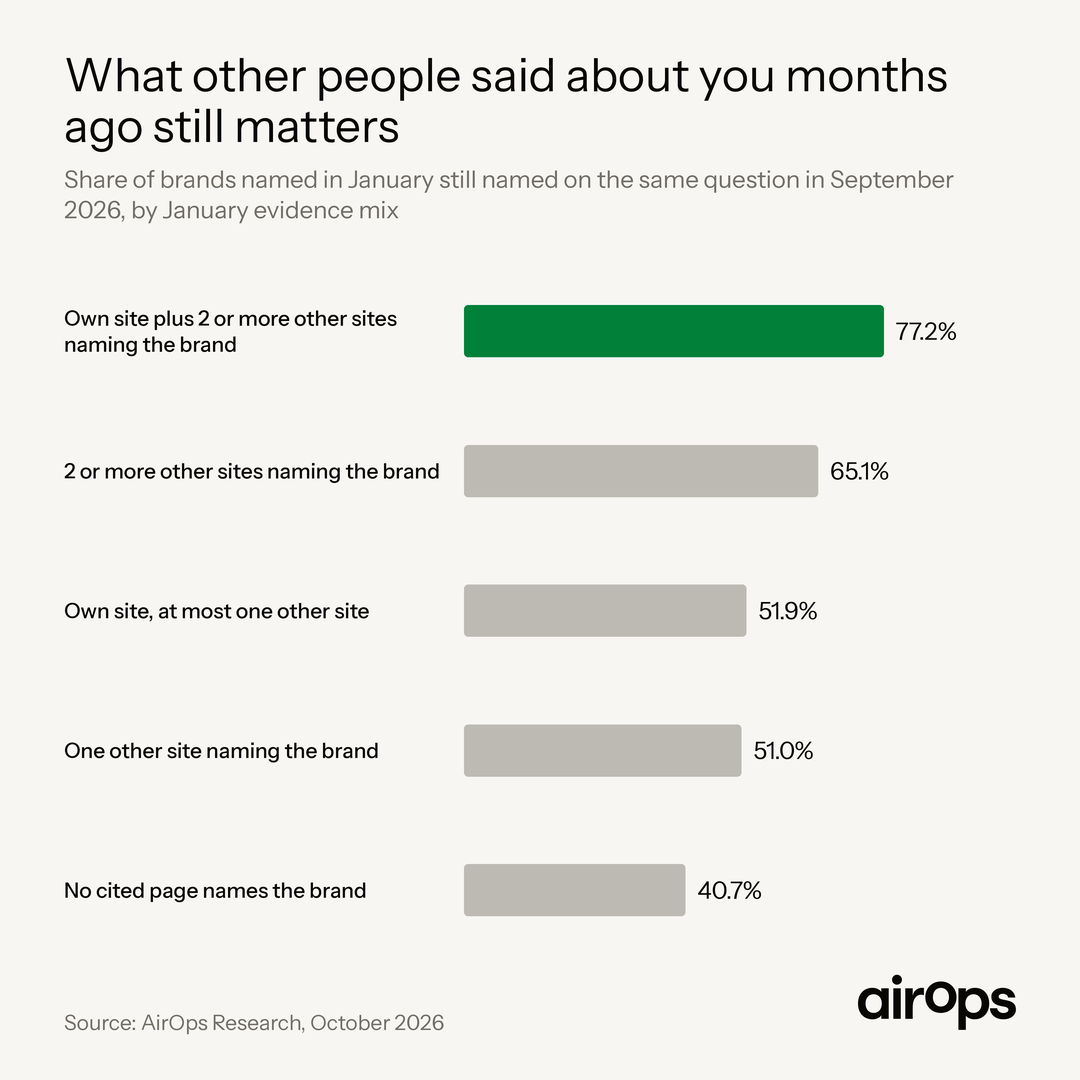
AI answers draw on far more than your website. Reviews, publications, creators, forums, and paid placements all influence what an assistant recommends. Ask for intelligence on which third-party sources AI engines cite in your category, paid AI search data where ads now appear (such as ChatGPT ads), and a dated statement of which channels have full execution today.
5. Governance and scale
Procurement will ask about SOC 2, SSO, roles, data retention, and auditability. Marketing ops will ask about multi-brand workspaces. Legal will ask who approves claims before publish. Put those checks into the RFP so they are settled before the pilot ends. Support for open standards such as the Model Context Protocol (MCP) lets your data and brand context work inside the AI tools your teams already use.
6. Expertise and ownership
New channels reward teams with a strategy and channel specialists who have run the work before. Score providers on named experts, a regular operating cadence with business reviews, and work done inside a shared workspace.
How should you evaluate managed services and specialist partners?
Managed services succeed when they extend your team inside a governed system. Score partners on:
- Deliverable transparency. Outputs named by prompt cluster, page, channel, and owner on a weekly or biweekly cadence.
- Editorial and subject-matter rigor. Expert review, claim checks, and brand compliance sit inside the path to publish for every piece.
- Offsite citation quality. Partners earn presence on sources AI engines already cite in your category.
- Business-outcome reporting. Reports connect citations and shipped work to GSC, GA4, and pipeline, with baselines and control sets where tests run.
Ask for named engines and the pages they would target first. Hold every partner, including AirOps, to the same tests.
What questions should you ask AEO vendors before signing?
Revenue and measurement
1. How do AI citations join GSC, GA4, and CRM data in your interface or exports?
- Strong answer: Native joins plus exportable tables with shared keys.
- Warning sign: A CSV dump with no join keys.
2. What happens to measurement when AI referral tags are missing?
- Strong answer: Fallback to citation, content-change, and assisted models.
- Warning sign: "Then we cannot show ROI."
3. What baselines and targets will you set for the first 90 days?
- Strong answer: Prompt-level baselines, shipped work, and citation and traffic targets.
- Warning sign: Guaranteed ranking promises.
Data and answer intelligence
4. Which AI engines, regions, and personas do you cover, and how do you document interface versus API collection?
- Strong answer: Named engines, cadence, persona and region controls, and written methodology.
- Warning sign: "We cover everything," with no sample design.
5. How do you separate citations, mentions, and share of voice in reporting?
- Strong answer: Separate metrics with definitions finance can reuse.
- Warning sign: One blended score with no formula.
6. How do you annotate model updates and retrieval changes that move answers?
- Strong answer: A change log tied to volatility windows.
- Warning sign: Every drop blamed on your content.
7. What sample sizes and re-run frequencies sit behind each chart?
- Strong answer: Documented sample sizes and confidence limits.
- Warning sign: Screenshots without underlying runs.
8. Do you capture full answer text, follow-up branches, and the questions AI tells buyers to ask vendors?
- Strong answer: A searchable answer history with exports for sales.
- Warning sign: Charts only.
Insight to shipped work
9. How do insights become governed drafts in our CMS?
- Strong answer: Brand rules, human review, and CMS staging.
- Warning sign: "Our team will email you a doc."
10. How do you decide which pages to refresh first?
- Strong answer: Opportunity sizing by prompt value, gap, and page potential.
- Warning sign: A calendar with no prioritization logic.
11. Can sales get a weekly digest of the vendor questions and objections appearing in AI answers for our category?
- Strong answer: Yes, tied to prompt clusters and competitors.
- Warning sign: Marketing-only dashboard access.
Channel coverage
12. Which channels have full execution today, and which are in development?
- Strong answer: A dated readiness map by channel.
- Warning sign: Every channel described as live with no detail.
13. What is your policy on offsite placements and digital PR for AI citations?
- Strong answer: Target sources engines already cite, with no bulk link packages.
- Warning sign: Guaranteed placements on unrelated sites.
Governance and scale
14. Which security certifications, SSO options, and data-retention controls ship on day one?
- Strong answer: SOC 2, SSO or SAML, and retention terms in the DPA.
- Warning sign: Security review deferred until after signature.
15. Who approves claims before publish, and is that logged?
- Strong answer: Role-based approvals with history.
- Warning sign: Untracked edits by shared users.
Expertise and ownership
16. Will your experts work inside our workspace or only in yours?
- Strong answer: A shared system of record with our reviewers in the loop.
- Warning sign: A separate process we cannot inspect.
17. How do you handle conflicts when you also advise our competitors?
- Strong answer: Clear separation, data isolation, and disclosure.
- Warning sign: Vague reassurances.
18. Can we run a paid pilot on our prompts and pages before an annual commitment?
- Strong answer: A 30 to 60 day pilot with written decision gates.
- Warning sign: An annual contract required to see real data.
How do you run a 30 to 60 day proof plan?
A short, structured pilot gives you evidence for the budget decision. Write the decision gates and the scorecard down before day one. The six checks below sit inside the three steps.
Step 1: Set the baseline and the business question (days 1 to 10)
- Choose one product line or region and a priority prompt set tied to it.
- Record citations, mentions, share of voice, and GSC and GA4 numbers for the target pages.
- Agree with finance on the metric that would justify expanding the program.
- Check 1, engine and persona fidelity: confirm coverage matches the engines and regions that influence your deals.
Decision gate: marketing and finance sign off on the baseline and the target.
Step 2: Ship work in at least two channels (days 11 to 30)
- Refresh the owned pages that map to your priority prompts.
- Pursue external content on sources AI engines already cite in your category.
- Check 2, answer history quality: spot-check 20 answers for full text, citations, follow-ups, and vendor questions.
- Check 3, insight to draft: take one gap to a brand-compliant draft with human review and CMS staging.
- Check 4, sales handoff: produce one digest of the questions and objections found in AI answers.
Decision gate: planned work shipped on schedule with brand approval.
Step 3: Read the results and decide (days 31 to 60)
- Compare citations, mentions, and share of voice against the baseline.
- Report early traffic and conversion signals for the same pages.
- Check 5, volatility labeling: review a model-change window and confirm annotations exist.
- Check 6, measurement join: connect at least one AI citation view to GSC and GA4 for the same URLs.
Decision gate: a written go or no-go recommendation with the numbers behind it.
Score each check pass or fail. Two or more fails on answer history or measurement are grounds to pause the purchase.
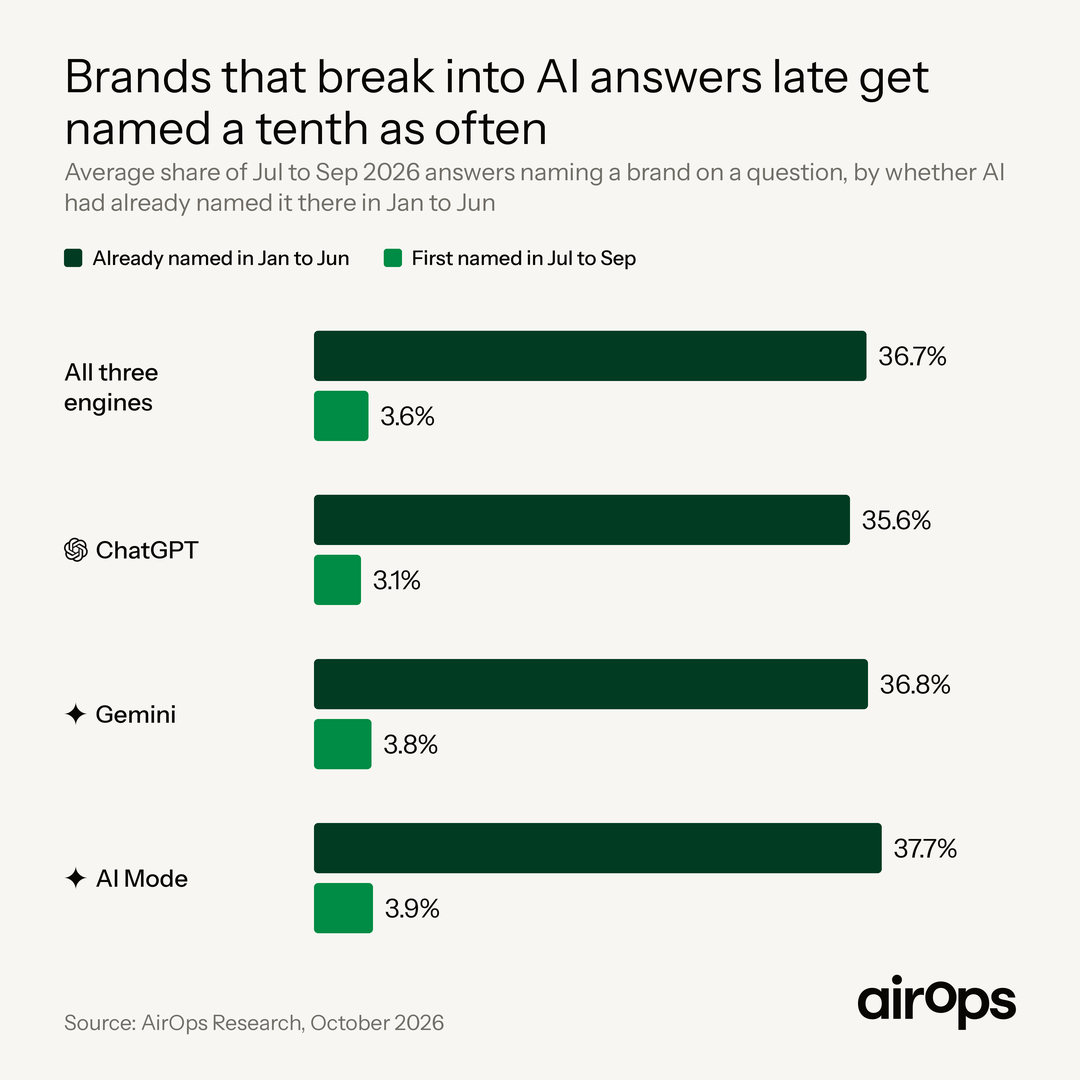
In a December 2025 Semrush test of 81 new pages, Google AI Mode cited 36% the day after publication and 56% by day 7, falling to 26% by day 30; ChatGPT search reached 17% by day 7 and 42% by day 30. Google says a page must be indexed and snippet-eligible to appear in AI Overviews or AI Mode, and crawling can take a few days to a few weeks.
Plan on two to four weeks as the earliest fair window, and measure whether citations hold, not a single appearance.
There is no published benchmark for how long a change in AI citations takes to show up in pipeline, so the pilot should measure time from citation movement to first influenced lead, opportunity, and closed-won. For planning, expect a multi-month lag: a Q3 2026 B2B study from Octane11 found the last AI referral visit came a median of 70 days before close (referral timing, not citation timing), and B2B buying cycles average 10.3 months, per the 6sense 2026 Buyer Experience Report.
How should you handle ROI and rollout ownership?
The business case still hinges on measurement. In the 2026 Marketing Leaders Reality Index, 86.6% of 300+ marketing leaders are prioritizing AI search, but only 23% are confident in measuring it. Pipeline or revenue targets increased for 75.4% of teams, but only 43.0% reported any budget increase. Build your model from the pilot baseline, and use our guide to AEO ROI and the business case for the calculation.
Name an owner for the rollout before you sign, and decide how SEO, content, and marketing ops share the work. Our hub on enterprise buying and rollout covers team structure and rollout across brands and product lines.
How does AirOps approach enterprise AEO?
AirOps is an enterprise AEO platform and expert partner for marketing leaders, connecting AI search intelligence, coordinated action across channels, and measurement tied to growth.
AirOps experts set priorities and guide execution alongside your team across owned content, external content, AI ads, influencer and social, and community. They work inside the same platform your team uses, so each engagement builds on shared brand context and data. Your marketers stay in the approval path for everything that ships.
| Decision question | How AirOps answers it |
|---|---|
| 1. Revenue | The Measurement pillar reports AI search metrics beside GSC and GA4 data, and joins those views to CRM and pipeline reporting. |
| 2. Data | The Intelligence pillar tracks citations, mentions, and share of voice across ChatGPT, Google AI Mode, Google AI Overviews, Gemini, Perplexity, and Claude, with prompt-level answer detail by persona and region. |
| 3. Action | Campaigns, Grids, Playbooks, and Workflows turn opportunities into governed work, all shaped by one Brand Kit. |
| 4. Channels | Owned content execution is live, with governed drafts staged into your CMS. External content is supported with intelligence and expert execution aimed at sources AI engines already cite. AI Ads is live for Enterprise customers starting with ChatGPT Ads, with Ad Load %, Paid Share of Voice, and an Ads Library. Influencer and social and community offer strategy, intelligence, and measurement today, with execution in development. |
| 5. Governance | Brand Kit holds voice, claims, and terminology rules for every output. AirOps is SOC 2 Type II certified, with SSO via Okta, Azure AD, and Google Workspace, plus role-based access control. AirOps MCP brings Brand Kit context and live AEO data into MCP-compatible tools. |
| 6. Expertise and ownership | AirOps experts work with your team inside your workspace. |
See how this works for large organizations on the AirOps for enterprise teams page.
What should your next step be?
Bring your priority prompts and growth targets to an evaluation conversation. We will walk through the six questions with your brand and category, and outline a 30 to 60 day proof plan your team can run.
FAQ
How long should an AEO platform pilot run?
Plan for 30 to 60 days. That window gives you time to set a baseline, ship work in at least two channels, and read early movement in citations, mentions, and share of voice before an annual commitment.
What is the difference between a point visibility tracker and an enterprise AEO platform?
A point visibility tracker monitors how often your brand appears in AI answers. An enterprise AEO platform adds governed execution across channels, measurement joined to your analytics and CRM, and expert support.
Do AEO platforms cover generative engine optimization (GEO)?
Yes. Teams use AEO and GEO for the same goal: earning presence in AI-generated answers. The criteria and questions in this guide apply to both.