- AirOps is the only platform that connects AI search visibility and AEO monitoring to content execution, brand governance, and CMS publishing in one closed loop.
- Scrunch offers broad AI engine coverage with a forward-looking Agent Experience Platform (AXP) for AI-optimized content delivery, but has no content creation or publishing capabilities.
- Peec provides prioritized recommendations through its Actions module with a Relative Opportunity Score, but stops at monitoring without any execution path.
- The real decision is operational: do you need a platform that turns visibility data into published content, or one that tells you what to fix while your team handles every step manually?
- AirOps starts free, Scrunch starts at $250/mo, Peec starts at $95/mo.
Enterprise content teams can see their brand's AI visibility declining across ChatGPT, Perplexity, Gemini, and Google AI Overviews. The problem is not a lack of data. It is the gap between knowing what needs to change and shipping the content that changes it.
AirOps, Scrunch, and Peec land on the same shortlist because all three promise to help you track how your brand shows up in AI-generated answers. AirOps covers the full loop from monitoring through governed content execution. Scrunch adds AI-readability infrastructure on top of its analytics, while Peec delivers scored recommendations for prioritization. The platform you choose determines whether your team produces content or moves data between disconnected tools.
This comparison breaks down how each platform handles monitoring, execution, governance, and integrations so you can decide which operational model fits your team.
AirOps vs Scrunch vs Peec at a glance
AirOps is the only option with built-in automation and full-stack AI workflows that connect monitoring to published content. Scrunch and Peec both require separate tools for content creation, governance, and publishing.
AirOps vs Scrunch vs Peec: platform overview
AirOps is the enterprise growth platform for AI search, closing the loop from Answer Engine Optimization (AEO) insight through content execution and measurement. AirOps connects monitoring, content creation, brand governance, and CMS publishing so enterprise content teams turn AI visibility signals into governed, published content at scale.
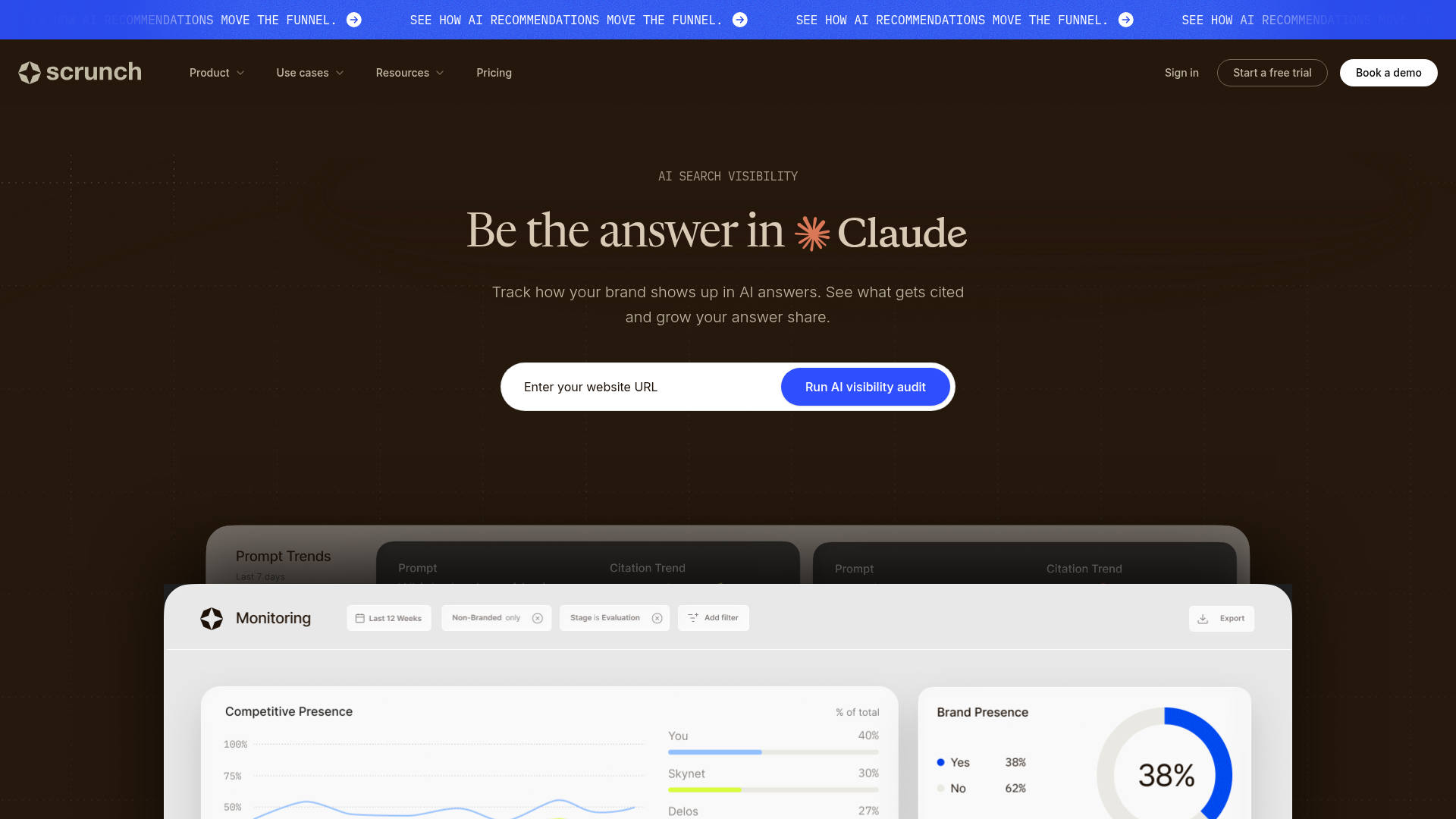
Scrunch is an AI visibility monitoring platform that pairs citation analytics with an Agent Experience Platform (AXP) for serving AI-optimized content directly to AI crawlers. Scrunch tracks brand visibility across 9 LLMs and adds infrastructure for making content more readable to AI agents. Best suited for teams wanting monitoring combined with technical AI-readiness improvements.
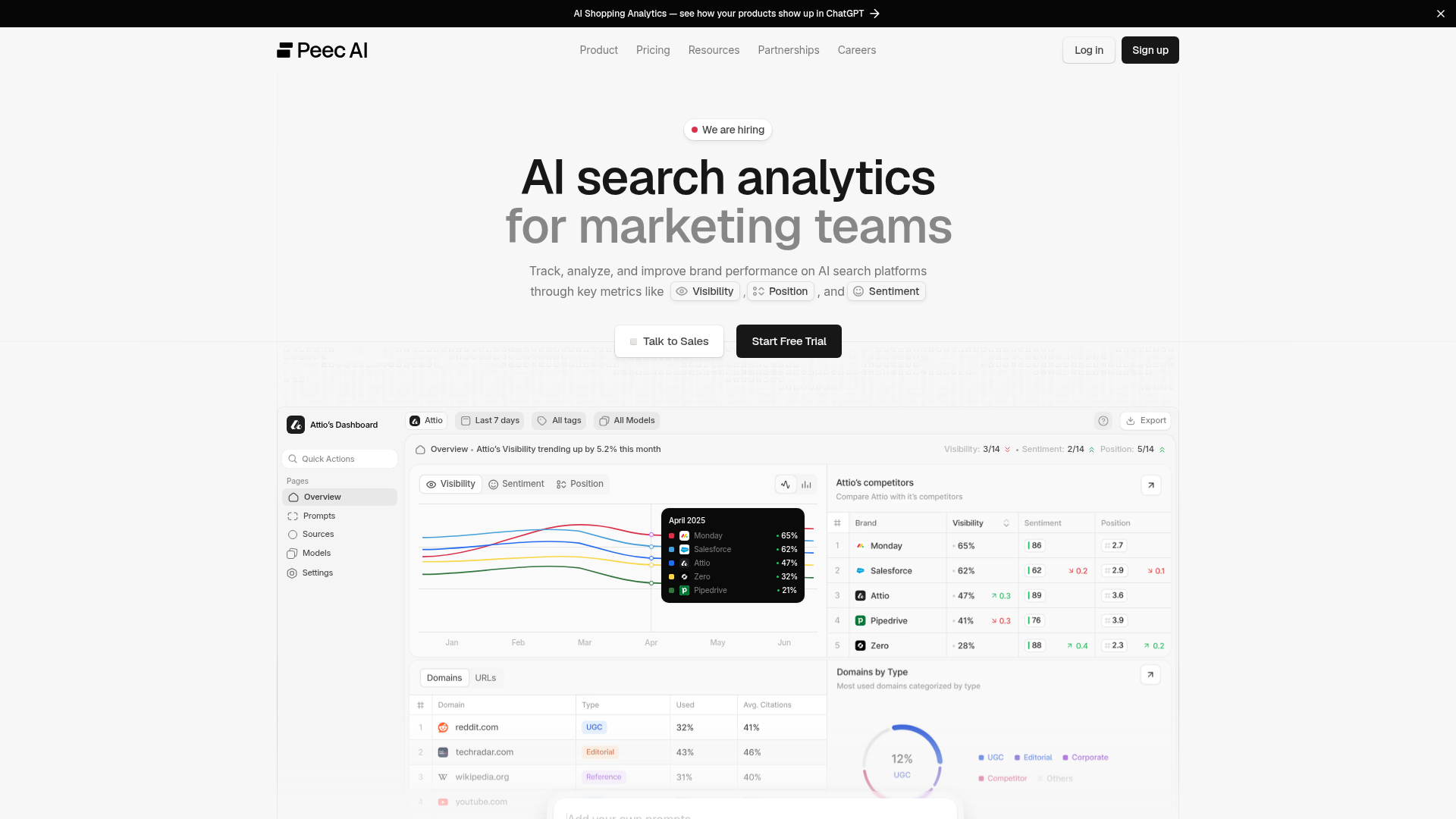
Peec is an AI search monitoring platform focused on prioritized recommendations through its Actions module and Relative Opportunity Score. Peec tracks visibility across 7-9 AI engines using a UI scraping methodology and provides scored recommendations for improving brand presence. Best suited for teams starting their AI monitoring practice that want clear guidance on what to work on next.
Core features: how AirOps, Scrunch, and Peec stack up
The sections below cover what each platform offers and where its capabilities end.
AirOps features:
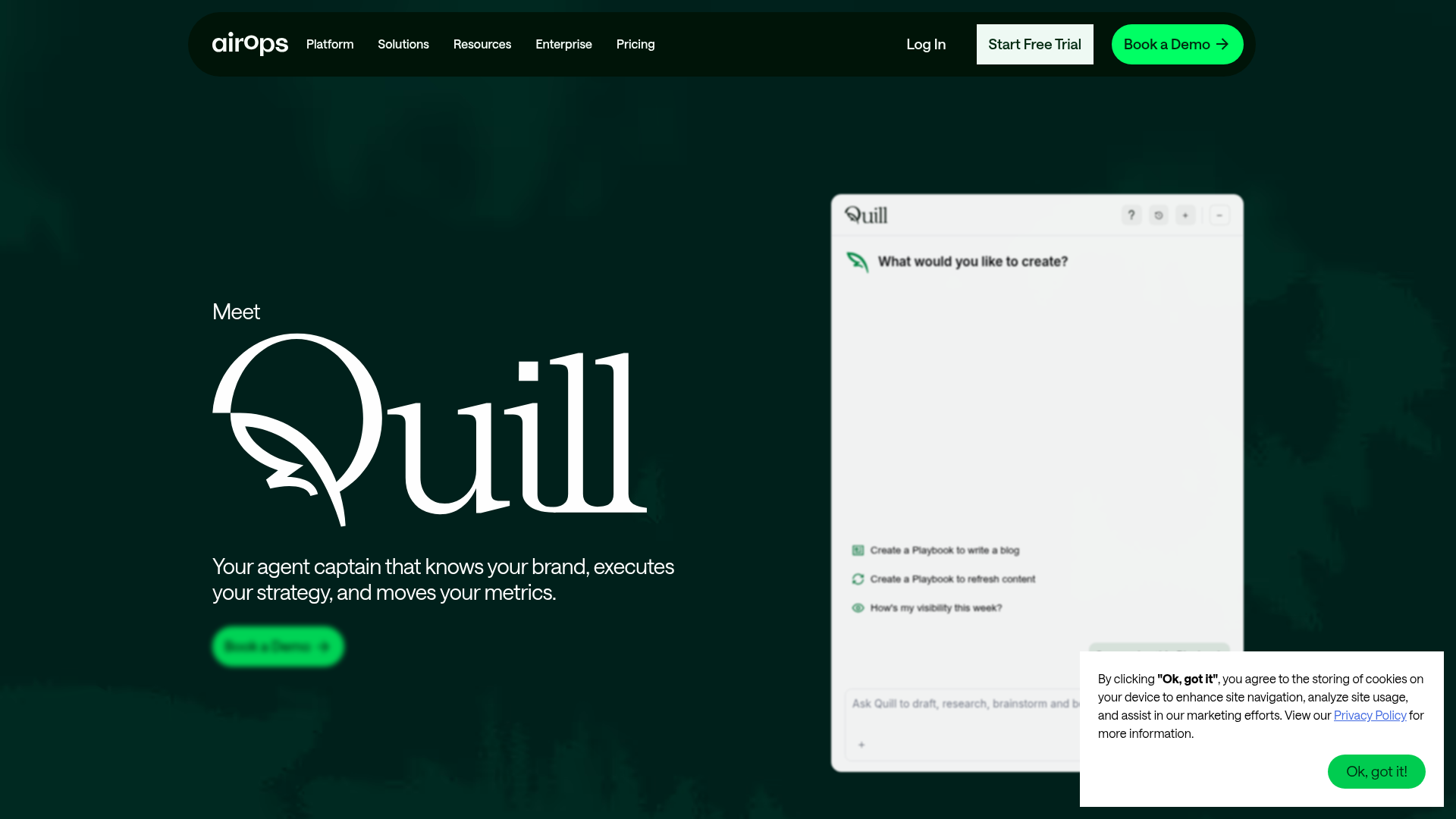
- Quill
- Quill is an autonomous agent captain that monitors AI visibility signals, identifies content gaps, executes campaigns with human approval, and learns from every run.
- Neither Scrunch nor Peec offers an execution agent. Their data surfaces what needs work; your team handles every step from there.
- Page360
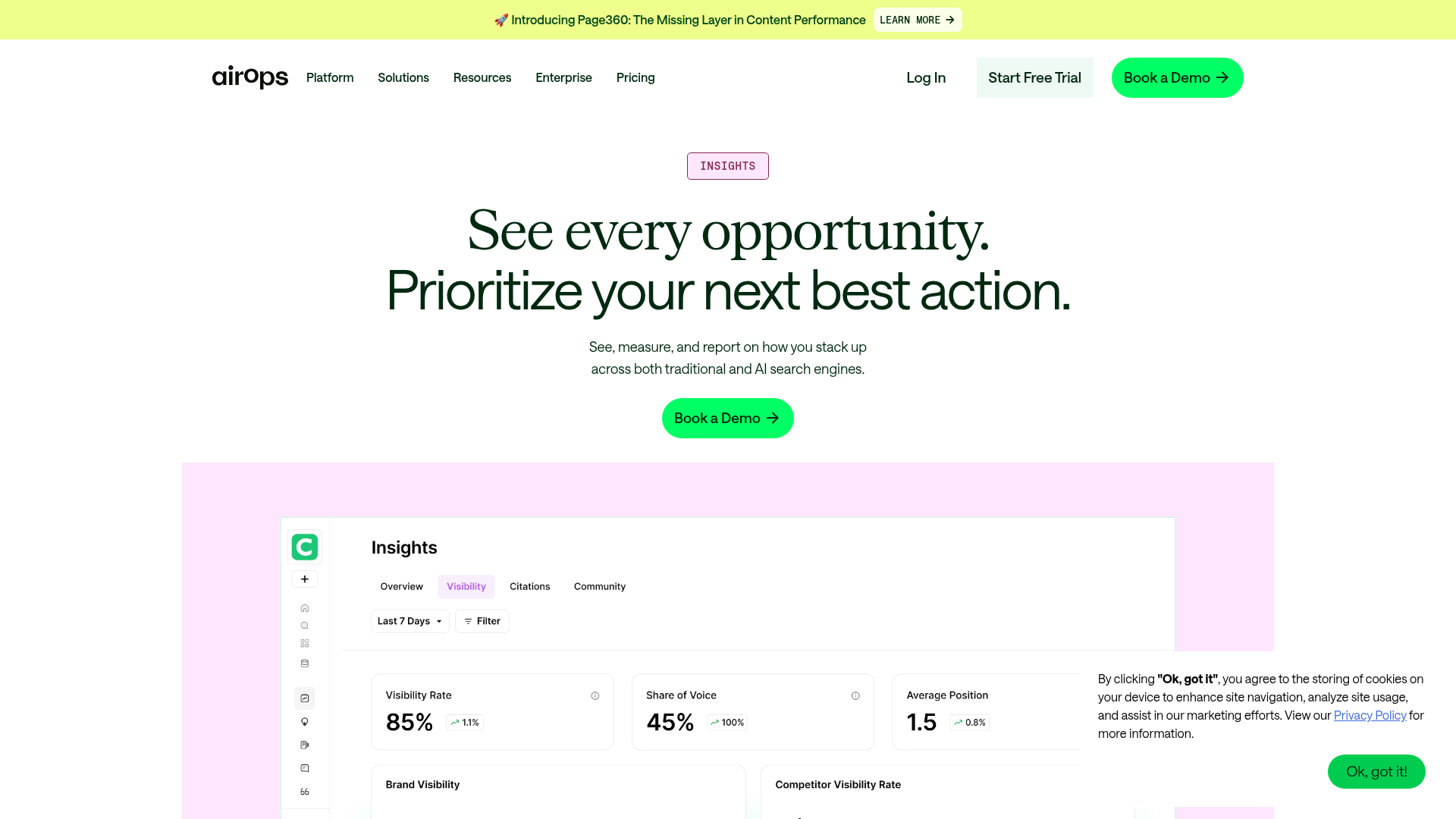
- Page360 combines AI citation data, Google Search Console (GSC) performance, and Google Analytics 4 (GA4) engagement into a single per-page health view.
- Neither Scrunch nor Peec integrates SEO or analytics data into their AI visibility monitoring.
- Prompt Discovery
- Prompt Discovery mines real user queries from four intent sources: panel data, People Also Ask, search intent signals, and Voice of Customer tools like Gong and Zendesk.
- Scrunch converts keywords into prompts rather than mining actual queries. Peec offers Query Fan-outs for ChatGPT only.
- Grids
- Grids provide a spreadsheet-style interface for bulk operations, triggering Workflows across hundreds of pages simultaneously.
- Neither Scrunch nor Peec offers bulk content operations.
- Brand Kits
- Brand Kits store tone, writing rules, product context, and audience profiles with scoped rules per audience, region, and content type. They are structured, versioned, and accessible through Model Context Protocol (MCP).
- Neither Scrunch nor Peec includes brand governance capabilities.
- AirOps MCP with 35+ tools
- AirOps MCP provides read and write capabilities that connect Brand Kit context to external AI agents including Claude, ChatGPT, Cursor, and Replit.
- Peec offers read-only MCP on all paid plans. Scrunch does not offer MCP connectivity.
- Offsite
- Offsite manages third-party publisher placements, tracks Influence Score, and grows AI citation share from earned media sources.
- Neither Scrunch nor Peec manages offsite publisher placements or tracks earned media contributing to AI visibility.
- Query Fan-outs
- Query Fan-outs reveals the sub-queries AI engines run behind each user prompt, showing what the model researches before generating an answer.
- Peec offers this for ChatGPT only. Scrunch does not surface sub-query behavior.
- Workflows
- Workflows provides a drag-and-drop builder with conditional logic, 50+ templates, and connections to multiple AI models and Brand Kit context.
- Neither Scrunch nor Peec includes a workflow builder.
- Closed-loop execution
- Closed-loop execution connects insight to action to measurement to next campaign, so every content change feeds back into the system and performance compounds over time.
- Scrunch and Peec both stop at monitoring. Acting on their data requires separate tools.
Scrunch features:
- Answer Share and Citation Tracking
- Scrunch tracks brand visibility across 9 LLMs, measuring Answer Share and citations with Influence Scores that weight citations by prominence in AI answers.
- Agent Experience Platform (AXP)
- AXP is an edge-deployed content delivery system for AI agents, claiming 200x token efficiency by serving AI-optimized content directly to AI crawlers.
- Agent Traffic Analytics
- Agent Traffic Analytics separates AI bot traffic by type and model within GA4, showing which AI engines crawl your content most frequently.
- AI Search Trends
- AI Search Trends surfaces trending topics being discussed across AI engines, helping teams identify emerging content opportunities.
- Hallucination Detection
- Hallucination Detection identifies instances where AI engines generate inaccurate information about your brand.
- Site Maps
- Site Maps provides an AI-perspective visualization of your website with page scoring, showing how AI engines perceive your content structure.
- Shopping module
- The Shopping module tracks product-level AI visibility, showing how individual products appear in AI-generated shopping recommendations.
Peec features:
- Actions module
- Actions delivers prioritized recommendations with a Relative Opportunity Score, ranking content improvements by estimated impact.
- Query Fan-outs (ChatGPT only)
- Peec surfaces the sub-queries ChatGPT runs behind user prompts, revealing additional content opportunities hidden within a single question.
- AI Shopping Analytics
- AI Shopping Analytics provides SKU-level visibility tracking, showing how individual products appear in AI-generated shopping recommendations.
- Sentiment Analysis
- Sentiment Analysis tracks how AI engines describe your brand, identifying positive, negative, and neutral characterizations across answers.
- MCP (read-only)
- Peec offers read-only MCP access on all paid plans, allowing external AI tools to pull monitoring data from the platform.
AirOps provides monitoring, prioritization, execution, governance, and measurement in one system. Scrunch adds AI-readability infrastructure for technical optimization, while Peec adds scored recommendations. Both require separate tools for everything past insight.
Product architecture overview: AirOps vs Scrunch vs Peec
Architecture determines what a platform can do today and how far it scales. AirOps spans the full loop from data ingestion through governed publishing, while Scrunch focuses on monitoring plus AI-readability infrastructure, and Peec optimizes the monitoring-to-recommendation path.
Data sources and signals
Broader data inputs mean fewer blind spots when prioritizing content work.
- Data sources and integrations: AirOps pulls AI visibility from multiple engines and connects natively to GSC, GA4, Semrush, Ahrefs, and Moz. Scrunch tracks 9 LLMs but does not integrate with SEO tools or analytics platforms, while Peec monitors 7-9 engines without GSC, GA4, or keyword data connections.
- Data accuracy and freshness: AirOps Prompt Discovery sources questions from real intent signals including panel data, ChatGPT behavior, and Voice of Customer tools. Scrunch operates on a 72-hour refresh cycle and converts keywords rather than mining actual queries. Peec uses a UI scraping methodology that may introduce variability as AI interfaces change.
- Data portability: AirOps makes data available through APIs, MCP (read and write), Grid exports, and direct CMS publishing. Scrunch provides API access gated to Enterprise plans. Peec offers read-only MCP on paid plans with Looker Studio as its only native reporting integration.
AirOps is the only platform combining AI visibility with traditional SEO and analytics data. Scrunch and Peec operate in isolation from your existing SEO stack, requiring manual assembly for holistic prioritization.
Prioritization of opportunities
The next question after monitoring is which pages to fix first.
- Decision engines and scoring: AirOps Page360 combines AI citation data, SEO performance, and content freshness into a per-page health score. Scrunch identifies gaps through Site Maps and page scoring without factoring in SEO performance, while Peec's Relative Opportunity Score ranks recommendations by estimated impact.
- AI-powered recommendations: AirOps recommendations are actionable inside the platform and can trigger Workflows that draft, govern, review, and publish updates. Scrunch and Peec both generate recommendations that require separate tools for execution.
- Integration of signals: AirOps is the only platform combining AI visibility with GSC rankings, GA4 traffic, and third-party SEO metrics. Scrunch and Peec focus on AI engine data without factoring in traditional search performance.
The fundamental difference is what happens after prioritization. AirOps connects scoring directly to execution Workflows, while Scrunch and Peec hand off to your team with varying levels of guidance.
WorkflowPlaybook building & automation
AirOps is the only platform in this comparison with a native WorkflowPlaybook builder.
WorkflowPlaybook builder capabilities and flexibility: AirOps provides a visual drag-and-drop builder with access to multiple AI models, live data sources, and Brand Kit context. Neither Scrunch nor Peec includes aworkflowplaybook builder.- Automation features: AirOps supports scheduling, webhook triggers, human review gates, and autonomous execution through Quill. Scrunch and Peec do not offer content automation.
- Conditional logic and triggers: AirOps supports branching logic and threshold-based triggers, such as auto-drafting an update when visibility drops. Scrunch and Peec do not offer conditional logic.
- Ease of building vs. complexity of what can be built: AirOps balances flexibility with usability through 50+ pre-built templates and a visual builder that non-technical team members can operate. Scrunch and Peec do not face this tradeoff because neither offers
workflowplaybook building.
For teams that need to move from insight to published content at scale, the absence of workflowplaybook automation in Scrunch and Peec means every content action remains manual.
Governance, context & brand control
Brand control features determine whether AI-assisted content stays on-brand automatically or requires manual review on every piece.
- Brand voice and governance: AirOps Brand Kits store tone, writing persona, product context, and terminology rules with scoped adjustments per audience, region, and content type. Neither Scrunch nor Peec includes brand governance.
- Knowledge Bases and Brand Kits: AirOps Knowledge Bases ground Workflows in factual, brand-specific context. Brand Kits add structured governance that travels with your team through MCP into external AI tools. Neither competitor offers equivalent systems.
- Customization vs. templates: AirOps offers deep customization through the Workflow builder and scoped Brand Kit dimensions alongside pre-built templates. Scrunch provides a standardized monitoring interface, while Peec provides standard dashboard views with scored recommendations.
For enterprise teams producing content with multiple writers and agencies, brand governance is non-negotiable. AirOps is the only platform in this comparison that addresses it.
Integrations & ecosystem
How well a platform connects to your existing stack determines how much manual bridging your team handles daily.
AirOps integrations:
- CMS: Publish directly to Webflow, WordPress, Contentful, Sanity, ContentStack, Ghost, Strapi, Storyblok, Framer, and Shopify from Workflows and Grids.
- SEO: Page360 pulls keyword rankings from Semrush, backlink data from Ahrefs, and domain authority from Moz alongside AI visibility signals.
- Analytics and project management: GA4 feeds into Page360 scoring. Content tasks route to Asana, ClickUp, Monday.com, Airtable, Wrike, and Notion.
- AI tools through MCP: Brand Kit context travels with your team into Claude, ChatGPT, Cursor, Replit, and other AI tools.
Scrunch integrations:
- GA4 (Agent Traffic Analytics): Separates AI bot traffic by type within your existing analytics setup.
- CDN/hosting and API: Connects to hosting infrastructure for AXP content delivery. API access gated to Enterprise.
Peec integrations:
- Looker Studio and MCP (read-only): Native reporting integration plus programmatic data access on all paid plans.
AirOps connects to your content management system (CMS), SEO tools, analytics, project management, and AI assistants natively. Scrunch and Peec both require manual bridging to move monitoring data into content operations.
Platform depth & scalability
Enterprise content teams need platforms that scale with growing teams and content libraries.
- Architectural breadth and depth: AirOps spans the full loop from monitoring through governed publishing. Scrunch goes deep on AI monitoring with unique infrastructure features like AXP, while Peec covers a narrower functional range focused on scored recommendations.
- Scalability across teams and content volume: AirOps Pro plans include unlimited seats, and Grids handle bulk operations across hundreds of pages simultaneously. Scrunch's Core plan caps at 5 users with 125 prompts and 1 country. Peec's Starter plan restricts to 50 prompts, pushing teams toward higher tiers quickly.
- Long-term extensibility and adaptability: AirOps MCP connects to new AI tools as your team adopts them, and the Workflow builder adapts to new channels without rebuilding. Scrunch's AXP concept signals innovation for AI content delivery. Peec's read-only MCP provides data access, though its lack of execution capabilities limits growth with your operational needs.
AirOps scales with both team size and operational complexity. Scrunch and Peec both hit structural constraints as enterprise teams expand beyond monitoring into systematic execution.
AirOps vs Scrunch vs Peec: out-of-the-box services & solutions
Pre-built solutions reduce time-to-value. The difference is whether that starting point includes execution or stops at dashboard configuration.
AirOps Power Agent templates let teams deploy a governed content refresh pipeline within hours. Scrunch and Peec focus on monitoring setup, which delivers visibility data rather than operational output.
AirOps vs Scrunch vs Peec: support, resources & community
AirOps invests in hands-on enablement through managed services and structured training. Scrunch provides documentation-first support. Peec offers standard support channels without dedicated community programs.
Execution & training
Implementation support and training: AirOps offers managed services including Brand Kit setup, custom Workflow building, Knowledge Base ingestion, and CMS integration setup. Implementation typically runs six weeks to full production. AirOps University provides certifications, Academy offers async learning, and live cohort trainings provide structured group instruction. Scrunch provides standard onboarding and documentation. Peec provides onboarding guides.
Managed services vs. self-service: AirOps offers dedicated Account Managers (Pro), embedded Content Engineers (Enterprise), 1:1 Expert Onboarding, and custom agent builds. Scrunch and Peec are primarily self-service.
Ease of use & onboarding
Onboarding process: AirOps pairs a visual Workflow builder with Copilot and Power Agent templates that lower the curve for non-technical team members. Scrunch and Peec both offer clean interfaces with narrower scope, making initial setup straightforward.
Ease of use: AirOps balances depth with usability through templates, drag-and-drop building, and Copilot assistance. Scrunch provides an intuitive monitoring dashboard. Peec presents recommendations in a priority queue that works without extensive training.
Support & resources
Resources: AirOps maintains a resource library, documentation hub, webinars, and the Content Engineering Certification. Scrunch provides a help center and documentation portal. Peec offers a help center.
Community: AirOps maintains an active Slack community and an AirOps Champions program. Scrunch does not operate a dedicated user community. Peec does not offer community programs.
Customer support: AirOps provides priority support and Customer Success Managers on Pro plans. Scrunch offers email support with faster response at Enterprise. Peec provides email support across all paid plans.
AirOps vs Scrunch vs Peec: pricing & value comparison
Subscription price is only part of the equation. The real cost includes the separate tools needed alongside each platform to run a complete content operation.
AirOps starts free and bundles monitoring, execution, governance, and publishing into one platform, reducing total tool spend. Scrunch and Peec both require separate SEO tools ($100-400/mo), content creation platforms, and CMS publishing tools. Scrunch's Core plan restricts to 1 country and 1 optimization per month, forcing Enterprise conversations early. Peec's advertised pricing does not include model add-ons that increase effective cost by 30-60%.
Real-world: when to use each platform
Each platform fits a different operational model.
AirOps
Workflow fit: Teams running systematic content refresh programs and brand governance at scale. Your team moves from content gap to published, governed update without switching tools.
Industry fit: B2B SaaS, e-commerce, media, and financial services teams producing 50-500+ pieces per year.
Scrunch
Workflow fit: Teams wanting AI monitoring combined with technical AI-readiness infrastructure. Works for teams with existing content tools that need specialized analytics.
Industry fit: E-commerce brands exploring AI shopping experiences and technology companies wanting AI bot traffic analysis.
Peec
Workflow fit: Teams starting their AI visibility practice that want clear, scored recommendations. Works for teams with existing content tools that need prioritized monitoring.
Industry fit: Mid-market companies building an AI monitoring baseline. E-commerce brands can use AI Shopping Analytics for SKU-level tracking.
AirOps vs Scrunch vs Peec: strengths & limitations
AirOps
Strengths:
- Closed-loop content execution: The only platform connecting AI visibility monitoring to governed content creation, CMS publishing, and performance measurement in one system.
- Brand Kit governance depth: Scoped rules adjust output per audience, region, and content type automatically, with MCP pushing brand context into external AI tools.
- Broad integration ecosystem: Connects to 10+ CMS platforms, SEO tools, analytics, project management, and AI assistants natively.
Limitations:
- Custom pricing on Pro and Enterprise requires a sales conversation. Solo is free, but advanced execution features need custom pricing.
- Platform depth creates an initial learning curve. Power Agent templates, Copilot, and managed services reduce the entry barrier.
- Narrower AI engine monitoring count than Scrunch's roster. Teams seeking the broadest engine coverage may find Scrunch more complete for pure monitoring.
Scrunch
Strengths:
- Broadest AI engine coverage: Tracks 9 LLMs, the widest visibility across AI assistants in this comparison.
- AXP infrastructure innovation: A forward-looking approach to AI content delivery that could become a meaningful differentiator.
- Agent Traffic Analytics: Unique capability to separate AI bot traffic by model type within GA4.
Limitations:
- No content execution path: Requires a completely separate content operations stack for creation, governance, and publishing.
- No SEO data integration: Does not connect to GSC, keyword tools, or backlink data.
- Core plan restrictions: Limited to 1 country, 4 LLMs, 1 optimization per month, and no API access.
Peec
Strengths:
- Scored recommendations: The Relative Opportunity Score provides a clear priority queue that reduces decision fatigue.
- Lower entry price: Starter at $95/mo makes initial AI monitoring accessible for smaller teams.
- Read-only MCP on all paid plans: Provides programmatic data access without requiring Enterprise pricing.
Limitations:
- Monitoring only: No content creation, brand governance, or publishing capabilities.
- No diagnostic capability: Cannot explain why visibility changed, only that it changed.
- Restrictive prompt limits with hidden costs: Starter allows only 50 prompts, and model add-ons increase effective pricing 30-60% above advertised rates.
Bottom line
For content teams that need the full loop from AI visibility data to governed, published content, AirOps is the clear fit. Scrunch suits teams wanting monitoring with AI-readability infrastructure, and Peec works as a scored recommendations platform for teams building their AI monitoring practice.
Choose AirOps if:
- Your team needs to close the gap between AI visibility data and published content improvements at scale
- You manage a large content library requiring systematic refresh programs with brand governance
- You want one platform that handles monitoring, content creation, CMS publishing, and measurement
Choose Scrunch if:
- Your primary need is broad AI engine monitoring combined with technical AI-readiness infrastructure
- You already have content creation tools and want specialized AI visibility analytics with AXP delivery
- You are an e-commerce brand interested in AI shopping visibility and bot traffic analysis
Choose Peec if:
- You are starting your AI visibility practice and want scored, prioritized recommendations
- Your team prefers a lower entry price point with clear guidance rather than a full operations platform
- You need read-only MCP access for programmatic data integration without Enterprise pricing
Why teams choose AirOps
AirOps answers "where does my brand show up in AI search?" and then closes the loop: what needs to change, who drafts the update, does it pass governance, where does it publish, and what did it move? Scrunch and Peec answer the visibility question too, but teams that choose monitoring-only platforms still face the operational gap of connecting separate tools.
Teams choose AirOps for a direct path from visibility insight to governed, published content. Webflow grew AI-attributed signups from 2% to over 10%. Chime achieved 3x AI citations with 89% time reduction per content refresh in a six-week implementation. Carta increased AI search citations 7x. Each team replaced the knowing-doing gap between monitoring dashboards and content tools with Brand Kit-governed Workflows that execute from insight to published page.
Ready to close the gap between AI visibility data and published content? Book a call with our team to see how AirOps fits your workflow
Frequently Asked Questions
FAQs
What can AirOps do that Scrunch and Peec cannot?
AirOps connects AI visibility monitoring to content creation, Brand Kit governance, and direct CMS publishing in one system. Scrunch and Peec both stop at monitoring and recommendations. Content creation, governance, and publishing require separate tools outside their platforms.
How does Scrunch compare to Peec for AI visibility monitoring?
Scrunch tracks 9 LLMs with AI-readability infrastructure through AXP. Peec tracks 7-9 engines with a UI scraping methodology and focuses on scored recommendations. Scrunch offers broader engine coverage and Agent Traffic Analytics, while Peec offers lower entry pricing and clearer prioritization through its Relative Opportunity Score.
Is Peec's pricing competitive at scale?
AirOps delivers complete value by bundling monitoring, execution, and governance. Peec's Starter at $95/mo appears affordable, but model add-ons increase effective pricing by 30-60%. The Pro ($245/mo) and Advanced ($495/mo) plans bring costs closer to Scrunch while offering monitoring only.
Can I use Scrunch or Peec alongside AirOps?
Yes. Some teams use Scrunch's Agent Traffic Analytics alongside AirOps execution capabilities. However, AirOps covers monitoring, execution, and governance in one platform, so the overlap may not justify additional cost.
Which platform has the best integrations for enterprise content teams?
AirOps connects to 35+ tools across CMS, SEO, analytics, project management, and AI assistants through MCP. Scrunch gates integrations behind Enterprise pricing. Peec offers Looker Studio and read-only MCP. For teams with existing tech stacks, AirOps provides significantly broader connectivity. All three platforms appear in the G2 AI Search Visibility Optimization Tools category.
Teams that already use a content platform should choose which tool?
Teams with existing content execution tools that want specialized AI monitoring can consider Scrunch for broad engine coverage or Peec for scored recommendations. Teams wanting to consolidate monitoring, execution, and governance into one system should evaluate AirOps.
How do the three platforms handle AI search for e-commerce?
AirOps provides the full execution loop applied to product content optimization and lets teams act on visibility gaps directly. Scrunch offers a Shopping module for product-level AI visibility. Peec provides AI Shopping Analytics for SKU-level tracking. Both identify gaps that require separate tools to address.
Get the latest on AI content & marketing
