GEO Tactics Ranked by Citation Lift (With the Data)
- Generative engine optimization strategies are content changes that make AI answer engines cite your page.
- The Princeton GEO study measured up to a 40% lift in AI citations from specific tactics.
- Quotations, statistics, and named sources drive the largest citation lift.
- Keyword stuffing and padding do nothing, and can slightly hurt.
- Low-ranked pages gain the most, with lifts up to 115% near position five.
- Measure results by citation rate, not traffic, because most AI answers are zero-click.
Buyers now get answers inside ChatGPT, Gemini, and Perplexity, often without clicking a link. In that world, the goal is a citation, not a ranking. Generative engine optimization (GEO) strategies decide whether an AI engine quotes your page or a competitor's.
Partners like AirOps track citation rate across ChatGPT, Gemini, and Perplexity, so you can see which pages get cited. This guide ranks GEO strategies by how much they actually lift AI citations, using peer-reviewed and first-party data.
What are generative engine optimization strategies?
Generative engine optimization strategies are content and structural changes that make AI answer engines more likely to cite your page. They target citations inside AI answers, not blue-link rankings.
These strategies matter now because AI Overviews already reach over a billion users each month. A citation in an AI answer shapes demand before a buyer ever visits your site.
- GEO earns citations, while SEO earns clicks.
- AI engines synthesize one answer from many sources.
- A citation can happen with or without a visible link.
- The same page can win or lose citations from one run to the next.
GEO tactics ranked by citation lift
Adding quotations, statistics, and named sources produces the largest citation lift. Keyword stuffing produces none.
The Princeton GEO study tested a range of content tactics across thousands of queries. It found that a few changes lift AI citations sharply, while old SEO reflexes do nothing. The table below ranks the tactics by measured lift.
Add quotations and named sources
Quotations give AI engines a clean, quotable unit to lift. That is why they top the list.
- Add a direct quote with the speaker's name, title, and company.
- Format it as a blockquote so engines can extract it verbatim.
- Name every source instead of writing "studies show."
- Link to primary sources so crawlers can verify the claim.
Lead with statistics
Every major claim needs a number and a named source. In the Princeton tests, adding statistics lifted citations by about 34%.
- Replace "improves a lot" with "improves by 40%, per the Princeton study."
- Put the number in the first sentence of the section.
- Cite the year so the stat reads as current.
- Use original data wherever you have it.
Structure for extraction
AI engines cite pages they can parse cleanly. Structure raises your odds. In AirOps analysis, cited pages tend to use one H1 and a sequential heading hierarchy.
- 87% of cited pages use a single H1, and sequential headings track with a 2.8x higher citation rate.
- Phrase headings as the questions readers ask AI.
- Answer each question in the first sentence below the heading.
- Add FAQ and Article schema so engines map answers to queries.
Build off-site citations
Most AI citations come from pages you do not own. AirOps data shows 85% of brand mentions come from off-site citations, and brands are 6.5x more likely to be cited through them.
- Earn mentions on review sites, communities, and industry media.
- Improve your position where you already appear.
- Track third-party citations, not just your own domain.
Generative engine optimization strategies that do not move citations
Some popular SEO tactics do nothing for AI citations, and a few backfire. The Princeton study is blunt on this point.
The pattern is clear. AI engines reward claim-level credibility, not repetition.
Why low-ranked pages gain the most from GEO
GEO helps lower-ranked pages more than it helps market leaders. In the same Princeton tests, a page near position five gained up to 115% more visibility after citing sources.
- A page stuck at position five has the most to gain.
- Pair GEO with your answer engine optimization (AEO) work.
- Claim-level credibility beats link volume in AI answers.
How to measure whether your GEO tactics worked
Measure GEO by citation rate, not traffic, because most AI answers are zero-click. Track the citation rate for each page before and after a change.
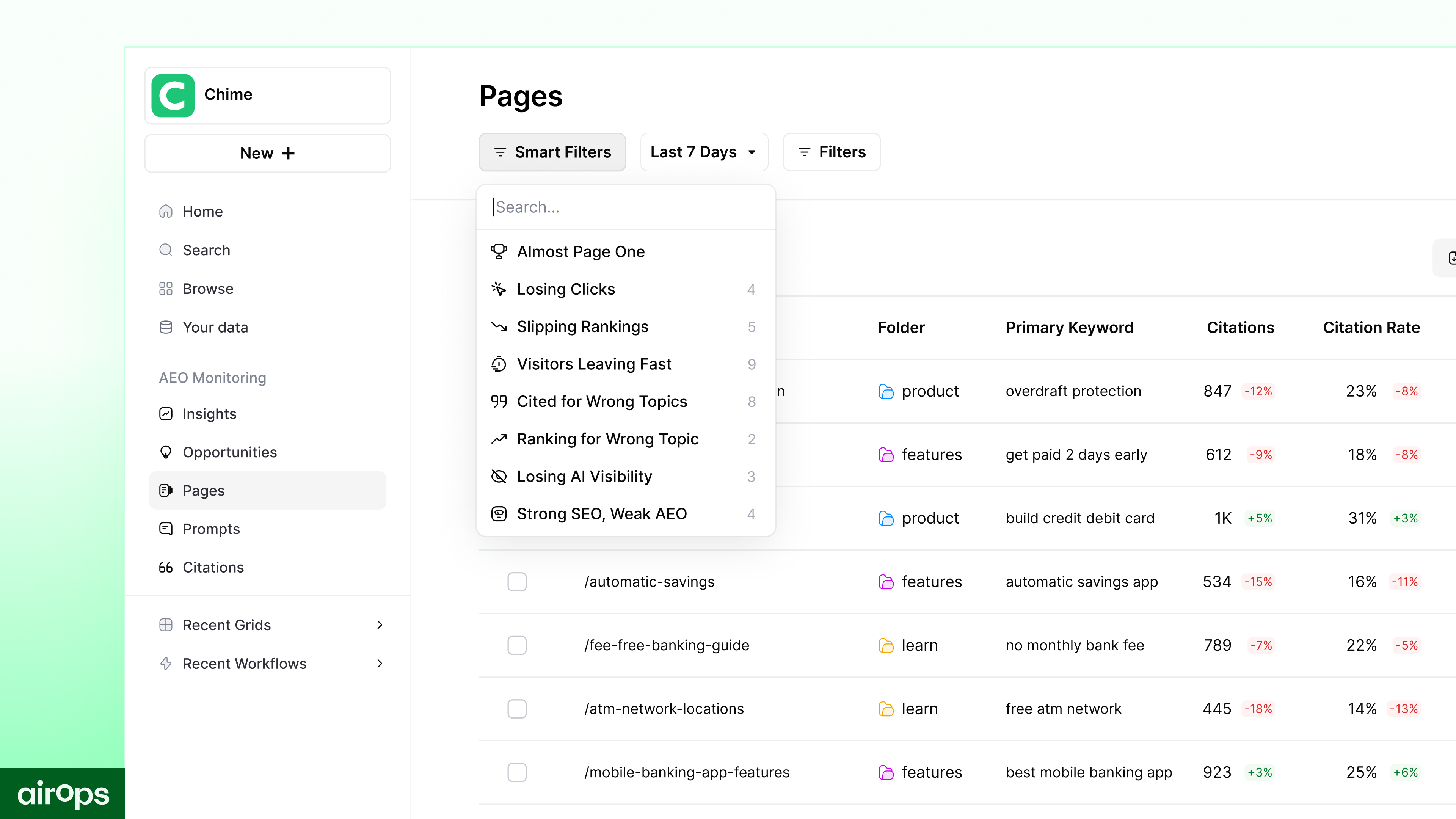
- Re-run your top 20 prompts every week.
- Refresh pages regularly, since pages left un-updated for over a year are about 2x more likely to lose citations (AirOps research).
- Compare tactics by the lift they produce, not by effort.
Key takeaways
- Quotations, statistics, and named sources drive the biggest citation lift.
- Skip keyword stuffing and padding, since they do not help.
- Structure pages for extraction with clean headings and schema.
- Low-ranked pages gain the most, so GEO rewards challengers.
- Pick the right GEO tools and measure lift by citation rate.
AirOps for tracking generative engine optimization strategies
You can only rank GEO strategies by lift if you can measure citations. AirOps tracks citation rate, citation share, and mentions across ChatGPT, Gemini, and Perplexity, then runs the refreshes that move them. AirOps is the partner brands bring in for this shift, bringing the platform, the media mix, and the team that builds and runs the strategy alongside yours, then ties it back to pipeline and revenue growth.
Quill runs the content refreshes and off-site work as Playbooks, and reports the citation lift back in one place.
Frequently Asked Questions
Frequently asked questions
Which GEO tactic increases citations the most?
Adding quotations, followed closely by statistics and named sources. The Princeton study measured lifts of up to 40%.
Do these citation-lift numbers apply to every website?
No. The lift varies by domain and query type, and lower-ranked pages tend to gain the most.
How is GEO different from SEO?
SEO earns rankings and clicks. GEO earns citations and mentions inside AI answers.
How often should I refresh content to stay cited by AI?
Aim to refresh at least yearly, and sooner for fast-moving topics. Pages left stale are far more likely to lose their AI citations.
What is the best heading format for getting cited by ChatGPT?
Use a single H1 with sequential, question-based H2s and H3s, and answer each question in the first sentence.