Prompts for a CMO AI content operating model
- This page gives you six copy-paste prompts that turn AI content plans into an operating model you can run.
- The prompts produce an audit, an org design, an ownership map, a budget case, a rollout plan, and a scorecard.
- Gartner's 2026 data shows CMOs put 15.3% of marketing budgets into AI, and 30% report they are ready to scale it.
- Answer engine optimization (AEO) needs a named owner with responsibility for refreshes and third-party sources.
This guide from AirOps, an enterprise AEO platform, collects prompts for a CMO AI content operating model. Each prompt produces one leadership artifact you can bring to your next executive meeting.
Your writers and SEO leads already have tactical prompts, such as our ChatGPT prompts for enterprise SEO content teams. These six work one level up. They settle ownership and funding, then define how you measure results in AI search. Run them in order, or start with the artifact your board asks for first.
How are CMOs using AI to scale content marketing?
Chief marketing officers (CMOs) scale content with AI by redesigning ownership, governance, and measurement around it. Tool choices follow those decisions. Here is how CMOs use AI to scale content marketing once the model is in place:
- They assign one accountable owner to every content workflow, including refreshes.
- They run every AI draft against shared brand context and a named human reviewer.
- They measure AI search citations and pipeline alongside output volume.
- They fund the model as a program with its own budget line.
Budget is already moving. In Gartner's 2026 CMO spend survey, CMOs put 15.3% of marketing budgets into AI. Only 30% report the maturity to scale those capabilities. Gartner also found 56% lack the budget to deliver their 2026 strategy.
A content operating model closes that gap with six components. Each one answers a leadership question, and each gap shows up fast in your results.
| Operating model component | What it decides | What breaks without it |
|---|---|---|
| Strategy | Which topics, audiences, and AI search prompts you go after | Output grows while citations and pipeline stay flat |
| Roles | Who owns brand context, workflows, review, and AEO | Work stalls between writers, SEO, and brand |
| Workflows | How briefs, drafts, refreshes, and distribution run | Every writer prompts AI differently, and quality drifts |
| Governance | Which brand rules, claims, and review gates apply | Off-brand or unsupported claims reach your site |
| Measurement | Which metrics you report and how often | You defend spend with output counts |
| Budget | How you fund tools, roles, and agency work | Pilots never reach production scale |
Adoption is still shallow. BCG's 2026 agentic marketing research found 42% of CMOs use generative AI only to assist humans with discrete tasks. Task help saves hours. An AI content operating model turns those hours into results you can report.
Prompts for a CMO AI content operating model, step by step
Run these six prompts in order, because each one uses the output of the one before it. Paste your own data wherever you see [brackets].
| Prompt | Output artifact | Owner | When to run |
|---|---|---|---|
| 1. Current-state audit | Gap analysis across six components | VP of content | Week 1 |
| 2. Target org design | Role map with named owners | CMO | Week 2 |
| 3. Workflow ownership map | Ownership chart per workflow | Head of content operations | Week 3 |
| 4. Budget and resourcing case | One-page memo for finance | CMO and finance partner | Week 4 |
| 5. 90-day rollout plan | Phased plan with exit criteria | Program lead | Week 4 |
| 6. Leadership scorecard | Monthly one-page scorecard | CMO | Week 5, then monthly |
The prompts build on the content engineer role, which connects AI workflows to brand standards. They turn that practice into a model your leadership team runs every month.
1. Audit your current content operations
Start with a current-state content operations audit. You need an honest baseline before you redesign anything.
You are a content operations advisor to the CMO of [company], a [industry] brand.
Audit our current content operating model with the inputs below.

Inputs:
- [org chart]
- [content inventory export]
- [AI tools in use and who uses them]
- [last quarter's content output and results]

For each component (strategy, roles, workflows, governance, measurement, budget), report:
1. How it works today, in two sentences.
2. Who owns it, or "no owner."
3. Where AI is used and where it stops.
4. The biggest gap, rated high, medium, or low.

Rank the three gaps that block scale most by impact on pipeline.
Format the audit as a table. Add a 100-word summary for the executive team.
Strong output from this prompt has these traits:
- Every component lists a named owner or flags "no owner."
- Each AI use case maps to a specific workflow and its stopping point.
- The top gaps connect to pipeline or AI search results.
2. Design the target org and roles
Your audit shows where ownership breaks. This prompt designs the org that fixes it, starting with your current headcount. For fuller job scopes, use these growth org role definitions.
You are an org design advisor to the CMO of [company].
Design a target content org for AI-assisted production and AEO.

Inputs:
- Audit: [paste Prompt 1 output]
- Current team: [roles, headcount, and reporting lines]
- Constraints: [hiring budget], [agency contracts], [timeline]

For each role, define:
1. The outcomes it owns.
2. The workflows it runs or approves.
3. Whether it replaces, extends, or adds to a current role.

Include an owner for brand context, an owner for AEO, and an executive sponsor.
Flag each role as a new hire or a reskilled role.
Output a role table and a one-paragraph rationale for the CFO.
Expect a role table close to the one below.
| Role | Owns | Replaces or extends |
|---|---|---|
| AEO lead | Citation and mention goals, prompt tracking, and refresh priorities | Extends the SEO lead role |
| Content Engineer | Workflow design, testing, and maintenance | Adds a role, often reskilled from content operations |
| Brand context owner | Brand Kit rules, terminology, and approved claims | Extends brand or editorial leadership |
| Editorial reviewer | Final human review before anything publishes | Extends the managing editor role |
| Executive sponsor | Budget, priorities, and cross-functional decisions | Extends the CMO or VP of marketing role |
3. Map workflow ownership across your content org
A workflow ownership map assigns one accountable owner to every stage of every content workflow. It keeps AI drafts moving between writers, SEO, and brand.
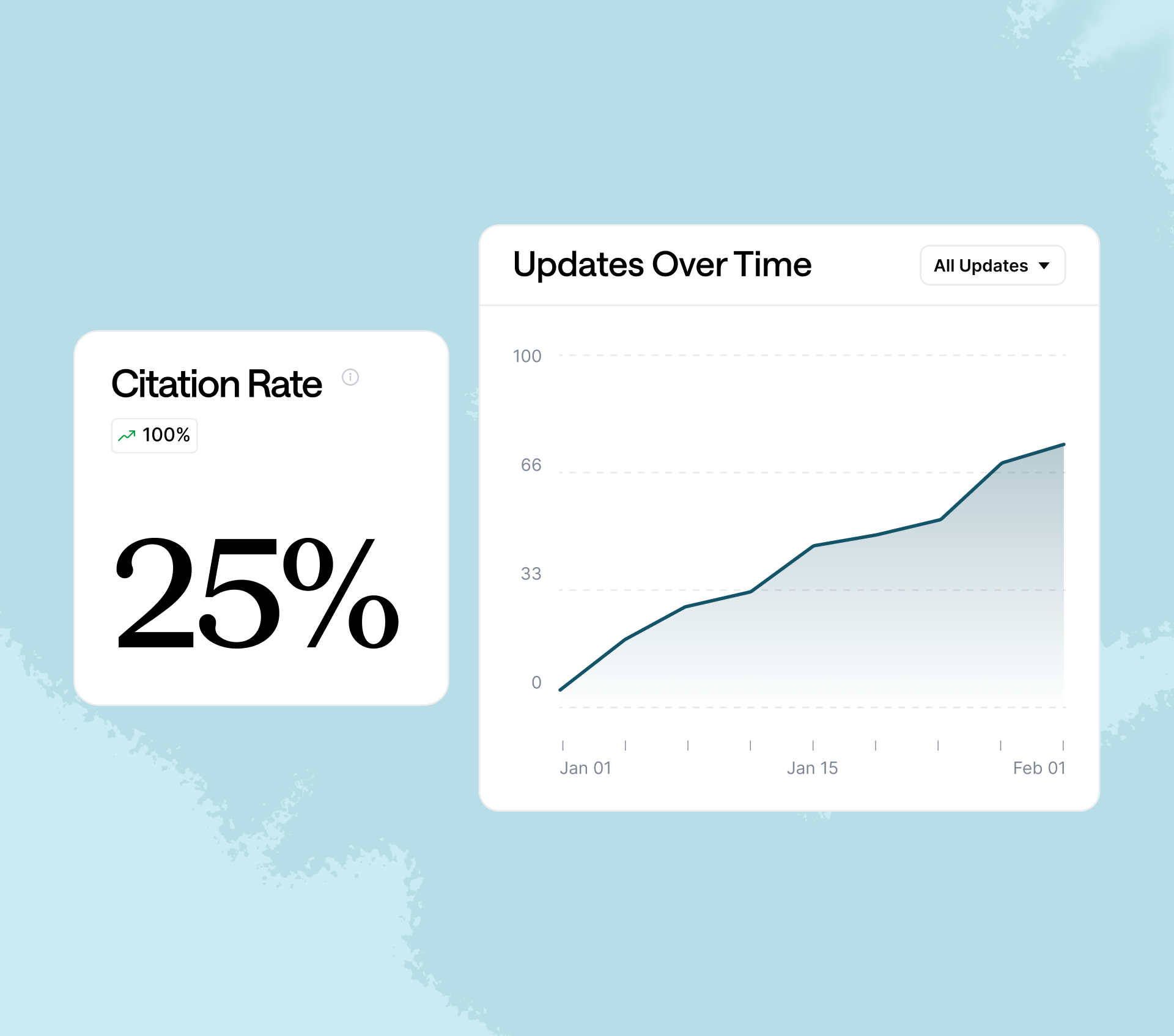
Cross-functional handoffs are where AI programs stall. In 2025, BCG's marketing transformation research found only 15% of AI initiatives operate cross-functionally at enterprise scale. The AirOps view below shows content operations organized into repeatable workflows.
This prompt builds a responsible, accountable, consulted, and informed (RACI) chart for each workflow.
You are the head of content operations at [company].
Build a RACI chart for each of our content workflows.

Workflows: [e.g. new article, page refresh, product launch page, third-party placement]
Stages per workflow: brief, draft, brand review, SEO and AEO review, publish, refresh
Roles: [paste Prompt 2 role table]

Rules:
- Assign exactly one Accountable owner per stage.
- Make a human reviewer Accountable for every publish stage.
- Pull voice, terminology, and claims from one shared Brand Kit in every workflow.

Flag stages with no owner or more than one Accountable owner.
Output one table per workflow.
List the handoffs that need a response-time target.- Each stage shows one Accountable name, with no shared ownership.
- Refresh shows up as its own stage with its own owner.
- Every AI step names the Brand Kit as its context source.
4. Build the AI content budget case
Your chief financial officer (CFO) needs a funding case tied to outcomes. In 2025, Gartner data reported by Marketing Brew showed 39% of CMOs planned agency budget cuts. Those dollars fund owned roles and workflows when you show the math.
You are a finance-minded marketing strategist writing a memo for the CFO of [company].
Build an AI content budget case for [fiscal year].

Inputs:
- Current content spend by category: [headcount], [agencies], [tools], [freelancers]
- Target roles: [paste Prompt 2 role table]
- Ownership map: [paste Prompt 3 RACI chart]
- Current output and content-sourced pipeline: [numbers]

Show:
1. Current cost per published or refreshed page.
2. Projected cost per page under the new model.
3. Spend to shift from agencies and freelancers to owned roles and workflows.
4. The pipeline and AI search metrics you will report each quarter.

Keep the memo to one page. List every assumption in a table.- Cost per page drops, and every assumption is visible.
- Agency spend shifts to named owned roles.
- Every metric in the memo ties to pipeline or AI search.
Pair the memo with these content ROI report prompts so finance sees the same numbers every quarter.
5. Plan a 90-day AI rollout
A 90-day AI rollout plan takes the model out of slides and into production. Start with one product line or content type. Expand once the first workflow hits its targets.
You are a program lead at [company] rolling out a new AI content operating model.
Scope: [product line or content type for the pilot]

Inputs:
- [Prompt 2 role table]
- [Prompt 3 RACI chart]
- [Prompt 4 budget memo]

Build a plan in three 30-day phases:
- Days 1-30: baseline metrics, Brand Kit setup, first workflow live.
- Days 31-60: second and third workflows, refresh program for the top [number] pages.
- Days 61-90: expand to [additional scope], first leadership scorecard review.

For each phase, list owners, milestones, exit criteria, and risks.
End with the decisions the CMO makes at day 30, day 60, and day 90.- Each phase ends with exit criteria you can measure.
- Owners match the RACI chart from Prompt 3.
- The plan names the decision you make at each checkpoint.
For the AI search program inside this rollout, use the CMO guide to AI search alongside your plan.
6. Build your marketing leadership scorecard
A marketing leadership scorecard shows whether the model works. It pairs production health with AI search results and pipeline. Keep it to one page so your executive team reads it.
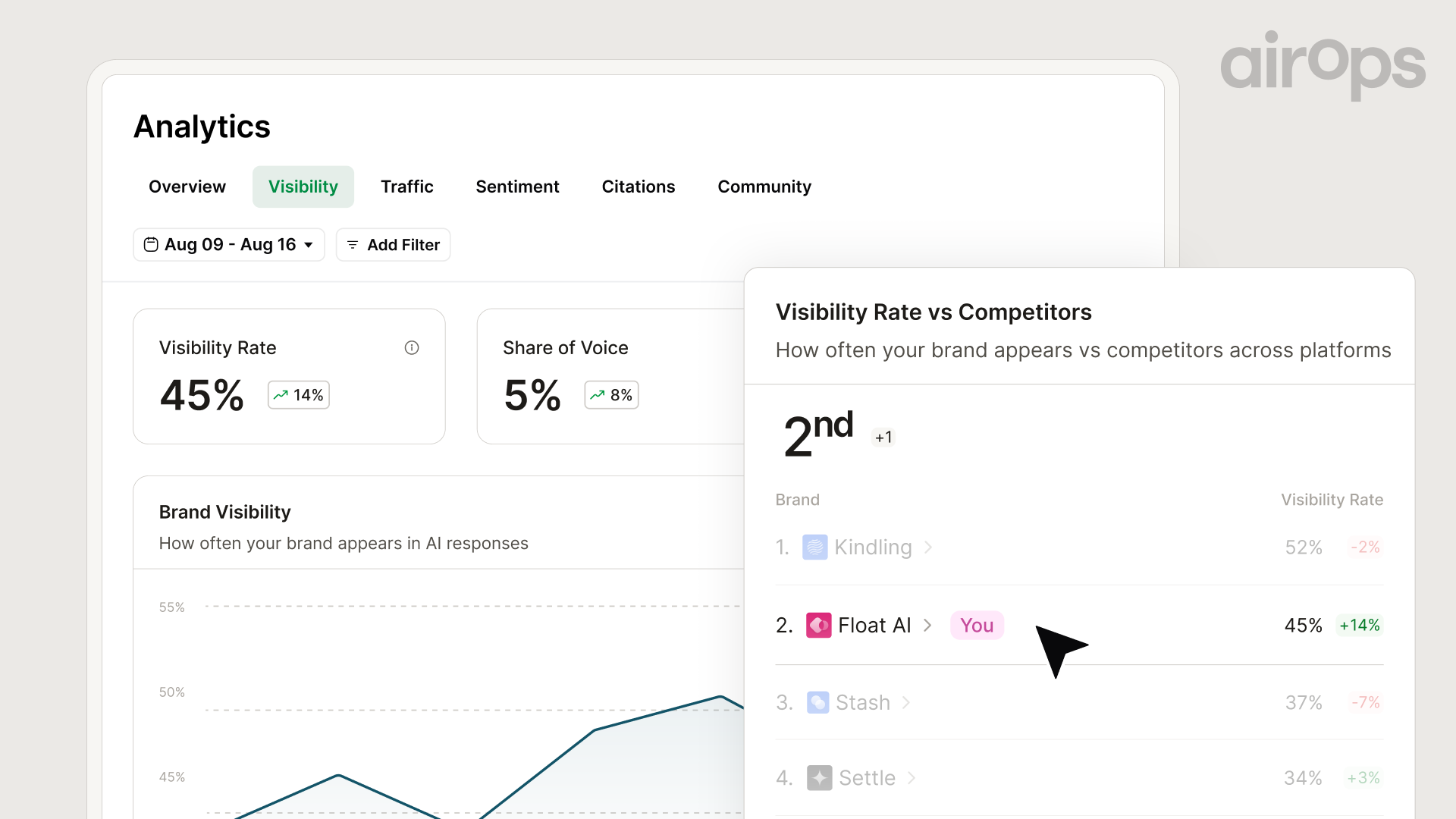
The AirOps Analytics view below tracks citation and mention metrics over time.
You are a marketing analyst building a monthly scorecard for the CMO of [company].

Data:
- [content output by workflow]
- [last-updated dates for priority pages]
- [AI search citation and mention rates by topic]
- [share of voice against named competitors]
- [pipeline sourced or influenced by content]

Build a one-page scorecard with four sections: production, quality, AI search, and pipeline.
For each metric, show current value, target, three-month trend, and owner.
Flag any cited page not updated in [number] months.
Close with three actions for next month, each with an owner.
Keep freshness on the scorecard. AirOps research on stale content found pages left over a year without updates see citation likelihood drop by over 50%.
| Metric | What it tells you | Cadence |
|---|---|---|
| Pages published and refreshed per workflow | Whether your workflows ship on schedule | Weekly |
| Share of priority pages updated in the last 3 months | Freshness risk for AI citations | Monthly |
| Citation rate by topic | How often AI search answers cite your pages | Monthly |
| Mention rate by topic | How often AI answers name your brand | Monthly |
| Share of voice | Your share of AI answer mentions against named competitors | Monthly |
| Review pass rate | How often drafts clear human review on the first pass | Monthly |
| Pipeline influenced by content | Whether the model moves revenue | Quarterly |
How should you structure AEO across several product lines?
Run AEO across several product lines with one central AEO lead and a named owner in each product line. The central lead owns the prompt set, the Brand Kit, and the monthly scorecard. Each product line owner runs refreshes and third-party work for their own pages and reports against the same metrics.
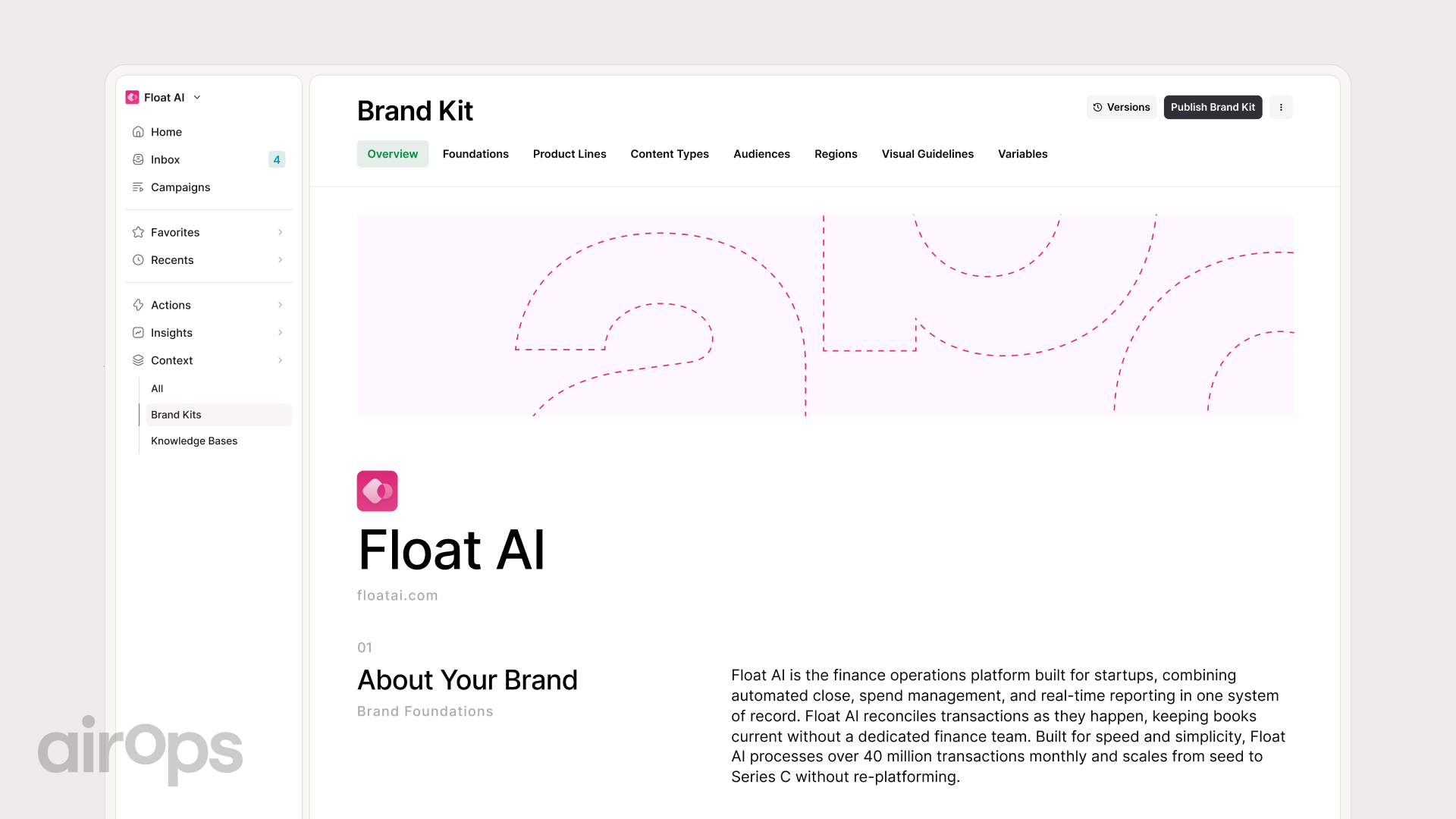
The Brand Kit view below shows the shared rules every product line and reviewer checks against. The brand governance hub covers how to keep that output consistent at scale.
Four controls keep that structure consistent across product lines:
- Keep one Brand Kit for voice, terminology, approved claims, and banned phrases.
- Build a shared workflow library so business units reuse tested workflows.
- Name one owner per workflow stage, using your RACI chart.
- Set human review gates before anything publishes under your brand. Our enterprise content governance prompts help you design them.
To orchestrate the AI content workflows behind this structure, give each stage one owner and every team one handoff format, then roll out in waves. Our agentic AI content workflow prompts cover that rollout step by step.
What organizational changes are needed to scale AEO effectively?
AEO is the work of earning citations and mentions in AI answers. It scales when it becomes a named function with refresh ownership and responsibility for third-party sources. As a side project inside SEO, it stalls once the work spreads across channels. AI answers draw on pages you own and pages you don't, so ownership has to cover both.
- Give AEO a named lead with citation and mention goals.
- Assign refresh ownership for every page that earns AI citations.
- Write third-party sources, reviews, and community threads into a specific job description.
- Report AI search metrics on the same monthly scorecard as pipeline.
Off-site ownership matters most for AI answers. The 2026 State of AI Search report from AirOps found 85% of brand mentions come from third-party pages. Pages not updated quarterly are 3× more likely to lose citations.
| Area | Before | After |
|---|---|---|
| AEO ownership | Shared across SEO and content, with no single owner | One AEO lead with citation and mention goals |
| Refresh | Ad hoc, triggered by traffic drops | Scheduled by citation risk, with a named owner |
| Third-party sources | Owned by PR and measured on coverage | Owned jointly and measured on AI mentions |
| Reporting | Rankings and traffic | Citations, mentions, share of voice, and pipeline |
| Review | Brand review at the end | Brand Kit rules applied inside every workflow |
Run Prompt 2 again with these changes as constraints. The output gives you an AEO org you can staff this quarter.
For role scopes and the leadership case, use this guide to building an AEO team. Our enterprise AEO strategy guide covers the wider plan.
Key takeaways
- Your AI content operating model needs owners, governance, and metrics before it needs more tools.
- Run the six prompts in order so each artifact feeds the next one.
- Fund the model by shifting agency and freelance spend into owned roles and workflows.
- Give AEO a named owner and a refresh cadence tied to citation risk.
Frequently asked questions
What is an AI content operating model?
An AI content operating model assigns an owner and AI rules to every content workflow. It also sets the metrics you report to leadership.
How fast does a new operating model show results?
Expect baselines and your first live workflow within 30 days. First scorecard trends show up by day 90, when the 90-day AI rollout plan closes.
How much budget should a CMO allocate to AI content?
Gartner's 2026 CMO spend survey puts the average AI allocation at 15.3% of marketing budget. Among CMOs at AI-ready organizations, the figure rises to 21.3%.
Do you still need a content team with an AI content operating model?
Yes. Your writers and editors bring the judgment, and the model gives them shared context and clear review gates.
Who should own AEO in a marketing org?
A named AEO lead should own citation and mention goals and report to the CMO or VP of marketing. That lead partners with content, SEO, and PR on refreshes and third-party sources.
AirOps for CMO AI content operating models
AirOps is an enterprise AEO platform and expert partner for marketing leaders, connecting AI search intelligence, coordinated action across channels, and measurement tied to growth. Use it to turn these six prompts into a working model. AirOps experts set priorities with you and guide execution across the channels that shape AI discovery.
- Brand Kit holds the voice, terminology, and claims your governance prompts define.
- Workflows run your ownership map and 90-day rollout across business units.
- AirOps Analytics tracks the citations, mentions, and share of voice on your scorecard.
Start with the audit prompt, then bring its output to a working session with AirOps experts.