- Content engineering shifted content from one-off deliverables to structured systems teams can update and reuse
- Metadata, templates, and refresh rules replaced ad-hoc publishing
- Content engineers turned strategy into repeatable execution that scales without drift
- AI Search started surfacing pages built for machines to parse, not just humans to read
- Teams that treated content like infrastructure saw visibility compound instead of decay
AI promised faster production and better results. Many teams saw the opposite: rising output, weaker engagement, drifting voice, and more time spent fixing drafts than shipping work people trust.
Content engineering changes that pattern. It gives content teams systems to create, update, reuse, and distribute content at scale while people stay accountable for accuracy and brand standards.
This guide defines content engineering, walks through the elements that make it work, and shows how teams apply it to content ops, SEO, and AI search. It also explains what content engineers do and when the role fits your organization.
What is content engineering?
Content engineering is the practice of building systems that help teams create, update, reuse, and distribute content at scale without losing accuracy, consistency, or voice.
Teams stop treating content like one-off deliverables and start treating it like infrastructure. Structure, labels, and relationships live alongside the words themselves.
These systems replace ad-hoc publishing habits with repeatable building blocks.
Content engineering bridges the gap between content strategy and technical implementation, ensuring that content is structured, tagged, and optimized for efficient content management and delivery across multiple channels. By thinking of content as a strategic asset, content engineering enables organizations to maximize the ROI of their content assets and improve the overall customer experience.
In practical terms, a Content Engineering strategy means designing repeatable systems for every stage of the content lifecycle, from research and creation through distribution and refresh, so the team can scale without sacrificing quality. Content engineering helps teams:
Automate repeatable tasks (research steps, briefs, internal linking checks, refresh cycles)using AI for content planning
Keep voice and standards consistent across channels
Reuse content without copy-pasting and drift
Ship content that machines can parse and surface in AI search
Writers still own judgment and craft. The system removes the busywork that slows them down.
The 10x Content Engineering Framework
The transformation to a 10x Content Engineer happens in three stages:
Automate the repetitive – Use AI for research, metadata, and first drafts so teams can focus on creativity and refinement.
Build scalable content systems – Create workflows for dynamic content hubs, internal linking, and programmatic SEO.
Continuously optimize & refine – Implement automation feedback loops, ensuring AI-driven content improves over time.
Josh Spilker, head of search marketing at AirOps, explains the need for content engineering:
You can't scale content with a broken system. It's difficult to scale content creation without a structure that guides how content gets created, updated, and measured. Content engineers fix this by thinking in systems, not individual posts.
Content engineers drive visibility and velocity. Teams using this approach cut production costs by 50%, doubled their publishing speed, and refreshed content with 40% more impact.
Great workflows start with clear checkpoints and human review. Automation without oversight leads to chaos. Every system should incorporate brand standards, editorial voice, and manual review to prevent errors and maintain quality.
A Content Engineering workflow connects these stages into a single loop: research feeds briefs, briefs feed drafts, drafts feed review, and performance data feeds the next research cycle. Each handoff is automated where possible and human-reviewed where judgment matters.
The core elements of content engineering
You don't need a rigid framework to start. Most teams build a few reusable parts, then improve them as performance data comes in.
Content models and modular structure
Break content into parts you can reuse across pages and channels.
Examples include:
A product definition block shared across docs, landing pages, and onboarding
A common objections block reused on pricing pages, in sales enablement, and in review responses
A standard "how it works" section for every feature page
This structure reduces duplication and keeps voice steady as the library grows.
Metadata, taxonomy, and intent signals
Metadata tells systems and teammates what each piece of content is for.
Common fields include:
Persona or audience segment
Funnel intent
Topic cluster or category
Product area
Last reviewed date and owner
Taxonomy gives teams a shared language. It also supports internal linking, navigation, and recommendations at scale. As Content Engineering matures, this metadata also determines whether answer engines can parse and cite your pages accurately.
Markup and structured data
Structured formatting helps search engines and AI systems parse content reliably.
Use patterns such as:
FAQs with consistent question-and-answer blocks
Clear headings that match search intent
Schema where it fits, including FAQ, HowTo, Product, and Article
Relationships between content, users, and data
Connect content to the signals that matter:
Which pages support each other through internal links
Which queries drive AI citations or brand mentions
Which pages need updates after product changes or SERP shifts
As these relationships mature, the system gets smarter with every cycle.
To see how content models, metadata, and structured data come together in practice, watch this breakdown from Connor Beaulieu:
He shows how modular structure and tagging turn content into reusable, discoverable assets as teams scale.
Why content engineering matters for scalable content ops
Content teams publish across more channels, refresh pages more often, and carry higher expectations for consistency. Without a system, that pace creates friction at every stage of the workflow.
As scale increases, the real test becomes how quickly teams can adapt without breaking standards.
Content engineering helps teams adapt quickly to new trends, market shifts, and user feedback. With flexible content structures and automation, teams can update and scale content without slowing down.
Agility also applies to governance. Clear workflows for creating, reviewing, and publishing content make it easier to stay on brand and compliant while priorities shift.
What teams get from content engineering
Content engineering changes how work moves through a team. Shared systems replace manual handoffs and scattered fixes, which makes reuse, quality control, and distribution part of the operating model rather than side work. The benefits of Content Engineering compound over time: each cycle of creation, measurement, and refresh makes the next one faster and more precise.

Each benefit in the chart maps to everyday outcomes, from fewer rewrites to faster refresh cycles and steadier visibility across search and AI assistants. Over time, those systems compound as content becomes easier to maintain, route, and trust.
These gains don't come from extra effort. They come from building content so teams can reuse work and move it through their stack with less manual handling.
Make content more reusable
Modular content changes how teams create. A single source of truth can surface as a blog post, a landing page section, a help center answer, or a sales enablement snippet without rewriting the core message.
That structure keeps voice steady while formats adapt to how and where people encounter the content.
Distribution improves when structure replaces page-level publishing.
Metadata turns routing into a system. Audience segment, intent stage, product area, region, and behavior signals guide where content appears instead of living in someone's head. That shift removes guesswork across channels.
Cut wasted effort
Most teams spend too much time repairing their own output. Broken links, outdated claims, and naming drift create steady rework.
Content engineering replaces cleanup with routine checks such as refresh schedules, link monitoring, and rules that surface problems early. Teams spend less time restarting and more time improving what already exists.
Support personalization without chaos
Personalization fails when every version lives on its own.
When modules connect to clear signals, teams can change examples, CTAs, or industry references without touching the underlying claims. Core content stays stable while surface details adapt to context. That balance keeps personalization durable instead of fragile.
Stay agile as information changes
Markets move. Products evolve. Search behavior shifts.
Teams that rely on page-level edits fall behind. Teams that revise source content and let systems propagate updates keep pace. Ownership and review paths make those changes predictable as volume grows.
How content engineering works in practice
Most teams don't adopt content engineering in one sweep. They solve one bottleneck at a time, then link those fixes into a system.
It often starts with a breakdown. Pages go stale. Internal links decay. Writers spend more time fixing drafts than shipping.
That's where structure matters. This is where theory turns into execution.
Here's a practical look at how these principles show up inside team processes with Oshen Davidson:
Build the system around the work that repeats
Look at what slows the team down every week.
Topic research. Briefs. Updating outdated claims. Finding where pages support each other. These steps repeat across every campaign, yet many teams still manage them by hand.
Those steps become shared building blocks inside a system:
Templates for briefs and outlines
Rules for how internal links get added and checked
Metadata that flags who a page serves and when it needs a refresh
Triggers that surface content when it drifts from standards
Content Engineers automate internal linking workflows by defining rules that match anchor text to destination pages based on topic clusters, then running those rules across the full library on a schedule. Instead of auditing links page by page, the system flags gaps and inserts recommendations that editors approve in a single pass.
Once these pieces live inside a system, teams stop starting over and start improving what already exists.
Keep humans accountable for what ships
Automation can draft, flag, and route work. People still decide what is true, useful, and safe to publish.
Oversight shows up in everyday decisions:
Editors review claims tied to trust or compliance
Brand owners approve shifts in voice or positioning
Legal or product partners step in when language carries risk
That accountability protects credibility as output grows.
Define standards that reflect outcomes
Standards fall apart when they track volume. They hold when they describe what success looks like.
Examples that scale:
Product pages include a verified evidence block
High-traffic pages follow a fixed section order that supports AI Search extraction
Topic clusters follow consistent internal linking rules
Pages above a traffic or revenue threshold refresh on a defined schedule
These rules give the system guardrails. Teams move faster because they don't debate basics every time they publish.
When repetition lives inside systems, people own judgment, and standards anchor quality, content engineering turns into how work gets done.
Content Engineering Tools and Platforms
Content Engineers use tools across five categories: research, creation, optimization, distribution, and measurement. No single platform covers every stage, which is why the system design matters more than any individual tool.
Research tools pull keyword data, competitive gaps, and audience signals into structured briefs. Creation tools handle drafts, templates, and modular content assembly. Optimization tools run checks for SEO, readability, and brand compliance before publication. Distribution tools push content to the CMS and syndication channels. Measurement tools track rankings, AI citations, and engagement across traditional and AI search surfaces.
The gap most teams face is not tool selection but tool integration. A Content Engineering partner like AirOps connects these stages so data flows from research to measurement without manual transfers. Grids manage every article and update from one interface, Workflows automate multi-step production sequences, and Brand Kits keep voice and standards consistent across every output.
Evaluate tools by how well they connect to the rest of your stack, not by feature count alone. The best Content Engineering setup is one where the handoffs between stages are automated and the team focuses on the decisions that require human judgment.
What does a content engineer do?
Content engineering created a new role in modern teams.
A content engineer blends strategy, systems thinking, and execution. They build the structure that lets a content program scale. Many teams now look for a 10x content engineer who can design these systems end-to-end instead of optimizing one page at a time.
The day-to-day work looks like this:
Build templates and reusable content models
Define metadata, taxonomy, and governance rules
Connect tools across research, creation, publishing, and measurement
Set refresh programs and monitor content health
Track performance across SEO and AI search signals
Improve internal linking systems and topic coverage
They focus on systems rather than individual posts. Success shows up in visibility patterns, conversion paths, update velocity, and content health.
At a growth-focused company, a Content Engineer owns the systems that connect content production to pipeline and revenue. They build automated refresh programs, design internal linking architectures, and create feedback loops between search performance data and editorial priorities.
A typical Content Engineer job description asks for experience in workflow automation, metadata design, SEO, and cross-functional collaboration with product, analytics, and engineering teams.
Content Engineering Skills
Content Engineers combine editorial instincts with technical execution. The core skill set spans five areas.
Systems thinking is the foundation. Content Engineers design workflows that connect research, creation, optimization, and measurement rather than treating each stage as a standalone task.
SEO and AI search fluency means understanding how traditional search engines and answer engines evaluate content, from keyword targeting and schema markup to citation patterns and entity recognition.
Workflow automation covers the ability to build repeatable processes using tools, APIs, and integrations that reduce manual handoffs across the content lifecycle.
Data literacy involves reading performance metrics, identifying patterns in search console data and AI citation reports, and translating those patterns into editorial decisions.
Editorial judgment keeps quality intact at scale. Content Engineers know when automation is safe and when a human needs to review claims, voice, and compliance before content ships.
How teams build content engineering capability
Content engineering is still an emerging discipline, which means teams often struggle to define where to find the right talent or how to upskill existing staff.
Some organizations develop the role internally by training senior writers, SEOs, or content ops managers on systems thinking, metadata design, and workflow automation. AirOps University was built for that purpose, offering a Content Engineering course curriculum covering modular content modeling, refresh automation, AI Search optimization, and governance design.
Other teams choose to hire dedicated content engineers from the market. AirOps maintains a job board that connects companies with professionals who specialize in content systems, automation, and AI-ready publishing workflows.
Whether you train or hire, the fastest-moving teams treat content engineering as a core capability rather than an experiment on the side.
Why hiring a content engineer can unlock growth
As content programs scale, someone has to design the system behind the work. Teams that rely only on writers and strategists feel that gap quickly.
That pressure has pushed many organizations to treat the content engineer as a growth hire rather than a support role.
Writers and strategists often own planning and craft. Content engineers turn that direction into consistent execution across a large content library.
The impact shows up in a few clear ways.
Shift measurement from outputs to outcomes
Mature teams track visibility, engagement, pipeline influence, and conversion paths. Content engineers build feedback loops that tie production decisions to those metrics.
Make AI safer at scale
Generative output brings risk: drifting voice, unsupported claims, and pages that compete with each other. Content engineers reduce that risk through clear claim rules, review ownership, standard structure, and refresh routines that keep pages current.
Improve cross-team alignment
Content touches product, analytics, design, SEO, and legal. Content engineers translate strategy into systems those teams can work with and trust.
How the content engineer role differs from the content strategist
Both roles care about performance. They work at different layers of the system.
What a content strategist owns
A strategist sets direction:
Audience needs and pain points
Narrative, themes, and positioning
Editorial priorities and content plans
Success metrics and goals
What a content engineer owns
A content engineer shapes execution:
Templates, modules, and reusable structures
Metadata standards and taxonomy
Automation steps for research, production, and refresh
Quality checks and governance rules
Measurement loops tied to SEO and AI search visibility
In practice, a strategist can define priorities for the quarter. A content engineer can build the system that ships and improves the work across the entire library. A Content Engineer also differs from a prompt engineer: prompt engineers optimize individual AI interactions, while Content Engineers design the end-to-end systems that govern how content gets researched, produced, reviewed, and measured across an entire library.
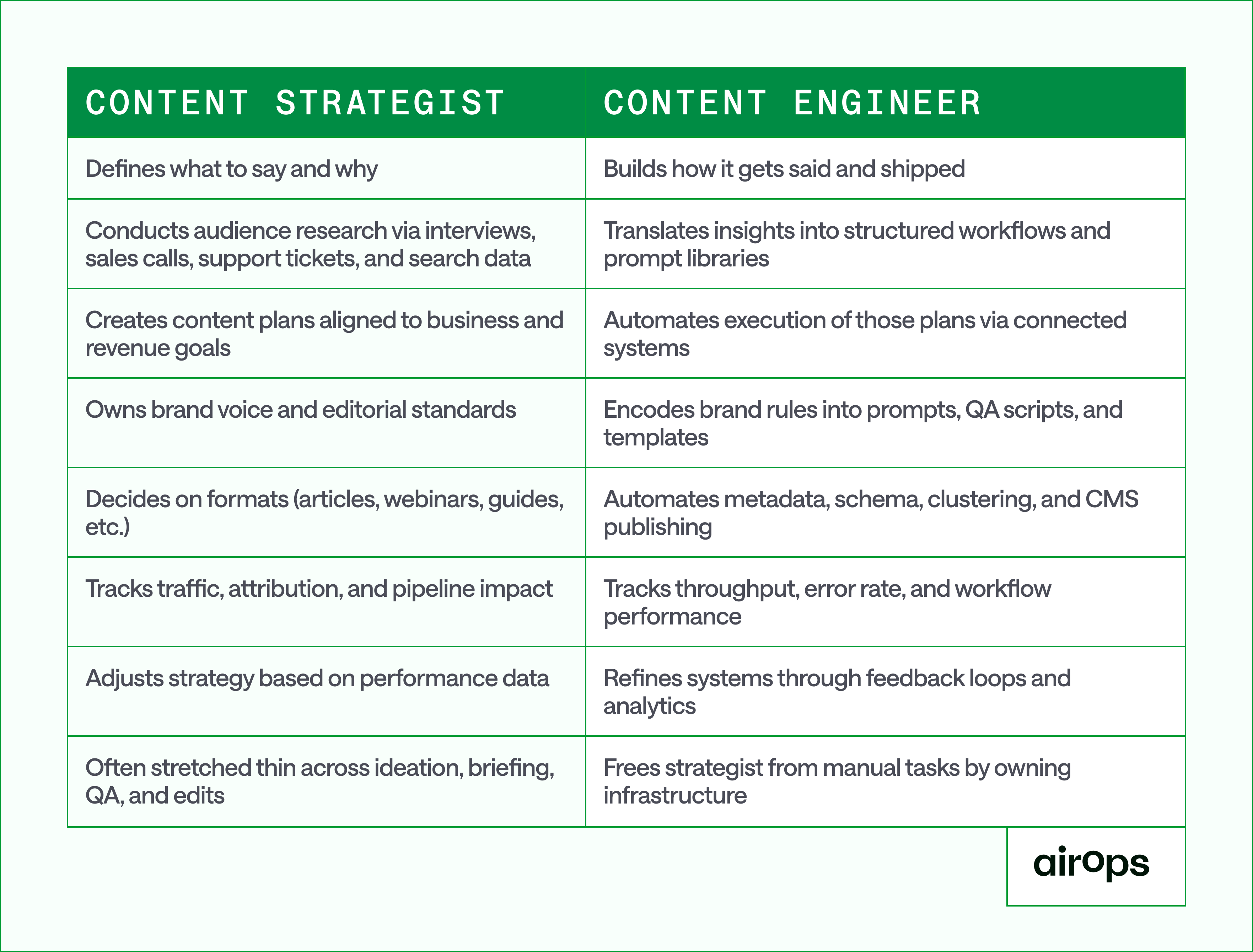
You can see a deeper breakdown of how these responsibilities diverge in our guide on the content strategist vs. content engineer.
Content engineering and AI Search
Search now lives inside assistants and answer engines that pull passages, citations, and summaries from across the web.
An AI Content Engineer applies these principles specifically to answer engine visibility. Content engineering raises AI Search visibility because teams create content machines can parse and trust. That shows up in practical choices such as clear structure that matches intent, FAQs that answer questions directly, schema that adds meaning, internal links that signal topical authority, and refresh programs that keep pages current.
When machines struggle to interpret a page, they stop surfacing it.
Real-world examples of content engineering in action
These teams applied content engineering under real constraints and saw clear gains in speed, accuracy, and visibility.
Docebo
Docebo brought content operations in-house to regain control over a fast-moving, compliance-heavy library tied to frequent product releases and legal requirements.
With AirOps, the team cut production costs by 50%, doubled content velocity to 25 refreshed pages per month, and automated refresh triggers based on a 15–20% drop in clicks or impressions from Google Search Console.
The shift also delivered 25% more sessions from AI discovery, with AI-driven traffic now generating 12.7% of high-intent leads.
Read the full Docebo case study.
Carta
Carta embedded brand controls, compliance review paths, and collaboration workflows directly into daily content creation.
Within the first few months, the team achieved a 300% increase in content velocity — moving from 5 to 20 top-of-funnel pieces per quarter — alongside 60%+ time savings as workflows matured.
New pages created with AirOps reached a 75% AI citation rate, with an average of 3 days from publication to citation, some appearing within a single day.
Read the full Carta case study.
Chime
Chime rebuilt its refresh workflows around automated opportunity detection, compliance checks, brief generation, and one-click publishing for a library of 700+ blog posts.
In under six weeks, the team achieved a 70% increase in refresh velocity (from 16 to 27 posts per month), an 89% reduction in refresh time (from 45 minutes to under 5 minutes per post), and a 3× increase in AI Search citations across priority questions.
Read the full Chime case study.
How content engineering fits into a modern growth organization
As content engineering matures, teams split responsibilities to keep work moving without confusion.
Most orgs land on four areas of ownership:
Strategic ownership defines audience, priorities, and success metrics tied to visibility, pipeline, and revenue.
Content engineering designs and maintains the systems behind research, production, refreshes, internal linking, and distribution.
Governance and context ownership manages brand voice, compliance needs, taxonomy, and shared source-of-truth assets that connect marketing, product, legal, and analytics.
Executive sponsorship provides alignment, budget, and cross-functional support so systems compound over time.
Content stops living as a set of deliverables and starts operating as a growth system.
Teams that get this right treat content engineering as infrastructure inside the growth org, with clear ownership across strategy, systems, and governance.
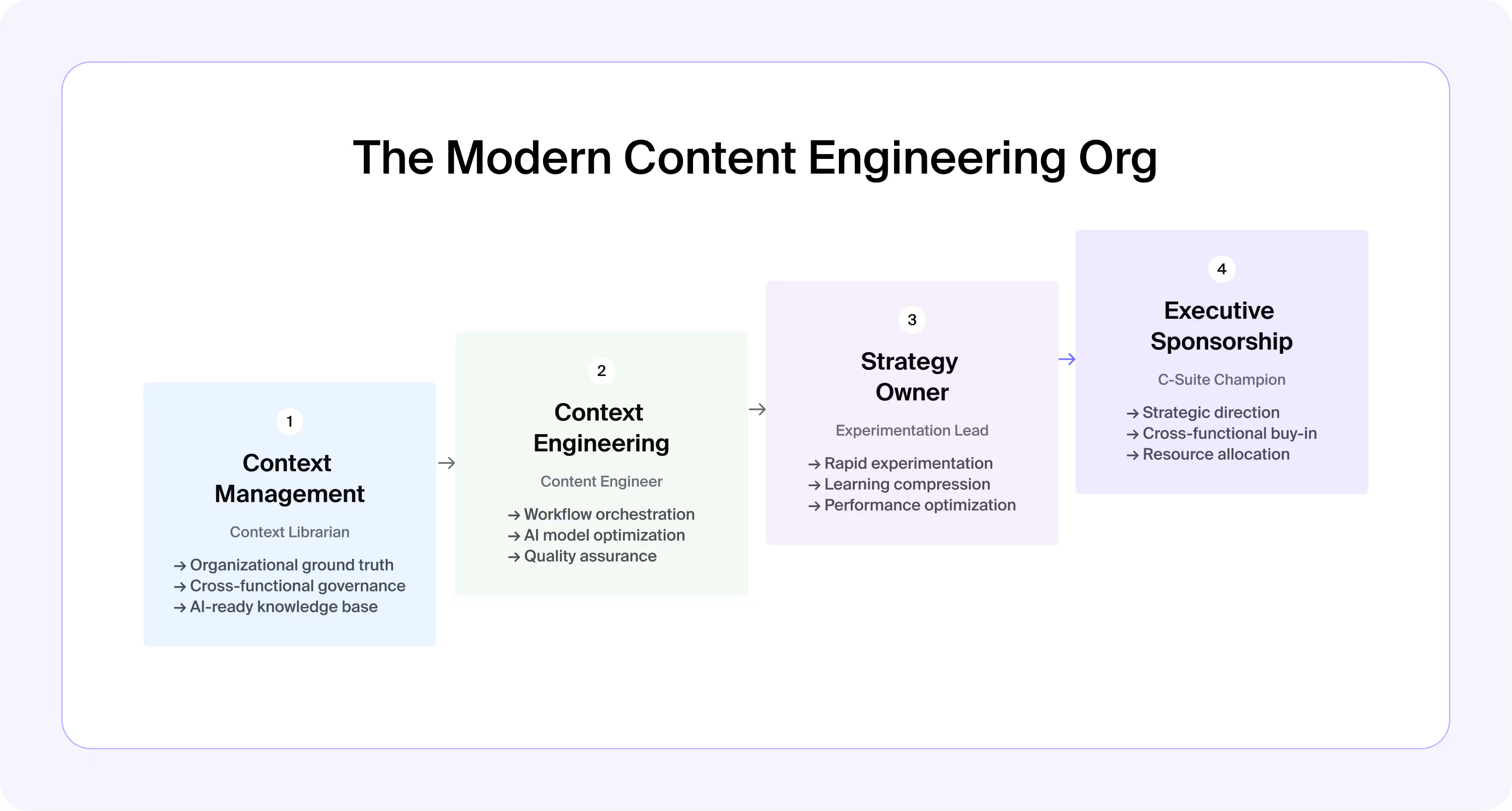
You can see how leading teams structure this model in our breakdown of the modern content engineering growth organization.
Key takeaways
Content engineering treats content as a system rather than a series of one-off deliverables.
Structured content supports reuse, automation, and personalization at scale.
Human oversight and clear standards protect trust.
Content engineers connect strategy with execution.
Modern growth teams separate strategy, systems, and governance to move faster.
Teams that scale systems outperform teams that scale volume.
Build systems that make content compound
Content got harder as channels multiplied and AI reshaped discovery. Most teams never built systems that could keep pace.
Content engineering turns content into infrastructure that supports AI Search, protects accuracy, and improves with every update. Teams that invest in these systems build programs that earn visibility and hold trust over time.
AirOps helps Content Engineers manage refresh workflows by connecting search performance data, AI citation signals, and content updates in one platform. AirOps is the partner brands bring in for this shift: the platform, the media mix, and the team together, not just software to log into, with a team that builds and runs the strategy alongside yours and ties it back to pipeline and revenue.
Book a demo to see how AirOps turns Content Engineering into a repeatable growth system.
Get the latest on AI content & marketing
