Prompts to build a content refresh business case
- This page gives you copy-ready AI prompts that build a content refresh business case for your chief marketing officer (CMO).
- The six prompts cover opportunity sizing, return on investment (ROI), cost of inaction, pilot scope, the pitch, and objections.
- AirOps research on stale pages and AI citations supplies the outside evidence for your cost of inaction.
- A 90-day pilot with a control group turns your forecast into proof before you ask for full budget.
- The final output is a one-page pitch that ends with a specific budget decision for your CMO.
Your archive loses clicks and AI citations every quarter, and you need budget to fix it. AirOps citation tracking shows which of your pages gain and lose AI citations across ChatGPT, Gemini, and Perplexity.
A content refresh business case wins budget when it runs on your own numbers. That means your Google Search Console (GSC) and Google Analytics 4 (GA4) exports, plus page-level citation data. Your CMO funds a sized loss with a testable fix, and the prompts below build both.
How do I justify a content refresh program to my CMO?
Justify a content refresh program as revenue protection with four parts. You need a sized opportunity, a conservative ROI model, a priced cost of inaction, and a 90-day pilot. Each part answers one question your CMO asks before approving spend.
Your CMO weighs refresh work against every other line in a flat budget. The case lands when each claim traces to a specific URL and a dated metric. Tie the program to your content strategy priorities so it fits the plan your CMO already approved. Our AEO pipeline business case guide shows how to frame the revenue side.
| Business case component | Question your CMO asks | Prompt that answers it |
|---|---|---|
| Opportunity size | Which pages are worth the work? | Prompt 1 (opportunity inventory) |
| ROI model | What do we get back for each dollar? | Prompt 2 (ROI inputs and formula) |
| Cost of inaction | What happens if we wait a year? | Prompt 3 (cost of inaction) |
| Pilot plan | How will we know it worked? | Prompt 4 (pilot and success criteria) |
| One-page pitch | What exactly am I approving? | Prompt 5 (one-page pitch) |
| Objection plan | Why not fund net new content instead? | Prompt 6 (objection handling) |
- Size the opportunity in pipeline dollars your CMO already tracks.
- Label every outside statistic with its source, year, and sample.
- Ask for pilot budget first, and tie full funding to results.
Why does content refresh ROI matter to a CMO now?
Budgets are flat and buyers research in AI, so your existing pages must carry more of the growth target. Gartner's 2026 CMO spend survey puts marketing budgets at 7.8% of revenue, up from 7.7% in 2025. In the same survey, 56% of CMOs say they lack the budget to deliver their 2026 strategy.
The sample covered 401 marketing leaders, mostly at $1B+ companies in North America, the UK, and Europe. Your CMO hears that pressure as a demand for growth from assets you already own.
| Evidence | Source | How to use it in your pitch |
|---|---|---|
| Budgets at 7.8% of revenue; 56% of CMOs short of budget | Gartner 2026 CMO spend survey | Frame refresh as owned growth |
| 94% of business buyers report using AI in buying | Forrester Buyers' Journey Survey, 2025 | Show research starts in AI |
| Pages not updated in over a year are more than 2X as likely to lose citations | AirOps stale content research, 2025 | Anchor your cost of inaction |
| Pages not updated quarterly are 3× more likely to lose citations | AirOps 2026 AI search research | Justify the cadence in your ask |
| AI-assistant citations are 25.7% fresher than organic results | Ahrefs study of 17M citations, 2025 | Support upkeep, labeled correlational |
Buyer behavior explains the urgency. In Forrester's 2025 buyer research, 94% of business buyers report using AI in their buying process. Content decay now costs you AI citations as well as organic clicks.
- Name the source, year, and sample on every slide that carries a statistic.
- Label freshness data as correlational, since no study here proves refreshing causes citations.
- Put outside numbers beside your own GSC trend so your CMO sees both.
- Frame content refresh for AI search as protection for pages that already earn pipeline.
Prompts to build a content refresh business case, step by step
Run these six prompts in order, and paste each output into the next one. Every prompt tells the AI to use only your data and to show three scenarios. Replace each [bracketed] field with your own export or estimate. For the full refresh process after approval, see our content refresh strategy guide.
How do you size a refresh opportunity inventory?
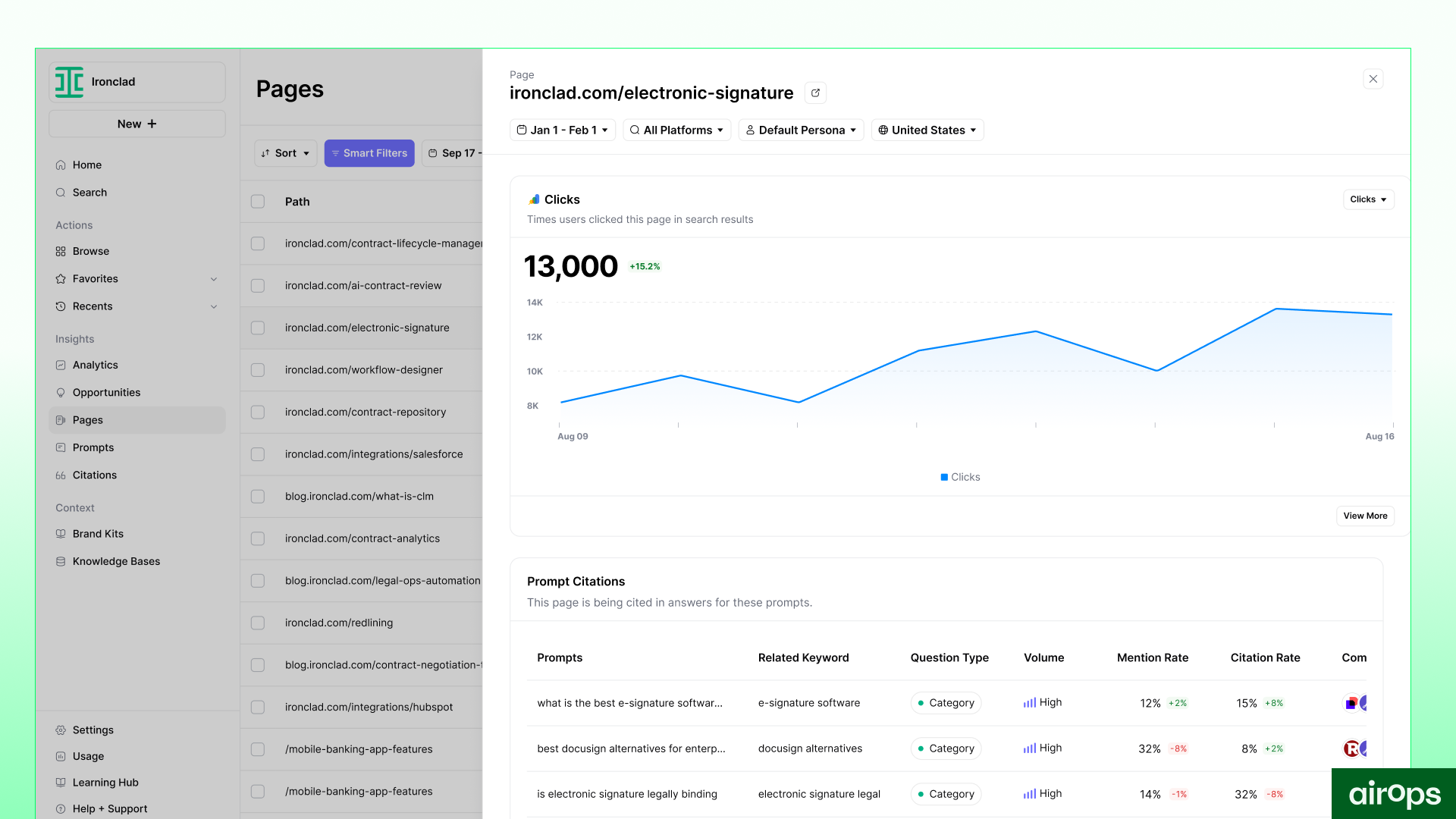
Size it by ranking every URL on recoverable clicks and conversions at risk. Prompt 1 adds AI citation loss, so pull citations per URL with an AI search visibility method first. The Page360 view below shows the page-level signals that drive refresh prioritization.
You are a content analyst building a refresh business case for a CMO.
Use only my data. Do not invent benchmarks.

Inputs:
- GSC clicks and impressions by URL, 16 months: [paste GSC export]
- GA4 conversions by landing page: [paste GA4 export]
- AI citations by URL: [paste citation export]
- Conversion rate: [conversion rate]
- Average deal value: [deal value]

Tasks:
1. Compare the last 3 months with the same months last year.
2. Flag URLs that lost [decline threshold %] or more of clicks.
3. Estimate recoverable clicks at [low %], [mid %], and [high %] recovery.
4. Label those conservative, base, and aggressive. Convert each to value.
5. Rank URLs by base-case value. Return the top [number] in a table.- Pull 16 months of GSC data to compare the same season.
- Set recovery rates yourself, and keep the low rate defensible.
- Paste the ranked table into Prompt 2 as the base of your ROI model.
How is content refresh ROI calculated?
Content refresh ROI equals incremental value minus refresh cost, divided by refresh cost. The refresh ROI definition covers the metric itself. Prompt 2 focuses on the inputs your CMO and finance partner will question.
Build a refresh ROI model for a CMO.
Use only my inputs, and show every formula.

Inputs:
- Ranked inventory: [paste Prompt 1 output]
- Hours per refresh: [hours per refresh]
- Hourly cost: [hourly cost]
- Conversion rate and deal value: [conversion rate], [deal value]

Formula: ROI = (incremental value - refresh cost) / refresh cost

Tasks:
1. Calculate 12-month ROI and payback month in conservative, base, and aggressive scenarios.
2. Test each input at plus or minus 20%, and rank the inputs by impact.
3. Flag every input that is an estimate instead of measured data.| Input | Where it comes from | Conservative default |
|---|---|---|
| Recoverable clicks | Prompt 1 inventory | Lowest recovery rate you can defend |
| Hours per refresh | Your last 10 refreshes | Upper end of your actual range |
| Hourly cost | Finance or agency rate card | Fully loaded rate |
| Conversion rate | GA4 landing page report | Trailing 12-month average |
| Deal value | Your CRM | The value finance accepts |
- Use your own hours per refresh, since no benchmark covers update cost.
- Send the sensitivity results to finance first.
- Lead with the conservative scenario.
How do you write the cost of inaction narrative?
Write it as the pipeline you lose each quarter the archive goes unrefreshed. Prompt 3 pairs your own decay rate with AirOps freshness data. AirOps tracked pages that went over a year without an update. In its stale content research, those pages were more than 2X as likely to lose citations. Our guide to content decay explains the pattern behind those losses.
You are writing a cost of inaction narrative for a CMO budget review.
Use my data first. Label outside research as context.

Inputs:
- Year-over-year click change for the top [number] URLs: [paste Prompt 1 output]
- Pipeline from those URLs, last 12 months: [paste CRM data]
- AI citation trend for those URLs: [paste citation data]

Tasks:
1. Calculate my quarterly decay rate in clicks and conversions.
2. Project 4 quarters of loss with no refresh in conservative, base, and aggressive scenarios.
3. Convert lost conversions into pipeline at [deal value].
4. Write a 150-word narrative with one number per sentence.
5. Do not claim that refreshing causes citations.- Make your own decay rate the headline number and outside research the support.
- Price the loss per quarter so your CMO sees the cost of waiting.
- Ahrefs' 2025 study of 17M citations found AI-assistant citations 25.7% fresher than organic results. Cited pages still averaged 2.9 years old.
How do you scope a content refresh pilot and success criteria?
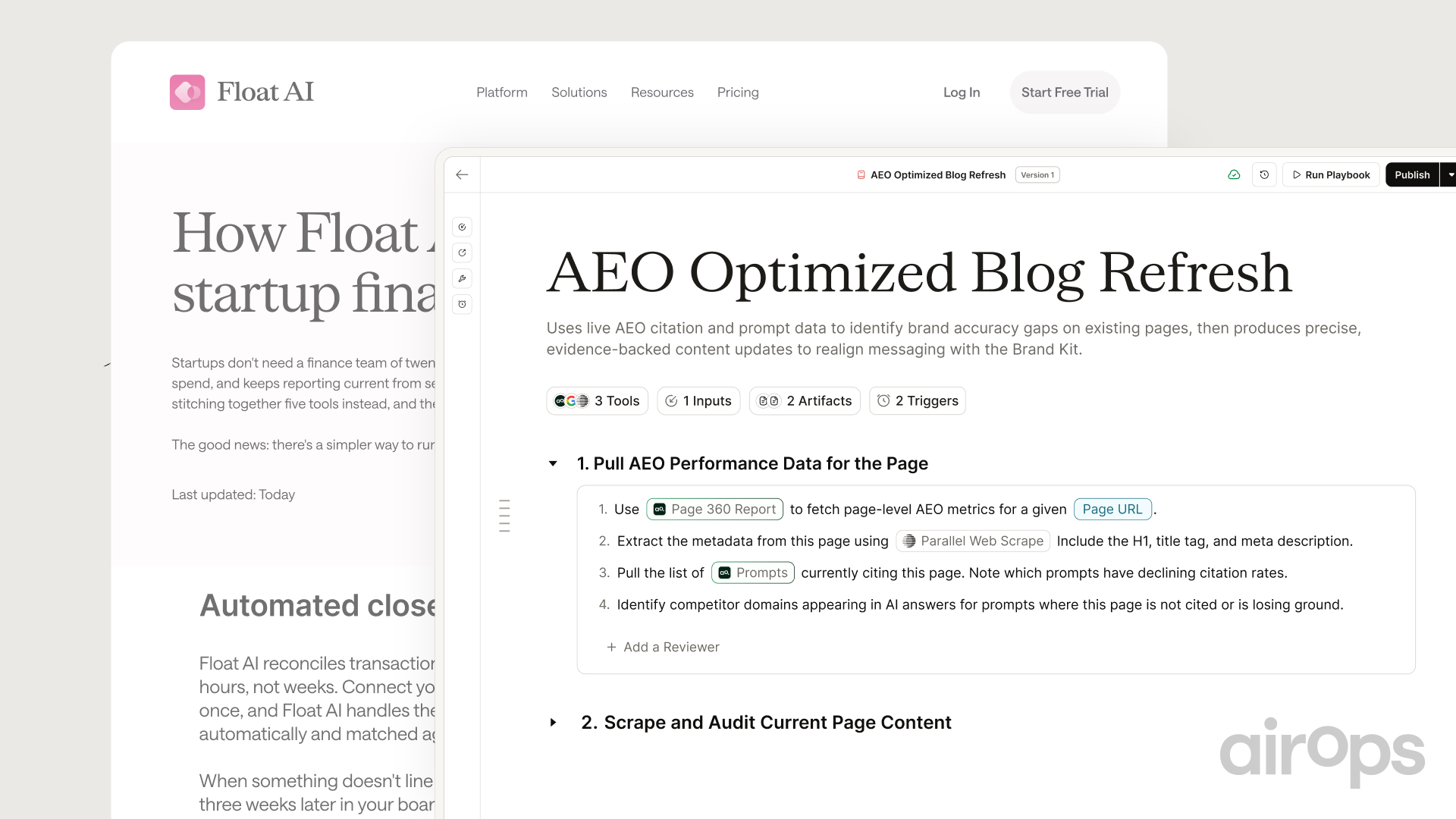
Scope the content refresh pilot as 20 to 30 refreshed pages, a matched control group, and 90 days. The control group separates refresh impact from seasonality and algorithm changes. The workflow below shows how a measured refresh pilot runs in AirOps.
You are designing a content refresh pilot that a CMO will judge.
Use only my inventory and baseline data.

Inputs:
- Ranked inventory: [paste Prompt 1 output]
- Pilot size and length: [20-30] pages, [90] days
- Baseline per URL, last 90 days: [clicks, conversions, AI citations]

Tasks:
1. Split candidates into refresh and control groups matched on traffic, topic, and page age.
2. Set success thresholds in conservative, base, and aggressive scenarios.
3. Write the decision rule that unlocks full funding or ends the program.| Metric | Baseline | Success threshold | When measured |
|---|---|---|---|
| Clicks to pilot pages | Trailing 90 days in GSC | Beats control by [base-case %] | Day 30, 60, and 90 |
| AI citations on priority prompts | Week before launch | Net gain over control | Day 30 and 90 |
| Conversions from pilot pages | Trailing 90 days in GA4 | [Base-case lift] over control | Day 90 |
- Pick control pages before any refresh starts.
- Report results against the control group only.
How do you draft the CMO one-page pitch?
Draft it in six blocks: ask, opportunity, ROI range, risk of inaction, pilot, and decision needed. Prompt 5 compresses the earlier outputs into one page your CMO reads in two minutes.
You are drafting a one-page pitch from a VP Marketing to a CMO.
Use only the outputs I paste below. Keep it under 400 words.

Inputs: [paste Prompts 1-4 outputs], [pilot budget], [full program budget]

Structure:
1. The ask, in one sentence with a dollar figure.
2. The opportunity, with the top [number] pages and value at risk.
3. The ROI range in conservative, base, and aggressive scenarios.
4. The risk of inaction, priced per quarter.
5. The pilot, with its control group and decision rule.
6. The decision needed, with a date.

Lead with the conservative scenario.- Put the dollar ask in the first line so your CMO sees the decision upfront.
- Keep one number per sentence so the page survives a forward to finance.
- Back your cadence with AirOps 2026 AI search research. Pages not updated quarterly are 3× more likely to lose citations.
How do you prepare objection handling before the meeting?
Prepare it by drafting an evidence-backed answer to each objection before your CMO raises it. Prompt 6 stress-tests your case from the CMO's side of the table.
Act as a skeptical CMO reviewing this refresh business case.
Use only my pitch and data below.

Inputs:
- One-page pitch: [paste Prompt 5 output]
- ROI model: [paste Prompt 2 output]
- Current content budget and headcount: [budget] and [headcount]

Tasks:
1. List the 6 hardest objections you would raise, ranked by risk to approval.
2. Draft a 2-sentence answer to each, using only my data.
3. Flag every answer that lacks evidence.
4. Show how each answer holds in conservative, base, and aggressive scenarios.- Run this prompt twice, once as your CMO and once as your chief financial officer (CFO).
- Close every flagged gap before the meeting, or drop the claim.
- Borrow scenario logic from forecasting SEO ROI when finance wants channel-level context.
Which objections will your CMO raise about a refresh program?
Expect four objections from your CMO before approval. They cover net new content, causality, headcount cost, and whether AI search changes the math. Each answer below draws on your pilot and named outside evidence.
| Objection | Answer | Evidence |
|---|---|---|
| Why not fund net new content instead? | Fund both, and set the refresh vs new content split by value per hour | Your ROI model from Prompt 2 |
| Can you prove the refresh caused the lift? | The matched control group isolates refresh impact | Your pilot table from Prompt 4 |
| What does it cost in headcount? | A trigger rule caps refresh volume at measured decline | Your trigger threshold and monthly cap |
| Does AI search change the math? | AI search raises the bar for content buyers can verify | Gartner survey of 645 B2B buyers |
Gartner's survey of 645 B2B buyers found 69% prefer to validate AI-generated insights with sales reps. Buyers check AI answers against sources they trust. Your refreshed pages give AI answers and your reps accurate material to cite.
- Answer the net new objection with expected value per hour from your own ROI model.
- Answer causality with the control group, and commit to a day-90 readout.
- Answer headcount with a trigger rule that caps refresh volume each month.
Key takeaways
A refresh program wins budget when your CMO sees a priced loss and a low-risk test. These four moves build that case.
- Size the opportunity as pipeline at risk, because your CMO budgets in revenue terms.
- Make your own decay rate the headline and outside research the supporting context.
- Ask for a pilot with a control group before you ask for a full program.
- Plan post-approval updates with content ROI report prompts so your first readout builds trust.
Frequently asked questions
These answers cover the follow-up questions your CMO asks after the pitch. Each one stands on its own for reuse in your deck.
How long should a content refresh pilot run before I report results?
Run the pilot for 90 days, with readouts at day 30 and day 60. Report the day-90 result as the gap between refreshed and control pages.
What is a good content refresh ROI?
A good content refresh ROI beats your conservative scenario and your next-best use of the same hours. Set that bar in Prompt 2 before the pilot starts, using your own cost and conversion inputs.
Can I prove a refresh caused the lift?
A matched control group separates refresh impact from seasonality and algorithm changes. Pick the control pages before any refresh work starts, so the comparison stays clean.
What trigger should start a page refresh?
Start a refresh when a page crosses a decline threshold set from your own data. For example, set a percentage drop in clicks or impressions over a fixed window, and cap the pages you refresh each month. AI agents for content refresh can watch those thresholds for you.
How do I build an ROI model for content refresh versus net new content?
Score both options on expected value per hour. Refresh inputs come from Prompts 1 and 2: recoverable clicks, conversions at risk, and hours per refresh. New content inputs are the traffic a new page can realistically earn in the same window and its full production hours. Run both at conservative rates, keep refresh running alongside net new content, and set the split by value per hour.
AirOps for content refresh business cases
AirOps is an enterprise AEO platform and expert partner for marketing leaders, connecting AI search intelligence, coordinated action across channels, and measurement tied to growth. Its intelligence, including citation tracking and Page360 page-level data, feeds your sizing and cost of inaction prompts with real numbers. Prompt Discovery shows which questions your buyers ask AI, so your pilot targets prompts tied to pipeline.
Refresh Playbooks run pilot pages through one consistent workflow, so you report hours and results per page. AirOps experts help you choose the control group and set thresholds your CMO accepts. Your CMO then gets a day-90 readout built on the same data that sized the opportunity.