Prompts to evaluate enterprise AI visibility services
- These six prompts turn a long vendor list into a scored, signed shortlist.
- Measure presence as a visibility rate across many runs, by engine, persona, and region.
- Score each vendor on competitor share of voice, multi-brand coverage, and pipeline measurement.
- Test every claim on your own prompts with a short pilot before you sign.
- Close with a decision memo that a named person approves at each gate.
AI search now shapes how buyers build vendor shortlists. In January 2026, Forrester reported that 94% of business buyers use AI during their buying process. That makes your choice of enterprise AI visibility services a pipeline decision.
Platforms like AirOps track visibility rate and share of voice across ChatGPT, Gemini, and Perplexity. Answer engine optimization (AEO) is the work of earning mentions and citations in those answers. Services add experts who set AEO priorities and run the program.
This prompt library helps you evaluate platforms and services on one objective scale. Each prompt runs in ChatGPT, Claude, or Gemini and produces an artifact you can share.
What prompts should you use to evaluate enterprise AI visibility services and platforms?
Use six prompts, in order, to score enterprise AI visibility platforms and services on four categories:
- AI search intelligence across engines, personas, and regions.
- Coordinated action across owned content, external content, community, social, and AI ads.
- Measurement that ties AI visibility to pipeline and revenue.
- Expert support that sets priorities and guides execution.
Each prompt produces one artifact. The map below shows the order, timing, and owner.
| Prompt | What it produces | When to run it | Who owns it |
|---|---|---|---|
| 1. Presence measurement plan | Prompt set, run counts, and metric definitions | Before vendor outreach | AEO lead |
| 2. Requirements scorecard | Weighted rubric with pass/fail gates | Before the request for proposal (RFP) | Marketing ops lead |
| 3. Share of voice reporting check | Pass/fail checklist for competitor reporting | During demos | AEO lead |
| 4. Multi-brand and multi-region test | 30-day pilot plan with pass criteria | After demos | Brand owners |
| 5. Vendor demo question set | Scored questions mapped to the scorecard | Before each demo | Marketing ops lead |
| 6. Shortlist decision memo | Recommendation with named sign-offs | After the pilot | CMO |
A March 2026 Gartner buyer survey found 45% of 646 B2B buyers used AI during a recent purchase. Forrester's higher figure counts AI use at any point in buying.
Use the same rubric to evaluate AI search visibility tools and managed services side by side. The offers fall into three shapes:
- A self-serve platform gives you software, data, and workflows your own marketers run.
- A managed service gives you specialists who run the program on your behalf.
- A hybrid pairs a platform with strategists who set priorities and guide execution.
For the wider buying process, see our guide to answer engine vendor evaluation. Our AEO platform buyer's guide covers the method: criteria, demo questions, and a pilot plan. This page gives you the copy-paste prompts to run each step.
Six prompts to evaluate enterprise AI visibility services
Run these prompts in order. Paste each one into ChatGPT, Claude, or Gemini, then fill in the [bracketed] variables.
Prompt 1 measures your brand presence in AI recommendations
Enterprise brands measure their presence in AI search recommendations as a visibility rate. Visibility rate is the share of runs where AI names your brand, tracked by engine, persona, and region.
Repeated runs matter because answers shift. SparkToro's January 2026 study found a less than 1 in 100 chance of two runs listing the same brands.
SparkToro ran that study with Gumshoe, an AI-tracking vendor, and it is not peer-reviewed. Its author still endorses visibility percentage across many runs as a reasonable metric.
AirOps research found only 30% of brands stay visible from one answer to the next. A multi-run rate captures that movement in one stable number.
You are an AI search measurement analyst. Build a presence measurement plan for [your brand] in the [category] category. Compare it against [competitors]. Cover ChatGPT, Gemini, Perplexity, and Google AI Overviews. Write 40 buyer prompts across [personas] and [regions], split by funnel stage. For each prompt, set the runs per engine and a weekly cadence. Define visibility rate, citation rate, and share of voice as separate metrics. Flag prompts that need extra runs to give a stable rate. Return a table with prompt, persona, region, engine, runs, and metric.- It defines visibility rate, citation rate, and share of voice as separate metrics.
- It sets several runs per prompt and engine, with no single-snapshot readings.
- It splits prompts by persona, region, and funnel stage.
- It drops rank position as a headline metric.
Prompt 2 builds a weighted requirements scorecard
A weighted scorecard keeps every vendor on the same scale. Build this scoring rubric before the first demo, so no pitch sets your criteria.
Weight pipeline measurement heavily when finance funds the program. Our AEO pipeline business case guide shows how to frame it.
Act as a B2B SaaS marketing operations lead. Build a weighted requirements scorecard for enterprise AI visibility services. My priorities are [priorities], my brands are [brands], and my regions are [regions]. Score engine coverage, multi-run sampling, competitor share of voice, and multi-brand and region support. Also score the citation vs mention split, action workflow, pipeline measurement, expert services, and cost per prompt-run. Assign weights that total 100. For each requirement, describe what a score of 1, 3, and 5 looks like. Add pass/fail gates for any requirement I mark as mandatory.| Requirement | Weight | What strong looks like |
|---|---|---|
| Engine coverage | 10 | ChatGPT, Gemini, Perplexity, and Google AI Overviews tracked on your prompts |
| Multi-run sampling | 15 | Several runs per prompt and engine, with run counts shown |
| Competitor share of voice | 15 | Share of voice against competitors you name, trended weekly |
| Multi-brand and region | 10 | Separate brand and region reports plus one portfolio roll-up |
| Citation vs mention split | 10 | Citations and mentions reported as distinct metrics |
| Action workflow | 10 | Findings route to owned content, external content, community, social, and AI ads |
| Pipeline measurement | 15 | AI visibility tied to traffic, pipeline, and revenue in your CRM |
| Expert services | 10 | Named strategists who set priorities and guide execution |
| Cost per prompt-run | 5 | A clear price per prompt, engine, and run at your volume |
Adjust these weights to match your plan before scoring starts.
- It totals 100 and matches your stated priorities.
- It describes observable vendor behavior at each score level.
- It keeps mandatory gates separate from weighted scores.
- It shows cost per prompt-run as a number you can compare.
Prompt 3 checks which services report share of voice against named competitors
Shortlist the enterprise AI visibility services that report AI share of voice (SOV) against competitors you name, across repeated runs. Ask each vendor to prove it on your own prompts. The view below shows one version of that report.
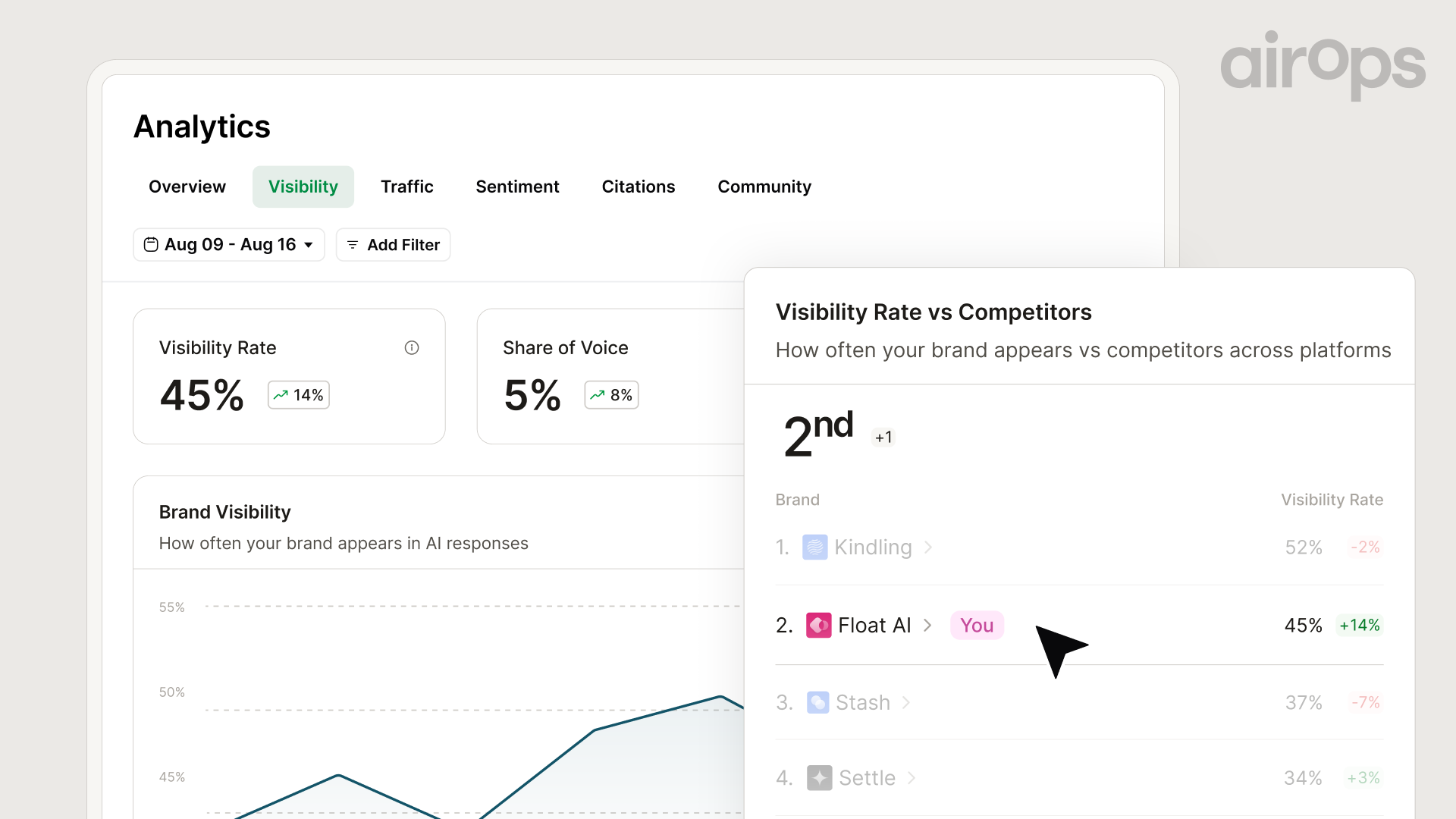
AirOps Analytics shows visibility rate, share of voice, and a visibility rate ranking against named competitors.
SOV only means something when you pick the competitor set. For metric definitions, see our explainer on AI share of voice. To run the measurement yourself, use our competitive AI share of voice prompts.
You are evaluating AI visibility vendors for [your brand]. My named competitors are [competitors]. Write a share of voice reporting check I can run in every demo. Ask each vendor to show SOV against my named competitors on my prompts. Require results across [engines], [personas], and [regions], with run counts shown. Ask how they separate mentions, citations, and SOV. Ask whether I can export the raw answers behind each number. Return a pass/fail checklist with the evidence the vendor must show live.| Check | Pass | Fail |
|---|---|---|
| Competitor set | You choose the named competitors | The vendor picks competitors for you |
| Prompt set | Reports run on your prompts | Reports run on a generic demo set |
| Run counts | Each figure shows its run count | One snapshot with no run count |
| Metric split | Mentions, citations, and SOV reported separately | One blended visibility score |
| Segments | SOV breaks out by engine, persona, and region | One global number |
| Raw answers | You can open and export the answers behind each figure | Figures with no answer evidence |
| Trend | SOV trends over time for each competitor | Current week only |
The metric split carries real signal. AirOps research compared brands earning both a citation and a mention with brands earning citations alone. The dual-signal brands were 40% more likely to resurface across runs.
- It names your competitors in every check.
- It requires live evidence in the demo for each pass.
- It keeps mentions, citations, and SOV distinct.
- It asks for raw answer exports behind every figure.
Prompt 4 tests multi-brand and multi-region coverage
The right services monitor several brands and regions in one program, with separate reports and one roll-up view. Test that claim with a pilot of 2 brands, 2 regions, and 20 prompts each.
Multi-brand AI visibility monitoring needs a distinct prompt and competitor set per brand. Multi-region AI visibility needs local-language prompts and local competitors. To govern AEO across brands after launch, use our multi-brand AEO governance prompts.
Design a 30-day pilot to test multi-brand and multi-region AI visibility coverage. Use [brand A] and [brand B], each with its own competitor set. Cover [region 1] and [region 2] in [languages]. Write 20 prompts per brand and region, mapped to [personas]. List what the vendor must deliver: per-brand reports, per-region reports, and one portfolio roll-up. Name the access each brand owner needs. Add pass/fail criteria for setup time, data accuracy, and report turnaround.- It keeps each brand's prompts and competitors separate.
- It uses local language and local competitors in each region.
- It rolls every brand and region into one portfolio view.
- It sets pass/fail criteria for setup time and accuracy.
Prompt 5 writes your vendor demo question set
Vendor demo questions work best when each one asks for live proof. Reuse the strongest ones in your AI visibility RFP.
Act as a CMO preparing for AI visibility vendor demos. Write 15 demo questions for [vendor name] based on my scorecard: [paste scorecard]. Group them by measurement, competitor reporting, multi-brand coverage, action, and pipeline. For each question, state the live evidence I should ask to see. Add three follow-up questions that test engine coverage claims. Flag any answer that relies on roadmap instead of shipped product. Keep security and contract questions out of scope.- It asks for on-screen evidence behind every answer.
- It follows your scorecard order, so scoring stays fast.
- It flags roadmap answers and scores them as zero.
- It keeps security and contract questions out of scope.
To build the full document, use our AI search RFP prompts.
Prompt 6 drafts a shortlist decision memo with human sign-off
A shortlist decision memo turns scores into a decision a person signs. It records the evidence and names who approved each gate.
Your own buyers decide early, so weight pre-contact presence heavily in your memo.
Draft a shortlist decision memo for choosing an enterprise AI visibility service. Use my scorecard results: [paste scores]. Use my pilot findings: [paste findings]. Recommend one vendor and one alternate, with reasons in plain language. List the top three risks and how we will check each one in the first 90 days. Add a sign-off table for [CMO], [finance lead], [procurement lead], and [brand owners]. Keep the memo under two pages.| Memo section | What it contains | Who signs |
|---|---|---|
| Decision | Recommended vendor, alternate, and contract term | CMO |
| Scores | Weighted totals and pass/fail gate results | Marketing ops lead |
| Pilot evidence | Visibility rate, SOV, and coverage results from the pilot | AEO lead |
| Cost | Annual cost, cost per prompt-run, and service fees | Finance lead |
| Risks | Top risks, owners, and 90-day checks | Procurement lead |
| Brand coverage | Brands and regions in scope at launch | Brand owners |
- It recommends one vendor and names an alternate.
- It ties every score to pilot evidence.
- It names a human signer for each section.
- It fits on two pages.
Security and single sign-on (SSO) questions live in our security and scale prompts. Attach those results to the memo's risks section.
How should you run the prompts during your evaluation?
Run the prompts across five gates, with a human review at each one. AI drafts the artifacts, and your reviewers make the calls.
Presence matters to leadership because AI summaries change click behavior. Pew Research Center's July 2025 browsing study tracked Google searchers. They clicked a traditional result in 8% of visits with an AI summary and 15% without one.
- Run Prompts 1 and 2 before vendor outreach. Your CMO approves the measurement plan and weights.
- Send the Prompt 5 questions with your RFP. Your marketing ops lead scores every response against the rubric.
- Run the Prompt 3 check live in each demo. Two reviewers score each vendor separately, then compare.
- Run the Prompt 4 pilot with your top two or three vendors. Your AEO lead verifies sample answers by hand.
- Draft the memo with Prompt 6. Each named signer approves their section before contract review.
After you choose, the work shifts to improvement. Our guide to enterprise AI visibility covers that next stage.
Key takeaways
- A visibility rate across many runs gives you a fair read on presence.
- Share of voice counts only when you name the competitors and the vendor runs your prompts.
- A two-brand, two-region pilot exposes coverage gaps faster than any demo.
- A signed memo makes the decision auditable for finance and procurement.
FAQ on evaluating enterprise AI visibility services
How is AI visibility measured?
AI visibility is measured across repeated runs of a fixed prompt set, by engine, persona, and region. Track three distinct metrics:
- Visibility rate, the share of runs that name your brand.
- Citation rate, the share of runs that link to your pages.
- Share of voice, your mentions relative to named competitors.
How many vendors should you shortlist?
Send your RFP to three to five vendors and pilot with two or three. A longer list slows scoring without improving the decision.
Is a platform plus managed service worth more than an analytics-only AEO tool?
A platform with expert services is worth more when you need someone to set priorities and run the program. An analytics-only tool fits teams whose in-house AEO experts already turn data into action. Pilot both shapes on your own prompts, then compare cost per prompt-run against the work each one takes off your team.
How often should prompts be tracked?
Track core buyer prompts weekly, with several runs per engine each cycle. Track long-tail prompts monthly, and add extra runs around major launches.
Should you build your own tracker instead of buying?
Build only when engineers can maintain prompt runs, engine changes, and reporting every week. Buy when you need competitor SOV, multi-brand coverage, and expert support on a set timeline.
AirOps for enterprise AI visibility evaluations
AirOps is an enterprise AEO platform and expert partner for marketing leaders, connecting AI search intelligence, coordinated action across channels, and measurement tied to growth. It maps to the evaluation concepts in this guide:
- Presence measurement as a visibility rate across many runs, by engine, persona, and region.
- Share of voice against the competitors you name, with mentions and citations kept distinct.
- Multi-brand and multi-region programs run from one place.
AirOps pairs AirOps Analytics with strategists who run the program alongside you. They set priorities across owned content, external content, community, social, and AI ads, then tie results to pipeline. See how that works in the AirOps enterprise program. To compare options, read AirOps vs Profound and AirOps vs Peec AI.