- LLM visibility measures whether AI platforms mention your brand and link to your content, not where you rank in Google
- AI answers change by platform and by prompt, making structured, multi-platform tracking essential
- The mention-citation gap reveals when AI knows your brand but doesn't trust your content enough to cite it
- Competitive share of voice shows which brands dominate AI recommendations for real buyer questions
- Consistent weekly testing uncovers trends and catches inaccuracies before they shape buyer perceptions
- Answerable content and strong authority signals drive reliable AI citations. Technical accessibility amplifies both
Tools like AirOps track brand citations across ChatGPT, Perplexity, and Google, showing which pages earn citations and how citation share shifts over time.
Your brand can rank on page one of Google and still disappear from the answers buyers get from ChatGPT, Perplexity, and Gemini.
AI search is reshaping how buyers discover and choose products. When someone asks an AI assistant "What's the best project management tool for remote teams?", the response pulls from sources your team has never tracked or optimized for. This is the core challenge of Answer Engine Optimization (AEO) tracking: understanding where your brand appears in AI-generated answers and why the gaps exist. Most marketing teams have no visibility into this at all. AirOps was built to close that gap, giving teams real data on how AI engines cite and recommend their brand.
Meanwhile, 50% of consumers now intentionally seek out AI-powered search engines, according to McKinsey research. They ask questions, get synthesized answers, and often act on them without ever visiting a traditional search results page.
For marketers, this creates an urgent blind spot. Your domain authority and content quality may be strong. But if AI platforms aren't citing your pages or mentioning your brand, you're losing influence at the exact moment buyers form their shortlists.
This guide covers how LLM citation tracking works and what metrics reveal about your competitive position. It walks through a practical, repeatable approach to benchmarking against competitors.
Why brand citation tracking in AI answer engines matters
AI answer engines shape buyer perceptions earlier than any landing page. When a prospect asks, "What's the best project management tool for remote teams?" the response builds a shortlist instantly.
Accurate, positive AI citations earn you early consideration. A competitor appearing in your place costs you ground before the sales cycle begins. How LLMs see your brand at this stage shapes which vendors make the shortlist.
LLM citation tracking in AirOps or other AEO tools measures how often AI systems:
- Mention your brand
- Describe your product accurately
- Recommend you alongside competitors
- Link back to your content as a source
These signals matter because AI discovery now influences purchase behavior. Recent studies show more than a third of consumers begin research with AI tools instead of traditional search engines. The business impact is direct: companies report that leads from LLM referrals convert 2 to 6 times higher than leads from any other channel, tying LLM citation tracking to pipeline quality.
How LLM citation tracking differs from traditional rank tracking
LLM citation tracking answers a specific question: does your brand appear in AI answers, and how accurately is it described? That requires different inputs and a different monitoring cadence than keyword rank tracking. Effective LLM brand tracking watches presence, accuracy, and citation source together, not just position.
Presence is the baseline
In AI search, presence is what matters first. If your brand isn't mentioned in an AI answer, you have zero visibility, regardless of where you rank on Google. Tracking brand mentions in LLMs starts with this presence signal, measured prompt by prompt.
Keywords versus prompts
Buyers don't type keywords into ChatGPT. They ask natural language questions like:
- "Which CRM works best for small sales teams?"
- "What tools help B2B marketers track intent signals?"
Tracking AI visibility requires prompts that mirror how real buyers ask questions, not how SEOs build keyword lists.
Why LLM responses require ongoing monitoring
LLM answers can change significantly based on:
- Timing
- Platform
- Small differences in phrasing
- New content entering the index
This variability makes structured, ongoing monitoring essential. Knowing how to monitor LLM mentions of your company or product on a set cadence turns this variability into a usable signal.
The mention-citation gap
One of the most actionable signals in AEO tracking is the gap between mentions and citations. An AI answer might name your brand as a recommended solution but link to a competitor's page, a review site, or no source at all. That pattern reveals a content trust gap: the model recognizes your brand but doesn't trust your content enough to use as a source. Closing this gap requires publishing clear, structured, authoritative content on your own domain that directly answers the questions AI engines surface. When you track the mention-citation gap over time, you can see whether your content investments are converting brand awareness into actual source authority.
How LLMs decide which brands to cite and recommend
AI platforms choose sources based on how relevant and authoritative your content is, and how easily they can access it.
Content relevance and answerability signals
LLMs favor content that clearly answers questions in structured formats. Pages with clear answers, structured headings, logical organization, and concise explanations appear more often in AI answers.
This concept is called answerability. The easier it is for AI systems to extract an answer, the more likely your brand appears.
When AI systems pull incorrect brand facts from poorly structured sources, those errors compound across every answer that references them. Fixing inaccurate LLM citations starts with publishing clearer, more authoritative content on your own domain.
Query fan-out and source selection
When a user asks a question, LLMs don't run a single search. They decompose the prompt into multiple sub-queries and retrieve sources from different angles. A question like "What CRM is best for SaaS startups?" might trigger sub-queries about pricing, integrations, onboarding speed, and customer reviews. Pages that surface consistently across these sub-queries earn citations because the model treats them as broadly authoritative on the topic. This means building topical depth across a cluster of related pages matters more than optimizing a single page. You can track which fan-out queries your content covers well, and where gaps exist, using tools like AirOps Insights.

Authority and trust indicators
AI systems assess authority through multiple signals: backlinks from respected sources, expert authorship with verifiable credentials, brand mentions across the web, and consistent entity information. Strong brand entity management gives AI search citations a consistent source of truth to draw from.
A brand with strong external validation appears more trustworthy than one with limited digital footprint.
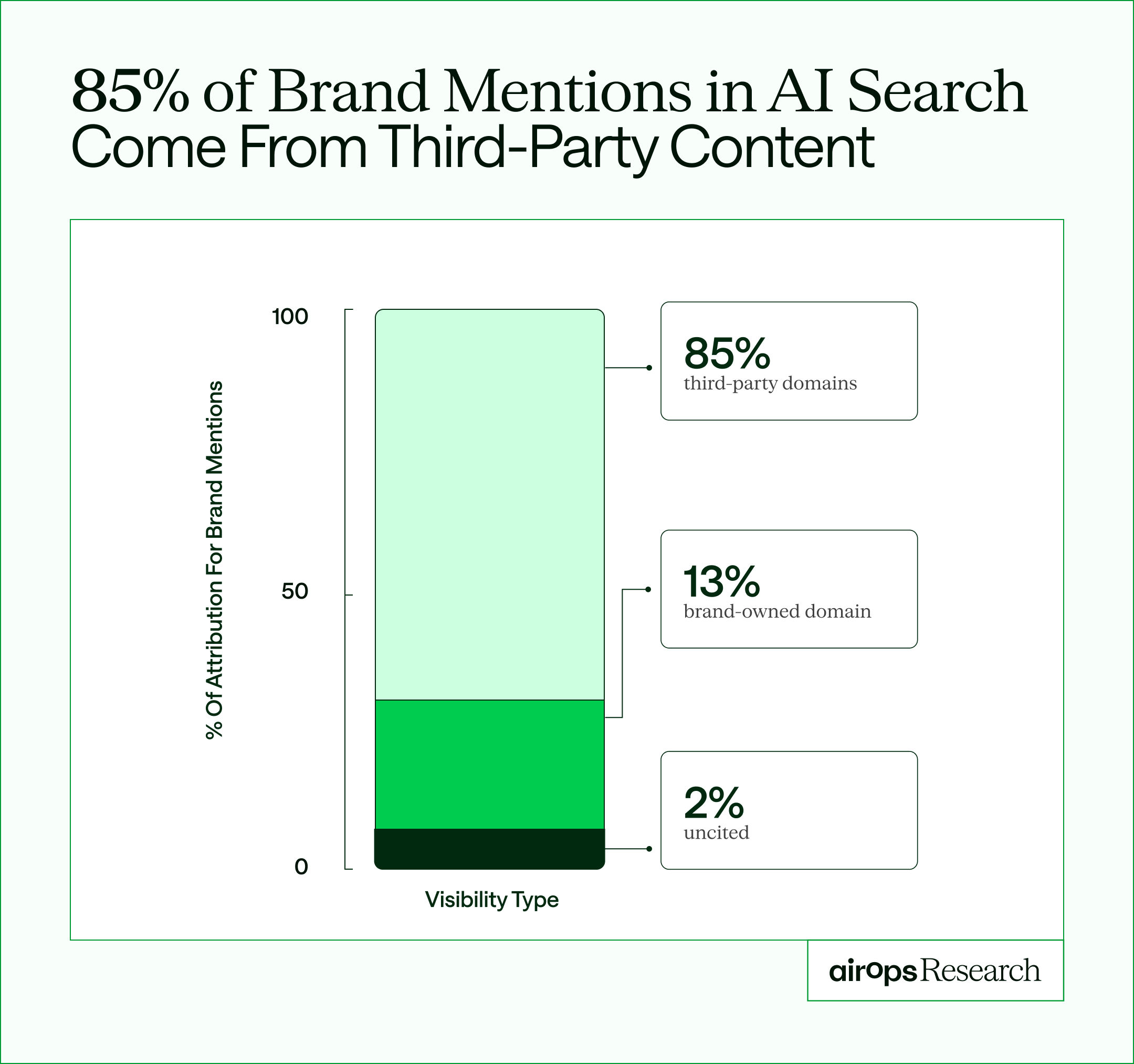
Off-site sources often drive that validation. AirOps research found 85% of brand mentions came from third-party pages, not owned domains. Track which external sources show up for competitors, since those pages often shape the vendor shortlists AI systems generate.
Technical accessibility and structured data
LLMs can only cite content they can parse. Visibility improves when you provide:
- Clean HTML structure
- Schema markup
- Fast-loading pages
- Crawlable, indexable content
The core LLM brand visibility metrics to track
To measure AI visibility credibly in AirOps, you need metrics designed for LLM behavior and not recycled SEO KPIs. This results in a brand visibility score, that shows your influence across LLMs, Google AI overviews and AI mode.
Here are the signals that actually matter.
Use these four core metrics to build a complete picture of AI search visibility:
1. Mention rate
How often does your brand appear and get mentioned when buyers ask relevant questions?
Example: If you test 20 prompts and your brand appears in 12 responses, you have a 60% brand visibility score.
This is the foundational AI visibility metric.
2. Sentiment
Not all mentions are equal.
Score responses as:
- Positive
- Neutral
- Negative
A high presence rate with negative sentiment signals a messaging problem.
3. Citation rate
Some platforms include source links. Others only reference brands. LLM link citation tracking shows exactly which of your URLs get pulled as sources.
Measure:
- How often LLMs link to your content
- Which pages they cite
- How frequently competitors receive linked citations
Mentions and citations together can also signal more stable visibility. AirOps research found that brands that earned both a mention and a citation were 40% more likely to reappear across consecutive answers. Track presence and citation rate together to see whether you're building repeat visibility rather than just one-off mentions.
4. Competitive share of voice
Brand visibility only matters in context.
If you appear in 40% of relevant responses and a competitor appears in 75%, you have a serious visibility gap. Share of voice shows that rate compared to your competitors.
Another signal worth tracking is first mention rate: how often your brand appears as the first name in an AI-generated answer. The first-mentioned brand captures disproportionate reader attention, similar to position one in traditional search results. Tracking first mention rate across prompts and providers helps you understand whether your brand is top of mind for AI engines or consistently trailing competitors.
How to track your brand across ChatGPT, Perplexity, and Gemini
Tracking LLM visibility works best as a repeatable process. The goal stays simple: measure how often AI systems mention your brand and how accurately they describe you, then compare that against competitors over time. Measuring AI citation accuracy for brands matters as much as counting mentions.
Here is a practical framework any team can follow.
Step 1: Build a prompt library that reflects real buyer questions
Start by creating a structured set of prompts that mirror how prospects actually search. These prompts anchor how you track brand citations in ChatGPT, Gemini, and Perplexity over time.
Aim for 20-30 prompts that cover:
- Category discovery queries
- Product comparison questions
- Problem-solution scenarios
- Implementation and use-case questions
Example prompts:
- "Best analytics platform for ecommerce brands"
- "Klaviyo vs HubSpot for mid-market companies"
- "How to improve customer onboarding at scale"
- "What software helps reduce churn for SaaS companies?"
Your prompt library becomes the foundation for consistent measurement. The more closely it matches real buyer intent, the more accurate your tracking will be.
This is a common challenge, as many internal teams instinctively fall back on traditional keyword-based workflows without realizing it. To overcome this, some AEO agencies, including Snezzi, begin with a dedicated research phase that tracks visibility across ChatGPT, Perplexity, and Google AI using real user prompts before any content or optimization work begins. Rather than relying on keyword tools, this approach aligns content with how buyers naturally ask questions, increasing the likelihood of appearing in AI-generated responses.
Step 2: Test the same prompts across multiple AI platforms
Run each prompt on all major AI answer engines:
- ChatGPT
- Perplexity
- Google Gemini
- Claude
Every platform pulls from different sources and ranking logic. A brand that appears prominently in Perplexity might be missing entirely from ChatGPT. Tracking across platforms gives you a complete picture instead of a single-channel snapshot. Comparing brand citations in ChatGPT and brand citations in Gemini side by side shows where each engine sources its answers.
Step 3: Score every response with the same criteria
For each prompt and platform, evaluate the output using a simple, repeatable scoring model:
- Mentioned or not mentioned: Did your brand appear at all?
- Accurate or inaccurate: Was the description correct?
- Sentiment: Positive, neutral, or negative
- Citation type: Linked source or mention only
This scoring turns subjective impressions into measurable data. Crystal Carter, Head of SEO Communications at Wix, recommends evaluating brand citations in ChatGPT and other platforms across four dimensions: regularity, accuracy, prominence, and sentiment. As she explains in a recent AirOps webinar, tracking whether your brand appears is only the first step. You also need to assess how prominently it appears and whether the description is accurate. Sentiment matters too: positive framing signals brand health, while negative framing signals a messaging problem worth addressing.
Step 4: Measure competitive context
Once you score responses, add a competitive layer:
- How often does your brand appear compared to competitors?
- Which platforms favor certain brands more than others?
- Where do answers conflict or disagree?
This analysis creates a true AI share-of-voice view instead of isolated brand checks.
Step 5: Track results on a regular cadence
LLM responses change frequently. New content enters indexes and algorithm updates shift outcomes.
A weekly tracking schedule lets you:
- Spot visibility changes early
- Catch inaccurate answers before they spread
- See which platforms trend up or down
- Measure whether content updates improve citations
Consistency matters more than any single data point. Many teams manage this process with a simple spreadsheet at first, then move to a dedicated tracking tool once the workflow becomes hard to maintain manually.
With this process in place, you move from guesswork to clear visibility into how AI platforms represent your brand.
Tools for monitoring LLM brand citations
The market for AI visibility tools has expanded rapidly. Options range from dedicated AEO platforms to established SEO suites that have added citation tracking modules. Here's how to think about the landscape. The best tools for tracking LLM brand visibility share a few traits, and the criteria below separate a real LLM visibility tool from an SEO add-on.
Dedicated AI visibility platforms
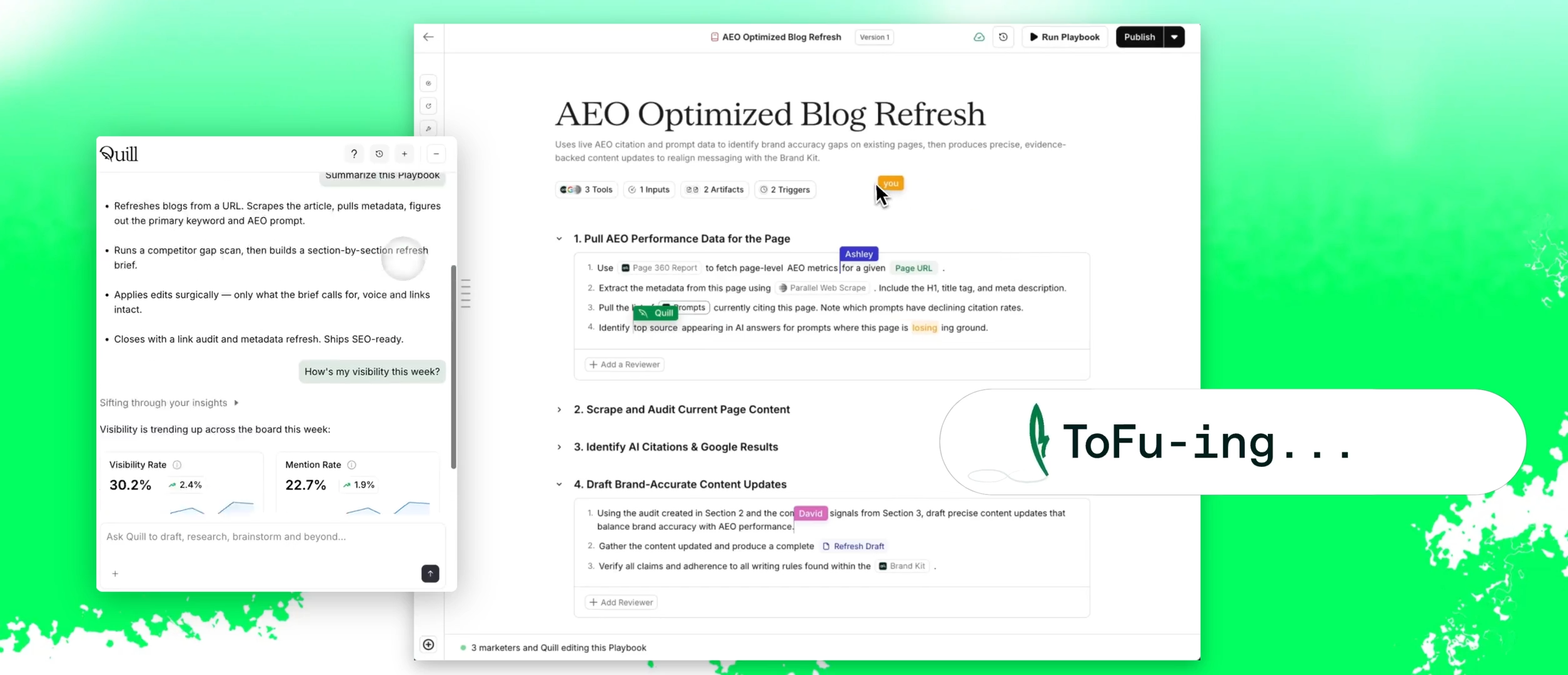
AirOps Insights tracks citations, mentions, sentiment, and competitive share of voice across ChatGPT, Perplexity, Gemini, Claude, and Google AI Mode. It connects AI visibility data to Google Search Console (GSC), Google Analytics 4 (GA4), and content performance metrics through Page360, so you can tie citation changes directly to traffic and engagement outcomes. AirOps also surfaces the actual sub-queries (fan-outs) AI engines run behind each prompt, giving you a clear map of content gaps. For teams that need to move from insight to action, AirOps connects tracking to content execution through Quill, its AI agent that runs Playbooks for content creation and ongoing optimization. Your team sets the strategy. Quill runs the execution. And with AirOps Offsite, you can systematically earn the third-party citations that drive AI visibility.
Other dedicated AEO platforms focus on specific strengths. Some prioritize enterprise-grade real-time monitoring with always-on capture across multiple brands. Others offer the broadest platform coverage, tracking seven or more AI engines simultaneously. Free-tier options exist for smaller teams exploring AEO before committing to a paid tool. The landscape is evolving fast, so evaluate each platform against the criteria in the "How to choose" section below.
SEO tools with AI tracking features
Several established SEO platforms now include AI citation tracking alongside their core search analytics. These features vary in depth, but they let teams already using those tools see citation data without switching platforms. The trade-off is that AI tracking is typically an add-on, not the core product, so prompt-level analysis and competitive detail may be lighter than what dedicated AEO platforms provide.
How to choose the right tool
When evaluating tools, prioritize these criteria:
- Multi-platform coverage: Does it track across ChatGPT, Gemini, Perplexity, Claude, and Google AI Mode?
- Prompt-level analysis: Can you see which specific questions trigger citations or mentions of your brand?
- Competitive benchmarking: Can you compare your citation rate and share of voice against named competitors?
- Accuracy and sentiment scoring: Does it differentiate between positive, neutral, and negative brand mentions?
- Actionable recommendations: Does the platform connect visibility gaps to specific content actions?
- Integration with existing analytics: Can it pull in GSC, GA4, or other performance data so you see the full picture?
Manual tracking approaches
If you're not ready for a dedicated tool, you can start by systematically querying AI platforms with your target prompts and logging which brands get cited. This is time-intensive and doesn't scale, but it gives you a baseline understanding of where your brand stands before you invest in automation. An LLM visibility checking tool for brand citation tracking automates this once manual logging stops scaling.
How to measure competitive share of voice in AI search
The tracking process measures your brand performance. Share of voice analysis compares that performance directly to competitors.
Share of voice in AI search measures which brands appear most often when buyers ask AI systems for help. The focus is brand mentions inside AI answers, not keyword rankings. Brands tracking citation share of voice across LLMs use it to see who owns each buyer question.
Identify which competitors AI systems recommend
Start with category-level prompts that naturally surface vendor lists, such as:
- "What are the best tools for [use case]?"
- "Which platforms help with [problem]?"
- "Top software for [industry] teams"
These questions reveal which brands LLMs treat as authoritative options in your space. This is also how you track brand mentions in LLMs at the competitor level, not just for your own brand.
Calculate AI share of voice
Use the same prompt library you built for brand tracking and tally results across platforms.
For each brand, measure:
- Total number of appearances
- Percentage of prompts where they appear
- Platforms where they appear most often
This metric quickly shows who dominates AI recommendations and where gaps exist.

Example of Share of Voice in AirOps
To calculate share of voice, use this formula: AI SOV = (Your brand's citations or mentions / Total citations or mentions for all tracked brands) x 100
Track this across a consistent set of prompts and AI engines over time. For example, if you track 200 prompts across ChatGPT, Gemini, and Perplexity, and your brand appears in 60 of those answers while a competitor appears in 90, your AI SOV is 30% and theirs is 45%.
AI answer engines like ChatGPT, Perplexity, Gemini, Claude, and Google AI Mode each have different retrieval behaviors and source preferences. Your SOV will vary by platform, so measure each engine separately in addition to tracking an aggregate score. Segment by topic or prompt category to see where you lead and where competitors dominate.
Track competitive movement over time
Share of voice only becomes meaningful when measured consistently.
Regular monitoring helps you spot:
- Competitors gaining visibility after publishing new content
- Sudden drops in your own mentions
- Platforms where certain brands outperform others
- Emerging rivals entering AI answers for the first time
When a competitor begins appearing more frequently, it usually means they published new high-answerability content or earned authority signals that shifted AI recommendations in their favor.
Tracking these shifts early lets you respond before perceptions harden.
How to track which sources AI cites in your category
Track the external sources AI engines cite, not just your own pages. Most AI answers pull from third-party domains, so the pages feeding those answers decide who gets recommended.
Source tracking shows which domains AI models trust in your space, and whether each citation points to you or a competitor. It also tells PR teams where a placement will move your AI visibility tracking numbers.
- The domains AI engines cite most for your category prompts.
- How often each source appears, and whether it links to you or a rival.
- Whether the citation is a direct link or a mention with no source.
- How fresh the cited pages are, since recent pages win citations more often.
This differs from backlink tracking. Backlinks measure who links to you across the web, while source tracking measures which pages AI pulls into answers. You can monitor both signals next to your own citations in AirOps Insights.
Building your AI search analytics dashboard
A useful dashboard focuses on four signals:
- Mention rate over time
- Citation rate
- Sentiment trends
- Competitive share of voice
Visualizations to include:
- Weekly trend lines
- Platform comparisons
- Top prompts by performance
- Competitors gaining or losing visibility
Set alerts for:
- Sudden drops in presence
- Spikes in negative sentiment
- Major competitor movements
- Citation drops where your brand disappears from prompts it previously appeared in
Teams can track all four signals (citations, mentions, sentiment, and competitive share of voice) in a single view using AirOps Insights, which connects citation data directly to content performance metrics through Page360. That means you can see how changes in AI visibility correlate with organic traffic, engagement, and conversions without switching between tools.

How to measure AI-sourced traffic and prove ROI
AI search visibility metrics only matter if you can connect them to business outcomes. Proving ROI requires tracking the traffic and conversions that AI platforms send to your site. Citation tracking in LLMs closes the loop when you tie each cited page to traffic and conversions.
Start with these steps:
- Filter AI referral traffic in GA4: Set up regex-based filters to isolate visits from ChatGPT, Perplexity, Gemini, and Claude referrers. This separates AI-sourced traffic from organic and direct channels.
- Add AI to lead source tracking: Include "ChatGPT" or "AI search" as options on contact forms and "how did you hear about us" fields. This captures Answer Engine Optimization impact that referrer data misses.
- Compare conversion rates by source: Track whether AI-referred visitors convert at different rates than other channels. Early data from multiple companies shows these leads often convert at higher rates because AI answers pre-qualify buyers before they reach your site.
- Correlate content updates with citation changes: When you refresh a page and its citation rate increases, measure whether traffic and conversions from that page also increase. This closes the loop between content investment and AI visibility returns.
Directional measurement matters more than precision here. As The North Star Metric for AI Search framework shows, tracking share of voice trends over weeks and months gives you a clearer signal than chasing daily fluctuations.
Common LLM tracking mistakes to avoid
AI citation tracking breaks down when teams make a few common mistakes:
- Tracking mentions without verifying accuracy
- Using generic prompts that miss real buyer intent
- Ignoring differences between AI platforms
- Treating citation tracking as a one-time project
Counting mentions alone can mislead you when details are wrong or outdated. Broad prompts like "best CRM" rarely match how buyers actually search. Each AI platform pulls from different sources, so single-channel tracking gives an incomplete view. And one-time audits miss the ongoing shifts that regular monitoring reveals. Inaccurate citations also erode brand trust, since buyers treat AI answers as objective, so tracking accuracy protects perception as much as visibility.
How to improve your brand's LLM citation rate
Tracking reveals where visibility falls short, but progress requires a clear path from insight to action. Effective improvement turns what you learn from monitoring into specific content updates. Refresh outdated pages and add structured answers to high-intent questions. Publish comparison resources that address buyer needs directly. A repeatable refresh workflow keeps this work consistent and measurable instead of turning it into scattered rewrites. Consistent AI brand citation tracking tells you which refreshes moved the needle and which pages to prioritize next.
Keep key pages fresh
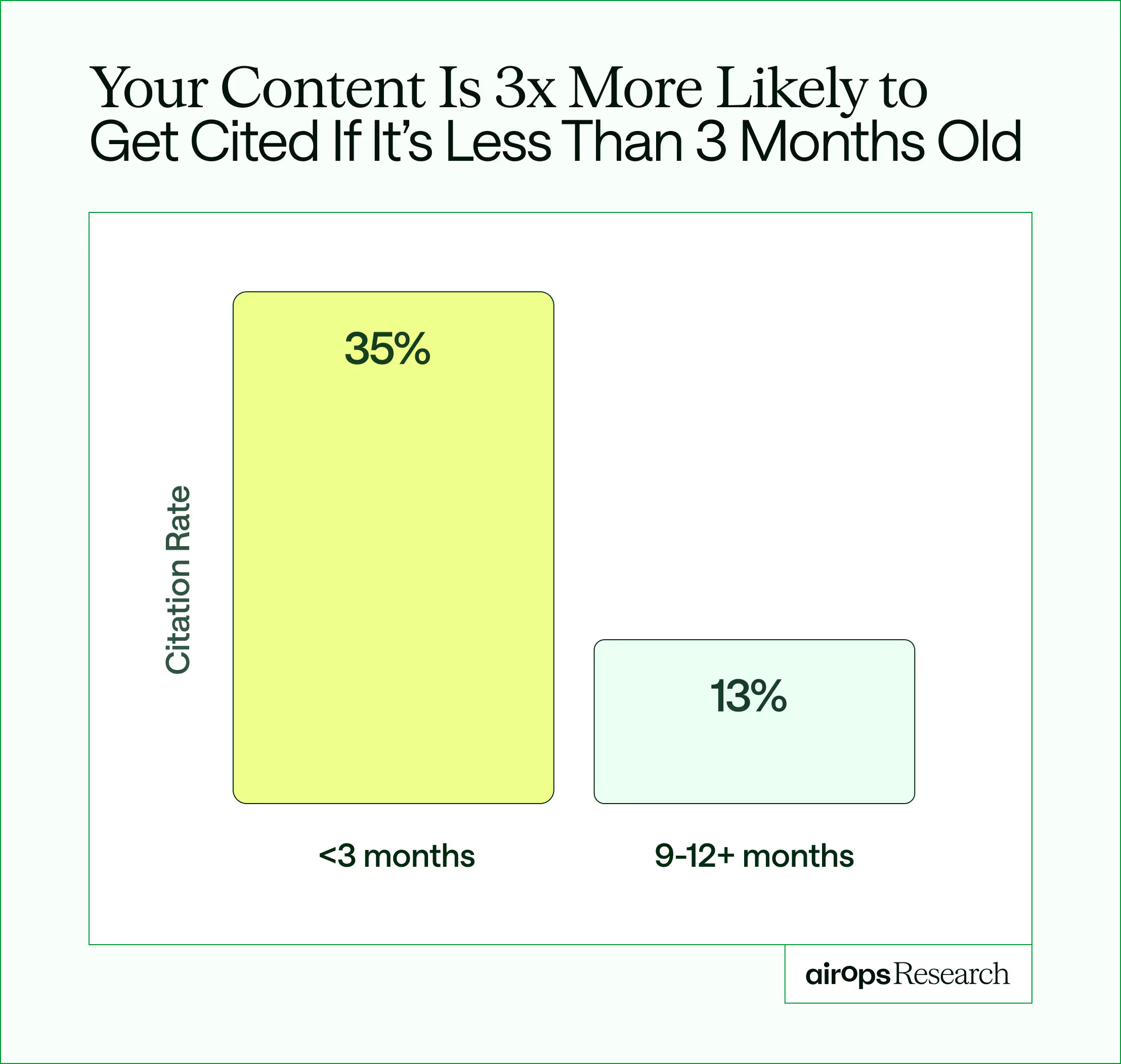
Freshness acts like a citation lever in AI search. AirOps research found that pages not updated quarterly were 3x more likely to lose citations. The volatility is stark: half of cited pages change every single month, according to Aja Frost, Head of Global SEO at HubSpot. Nearly six in ten pages that earn a citation appear once and never return the following month.
Start with high-intent pages buyers and AI systems rely on most like comparison pages, pricing and packaging pages, core category guides, and solution pages. Refreshing these pages is the fastest way to increase brand citations in AI answers.
Improve answerability
- Add clear question-and-answer sections
- Use structured headings
- Publish comparison content
- Address common buyer concerns directly
Content that speaks clearly to a defined audience shows up more often in AI answers. As Steve Toth, CEO of Notebook Agency, explains:
"When your content states who it's for, mirrors the ICP's terminology, and addresses common problems, the user context prompts the LLM to retrieve hyper-relevant content. That increases the likelihood your content will be recommended for high-intent queries." - Steve Toth
Writing with explicit audiences in mind helps AI systems match your pages to the right buyer scenarios. Specificity beats generic coverage when models decide which brands to cite.
Strengthen authority signals
- Earn mentions on industry sites
- Publish expert-led content
- Maintain consistent brand information
Improve technical accessibility
- Add schema markup
- Simplify page structure
- Remove crawl barriers
- Improve page speed
How to earn citations from the third-party pages AI trusts
Earn placements on the third-party pages AI engines already cite for your category. Most brand citations come from sources you do not own, so off-page work often moves AI visibility faster than on-site edits alone.
Start with the domains your source tracking flags as trusted, then pursue coverage there.
- Pitch expert commentary and original data to the publishers AI cites in your space.
- Contribute thought leadership to industry sites, since these articles feed LLM answers.
- Support community discussions and reviews where buyers and AI engines both look.
- Keep your brand facts consistent across every third-party page, so AI models trust them.
AirOps Offsite helps teams earn these citations systematically, then track results next to owned-page metrics so you see which placements moved your visibility. Learn more about earning offsite citations.
Turn AI visibility into a measurable advantage
AI answer engines already shape how buyers compare options and build shortlists. Visibility in this environment no longer depends on keyword rankings alone. It depends on how often AI platforms mention your brand and how accurately they describe you, relative to what competitors receive in the same conversations.
Teams that track LLM citations consistently can:
- Catch inaccuracies before they spread
- Close competitive visibility gaps
- Understand where each platform pulls information
- Measure real progress with credible metrics
The right tracking process turns AI visibility into something you can measure and prove to the business.
AirOps brings all of this into one system. AirOps Insights tracks citations, mentions, sentiment, and competitive share of voice across ChatGPT, Perplexity, Gemini, Claude, and Google AI Mode. Prompt Discovery surfaces the exact questions your buyers are asking. When Insights reveals a gap, Quill runs the Playbooks to close it, whether that means refreshing existing content or earning offsite citations through AirOps Offsite. Every action reports back against the visibility metrics your team wants to move, so results compound over time.
Book a demo to see how AirOps helps teams measure AI visibility, track competitors, and improve LLM citations at scale.
Frequently Asked Questions
FAQs
Can negative brand mentions in AI answers hurt my sales pipeline?
Yes, inaccurate or negative AI responses can disqualify your brand before prospects ever visit your website. Buyers increasingly trust AI summaries as objective, so a single misleading description can remove you from consideration during the critical early research phase.
Do AI answer engines favor newer content over older authoritative pages?
AI systems balance recency with authority signals, but stale content loses ground over time. Pages with recent updates, current statistics, and fresh examples tend to surface more reliably than older pages with outdated information, even if the older content has stronger backlink profiles.
How do I know which AI platform matters most for my industry?
Run identical prompts across ChatGPT, Perplexity, Gemini, and Claude, then track where your target buyers actually spend time researching. B2B tech buyers may favor Perplexity for sourced answers, while general consumers often default to ChatGPT. Platform priority should follow your audience behavior.
What should I do when an AI gives completely wrong information about my product?
Document the inaccuracy with screenshots, then prioritize updating your owned content with clear, structured corrections that directly address the misinformation. AI systems eventually re-index improved content, and consistent accurate information across your site and third-party sources helps correct the record over time.
How do I analyze my brand's offsite presence in LLM responses?
Start by identifying which third-party pages LLMs cite when answering questions about your category. AirOps research found that 85% of top-of-funnel brand visibility comes from unowned domains. Track the external URLs that appear in AI citations alongside your brand, then invest in relationships with the publishers and platforms that LLMs treat as authoritative sources for your industry.
What is the mention-citation gap and why does it matter?
The mention-citation gap occurs when AI platforms name your brand in an answer but don't link to your content as a source. It signals that AI recognizes your brand but doesn't trust your content enough to cite it. Close the gap by publishing structured, authoritative content on your own domain that directly answers the questions AI engines surface.
What is LLM citation tracking for brands?
LLM citation tracking measures how often AI engines mention your brand and link to your pages as sources. It runs a fixed set of prompts across ChatGPT, Perplexity, Gemini, and Claude, then scores mentions, citations, and sentiment over time.
Can I get alerted when my brand is no longer cited by LLMs?
Yes. AirOps Insights sets alerts for citation drops, so you know when your brand disappears from prompts it previously won. Weekly tracking catches these changes before they harden into lost visibility.
How can I track AI and LLM answer mentions at the SKU or product level?
Build prompts around specific products, SKUs, or use cases instead of category terms. Tag each prompt by product line, then track mention rate and citation rate per group so you see which products AI engines describe accurately.
Should I aim to get cited on aggregator blogs to boost LLM mentions?
Target aggregator blogs that already earn citations for your category. AirOps research found 85% of brand mentions come from third-party pages, so tracking which aggregators AI engines trust tells you where placement pays off.
Should I create a dedicated facts page as a canonical source for AI models?
A single, structured facts page gives AI engines one clear source for your brand details, pricing, and positioning. Keep it current and consistent with third-party sources, since LLMs look for agreement across owned and unowned pages.
How does backlink tracking compare to LLM citation tracking?
Backlink tracking counts the sites that link to your domain, while LLM citation tracking measures how often AI engines quote or link to your pages in their answers. Backlinks still signal authority, but citations show whether AI models trust your content enough to use it. Track both to see how offsite authority converts into AI answer presence.
How can PR teams use LLM citation analytics?
PR teams use LLM citation analytics to see which earned placements AI engines cite and how those citations shape brand sentiment. Track mention rate, citation rate, and sentiment across ChatGPT, Perplexity, and Gemini, then focus outreach on the publishers that move those numbers.
Get the latest on AI content & marketing
