- AI SEO tools help content teams track and improve how their brand appears in AI search results from platforms like ChatGPT, Gemini, Perplexity, and Google AI Mode. The category is maturing fast, but most tools still separate insight from execution.
- AirOps is the strongest option for teams that want to close the loop between AI visibility data and content output. It connects monitoring, content creation, brand governance, and measurement in a single system.
- When evaluating options, prioritize the workflow your team will run every week. The best tool for your stack is the one that shortens the distance between spotting a visibility gap and shipping the content that closes it.
Enterprise content teams are managing more channels, faster timelines, and higher expectations than ever. Traditional SEO tools still track rankings and keywords, but a growing share of brand discovery now happens inside AI-generated answers. When a buyer asks ChatGPT, Gemini, or Perplexity for a product recommendation, your brand either shows up or it doesn't.
That shift has created a new category of AI SEO tools. Some focus on monitoring where your brand appears in AI search results. Others help you create content designed to earn those AI citations. A few try to do both. The challenge is figuring out which approach fits your team's workflow, budget, and ambitions.
This guide reviews nine AI SEO tools built for enterprise content teams. Each review covers capabilities, pricing, strengths, and limitations so you can build a shortlist of the best enterprise SEO tools for what your team needs right now.
What is an AI SEO tool?
An AI SEO tool helps marketing teams optimize content for both traditional search engines and AI-powered answer engines. These tools use AI to analyze search behavior, generate or optimize content, and track how brands appear in AI-generated responses. The best enterprise search engine optimization tools connect visibility data to content workflows so teams can act on what they learn.
Answer engine optimization (AEO) is the practice of improving how your brand shows up when people search using AI platforms like ChatGPT, Perplexity, Google AI Mode, and Gemini. AI SEO tools increasingly include AEO capabilities alongside traditional keyword and ranking features. Most enterprise SEO tools now combine both, so one platform covers organic rankings and AI answer visibility.
Common use cases for AI SEO tools
- AI visibility monitoring: Track whether your brand is cited, mentioned, or recommended in AI-generated answers across platforms like ChatGPT, Gemini, Perplexity, and Google AI Overviews.
- Content optimization at scale: Score existing pages against search intent and AI citation patterns, then prioritize updates that improve both organic rankings and AI visibility. Content optimization tools for enterprises run this scoring across thousands of pages at once.
- Brand-consistent content creation: Generate new content that follows your brand's voice, terminology, and style guidelines without requiring manual editing on every piece.
- Competitive intelligence: See which competitors are earning AI citations for the queries your buyers are asking, and identify gaps in your coverage.
- Content refresh prioritization: Identify pages losing traffic or AI citations and route them into production workflows based on impact potential.
- Offsite mention building: Earn brand references on third-party sites that large language models (LLMs) use as training and retrieval sources, strengthening the consensus signal around your brand.
- Performance measurement: Connect content changes to business outcomes like AI-attributed traffic, citation rates, and conversion lifts.
What makes a great AI SEO tool?
- Insight-to-action connection: The tool should move you from data to content production without requiring manual handoffs between platforms.
- AI search coverage: It should track multiple AI platforms, not a single one. Buyers search across ChatGPT, Gemini, Perplexity, Google AI Mode, and others.
- Brand governance: Enterprise teams need controls for voice, tone, and terminology. A tool that generates off-brand content creates more work than it saves.
- Team-scale workflows: The tool should support multiple writers, editors, and stakeholders without bottlenecking on a single seat or credit pool. The best SEO tools for content teams price for the whole team, not per seat.
- Measurable outcomes: You should be able to trace content changes back to visibility improvements, traffic gains, and conversion impact.
1. AirOps: Best for LLM visibility insights to AEO & SEO content execution
Most AI SEO tools answer one question well: where does your brand show up in AI search? That's useful, but it leaves the harder problem unsolved. Getting from insight to published, on-brand content still requires spreadsheets, Slack threads, briefs, and manual QA. For enterprise teams producing hundreds of pages a month, that gap between signal and outcome is where velocity dies.
AirOps is built for enterprise teams to close that gap for AEO and LLM visibility. It connects AI visibility monitoring, content execution, brand governance, and performance measurement into a single operating system for AI search. Your team gets one place to see where you stand, decide what to do about it, produce the content, and measure whether it worked.
AirOps is the partner for this shift: the platform, the media mix, and the team together, not just software to log into. Our team builds and runs the strategy alongside yours, then ties the work back to pipeline and revenue growth.
What AirOps does for AI SEO
When your team needs to understand where your brand appears in AI search results, Insights tracks citation rates, mention rates, sentiment, and competitive positioning across ChatGPT, Gemini, Perplexity, Google AI Mode, and AI Overviews. It surfaces the exact questions buyers are asking before they reach your site, so you can see which queries produce brand citations and which ones go to competitors. Page360 connects those AI signals to Google Search Console and GA4 data, giving you a single view of how each page performs across both traditional and AI search.
Once you know where the gaps are, Quill, the AI agent that runs AirOps' execution engine, takes over. Say your team identifies 40 product pages with declining AI citations. Rather than briefing writers one page at a time, Quill pulls the AI visibility data, your Brand Kit guidelines, and competitor citation patterns, then produces optimized drafts across all 40 pages. Every draft follows your brand's voice, terminology, and style rules because Quill reads from your Brand Kit before writing a single word. Your team sets the strategy. Quill runs the execution.
The work doesn't stop at on-site content. Most brand discovery in AI search happens through third-party sources. LLMs look for consensus between what a brand says about itself and what others say about it. AirOps' offsite capabilities help your team build that consensus by identifying high-value external mention opportunities and tracking which offsite references are driving AI citations.
Why this matters for real teams
Without a connected system, AI visibility data sits in one dashboard while content gets produced in another. Writers don't see the citation data. Editors don't know which pages are losing AI visibility. Production velocity stays flat because every piece requires manual research, briefing, and QA.
Teams using AirOps see measurable differences. Webflow moved AI-attributed signups from 2% to 10% of total signups while increasing content refresh velocity by 5x. Carta achieved a 75% citation rate on new pages, with an average of three days from publish to first AI citation, resulting in a 7x increase in AI citations overall. Angi built a long-tail content strategy that converted 79% better.
These results come from the closed loop: insight reveals the opportunity, Action produces the content, and measurement confirms what worked so the next round is smarter. That feedback cycle compounds over time, which is why teams using AirOps tend to accelerate rather than plateau.
When AirOps is (and isn't) the right choice
AirOps is purpose-built for enterprise content teams that want to treat AI search visibility as a growth channel, not a reporting metric.
- AirOps works best for: Content teams of 5 or more who need to connect AI visibility data to content production. Teams publishing at scale who want brand-governed AI execution. Organizations that need both on-site and offsite AI search optimization in one platform.
- AirOps may not be ideal if: You need a standalone keyword research or backlink analysis tool. Your team is a solo operator looking for a simple content editor. You're focused exclusively on traditional SEO without AI search visibility goals.
Pricing
AirOps offers tiered pricing based on team size and usage. Plans include access to Insights, Quill, Brand Kit, Workflows, and Grids. Enterprise teams can request custom pricing for higher-volume needs. Visit the AirOps pricing page for current plan details, or book a call to discuss your team's requirements.
2. Semrush: Best for all-in-one SEO with AI visibility add-on
Semrush is one of the broadest enterprise SEO platforms on the market, now expanding into AI visibility tracking with its AI Visibility module.
Key features
- 26.2 billion keyword database covering organic, paid, and display research
- AI Visibility tracks brand mentions across ChatGPT, Google AI Mode, Perplexity, and AI Overviews
- Site audit, backlink analytics, and position tracking in a single platform
- ContentShake AI for content generation and optimization
Pros
- Most complete traditional SEO feature set in one subscription
- AI Visibility bundled into Pro+ and higher plans
- Strong competitive analysis across organic and paid channels
Cons
- AI Visibility described by users as "beta-like" in tracking accuracy
- On classic plans, AI visibility costs an extra $99/month per domain
- Per-seat pricing ($45-$100 per user) adds up for larger teams
- Content generation tools lack brand governance controls
Pricing
Semrush offers three main tiers. The SEO plan starts at $139 per month and covers core keyword and site audit features. Pro+ at $299 per month includes the AI Visibility module. The Advanced plan at $549 per month adds expanded limits and additional competitive features. Each additional user seat costs between $45 and $100 per month depending on the plan.
Who it's best for
SEO teams already invested in the Semrush ecosystem who want AI tracking without adding a separate vendor.
Who it's not suited for
Teams that need to connect AI visibility data directly to content production workflows. Semrush shows you where you stand, but producing content and measuring impact requires separate tools.
3. Ahrefs: Best for backlink intelligence with AI monitoring
Ahrefs has the strongest backlink index in the industry and recently added Brand Radar, a standalone AI brand monitoring product, to its toolkit.
Key features
- Industry-leading backlink index with historical data and link intersection analysis
- Brand Radar tracks brand mentions across AI-generated answers using 271 million+ organic prompts
- Brand Radar available as a standalone product at $199 per month
- MCP Server on all plans for programmatic access
Pros
- Deepest backlink data available, the gold standard for link analysis
- Brand Radar can be purchased independently without a full subscription
- Clean interface with minimal learning curve
Cons
- No free trial on any plan
- Analysis-focused with no content creation or workflow tools
- Credit-based pricing escalates costs for power users
- AI monitoring has no connection to content production or brand governance
Pricing
Ahrefs pricing starts at $129 per month for the Lite plan, which covers core keyword and backlink features. The Standard plan at $249 per month adds Content Explorer and expanded limits. Advanced runs $449 per month, and Enterprise starts at $1,499 per month. Brand Radar is available separately at $199 per month for teams that only need AI monitoring.
Who it's best for
Link-focused SEO teams that want AI brand monitoring as a standalone capability without a full platform switch.
Who it's not suited for
Teams looking for end-to-end content production. Ahrefs shows you what's happening but creating, governing, and measuring content requires additional tools.
4. Surfer SEO: Best for real-time content optimization
Surfer SEO offers the strongest real-time content optimization editor on the market, with AI Tracker added to monitor brand presence in AI-generated answers.
Key features
- Real-time content editor that scores drafts against top-ranking pages as you write
- AI Tracker monitors brand visibility across ChatGPT, Gemini, and AI Overviews
- SERP analyzer with NLP-based keyword recommendations
- 150,000+ customers across content and SEO teams
Pros
- Best-in-class content optimization experience for individual writers
- Intuitive interface that non-technical team members can use immediately
- Strong Google Docs and WordPress integrations
Cons
- No backlink analysis or technical SEO audit capabilities
- AI Tracker only available on Pro plans ($182/month) and above
- Page-by-page optimization with no batch workflows for enterprise-scale production
Pricing
Surfer SEO offers four tiers. Discovery starts at $49 per month for basic content optimization. Standard at $99 per month adds more content editor credits. Pro at $182 per month includes the AI Tracker module. Enterprise pricing starts at $999 per month with custom limits and dedicated support.
Who it's best for
Writer-led teams focused on content quality over production volume.
Who it's not suited for
Enterprise teams that need to optimize hundreds of pages at scale. Surfer excels at individual page work but lacks workflow infrastructure for high-volume production.
5. Conductor: Best for enterprise governance and analyst credibility
Conductor is an enterprise SEO platform with strong analyst recognition, including a 2025 Forrester Wave Leader designation, and expanding AEO capabilities.
Key features
- AI Search Performance tracking ChatGPT, Perplexity, AI Overviews, and Gemini
- Enterprise-grade governance with SOC 2 compliance
- Content strategy tools with topic clustering and intent mapping
- 2025 Forrester Wave Leader for SEO platforms
Pros
- Analyst credibility makes procurement easier at large enterprises
- Purpose-built for enterprise compliance and governance
- Broad integration ecosystem with major CMS and analytics platforms
Cons
- No public pricing. Median contract approximately $51,000 per year
- Complex implementation with significant setup time
- Innovation pace lags newer, AI-native competitors
Pricing
Conductor does not publish pricing. Based on user-reported data, the median annual contract is approximately $51,000. All plans are custom-quoted based on the number of domains, users, and features required. Expect a sales-led procurement process.
Who it's best for
Large enterprises in regulated industries that need SOC 2 compliance and a formal procurement path.
Who it's not suited for
Mid-market teams that need fast deployment and transparent pricing. Teams looking for AI-native content execution rather than traditional SEO workflows with AI monitoring added.
6. Frase: Best for dual SEO and GEO content scoring
Frase combines traditional SEO content optimization with generative engine optimization (GEO) scoring, giving writers dual feedback on how content will perform in both organic and AI search.
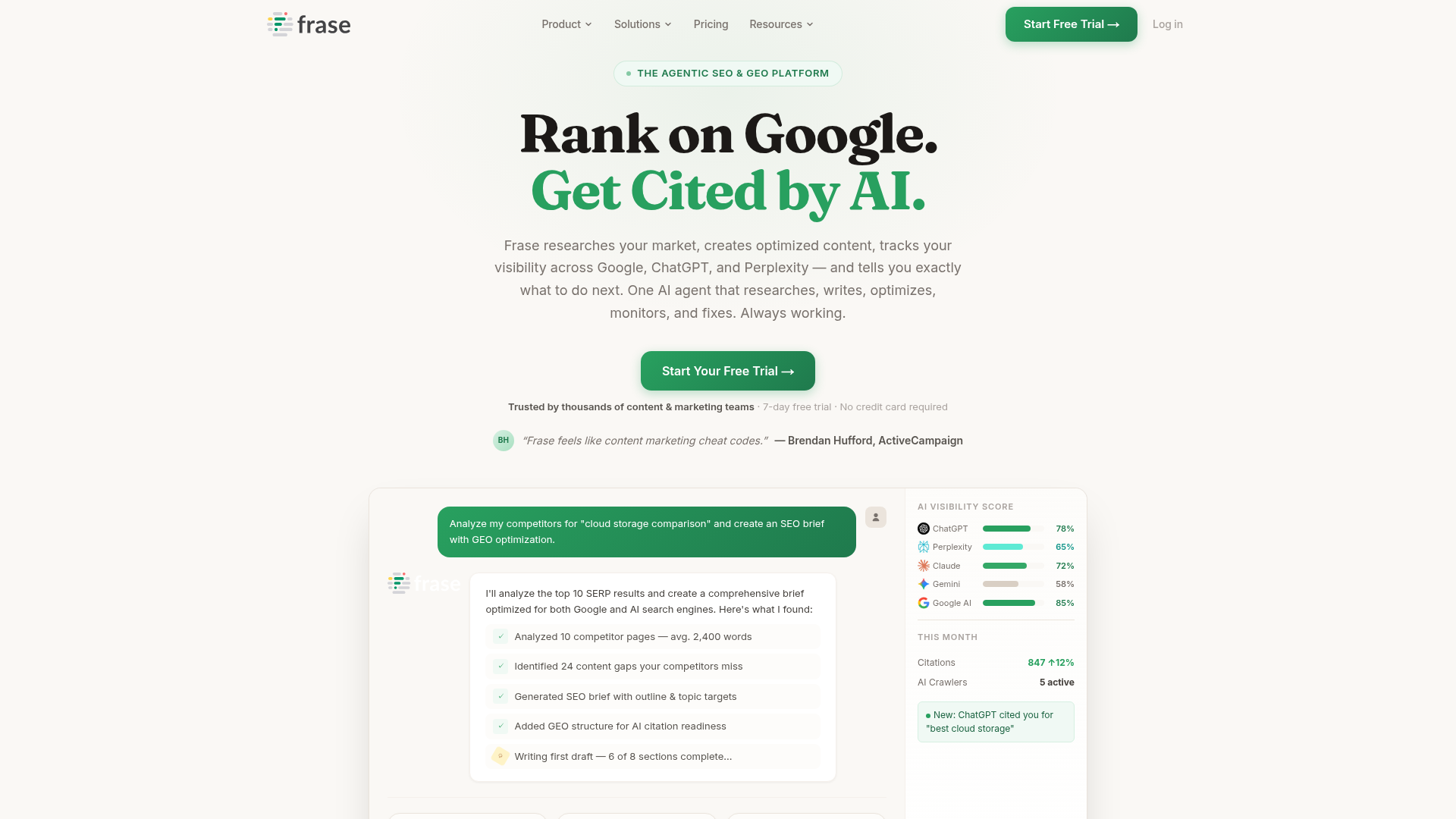
Key features
- Dual scoring model rating content for both traditional SEO and AI search visibility
- AI Agent on all plans for research and content generation
- Tracks brand visibility across up to 8 AI platforms
- 4.8 out of 5 rating on G2
Pros
- Dual SEO and GEO scoring provides unique optimization guidance
- Accessible pricing compared to enterprise alternatives
- AI Agent on all plans gives every user content generation access
Cons
- AI visibility tracking is an add-on on lower tiers
- Credit-based limits restrict high-volume teams
- No backlink analysis or technical SEO capabilities
Pricing
Frase offers three tiers. Starter at $49 per month covers basic content optimization and the AI Agent. Professional at $129 per month adds expanded credits and team features. Scale at $299 per month includes higher limits for enterprise production. AI visibility tracking may require an additional fee on lower tiers.
Who it's best for
Mid-market content teams that want one tool for both traditional SEO optimization and AI search readiness.
Who it's not suited for
Enterprise teams that need workflow automation, brand governance, or integration between AI visibility data and scaled content production.
7. Writesonic: Best for broad AI engine coverage
Writesonic is an AI writing platform that has expanded into AI search visibility tracking, offering coverage across 10 or more AI engines on its Enterprise plan.
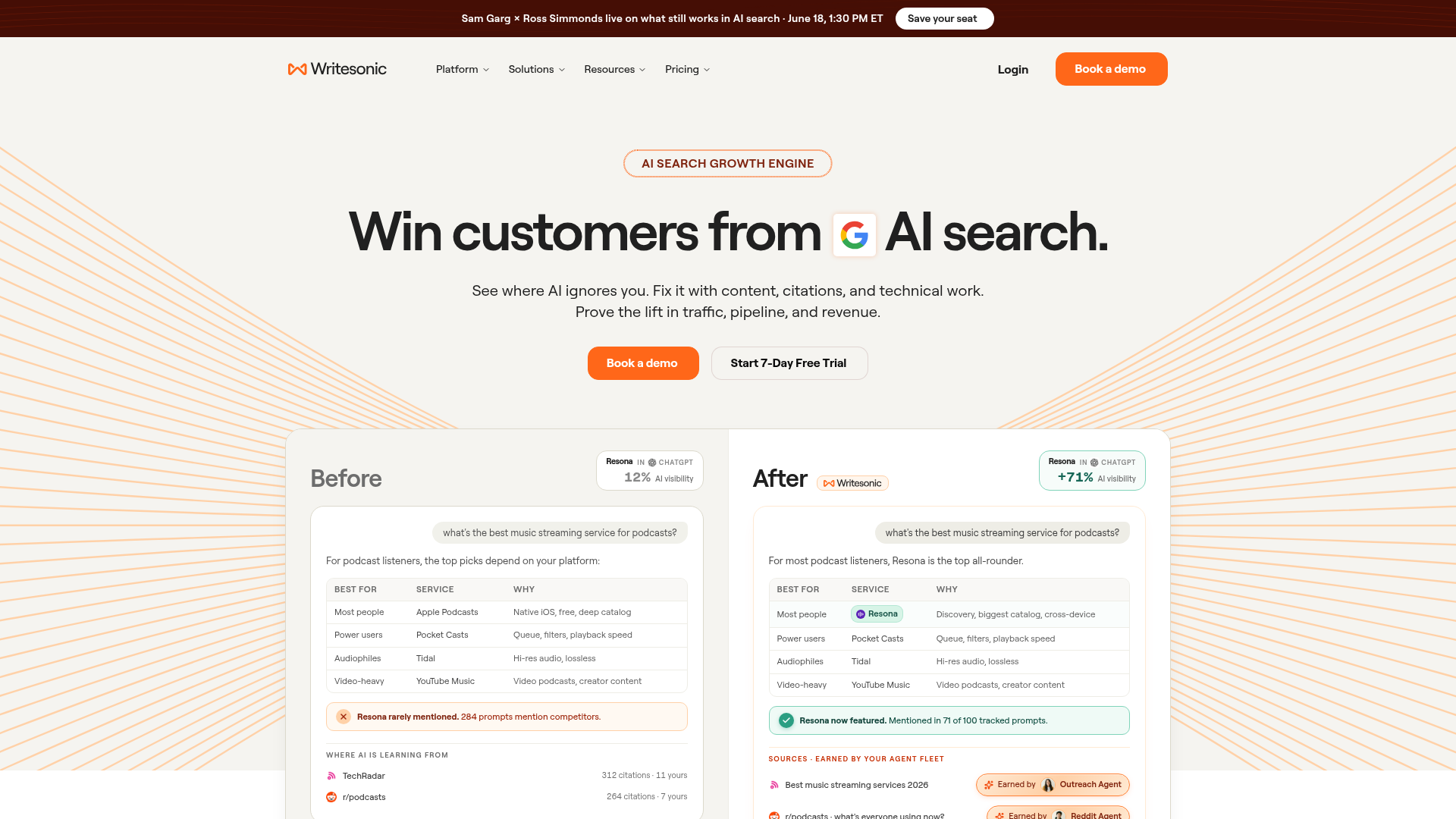
Key features
- AI content generation with SEO optimization built into the writing flow
- AI visibility tracking across 10+ AI engines on Enterprise plans
- Action Center for managing content updates and optimization tasks
- 4.7 out of 5 rating on G2
Pros
- Broadest AI engine coverage for visibility tracking among writing-focused tools
- Action Center provides task management for optimization
- Versatile content generation across multiple formats
Cons
- Full AI visibility tracking requires $249 per month or above
- AI-generated content typically needs significant editing before publication
- Limited brand governance controls for team consistency
Pricing
Writesonic starts at $79 per month for the Starter plan, which covers basic AI writing features. Basic at $199 per month adds more credits and some tracking capabilities. Growth at $399 per month expands tracking and production limits. Enterprise pricing is custom and includes full AI engine coverage across 10 or more platforms.
Who it's best for
Teams that prioritize high-volume content generation with the broadest AI engine tracking coverage.
Who it's not suited for
Enterprise teams where every published piece must match exact voice, tone, and terminology standards without extensive manual editing.
8. BrightEdge: Best for large-scale site management
BrightEdge is a legacy enterprise SEO platform built for organizations managing millions of pages, with AI features like Autopilot, AI Catalyst, and StoryBuilder added in recent years.
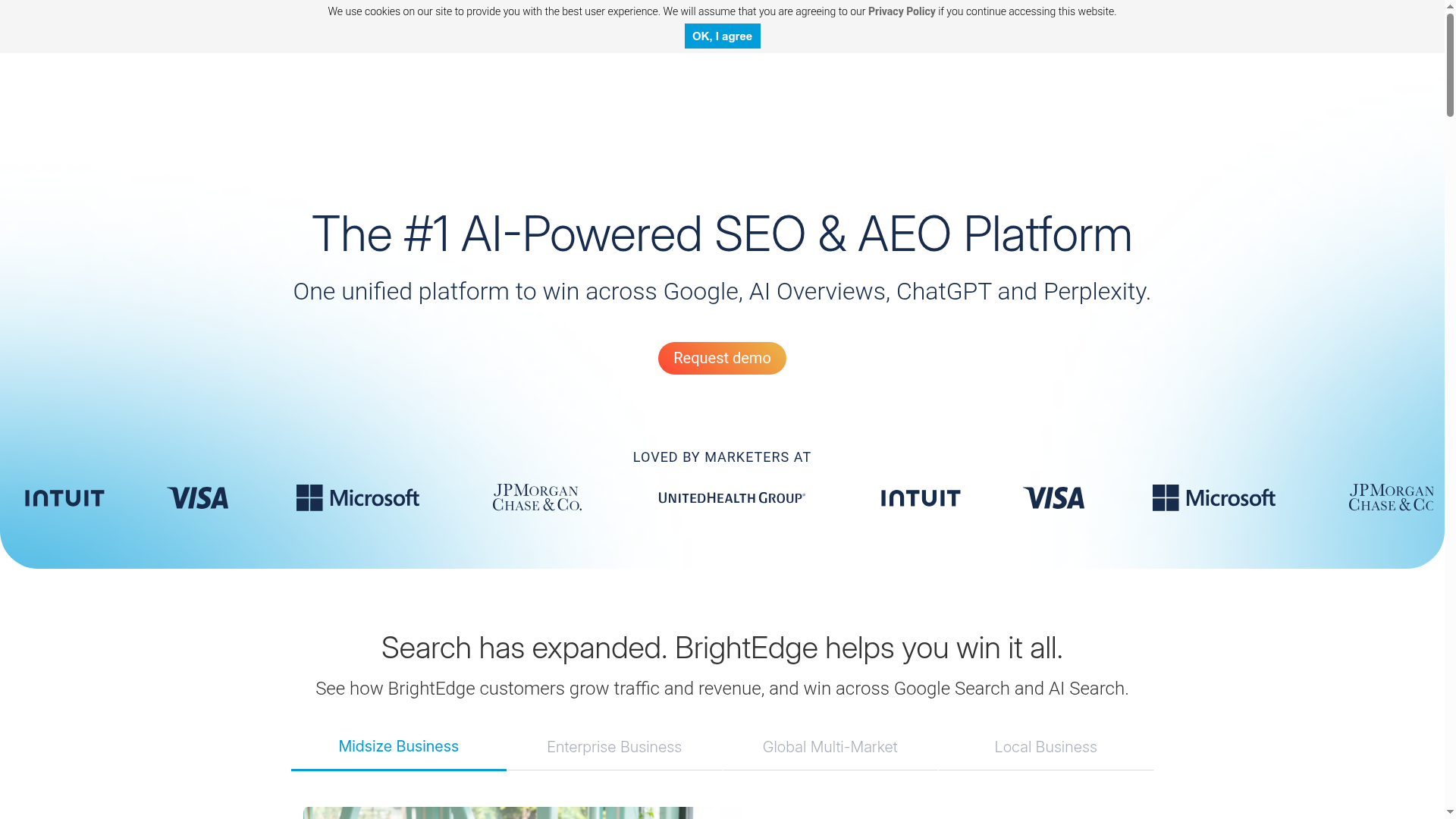
Key features
- Data Cube X for large-scale keyword and content intelligence
- Autopilot for automated on-page SEO recommendations
- AI Catalyst for AI-assisted content optimization
- Revenue attribution connecting SEO activity to business outcomes
Pros
- Handles millions of pages for the largest enterprise sites
- Revenue attribution provides board-level reporting on SEO impact
- Established enterprise relationships with proven implementation track record
Cons
- Value for Money rated 3.2 out of 5 on review platforms
- Credit-based pricing escalates costs for high-usage teams
- User interface feels dated compared to newer tools
Pricing
BrightEdge does not publish pricing. Based on user-reported data, the median annual contract is approximately $51,000. Pricing is custom-quoted and typically involves credit-based usage tiers, which can add up as your team scales activity.
Who it's best for
Large enterprises managing millions of pages that need revenue attribution and executive reporting.
Who it's not suited for
Mid-market teams looking for fast deployment and transparent pricing, or teams that want AI-native content execution.
9. Clearscope: Best for writer-friendly content optimization
Clearscope is a content optimization tool designed for editorial teams, with unlimited users on all plans and recent additions for AI prompt tracking.
Key features
- Content grading system scoring drafts against top-ranking content
- Prompt Tracking covering ChatGPT and Gemini
- Query fan-out awareness showing how AI models decompose complex queries
- Unlimited users on all plans, including Essentials
Pros
- Unlimited users on every plan, accessible for large editorial teams
- Writer-friendly interface requiring minimal training
- Query fan-out awareness provides unique AI search insight
Cons
- Tracks only ChatGPT and Gemini, missing Perplexity, AI Overviews, and others
- No backlink analysis, technical SEO, or content generation
- Limited workflow automation for enterprise-scale production
Pricing
Clearscope offers three tiers. Essentials starts at $129 per month and includes unlimited users with core content optimization features. Business at $399 per month adds expanded reporting and priority support. Enterprise pricing is custom for teams needing dedicated onboarding and advanced features. All plans include unlimited user seats.
Who it's best for
Editorial teams that want every writer using the same optimization framework without per-seat costs.
Who it's not suited for
Teams that need AI search visibility across multiple platforms, or organizations looking for content creation and brand governance alongside optimization.
10. JetOctopus
Best for
Ecommerce and enterprise teams that need deep technical SEO — crawl analysis, log file analysis, and GSC & GA4 data — for large sites where crawl budget and indexation are the main growth levers.
Pros
- The fastest crawler on the market at up to 250 pages/second, handling sites up to 100M+ URLs
- Real-time server log analysis tracks Googlebot and AI crawler behavior with no log line limits, including nginx real-time integration that updates every second
- GSC data retained for up to 16 months (vs. 3–4 months in most competing tools), enabling longer-term trend analysis
- No-limits philosophy: no domain, project, user, URL, or log line caps; agencies can manage all clients under one subscription without per-seat fees
- MCP server lets teams run technical SEO analysis directly from their AI assistant window, without switching tools
- Pricing listed on the website: monthly, quarterly, and annual payment options with no strict annual lock-in
- Support included in every package with real humans, no chatbot gating, and free technical help for log integration and custom crawl setup
Cons
- Not an AI answer-engine visibility tool; doesn't track brand mentions in ChatGPT, Perplexity, or Gemini
- No backlink analysis or keyword research; designed to complement tools like Ahrefs or Semrush, not replace them
- Best value realized on larger sites (50k+ pages); smaller sites may not need the crawl volume and log depth
Pricing
Monthly, quarterly, and annual plans available with no strict annual lock-in. Pricing listed on the website. Free trial available.
Who it's best for
In-house SEO teams and agencies managing large ecommerce or enterprise websites where crawl budget and indexation are the real bottlenecks to organic growth. Teams already using Ahrefs or Semrush for research will find JetOctopus slots in cleanly as the technical layer of their stack.
What sets enterprise SEO tools apart
Enterprise SEO tools handle scale that smaller platforms cannot. They track thousands of pages, support large teams, and connect SEO data to revenue reporting. The strongest enterprise SEO software doubles as an AI search optimization platform for enterprise SEO teams, covering ChatGPT, Gemini, and Perplexity, not just Google rankings.
- Scale: enterprise SEO platforms crawl and monitor thousands of URLs without slowing down.
- Governance: brand controls keep voice, tone, and terminology consistent across every writer.
- Team access: unlimited seats matter more than per-user pricing for large SEO teams.
- Reporting: revenue attribution connects SEO software features to board-level metrics.
- AI coverage: content optimization tools for enterprises now track ChatGPT, Gemini, and Perplexity alongside organic search.
How to choose the right AI SEO tool for your needs
Every tool on this list does something well. The right choice depends on the workflow your team runs every week and the outcomes you need to drive. Use these criteria to compare enterprise SEO platforms before you commit budget.
Here are the criteria that matter most when choosing between them.
- If you have strong keyword and backlink tools but no AI visibility data, prioritize a monitoring solution like Ahrefs Brand Radar or Semrush AI Visibility. If you have the data but can't turn it into content fast enough, prioritize execution capabilities like AirOps.
- If your team has more than five people producing content, prioritize tools with unlimited seats, collaboration features, and brand governance. Per-seat pricing compounds fast at scale. The best platforms for SEO teams price for the whole group.
- If your buyers search across ChatGPT, Gemini, Perplexity, and Google AI Mode, prioritize multi-engine tracking. Single-platform monitoring leaves blind spots.
- If your current workflow involves exporting visibility data to brief writers in a separate tool, prioritize platforms that connect insight to content production in one system. Manual handoffs slow your response time.
- If your team publishes AI-assisted content at scale, prioritize built-in brand governance. Without it, your editors become the quality control system, and that bottleneck grows with volume.
- If you're comparing sticker prices, look at total cost of ownership. A tool at $99 per month with per-seat fees, credit limits, and required add-ons can cost more than a $500 per month platform with everything included.
- If you manage SEO across many brands or regions, prioritize an enterprise SEO management platform with role-based access and centralized reporting.
The strongest AI SEO strategies are built on connected systems where visibility data flows into content production and performance measurement closes the loop. Merge used this approach to achieve top-two LLM visibility rankings against competitors ten times its size. Lightspeed saw a 37% increase in conversion rates by connecting AI search insights to content execution. Whichever tool you choose, prioritize the one that shortens the distance between knowing and doing.
Take search to the next level with AirOps
AI search is reshaping how buyers find and evaluate brands. Connected systems that move from visibility data to published content to measured outcomes are replacing fragmented tool stacks. AirOps brings that full loop into one platform so your team spends less time coordinating between tools and more time growing. Webflow discovered that AI-sourced traffic converts at 6x the rate of traditional organic. Your team can see what that looks like.
Book a call to see how the insight-to-action loop works in practice.
Frequently Asked Questions
FAQs
What is the difference between SEO and AEO?
SEO (search engine optimization) focuses on improving your rankings in traditional search results on Google and Bing. AEO (answer engine optimization) focuses on improving how your brand appears in AI-generated answers from platforms like ChatGPT, Gemini, Perplexity, and Google AI Mode. Both matter for enterprise content teams because buyers use both channels to research and evaluate products.
Can AI SEO tools replace my content team?
No. AI SEO tools amplify your team's capabilities by automating research, optimization, and production workflows. Your team still sets the strategy, defines brand standards, and makes editorial decisions. The best tools make your team faster and more consistent, not smaller.
How do I measure AI search visibility?
AI search visibility is measured through citation rates, mention rates, sentiment analysis, and competitive positioning across AI platforms. Citation rate tracks how often AI answers reference your content with a link. Mention rate tracks how often AI answers name your brand. Most tools on this list provide some form of these metrics, though coverage across AI platforms varies.
What is offsite AI search optimization?
Offsite AI search optimization is the practice of earning brand mentions on third-party sites that LLMs use as training and retrieval sources. AI models look for consensus. When multiple authoritative sources reference your brand positively, AI answers are more likely to cite and recommend you. This is a growing differentiator among AI SEO tools because most focus only on your own site's content.
How much should an enterprise team budget for AI SEO tools?
Budgets vary widely depending on team size, content volume, and the scope of AI search visibility you need. Entry-level tools start around $50 to $130 per month. Mid-tier platforms with AI tracking run $200 to $500 per month. Enterprise platforms with full execution, governance, and measurement capabilities are typically custom-priced. Factor in per-seat costs, add-on fees, and credit-based usage limits when comparing total cost of ownership.
What's the difference between an all-in-one SEO tool and a dedicated enterprise SEO platform?
All-in-one SEO tools bundle keyword research, backlinks, and audits for general use. A dedicated enterprise SEO platform adds scale, governance, and team controls built for thousands of pages and many users. Enterprise teams usually need the platform-grade option for compliance and reporting.
What's the best SEO forecasting tool for enterprise SEO teams?
The best SEO forecasting tool ties traffic projections to your own historical data and pipeline. Enterprise SEO platforms with revenue attribution give the most reliable forecasts because they connect rankings to business outcomes. Prioritize tools that model both organic and AI search visibility.
What is the best enterprise SEO tool for tracking high-volume backlinks?
Backlink-focused enterprise SEO tools with large link indexes track high-volume profiles best. Look for historical data, link intersection analysis, and alerting on lost or gained links. Pair backlink tracking with AI visibility monitoring for a complete view of authority.
What is the best SEO tool for managing international enterprise websites?
The best SEO tool for international sites tracks rankings by country and language at scale. Enterprise SEO platforms that segment data by market and support multi-region reporting fit global teams best. Confirm the tool also monitors AI answer visibility in each target market.
Which enterprise SEO platform has the best reviews?
Review scores shift by use case, so match ratings to your workflow instead of an overall rank. Read reviews from teams your size on G2 and similar sites. Weigh AI search coverage and governance features alongside traditional SEO scores.
Get the latest on AI content & marketing
