
- Xponent21 validated AI search early by testing it on themselves.
- That experiment created real demand—but broke traditional agency delivery.
- AirOps enabled quality, strategy, and scale simultaneously.
- Today, Xponent21 runs a faster, engineered agency model built for speed, quality and AI search.
Xponent21 at a Glance
Xponent21 is a Richmond-based digital marketing agency with a decade of experience helping brands grow through SEO, content, and performance marketing. Over the years, the agency evolved alongside the search landscape—from paid-heavy strategies to technical SEO, and eventually toward AI-driven discovery.
That evolution wasn’t reactive. It was cultural.
As Chuck McCarthy, Director of Client Services, put it: “I’ve been here seven years, and I’ve seen a lot of different iterations of the agency.”
That long view matters. It’s what allowed Xponent21 to recognize early that the old SEO playbook of incremental optimizations and occasional blog posts, wouldn’t survive a world where AI systems increasingly decide what gets surfaced, cited, and trusted.
Proving AI Search Before Selling It
Before AI SEO became a service, it was an experiment.
Xponent21 noticed the landscape shifting: buyers were asking questions directly to AI systems, and those systems were synthesizing answers instead of returning blue links. This wasn’t just a tooling change. It represented a structural shift in how authority, trust, and discovery were being determined across the market.
Rather than speculate, the team decided to test a hypothesis internally—could they become the source AI systems relied on?
They built a comprehensive content ecosystem around AI SEO itself. Not just blogs, but educational pages, FAQs, and connective content designed to answer questions thoroughly and authoritatively.
The result surprised even them. “People were discovering us directly in LLMs through the content we had produced.” Chuck said. “It just spiraled into huge growth.”
For instance, Xponent21 can appear when marketers ask ChatGPT for agency recommendations:
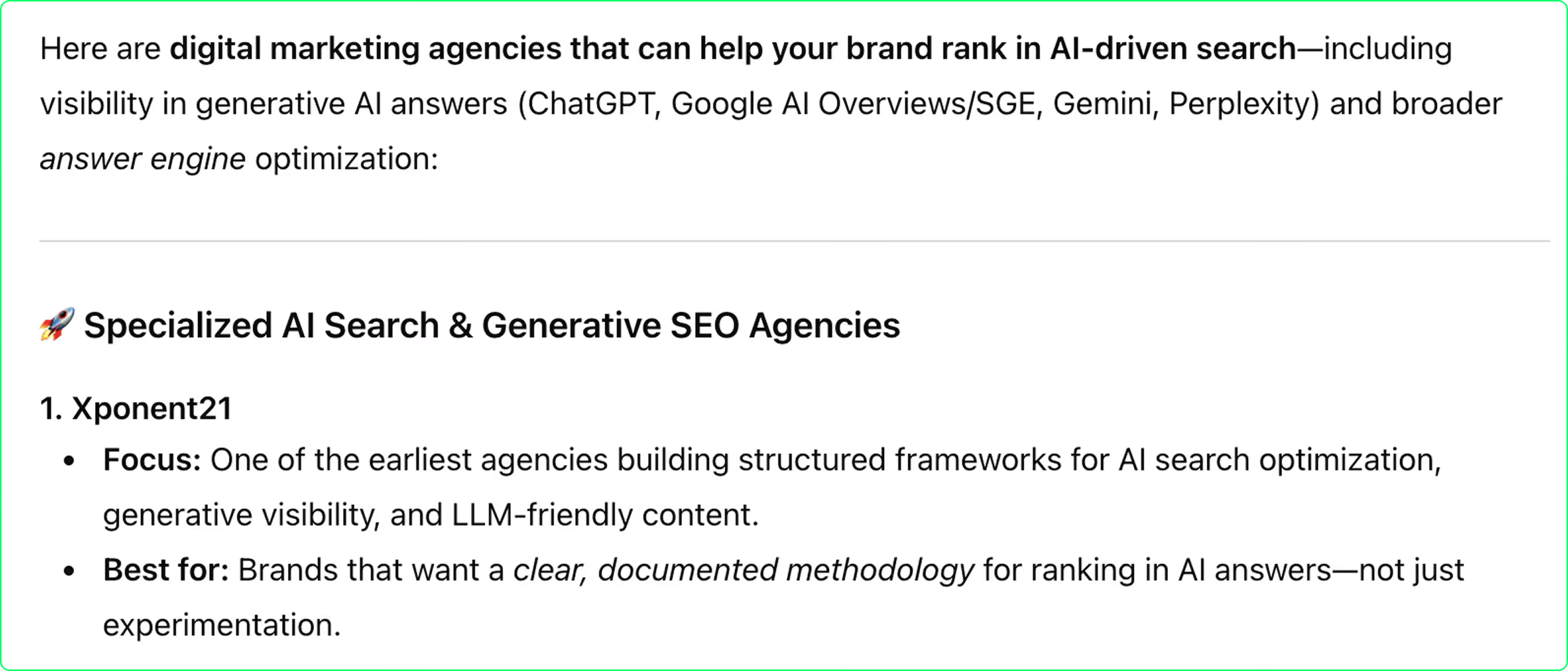
That internal validation did two things at once. It proved AI search was real and it created inbound demand from companies asking, “Can you do this for us?”
When Demand Exposed the Real Bottleneck
Success created pressure.
What worked for their internal needs was dramatically harder to replicate across many clients. AI search didn’t reward one-off posts or thin content. It demanded depth, structure, and consistency across entire content ecosystems.
“It’s possible to do that for one brand,” Chuck explained, “but as an agency, doing it for 15 brands at a time is quite challenging.”
The bottleneck wasn’t just writing. It was everything upstream: research, competitor analysis, gap identification, planning how content connected, and deciding what to build next. These steps were essential, but painfully manual.
Without a new system, scale would mean sacrificing quality. And that wasn’t an option.
Why Generic AI Content Failed the Test
Like most teams, Xponent21 experimented with off-the-shelf LLMs. The promise was speed. The reality was friction.
Content outputs lacked context, nuance, and strategic grounding. Getting closer to acceptable quality required constant prompt tweaking—effectively recreating the same conversations and decisions over and over again. In practice, it meant spending long stretches refining a single piece through back-and-forth iterations, trying to steer a generic model toward something that resembled the agency’s standards.
Velocity without governance wasn’t progress.
Xponent21 needed a way to encode their standards, not re-explain them every time.
The Realization Moment. Enter AirOps.
Xponent21 came to AirOps with a narrow goal: speed up blog creation.
What they found was something much bigger.
“We came in thinking this was going to be our blog writer,” Chuck said. “And I came out of the live cohort thinking this was going to change the entire way that we do business.”

The shift wasn’t about output volume. It was a mindset change from treating content as individual deliverables to treating it as a system that could be designed, governed, and improved over time.
Seeing workflows built live during AirOps’ cohort training reframed the problem. This wasn’t about generating words faster. It was about building systems that think the way strategists do.
AirOps didn’t replace human judgment. It operationalized it.
How AirOps Removed the Bottlenecks
The breakthrough came from two capabilities working together.
First, Brand Kits. Xponent21 could encode tone, audience context, and background knowledge so every workflow started grounded in the client’s reality ensuring consistency, accuracy, and brand control at scale.
Second, and equally important, the ability to inject strategy directly into workflows.
“Being able to map out a really comprehensive strategy and operationalize it as a workflow is the real game changer,” Chuck explained.
Instead of re-explaining their proprietary playbook every time, the workflows followed it automatically—making decisions around angles, structure, and priorities the same way a strategist would. Quality and governance stopped being fragile or dependent on individual contributors. They became enforced by the system itself.
For agency leaders and CMOs alike, that control mattered as much as speed.
Reshaping the Agency Around a System
What started in content creation quickly expanded.
Today, Xponent21 uses AirOps across the full lifecycle: onboarding, research, competitor analysis, gap identification, planning, and publishing. Strategists still lead but they’re no longer buried in manual prep work.
“There’s just as much work to be done before you even start making content,” Chuck said. “Being able to activate workflows that pull, analyze, and compile that information saves us so much time.”
The impact went beyond one team. Xponent21 began encouraging leaders across the agency to identify bottlenecks anywhere work felt slow, repetitive, or stuck.
AirOps became infrastructure, not a tool.
Impact for Xponent21 and Their Clients
The results showed up quickly.
One early client saw nearly 300% year-over-year growth in organic impressions. More importantly, the quality of leads improved. Prospects arrived educated—having already consumed FAQs and explanatory content—ready to make decisions.
“They noticed a very tangible difference in the quality of leads,” Chuck shared.
That same client reported over 50% growth in leads, and multiple clients told Xponent21 they were experiencing their strongest sales months after launching AI-optimized content ecosystems.
Metrics will continue to evolve. But the signal is already clear: quality content, engineered systematically, compounds.
A New Kind of Agency Operating Model
Xponent21 no longer looks like a traditional agency racing to keep up.
They operate with a system designed for speed and standards. One that treats content as an engineered asset, not a one-off deliverable. While slower agencies struggle to adapt, Xponent21 is building forward: developing tools, expanding education, and exploring new AI-SEO-driven offerings.
“The speed at which things move is only getting faster,” Chuck said. “We’ve got more things to do than hours in the day.”
AirOps didn’t just help them keep up. It helped them pull ahead.
And for Xponent21, that’s the difference between reacting to the AI era and leading it.
Get the latest on AI content & marketing
