Prompts to align content strategy with AI visibility goals
- AI answers now shape how buyers find vendors, so your content plan needs AI visibility goals.
- These 9 prompts turn business goals into tracked prompts, owner pages, and fixes.
- Map each tracked prompt to one page, then close citation gaps on that page or offsite.
- Measure citations and mentions across repeated runs, because single AI answers rotate often.
Use these prompts to align content strategy with AI visibility goals, one stage at a time. AirOps prompt tracking shows which prompts earn your pages citations across ChatGPT, Gemini, and Perplexity. Each prompt here turns a business goal into a tracked question with an owner page and a metric.
AI visibility is how often AI answers cite or name your brand for the prompts you care about. Rankings still matter. AI visibility adds a second goal: earning a place inside the answer itself.
This page groups the prompts into four stages: planning, mapping, content, and measurement. Run them in order the first time. After that, jump to the stage where your prompt results stall.
Each prompt includes [bracketed variables] you replace with your own data. Real inputs produce sharper answers, so paste actual sales notes, URLs, and results. Review every output before you act on it, and keep a log of what you changed.
AI already shapes how people in the US look for answers. Pew Research Center's 2026 survey found 49% of US adults use AI chatbots, up from 33% in 2024. In the same survey, 60% said they read AI summaries in search results.
How do you align content strategy with AI visibility goals?
Align them by turning each business goal into a set of tracked prompts. Then map each prompt to one page and measure citations and mentions per prompt. That loop is the core of an AI visibility content strategy.
- Set goals that tie AI search visibility to pipeline and revenue.
- Build a prompt set that mirrors how your buyers ask AI for help.
- Map each prompt to one owner page and close the gaps you find.
- Measure results across repeated runs and adjust the plan monthly.
The table shows the four stages and the prompts that cover each one.
| Stage | Question it answers | Output | Prompts on this page |
|---|---|---|---|
| Set goals | Which business outcomes should AI answers support? | AI visibility goals per product line | 1 |
| Build the prompt set | Which questions do your buyers ask AI? | Tracked prompts by funnel stage | 2 and 3 |
| Map and close gaps | Which page should win each prompt? | Prompt-to-page map with gap types | 4 through 7 |
| Measure and adjust | Is the plan moving citations and mentions? | Prompt-level scorecard and 90-day plan | 8 and 9 |
This work sits inside answer engine optimization (AEO), the practice of earning citations and mentions in AI answers. Your goals need to cover the answer as well as the click. Our AI search visibility hub covers the full practice.
Prompts to align content strategy with AI visibility goals at the planning stage
Planning prompts set direction before you write a word. They turn revenue targets into AI visibility goals and a prompt set you can track. Revisit them every quarter.
1. Translate business goals into AI visibility goals
You are a B2B content strategist for [company], which sells [product] to [buyer role]. Our top business goals this year are [goals]. Translate each goal into one AI visibility goal with the buyer question AI must answer, a metric, and a target. Return a table with goal, AI visibility goal, metric, and owner.- When to use it: at quarterly planning, before you commit budget to new content.
- What to add: citation and mention targets next to traffic. Ahrefs found AI Overviews correlated with 58% lower top-ranking click-through rates (2026; desktop, informational keywords).
2. Build a tracked prompt set by funnel stage
Act as an AI search analyst and map the prompts your audience asks AI, using the goals below. Write 10 prompts each for awareness, consideration, and decision, phrased the way a [buyer role] types them. Flag which prompts name a brand and which do not. Goals: [paste goals from prompt 1].- When to use it: when you start tracking AI search, or when your offer changes.
- What to add: real phrasing from sales calls, support tickets, and site search logs.
3. Find the questions buyers ask AI before they ask sales
Here are notes from [number] recent sales calls: [paste notes]. List the questions buyers asked before they spoke with us, rewritten as prompts for an AI assistant. Group the prompts by theme and rank them by deal influence. Mark any question our site does not answer today.- When to use it: when your prompt set feels generic. Forrester's 2026 research found 94% of business buyers report using AI while buying.
- What to add: lost-deal notes and objections, since those questions shape shortlists early.
How to map AI prompts to pages and find citation gaps
Mapping shows which page should win each prompt. It also shows where no page can win yet, which tells you what to build.
A citation gap is a tracked prompt where AI cites competitors or third parties and leaves you out. Citation gaps fall into four types: content, structure, freshness, and authority. For keyword-level gaps, use our content gap analysis prompts.
4. Map each prompt to one owner page
Here is my tracked prompt list: [paste prompts]. Here is my sitemap with titles and target keywords: [paste URLs]. Assign each prompt to the single best owner page, and mark prompts with no good page as new content needs. Mark prompts where two pages compete as merge candidates, and return a table.- When to use it: right after you build the prompt set. Review the citation signals in AI search before you assign pages.
- What to add: page performance data and the business value of each prompt.
5. Diagnose citation gaps for a prompt
For the prompt [prompt], AI cites these pages today: [paste cited URLs]. Compare them with our owner page at [URL] and list what they answer that we do not. Check answer placement, specificity, freshness, and structure. Classify the gap as content, structure, freshness, or authority.- When to use it: for high-value prompts where competitors earn citations and you do not.
- What to add: the full AI answer text, cited URLs from several runs, and your page copy. For a deeper audit, run our LLM citation audit.
6. Decide between your page and a third-party source
For the prompt [prompt], AI cites these sources: [paste URLs and domains]. Sort them into brand-owned, competitor, publisher, review site, and community. Tell me whether our best move is improving our page or earning a third-party mention. Name the third-party sources most worth pursuing and explain why.- When to use it: when AI answers lean on review sites, publishers, or forums.
- What to add: your current review profiles, partner pages, and press coverage. To plan which brands you appear beside, use our brand co-mention prompts.
Log the output of prompts 4, 5, and 6 in one prompt-to-page mapping table. Flag freshness gaps early, because AirOps research (ChatGPT, 2025) found over 70% of cited pages had updates within 12 months. The rows below are examples.
| Prompt | Funnel stage | Owner page | Current status | Gap type | Next action |
|---|---|---|---|---|---|
| How do I cut vendor onboarding time? | Awareness | Onboarding guide | Cited in some runs, never mentioned | Structure | Move the direct answer to the first paragraph |
| Best [category] software for [industry] | Consideration | Industry solution page | Not cited | Authority | Earn two review-site profiles and one publisher mention |
| [Your brand] vs [competitor] pricing | Decision | Pricing page | Cited with outdated figures | Freshness | Update prices and the last-updated date |
Prompts to plan and refresh content for AI search
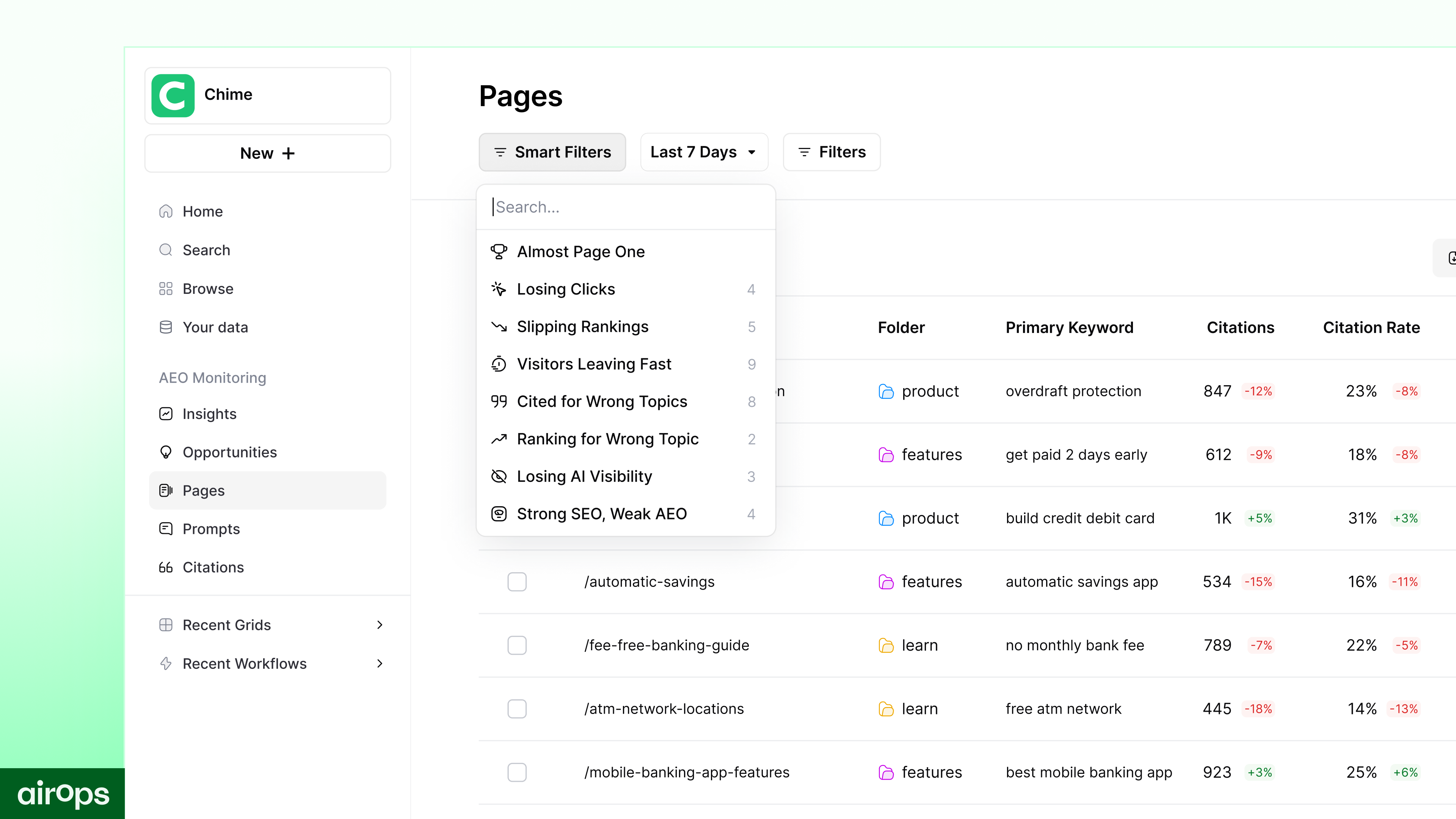
Your map now shows the gaps. A content strategy for AI search decides which gaps get a refresh, a new page, or offsite work.
Generative engine optimization (GEO) is the practice of shaping content so AI systems can retrieve and cite it. A GEO content strategy plans pages around prompts, then fills the gaps the map reveals.
Structure deserves a place in that plan. AirOps research (ChatGPT, 2025) found 68.7% of cited pages used sequential headings, against 23.9% of top Google results. The pattern is correlational, so test changes against your tracked prompts.
Use this guide to pick the right move for each gap.
| Signal | Refresh existing | Create new | Go offsite |
|---|---|---|---|
| An owner page exists, but AI cites competitors | Refresh first | Skip | Add when competitors win on reviews |
| No page answers the prompt | Skip | Create one owner page | Add after the page is live |
| AI cites review sites and forums | Tighten the owner page | Skip | Prioritize review and community sources |
| Two of your pages compete for one prompt | Merge into one page | Skip | Skip |
| The owner page is over 12 months old | Refresh and update the date | Skip | Skip |
7. Prioritize refreshes against tracked prompts
Here is my prompt-to-page map with gap types and last-updated dates: [paste table]. Rank the pages for refresh by prompt value, gap size, and content age. For the top five, list the specific edits each page needs. Flag any page that needs a rewrite instead.- When to use it: monthly, or when a tracked prompt drops. The AirOps guide on what content to refresh covers page selection.
- What to add: citation trends per page and the revenue tied to each prompt.
Once a refresh or new page is approved, write the brief with your team's standard template. Our AI content strategy guide covers what a brief for AI search should include.
Prompts to measure AI visibility and adjust the plan
AI answers change from run to run, even when the question stays the same. One snapshot tells you little, so measure AI visibility across repeated runs. Read trends across weeks before you change course.
In a 2025 Ahrefs study of Google AI Overviews, 45.5% of cited sources changed between consecutive answers. Your scorecard needs enough runs to separate signal from rotation.
8. Read prompt-level results across repeated runs
Here are results for [number] tracked prompts across [number] runs: [paste data]. For each prompt, report citation rate, mention rate, and share of voice against [competitors]. Separate stable wins from one-off citations, and flag prompts where AI cites us but never names us. Summarize what changed since the last review.- When to use it: every two weeks for priority prompts, and monthly for the rest.
- What to add: at least five runs per prompt, plus publish dates for recent page changes. For share of voice against named competitors, use our competitive AI share of voice prompts.
9. Build a 90-day plan from the results
Using my prompt-to-page mapping and the results below, build a 90-day content plan: [paste map and results]. Group the work into refreshes, new pages, and offsite placements. Give each item an owner, a due date, and a target metric. Put the highest-value citation gaps first.- When to use it: at the end of each quarter, or after a sharp shift in results.
- What to add: writer capacity, launch dates, and budget limits for offsite work.
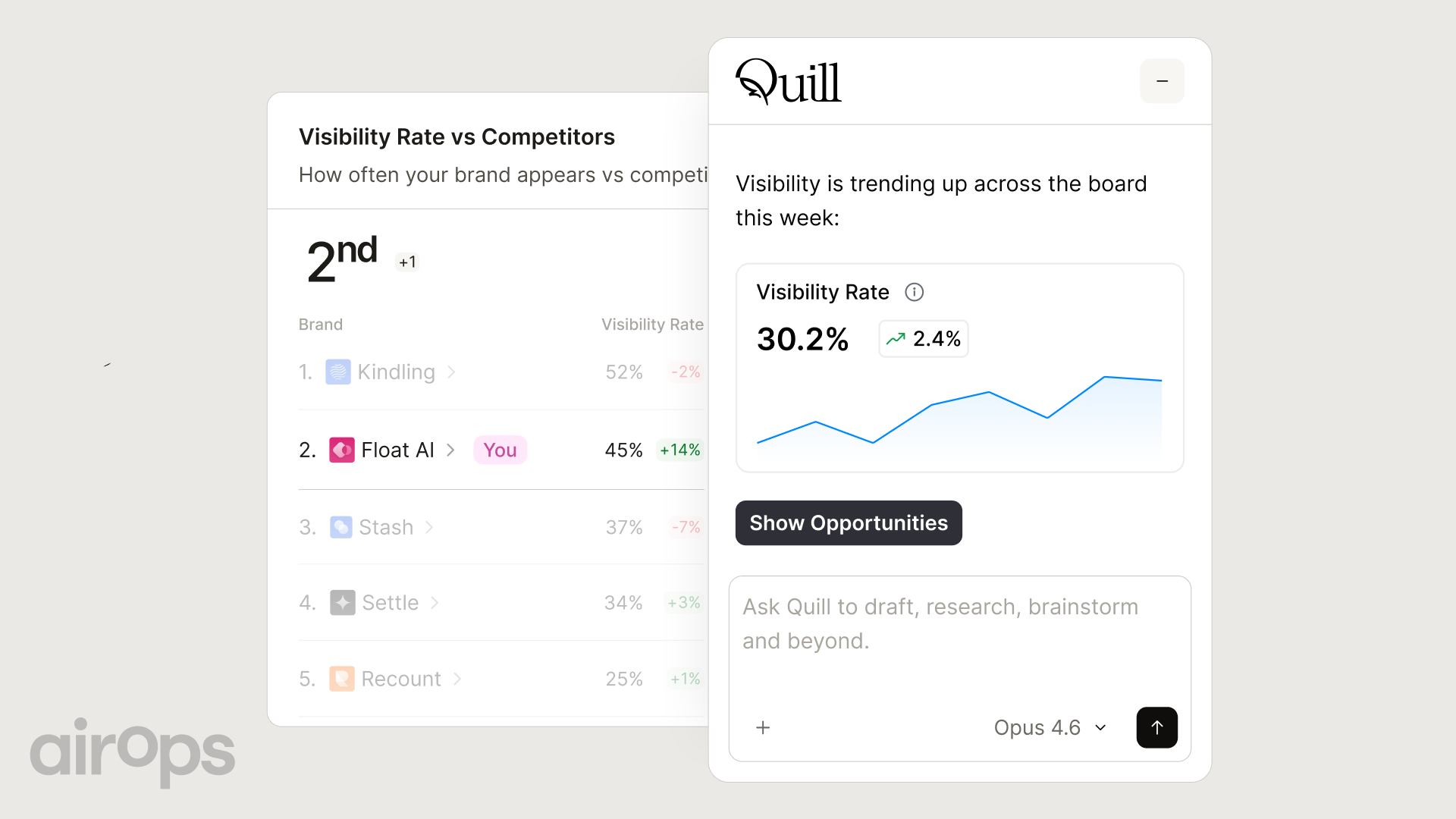
Pick metrics by goal. The AirOps guide to AI visibility metrics defines each one in depth.
| Goal | Primary metric | Secondary metric | Review cadence |
|---|---|---|---|
| Get cited for category questions | Citation rate per prompt | Share of voice against competitors | Every two weeks |
| Get named in recommendations | Mention rate per prompt | Sentiment of mentions | Monthly |
| Win decision-stage prompts | Citation rate on decision prompts | Demo requests from AI referrals | Monthly |
| Protect existing wins | Citation stability across runs | Owner page freshness | Monthly |
Key takeaways
- Set AI visibility goals from business goals before you choose a single topic.
- Give every tracked prompt one owner page, so effort never splits across pages.
- Choose a refresh, a new page, or offsite work based on the gap type.
- Judge progress across at least five runs per prompt before you change the plan.
Frequently asked questions
What tools help a content team find gaps in AI search coverage?
Three kinds of tools work together. An AI visibility tracker runs your prompt set across engines and shows where answers cite competitors or third parties. Search Console and GA4 show which owner pages lose clicks and AI referrals. A prompt-to-page map, built with Prompt 4, ties each gap to the page that should win it. AirOps Analytics and Page360 bring these views into one place.
How long does it take for content changes to show up in AI answers?
Timing depends on how often each platform refreshes its sources. Track the owner page across repeated runs for at least a month before you judge a change.
How often should I rerun these prompts?
Rerun measurement prompts every two weeks for priority prompts and monthly for the rest. Rerun the planning prompts each quarter.
Do I need to rewrite my whole content library?
No. Start with the owner pages mapped to your highest-value prompts, and refresh those before you write anything new.
Does this replace my SEO content strategy?
No. Search engine optimization (SEO) still earns the rankings AI systems draw from, and this plan adds prompt-level goals on top.
What's the difference between a citation and a mention?
A citation is a link to your page inside an AI answer. A mention is your brand named in the answer text, with or without a link.
AirOps for aligning content strategy with AI visibility goals
AirOps is an enterprise AEO platform and expert partner for marketing leaders, connecting AI search intelligence, coordinated action across channels, and measurement tied to growth. AirOps Analytics tracks your prompts across repeated runs, so you see trends across weeks.
Prompt Discovery finds buyer questions you do not track yet. Page360 connects your prompt-to-page mapping to page-level citation data, so you know which owner page to fix next. AirOps experts help you set priorities and guide the work across owned content, external content, and community.