Prompts to test brand governance in AI writing platforms
- This kit gives you five copy-paste prompts to evaluate brand governance in AI writing platforms.
- Require eight governance features, including scoped rules, approval gates, audit trails, and versioned brand settings.
- Pilot each finalist for two to four weeks with two tests on your own content.
- Score each vendor on five weighted criteria with a 0 to 3 scale and evidence from demos and pilots.
- Article 50 of the EU AI Act applies from 2 August 2026, so add disclosure handling to your RFP.
An AI writing platform RFP needs governance requirements that vendors prove live. These prompts turn your brand standards into tests.
AirOps is an enterprise AEO platform and expert partner for marketing leaders, connecting AI search intelligence, coordinated action across channels, and measurement tied to growth. AEO is the practice of earning citations and recommendations in AI answers. AirOps publishes this kit as a vendor-neutral framework you can run against any platform, ours included.
Vendor answers to governance questions sound alike on paper. Each one claims brand controls and audit logs. The differences show up when you run your own content through the product.
Governance matters more as your output grows. One off-brand claim in a template repeats in every draft built on it. You run each test here with your own content, then score the evidence before you sign.
What brand governance features should I require in an AI writing platform?
Require eight features: a central brand system, scoped rules, brand separation, generation-time enforcement, automated checks, approval gates, permissions, and versioning. Ask the vendor to show each one live with your rules.
- A central brand system that stores tone, writing rules, and terminology in one place.
- Rules scoped by content type, audience, or region, so each rule applies only where it belongs.
- Separate brand configurations for each brand, with no rule bleed between them.
- Enforcement at generation time, so first drafts follow your rules before anyone edits them.
- Automated checks that flag banned terms and unsupported claims before human review.
- Approval gates with an audit trail that records who approved each draft and when.
- Roles and permissions that control who edits brand rules and who publishes.
- Versioning with a draft and an active state, so rule changes go live on purpose.
These eight requirements form the core of AI content governance. Our guide to brand governance at scale covers the operating side in more depth, and our brand quality at scale webinar recap shows how teams run it.
The requirements matrix below shows what a pass looks like and what proof to request. Use it as the brand governance section of your RFP.
| Requirement | What a pass looks like in a demo | Evidence to request |
|---|---|---|
| Central brand system | The vendor loads your brand guide and rules into one editable record | Screenshot of your rules inside the product |
| Scoped rules | A rule for one audience changes that audience's draft only | Two drafts from one brief for two audiences |
| Multi-brand separation | Brand B drafts ignore Brand A's banned terms | Side-by-side drafts from two brand configurations |
| Generation-time enforcement | The first draft follows your rules with no manual prompt edits | Unedited first draft and the prompt used |
| Automated checks | The tool flags a planted banned term and an unsupported claim | Check report on a seeded test draft |
| Approval gates and audit trail | A draft can't publish until a named approver signs off | Exported log with approver, time, and rule version |
| Roles and permissions | A writer role can't edit brand rules | Permission matrix for each role |
| Versioning | Rule edits stay in draft until someone activates them | Version history with draft and active states |
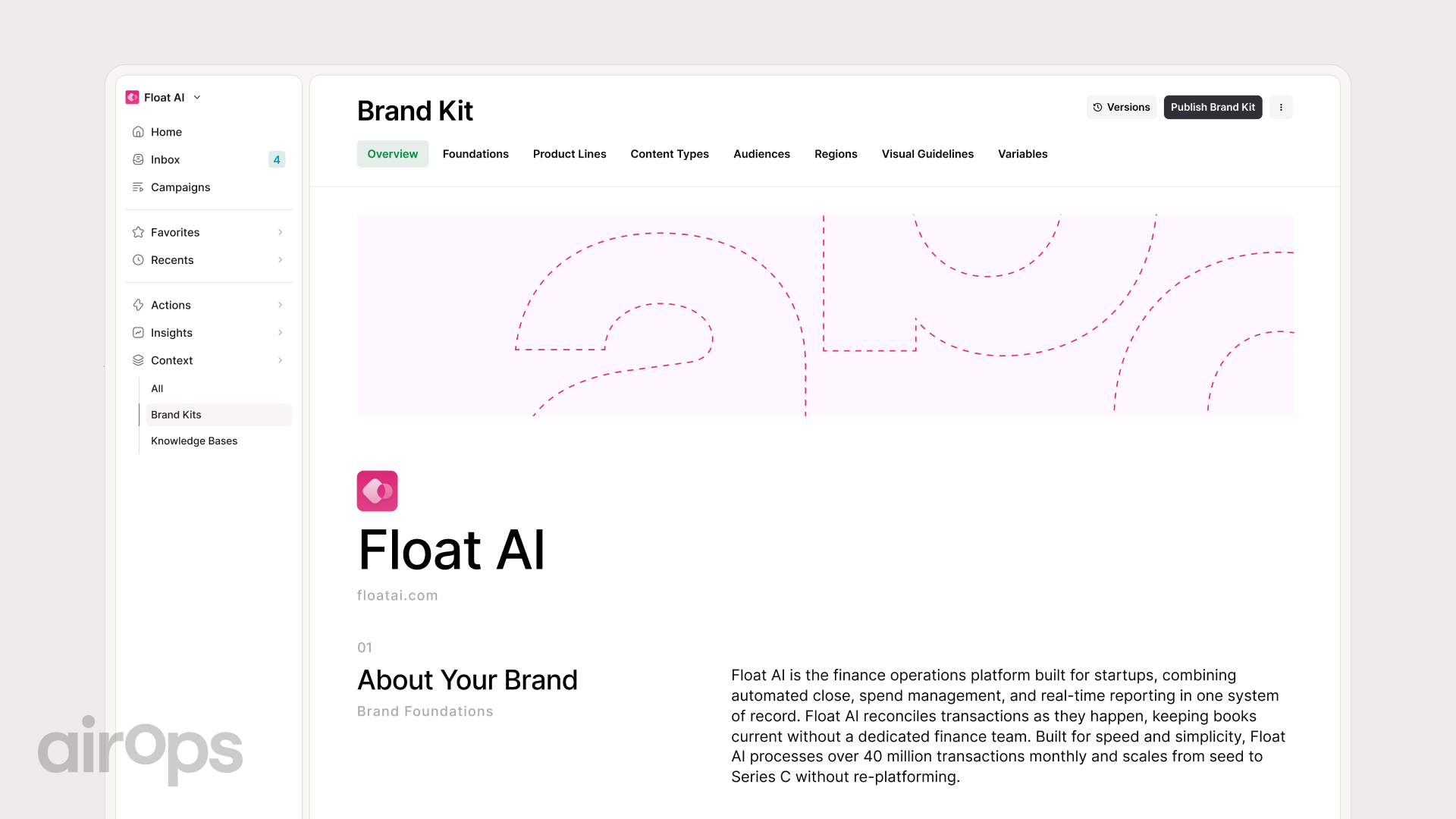
The Brand Kit below is one example of a central brand system with scoped writing rules.
Deadline pressure is where governance breaks. In an Optimizely-commissioned survey of 2,003 marketing leaders, 25% frequently or always publish AI content they know isn't fully on-brand. Savanta ran the study in seven markets in May and June 2026, and the answers are self-reported.
Generation-time enforcement and approval gates exist for that exact moment. Write them into your RFP as must-haves. To set the internal rules those gates enforce, use our enterprise content governance prompts.
Prompt 1 for a governance feature requirements list
Paste this prompt into your AI assistant to draft the governance section of your RFP.
I'm writing the brand governance section of an RFP for an AI writing platform. My company is [your company], with [number] brands sold to [audience] in [regions]. Our brand guide covers [tone, terminology, banned claims, legal disclaimers]. Write eight numbered brand governance features to require. Cover a central brand system, scoped rules, multi-brand separation, and generation-time enforcement. Also cover automated checks, approval gates with audit trails, roles and permissions, and versioning. For each feature, describe what a pass looks like in a live demo. List the evidence the vendor must supply. Mark each feature as must-have or nice-to-have for [your use case]. Return a table.What to look for in the output:
- Every requirement names a test you can run in a demo.
- Must-have items map to real brand risks, such as regulated claims.
- Evidence requests ask for exports and logs, never slides alone.
- Nice-to-have items stay out of the highest weights in your scoring matrix.
How do I test brand governance in an AI writing platform pilot?
Run two tests with your own content during a two to four week pilot. Use your real briefs and brand rules for every test. Give each vendor the same inputs so the results compare cleanly.
The pilot test plan below sets the inputs, pass thresholds, and owner for each test.
| Test | Inputs you provide | Pass threshold | Owner |
|---|---|---|---|
| Multi-brand configuration | Two brand guides and five shared briefs | Zero rule bleed across 10 drafts | Brand lead for each brand |
| Approval workflow and audit trail | Two approver roles and one rule change mid-pilot | Full log export with approver, time, and rule version | Marketing operations lead |
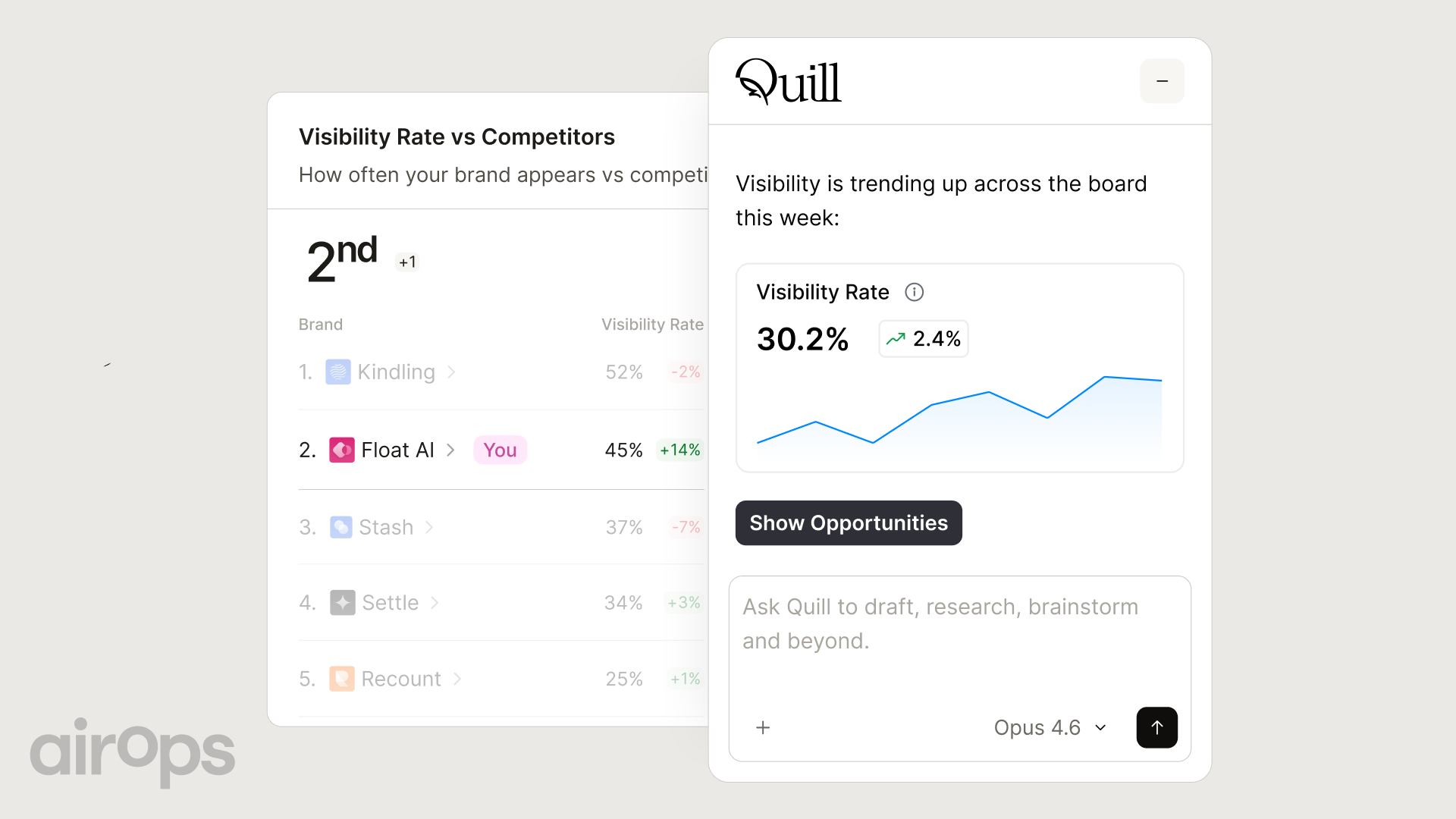
Multi-brand testing also covers AI search intelligence, shown below as a per-brand competitor ranking.
Prompt 2 for a multi-brand configuration test
Keeping tone and style consistent across brands starts with separate brand configurations. This test checks that each brand's rules stay separate and that shared rules apply only where you choose. It also checks that AI search performance reports for each brand on its own.
Run this multi-brand governance test inside each vendor's platform during the pilot. To design the governance model behind it, use our multi-brand AEO governance prompts and our guide to multi-brand content governance.
I'm testing multi-brand governance in [vendor] for [brand A] and [brand B]. Set up a separate brand configuration for each brand from the attached guides. Apply these shared rules to both brands: [shared rules]. Apply these rules to [brand A] only: [brand-specific rules]. Generate one draft per brand from this brief: [brief]. List every rule applied to each draft and the configuration it came from. Flag any rule from one brand that shows up in the other brand's draft. Show AI search tracking for [prompt set] separately for each brand.What to look for in the output:
- Each brand lives in its own configuration with its own rules.
- Banned terms for [brand A] never appear in drafts for [brand B].
- Shared rules update once and apply to every brand you select.
- AI search intelligence reports each brand separately, with its own prompts and competitors.
Prompt 3 for an approval workflow and audit trail check
An approval workflow and audit trail check proves you can trace any published sentence to a person and a rule. In 2025, McKinsey's state of AI survey found 51% of respondents at AI-using companies saw at least one negative consequence. The survey covered 1,993 respondents worldwide across all industries.
Show me the approval workflow for [content type] in [vendor]. Configure two approval steps: [role 1] first, then [role 2]. Publish one draft. Then change this brand rule: [rule change]. Publish a second draft under the new rule. Export the audit trail for both drafts. For each draft, show the approver, the timestamp, and the rule version applied.What to look for in the output:
- The log names each approver and the time of each approval.
- Each draft records the brand rule version it used.
- Change history shows every edit between the first draft and the approved version.
- You can export the log yourself without a support ticket.
What should a vendor demo script for AI writing platforms cover?
Make the vendor run your brief live against your rules. A vendor's own demo shows its strongest case, and your script shows how it handles your brand. Send the script two days ahead so the vendor loads your brand guide first.
Your script holds the questions to ask every vendor, in the same order. Run security in a separate session with our AI vendor security prompts, so the demo stays on governance. For the AI visibility side of a platform evaluation, see our AEO platform buyer's guide.
Prompt 4 for a vendor demo script
Write a 45-minute demo script for [vendor] as part of our AI writing platform RFP. Our brand is [your brand], and our top brand risks are [risks]. Include six live tasks the vendor must run on screen with our brand guide. Cover rule setup, scoped rules, a second brand, a planted banned term, an approval gate, and a rule version change. Add one follow-up question per task. List the evidence we should capture from each task.What to look for in the output:
- The vendor runs every task live, with no prerecorded clips.
- The vendor loads your brand guide before the call starts.
- Each task produces evidence you can attach to your scorecard.
- Follow-up questions probe failure cases, such as a rule conflict between brands.
Score each answer against this table during the demo.
| Demo question | Strong answer | Red flag |
|---|---|---|
| Where do our brand rules live? | One editable brand record, shown on screen | Rules live inside individual prompts |
| Can a rule apply to one audience only? | The vendor scopes a rule and shows two different drafts | The vendor says to write it into each prompt |
| How do you keep two brands apart? | Separate configurations with a no-bleed test shown live | One shared configuration with tags |
| What happens to a banned term in a brief? | The draft removes it and the check flags it | The term shows up in the draft unflagged |
| Who approved this draft, and under which rules? | Exported log with approver, time, and rule version | The vendor offers to ask support |
| How do rule changes go live? | Draft version, review, then activation | Edits go live the moment someone saves |
How do I score brand governance in an AI writing platform RFP?
Weight five criteria and score each on a 0 to 3 scale. Base every score on demo or pilot evidence. Then write a one-page decision memo for your approver.
This evaluation scorecard is our framework, so adjust the weights to your risk profile. The four scoring tiers are 0 (missing), 1 (partial), 2 (meets), and 3 (proven). A 3 needs evidence from your own pilot, and a 2 needs a live demo. After launch, keep checking live drafts with our AI draft compliance audit prompts.
| Criterion | Weight | 0 (missing) | 1 (partial) | 2 (meets) | 3 (proven) |
|---|---|---|---|---|---|
| Multi-brand separation | 27% | One shared configuration | Tags on shared rules | Separate configurations in the demo | Zero rule bleed in your pilot |
| Enforcement and automated checks | 20% | Manual review only | Checks after drafting | Rules applied at generation | Every planted term caught |
| Approval workflow and audit trail | 20% | No approval log | Log without rule version | Full log with no export | Exported log with rule version |
| Disclosure and compliance handling | 20% | No disclosure support | Manual disclosure notes | Disclosure settings by content type | Disclosure rules plus review records |
| Versioning and permissions | 13% | Anyone edits live rules | Roles without versions | Draft and active versions | Versions plus role-based activation |
The disclosure criterion reflects the EU AI Act. Per the European Commission's Article 50 transparency FAQ, updated 24 July 2026, Article 50 applies from 2 August 2026. Deployers must label AI-written text published to inform the public on matters of public interest. That duty applies only when the text has no human review or editorial control.
Spell-checking or grammar correction doesn't count as human review under that FAQ. Confirm how the rules apply to your content with your legal counsel.
Prompt 5 for a scoring matrix and decision memo
Build a weighted evaluation scorecard for our AI writing platform RFP. The vendors are [vendor A], [vendor B], and [vendor C]. Use these criteria and weights: [paste scoring table]. Score each vendor 0 (missing), 1 (partial), 2 (meets), or 3 (proven). Use only this evidence: [demo notes, pilot results, exported logs]. Cite the evidence behind every score and calculate weighted totals. Then write a one-page decision memo for [approver] with the recommendation, top two risks, and mitigations.What to look for in the output:
- Every score cites a specific demo note, pilot result, or log.
- No vendor scores a 3 without evidence from your pilot.
- The memo names the winning vendor's two biggest risks and how you'll manage them.
- Weighted totals use the weights your stakeholders signed off.
Key takeaways
- A feature you can't see live is a feature you can't score.
- Your own briefs and rules expose rule bleed faster than vendor samples.
- Traceability matters as much as quality, because every sentence needs an approver and a rule version.
- Weighted scores backed by evidence give your CMO a decision you can defend.
Frequently asked questions
How long should an AI writing platform pilot run?
Plan for two to four weeks so you can run both tests with real briefs and approvers. Shorter pilots skip the mid-pilot rule change, which is where versioning gaps show up.
Can AI writing platforms apply brand guidelines directly?
Yes, when the platform stores your guidelines as structured rules and applies them at generation time. A style guide PDF pasted into a chat window gives you no enforcement and no audit trail. Once you choose a platform, our brand guardrail prompts keep writers on brand.
Does the EU AI Act require labeling AI-written marketing content?
The Article 50 text-labeling duty is narrower than all marketing content. Per the European Commission's FAQ, it covers public-interest text published without human review or editorial control. Confirm your situation with legal counsel.
How many vendors should I put through the pilot?
Pilot two or three finalists after the demo round. More finalists stretch your editors' blind review time and weaken the comparison.
What approval workflows should an AI content platform support for regulated industries?
Require at least two approval steps for regulated content, with a named legal or compliance reviewer as the final gate. The platform should log each approver, the time, and the brand rule version, and block publishing until every step passes. Test this live with Prompt 3 on your own regulated claims.
AirOps for brand governance in AI writing platform evaluations
AirOps is an enterprise AEO platform and expert partner for marketing leaders, connecting AI search intelligence, coordinated action across channels, and measurement tied to growth. Its Brand Kit stores your tone and writing rules, scoped by content type, audience, or region. Brand Kit edits stay in a draft version until you publish them as the active version.
You can run multiple Brand Kits, one per brand, each with its own rules. Each Brand Kit also carries its own AI search intelligence, so you see how AI answers describe each brand. Workflows and Playbooks on the AirOps platform draft against the active Brand Kit.
Run all five tests in this article against AirOps the same way you run them against any vendor.