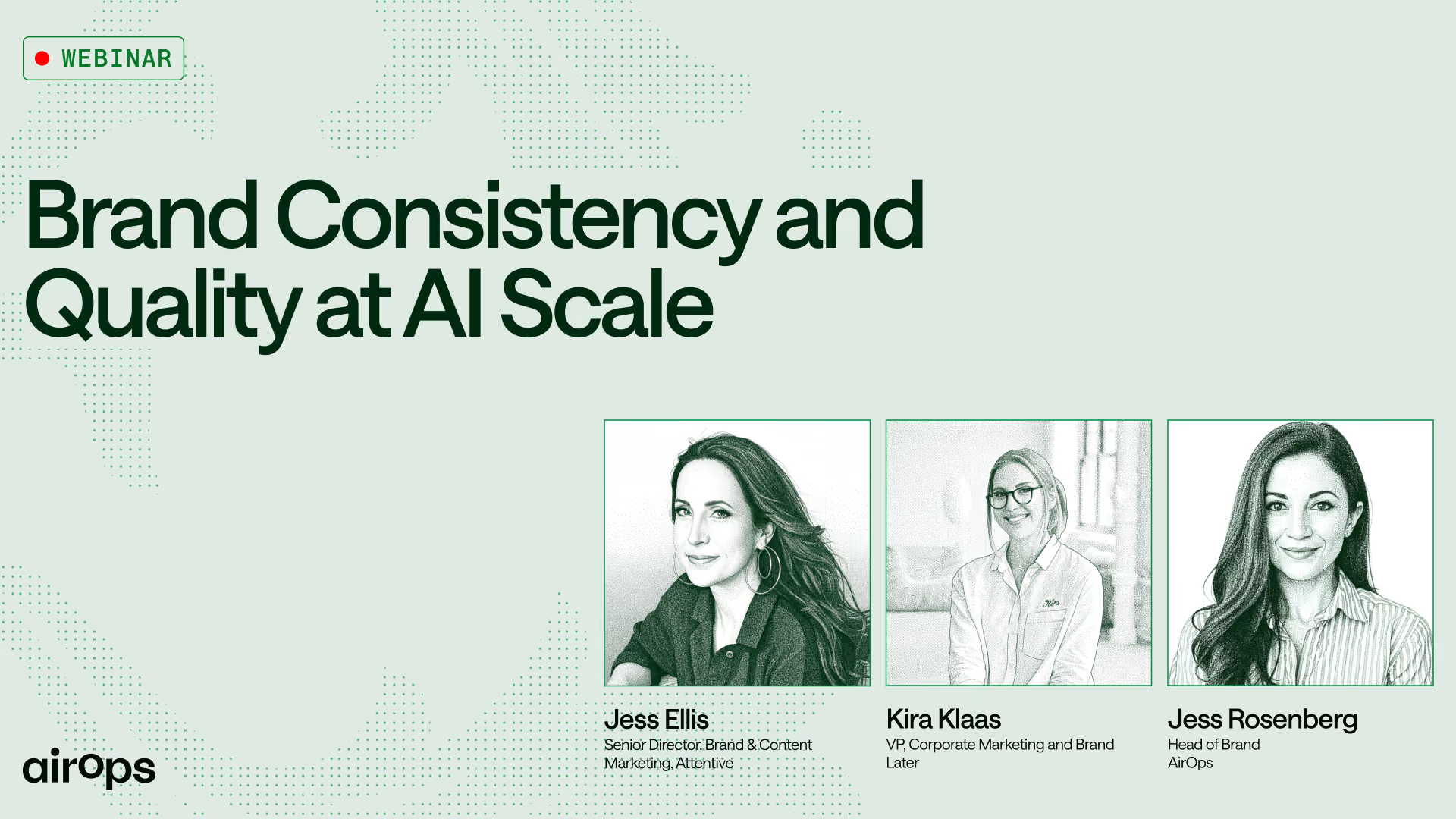
Jess Ellis (Attentive), Kira Klaas (Later), and Jess Rosenberg (AirOps) joined us for a panel on what it takes to scale content and brand production with AI without sacrificing quality. The conversation covered why brand matters more than ever when the cost of creation drops, how to build a culture of brand ownership across your org, and how to think in systems rather than one-off prompts while keeping human judgment at the center.
Top 5 takeaways
1. Brand is more important than ever
When the cost of creation drops to near zero, differentiation is the entire game. AI lowers the bar to participate, but it raises the bar to stand out.
2. Build brand culture, not brand police
Empower your org to create on-brand work through education, tools, and shared ownership. Clarity scales easier than control.
3. Consistency is the floor, not the ceiling
Build systems tight enough for production work to run predictably, then protect the space for your team to do the high-craft, high-strategy work that actually needs a human brain.
4. Taste at work is audience empathy
Creating with taste isn't about personal preference. It's about showing respect for your audience's time and intelligence with every output.
5. AI facilitates, you decide
Think in systems, not one-off prompts. But human judgment, discernment, and taste remain at the center of every decision.
Best practices and key learnings from the session
The panelists made one thing clear throughout: the principles of great brand work haven't changed, just the technology. What follows is a playbook for how brand leaders can adapt without losing what matters most.
Brand matters more when creation is cheap
Kira introduced the concept of brand-market fit: just as product-market fit measures whether your product solves a real need, brand-market fit measures how well the experience around your product connects with the people you serve. Multiple products can have the same product-market fit (Uber, Lyft, Waymo all get you from A to B), but they have very different brand-market fits. That's where loyalty gets created.
This becomes even more important as AI democratizes content creation. When anyone can publish at volume, originality, point of view, and authentic differentiation are what set you apart. As Jess Rosenberg put it: slop has always been around, but it's more visible now because AI has empowered so many people to create without the craft, taste, and quality bars that make outputs actually good.
Brand culture beats brand policing
All three panelists agreed: the phrase "brand police" needs to go. Instead of positioning the brand team as enforcers, the goal is to build a culture where people across the org feel like co-creators and stewards of the brand.
Jess Rosenberg described the ultimate North Star: when non-brand people start defending the brand the same way the brand team does. That comes from ownership and empowerment, not compliance. Show your partners what great brand outcomes look like, bring them along, and let them feel invested.
Jess Ellis reinforced this: clarity goes further than control. If you have a center of excellence or AI philosophy, keep building on it. If not, become a driver rather than a passenger. Set up a Slack channel, share inspiration, and work with your People and IT teams to push training forward.
Set AI principles that put your team first
Jess Ellis shared five principles her team at Attentive follows. They're simple enough to scale across any org.
.jpg)
Start your day with AI. Be curious and experiment in low-stakes ways. Share what you learn, including the failures. Remember that AI facilitates, but you decide. And build AI skills not just for efficiency today, but for how your role will evolve.
What's striking about this list is that none of it is new. As Jess pointed out, these would have been the right principles five or ten years ago. Same commitment to quality and ownership, just applied to new tools.
Consistency + taste: how they work together
Jess Rosenberg laid out a framework for thinking about brand quality as two layers that work in tandem, not in opposition.
.jpg)
Consistency is infrastructure. It's the system you build tight enough that production work (templates, one-pagers, data viz) runs predictably without pixel deviation. That's the floor, not the ceiling.
Taste is what you do with the room that consistency creates. Once production work isn't eating your team's time, you can redirect that energy toward the projects that actually need them.
The real failure isn't inconsistency. It's consistent mediocrity: a brand that's technically on-template but never produces anything genuinely exciting because the team never has space to think bigger.
What taste at work actually means
Kira pushed back on taste as a buzzword and offered a more grounded definition. Taste at work isn't about personal aesthetic preferences. It translates to deep empathy for your audience: making decisions that demonstrate respect for their time and intelligence.
Kira compared it to being a great party host: you make guests feel welcome, their needs are proactively met, and they want to come back.
When hiring for this world, Jess Rosenberg looks for three things: taste (can they tell the difference between good and great?), judgment under ambiguity (do they make good calls?), and a strong point of view.
From prompting to systems thinking
One of the biggest mindset shifts the panel discussed: getting away from the one-in, one-out prompting loop and starting to think more like an engineer. The key difference: you're not just getting a good output once, you're designing systems that reliably produce quality outputs while keeping a human at the wheel for decisions that require judgment.
.jpg)
At AirOps, the brand skill that Jess built in Claude earlier this year directly informed the visual Brand Kit feature in the platform. Now, instead of maintaining a separate skill, the team pulls brand context directly from AirOps via MCP. Anyone at the company working in Claude can create on-brand one-pagers, decks, and reports that pull from the correct voice, tone, and visual guidelines. Updates happen in one place and propagate everywhere.
Set rules of the road before you ship
Even with systems in place, the human layer matters. Jess Rosenberg shared the guidelines her team follows as they build with Claude Code and other AI tools.
.jpg)
The highlights: always ground outputs in your Brand Kit and positioning language. Always read things before publishing, because Claude is fast, not infallible. Don't publish vibe-coded microsites unless it's the only option. Document how to access and edit anything you build. You are responsible for every asset that goes out the door, whether AI wrote it or not. And mark things that are draft, FPO, or in progress as such.
As Jess put it: the principles have always been the same. Your name is on every asset that ships. That was true five years ago and it's true today.
Know where AI fits and where it doesn't
Kira shared a save/splurge framework that helps teams make clear decisions about where AI adds value and where it introduces risk.
.jpg)
Save (use AI): social and blog thumbnails, ad templates and size variations, background extensions, A/B test variants, placeholder content for mockups and internal pitches, and some B-roll imagery.
Splurge (keep human): hero campaign imagery that defines your brand, core product shots and brand assets, leadership and customer photography, any content where "real" is the value prop, and behind-the-scenes, creator, and influencer content.
This framework becomes especially useful when the team starts asking questions like "should we use AI to generate customer quotes or social proof?" The answer is almost always no for anything that needs to be authentic.
Jess Ellis also introduced a cut/create model: think about what you're doing with the time AI saves you. Don't just cut old tasks: reinvest that time into new workflows, new creative projects, and new enablement.
.jpg)
Start building
All three panelists emphasized learning by doing.
Jess Rosenberg's team learned Claude Code to build a custom slide generator, an infographic builder, and an asset generator that now handles production work for the entire marketing team. All built without engineers, in about two weeks, starting from a vibe coding hackathon.
Jess Ellis's creative director at Attentive built a custom brand photography generator in Lovable during their refresh. It lets the team control camera type, pose, styling, and scene direction to generate an ownable photo library.
The lesson: you don't need to start as an expert. Start with a problem you care about solving and patience to debug. Screenshot your errors, drop them into Claude, ask what's going wrong, and keep going. If the prototype solves a real pain, people will use it.
Rebranding: alignment beats tools
The panel tackled whether AI makes rebrands faster. The consensus: it can, but not for the reasons most people expect. Speed comes from alignment, not tools.
Jess Rosenberg shared that AirOps rebranded in 6 weeks, and no AI was used until the final week for generating employee headshots in a specific style. The rest was strategy, craft, research, and alignment with the CEO.
Kira reinforced this: what slows teams down is reconciling different opinions from different executives and stakeholders. At Brex, she navigated a rebrand with two co-CEOs, and the hardest part was reconciling both sets of opinions and identifying who the final decider was.
Tools the panelists recommend exploring
.jpg)
Chops, Claude + Claude Code, Cursor, Obsidian, Firecrawl, Anthropic's skills repo on GitHub, Lovable, Higgsfield, Eleven Labs, Figma Weave (formerly Weavy), Figma Make + Figma Buzz, Flora, AirOps, Google AI Studio, WisprFlow, and Descript.
Putting the insights into practice
The shift from AI experimentation to AI-powered brand operations doesn't require a massive overhaul. Start with one pain that keeps showing up on your team: a production bottleneck, a repetitive request type, or a quality gap that appears when you're not in the room.
Build a small proof of concept. Share it. Ask for feedback. If it sticks, expand. The panelists all agreed: the principles haven't changed. Direct, thoughtful, audience-first, consistent. What's changing is the infrastructure that helps those principles scale.
Final thoughts

As Kira said: all of our roles are changing, not just brand or marketing. Lean into the learning. Nobody has it all figured out. It's a universal moment of feeling behind and uncertain along with all the exciting potential, and you're entitled to change your mind as you go.
As Jess Ellis put it: clarity scales far easier than control. That doesn't mean overlooking off-brand work. It raises the standard. Brand guidance needs to be clear, available, and viable.
And as Jess Rosenberg said: just start somewhere, and let that somewhere lead you to the next experiment. Don't ask for permission. Be safe, be kind, bring people along, and the rest will fall into place. Brand Buddy over Brand Police.
How AirOps helps brand and creative teams scale on-brand content
AirOps helps teams turn brand guidelines into connected infrastructure that works across every AI tool in your stack. With Brand Kit, you can house your voice, tone, visual system, and proprietary knowledge in one place and pull it into Claude and other platforms via MCP. AirOps is the partner for this shift, bringing the platform, the media mix, and the team together, not just software to log into, and connects that work back to pipeline and revenue growth.
- Centralize your brand's voice, tone, and visual guidelines so every AI-generated output stays on brand.
- Connect your Brand Kit to Claude and other tools via MCP so your team creates on-brand assets where they already work.
- Update once, propagate everywhere: changes to your Brand Kit flow through to every tool and workflow that references it.
Want to see how Brand Kit can help your team scale on-brand content? Book a call.
Get the latest on AI content & marketing
