- AirOps connects AI search monitoring to content execution, publishing, and ROI measurement in one system.
- Peec provides clean AI search analytics at accessible pricing, but stops at monitoring with no workflows, governance, or CMS integrations.
- AirOps customers like Carta achieved 7x AI search citation increases and 75% citation rates on new pages.
- AirOps is the best AEO tool for enterprise teams
Your brand's visibility in AI search results determines whether buyers find you or your competitor first. ChatGPT, Gemini, Perplexity, and Google AI Overviews now answer the questions your content used to rank for.
AirOps, Profound, and Peec each approach AI search visibility differently. AirOps connects monitoring to execution. Profound leads with deep monitoring and is building toward execution. Peec focuses on analytics dashboards.
This comparison breaks down what each platform does, where it stops, and which one fits your team.
AirOps vs Profound vs Peec at a Glance
AirOps covers the widest surface area, from data collection through publishing. Profound goes deepest on monitoring with proprietary conversational data. Peec offers the fastest setup for teams that need analytics without operational complexity.
The right choice depends on whether your team needs a full operating system or a standalone dashboard.
AirOps vs Profound vs Peec: Platform Overview
AirOps is a full-loop AI search platform built around two connected parts: Insights and Action. Insights unifies Answer Engine Optimization (AEO) tracking in popular platforms like ChatGPT, Perplexity and Google AI Mode with Google Search Console (GSC), and Google Analytics 4 (GA4) data. Action provides Workflows, Grids, Power Agents, Brand Kits, and Knowledge Bases to turn insights into published, on-brand content across 30+ integrations and 7+ CMS connections. Quill is the agent captain that knows your brand and handles the execution for AI search.
Profound is a monitoring-first platform tracking brand visibility. Its standout asset is Prompt Volumes, a proprietary dataset from conversations showing which questions users ask AI assistants. Profound recently expanded into execution with Agents and Workflows, though these features are early in maturity. The platform holds #1 on G2 for AEO Software.
Peec is a monitoring-focused analytics tool tracking brand visibility across 7 AI platforms via UI scraping. It delivers clean dashboards, competitive benchmarking, and sentiment analysis. Peec does not offer workflow automation, content creation, brand governance, or CMS integrations. A beta "Actions" feature and Gap Analysis represent its first steps beyond monitoring.
Core Features: How AirOps, Profound, & Peec Stack Up
The question for your team: do you need a platform that shows you what to do, or one that helps you do it?
AirOps Features:
- Quill
- Quill monitors your AI visibility, executes the work to improve it, and learns from every result so every run gets sharper.
- Quill takes action from your Playbooks and routes the output for review.
- Helps teams automate repetitive production work, from briefs to drafts to published pages, while maintaining human oversight at critical stages
- No other platform in this comparison lets teams build and run end-to-end content workflows natively.
- Page360 Dashboard:
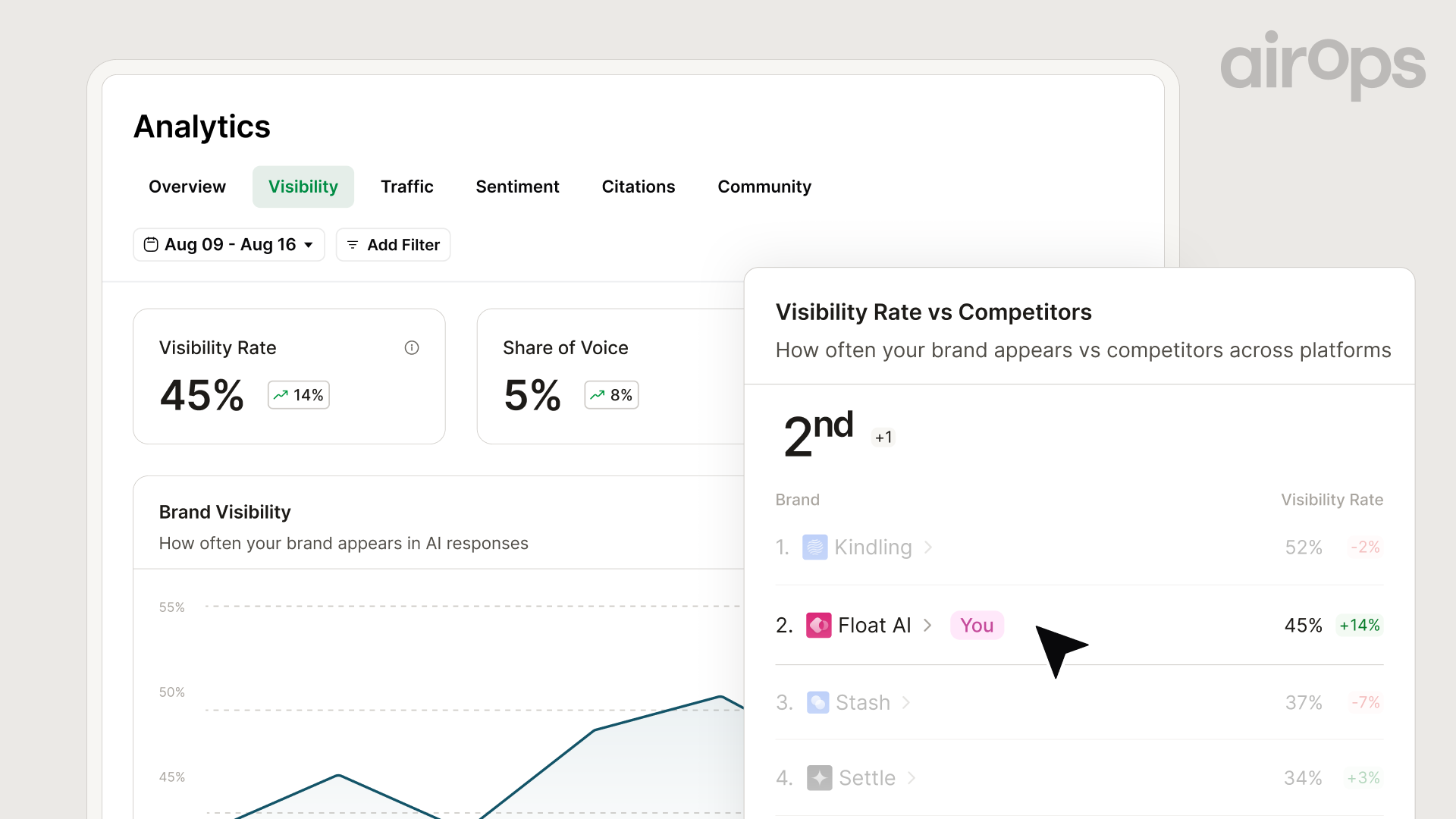
- Combines GSC, GA4, and LLM visibility tracking data into a single view with Smart Filters that surface high-priority pages ("Almost Page One," "Losing AI Visibility") and Bulk Actions that send pages to Grids or Workflows.
- Helps content directors identify which pages need attention and route them into production without switching tools or exporting spreadsheets.
- Matters because unified data eliminates the 15-25 hours/week teams spend cross-referencing separate dashboards to decide what to work on. Helps teams automate repetitive production work, from briefs to drafts to published pages, while maintaining human oversight at critical stages.
- Matters because no other platform in this comparison lets teams build and run end-to-end content workflows natively.
- Brand Kits & Knowledge Bases:
- Stores tone, rules, positioning, and reference data in a structured, AI-readable format with draft/publish versioning, accessible via MCP across Claude, ChatGPT, and Cursor.
- Helps teams enforce brand consistency automatically across every workflow and AI tool without manual review bottlenecks.
- Matters because governance at scale is what separates sustainable content operations from teams that trade quality for speed.
- Prompt Universe:
- Surfaces questions your customers actually ask across four real intent sources: SERP mining, ChatGPT Query Fanout, Perplexity Related Questions, and Voice of Customer data from Gong, Zendesk, and Intercom.
- Helps teams prioritize content around actual buyer questions rather than keyword guesses, directly informing AEO strategy.
- Matters because AI engines answer real questions, and teams optimizing for the right questions see faster citation results
Profound Features
- Multi-Engine AI Tracking:
- Covers AI platforms with filtering by provider, geography, persona, and date range for comprehensive visibility monitoring.
- Helps teams understand exactly where and how their brand appears across the broadest range of AI engines available.
- Matters because AI search is fragmented across engines, and coverage breadth determines whether teams have a complete visibility picture.
- Prompt Volumes:
- A proprietary dataset from 1.3 billion real AI conversations, showing which questions people ask AI engines with volume estimates. Available on Enterprise plans ($2-5K+/month).
- Helps teams make strategic decisions about which AI conversations to prioritize based on actual query demand, not synthetic estimates.
- Matters because no other platform offers real conversational volume data at this scale, making it genuinely unique competitive intelligence.
- Emerging Execution Features:
- Recently launched Agents and Workflows represent first steps toward closing the monitoring-to-action gap within the platform.
- Helps teams that already use Profound for monitoring begin acting on insights without switching tools entirely.
- Matters because the trajectory signals Profound's intent to become a fuller platform, though maturity will take time to develop.
Peec Features:
- AI Search Tracking:
- Monitors brand visibility across 7 AI platforms via UI scraping with a clean, accessible dashboard designed for fast orientation.
- Helps teams entering AEO for the first time see where their brand appears in AI search without a steep learning curve.
- Matters because 5/5 ease of use lowers the barrier for teams building their first AI visibility practice.
- Competitive Benchmarking:
- Compares AI visibility against competitors with trend tracking over time, surfacing share of voice shifts across AI engines.
- Helps teams demonstrate to leadership how their brand stacks up against competitors in AI search, supporting internal business cases.
- Matters because benchmark data is often the first step in securing budget for broader AEO investment.
- Sentiment Analysis & Gap Analysis:
- Surfaces how AI engines characterize your brand and identifies where competitor brands appear but yours does not. A beta "Actions" feature represents early moves toward actionability.
- Helps teams understand not just visibility but brand perception across AI platforms, and spot specific content gaps to address.
- Matters because understanding sentiment and gaps is the first step toward targeted content improvements, even if Peec does not automate those improvements.
AirOps teams move from data to published content inside one system. Profound teams monitor comprehensively and are beginning to act within the platform. Peec teams need external tools and manual processes, typically adding 15-25 hours of weekly effort.
Product Overview: AirOps vs Profound vs Peec
Each subsection compares all three platforms across the dimensions that matter most for enterprise content operations.
Data Layer
Data quality and breadth define the ceiling for every decision your team makes.
AirOps pulls from the widest set of sources among the three.
- Data Sources & Integrations: AirOps unifies GSC, GA4, and AEO data in Page360, with 30+ integrations spanning CMS platforms (Webflow, WordPress, Contentful, Sanity, Ghost, Strapi, Storyblok, Framer), project management (Asana, ClickUp, Monday.com, Airtable), and SEO data via DataForSEO and Semrush. Profound integrates with GSC and GA4 but does not connect to SEMrush, Ahrefs, Moz, data warehouses, or PM tools. Peec focuses on AI platform data from 7 engines and does not integrate with SEO tools, CMS platforms, or analytics suites.
- Data Accuracy & Freshness: AirOps Golden Prompts source from four real intent signals (SERP mining, ChatGPT Query Fanout, Perplexity Related Questions, Voice of Customer from Gong/Zendesk/Intercom), tracking actual user behavior rather than synthetic estimates. Profound's Prompt Volumes draws from 1.3 billion real conversations, a genuinely unique asset for understanding AI engine queries, though access requires Enterprise pricing at $2-5K+/month. Peec relies on UI scraping across 7 platforms, which captures surface-level results but may not reflect full variation in AI responses.
- Data Portability: AirOps data flows directly into Grids, Workflows, and CMS platforms. MCP connectivity makes data accessible in Claude, ChatGPT, and Cursor natively. Profound and Peec data live primarily within their dashboards, requiring manual export for use in other tools.
A unified data system reduces the time between seeing an opportunity and acting on it. Platforms where data flows into action without handoffs deliver the most value for large content operations.
Prioritization of Opportunities
Knowing what to fix first is harder than knowing what to fix. Prioritization separates platforms that surface data from those that surface decisions.
Your team's speed depends on how well the platform translates raw data into ranked priorities.
- Decision Engines & Scoring: AirOps Page360 uses Smart Filters to surface pages by priority: "Almost Page One," "Losing Clicks," "Losing AI Visibility," "Citation Rate Decline," and "Stale Pages," combining GSC, GA4, and AEO signals. Profound provides filtering and sorting across prompts and citations but does not blend traditional SEO and AI visibility signals into a unified scoring system. Peec offers Gap Analysis for competitive gaps, but prioritization is largely manual.
- AI-Powered Recommendations: AirOps generates prompt-level recommendations through its Opportunities Engine, connecting citation gaps to specific content actions and routing them into Workflows. Profound surfaces prompt-level data and is beginning to offer recommendations through emerging agent features. Peec's beta "Actions" feature is an early step; the platform currently relies on users to interpret analytics independently.
- Integration of Signals: AirOps combines SEO performance, AI citations, analytics, page freshness, and content publish tracking on a single timeline. Content Publish Tracking automatically overlays every update on Insights charts. Profound tracks AI signals across engines with strong per-provider granularity but does not merge these with SEO and analytics in a unified timeline. Peec tracks AI visibility without SEO or analytics integration, requiring cross-referencing with external tools.
Automated prioritization is the difference between a strategic content operation and a reactive one. The wider the signal set, the more confident your team is that it works on the right page at the right time.
Building & Automation
Monitoring tells you what's happening. Playbooks let you act on it. This is where the three platforms diverge most.
Workflow depth determines whether your team scales inside the platform or builds processes outside it.
- Playbooks and Workflow Capabilities & Flexibility: AirOps provides a visual, no-code builder chaining data sources, AI steps, Brand Kit context, Knowledge Base lookups, and Human Review checkpoints. Workflows handle briefs, drafts, refreshes, and AEO gap filling. Profound recently launched workflow features, though depth and range are still developing. Peec does not offer a workflow builder; teams need external tools for all content actions.
- Workflow Automation Features: AirOps runs fully automated workflows with scheduled triggers, bulk Grids operations, and direct CMS publishing. Agent-based playbooks offer templates. Peec does not offer automation. All actions require manual execution.
- Workflow Conditional Logic & Triggers: AirOps supports time-based scheduling, signal-based triggers (ranking drops, citation changes), and conditional routing with Human Review checkpoints at any stage. Profound is building trigger capabilities within its agent framework. Peec does not offer triggers or conditional logic.
- Ease of Building vs. Complexity of What Can Be Built: AirOps balances accessibility with depth: fork a Power Agent in minutes or build multi-step pipelines with custom logic. Profound's builder prioritizes accessibility as the feature set expands. Peec's 5/5 ease of use applies to monitoring, but the platform cannot support operational processes.
Teams producing 50+ pieces per month feel this gap every week. Chime reduced time per refresh from 45 minutes to 5 minutes (89% reduction) and tripled AI citations in four weeks using AirOps Workflows.
Workflow depth is the clearest dividing line between a monitoring tool and an operating system.
Context & Brand Control
AI content without governance is how brands lose trust. For enterprise content directors managing 5-20 person teams, governance is not optional.
Brand control depth determines whether your team scales quality alongside volume.
- Brand Voice & Governance Features: AirOps Brand Kits store tone, voice, rules, positioning, and visual identity in a structured, AI-readable format with draft/publish versioning, diff views, and approval workflows. Every workflow runs with Brand Kit context by default. Profound offers basic brand governance for monitoring, though without versioning, approvals, or scoped rule sets. Peec does not include brand governance; teams manage consistency through external processes.
- Knowledge Bases & Brand Kits: AirOps separates structured brand rules (Brand Kit) from reference datasets (Knowledge Bases), using semantic search to surface the right material at runtime. Brand Kit context is accessible via MCP across AI tools. Profound and Peec do not offer Knowledge Base or equivalent reference retrieval systems.
- Customization vs. Templates: AirOps provides modular Brand Kit dimensions (product lines, audiences, regions, content types) with scoped writing rules. Power Agent templates are forkable and fully customizable. Profound provides template-level customization for monitoring views. Peec offers dashboard customization but no content templates.
A 20-person team producing 100+ pieces per month cannot rely on manual brand review. Docebo cut production costs 50% while doubling velocity to 25 pages per month through AirOps Brand Kit governance.
Governance becomes the make-or-break capability as team size and content volume grow.
Integrations & Ecosystem
Integrations determine whether a platform fits your stack or creates a new silo.
Enterprise teams typically operate across 8-15 tools. Broader connectivity reduces handoffs.
AirOps Integrations:
- Webflow: Publish refreshed and new content directly from Workflows and Grids without manual CMS updates.
- WordPress: Push content to WordPress sites with metadata, keeping production inside one system.
- Contentful: Sync structured content to Contentful entries, supporting headless CMS architectures.
- Asana: Route content tasks from Workflows into Asana projects so production and project management stay connected.
- Semrush: Pull keyword and competitive data into Workflows via MCP for SEO-informed content decisions.
- Gong: Feed Voice of Customer data into Golden Prompts to surface the questions your buyers actually ask.
- Claude, ChatGPT, Cursor (MCP): Access Brand Kit context and Knowledge Bases natively inside AI tools your team already uses.
Profound Integrations:
- Google Search Console: Combine organic search data with AI visibility metrics for unified performance views.
- Google Analytics 4: Layer traffic data alongside AI citation tracking for broader impact analysis.
- Monitor visibility across AI platforms
Peec Integrations:
- 7 AI platforms: Track brand visibility via UI scraping across major AI search engines.
- CSV export: Download data for use in external tools and reporting systems.
AirOps connects to the widest ecosystem. Profound covers core analytics. Peec keeps its footprint minimal, simplifying setup but requiring more manual work.
For teams publishing directly from their content platform, CMS integration depth is the deciding factor.
Platform Depth & Scalability
A platform that works for 3 people may not work for 20. Scalability is about architecture, not promises.
Evaluate whether a tool can grow with your team over the next 12-24 months.
- Architectural Breadth & Depth: AirOps covers the full content lifecycle from monitoring through publishing and measurement, with AirOps Next extending into autonomous agents. Profound has deep monitoring roots and is investing in execution. Peec's architecture is purpose-built for analytics and does not extend into execution, governance, or publishing.
- Scalability Across Teams & Content Volume: AirOps Grids provide collaborative production with real-time editing, version history, and bulk operations. Webflow achieved 5x content refresh velocity on AirOps. Profound scales well for monitoring large prompt sets. Peec scales for monitoring workloads but does not address production-side scaling.
- Long-Term Extensibility & Future-Proofing: AirOps MCP connectivity extends the platform into any compatible tool without rebuilding integrations. Profound's proprietary conversational data gives it a foundation others cannot replicate. Peec's beta "Actions" may begin addressing the monitoring-to-action gap, though its architecture is optimized for analytics.
AirOps research shows content updated within 3 months is 3x more likely to be cited by AI engines. A platform that maintains that refresh cadence at scale protects long-term visibility.
The tools you choose now shape your team's capabilities for years.
AirOps vs Profound vs Peec: Out-of-the-Box Services & Solutions
Time-to-value matters as much as total capability.
Each platform approaches out-of-the-box readiness differently.
Peec wins on speed to first insight. Profound delivers monitoring value within days with unique Prompt Volumes intelligence. AirOps takes slightly longer to deploy fully but delivers value across monitoring and execution from the start.
AirOps vs Profound vs Peec: Support, Resources & Community
Platform capability means little without support infrastructure. Enterprise operations require onboarding, training, and support that match the work's complexity.
Each platform's support model reflects its target user.
Execution & Training
- Services, Implementation Support & Training: AirOps offers the Content Engineering Certification, Champions Program, and dedicated solution architecture for enterprise accounts. Profound provides tier-scaled onboarding support with growing training resources. Peec offers self-service documentation and email support.
- Managed Services vs. Self-Service Approaches: AirOps supports both: dedicated enterprise support and self-service access. Profound provides managed support on higher tiers. Peec is primarily self-service.
Ease of Use & Onboarding
- Onboarding Process: AirOps onboarding covers Brand Kit configuration, integrations, and workflow design (1-2 weeks full deployment). Profound focuses on AI engine tracking and prompt setup. Peec completes setup in under an hour.
- Ease of Use: AirOps earns 4/5, with Power Agents lowering the learning curve. Profound earns 4/5 with a well-designed monitoring interface. Peec earns 5/5 with its clean, focused dashboard.
Support & Resources
- Resources: AirOps provides documentation, workflow libraries, certification curriculum, and AEO research. Profound offers monitoring-focused documentation and research. Peec provides setup guides for its analytics features.
- Community: AirOps has a growing Content Engineer community through certification, Champions, and events. Profound's community is supported by its #1 G2 AEO ranking. Peec has an emerging user base among European teams entering AEO.
- Customer Support: AirOps provides tiered support with dedicated enterprise account management. Profound scales support by plan level. Peec offers email-based support.
AirOps vs Profound vs Peec: Pricing & Value Comparison
Total cost of ownership includes the tools and time needed to bridge gaps the platform does not cover.
Teams using Peec or Profound for monitoring still need separate tools for content creation, governance, automation, and CMS publishing. Those tools plus 15-25 hours/week of manual bridging work can exceed the cost of a unified platform. For 10+ person content teams, operational costs of acting on monitoring data in separate systems often dwarf subscription prices.
Real-World: When to Use Each Platform
The best platform depends on your team's current operations and growth trajectory.
These recommendations reflect the platforms as they exist in 2026.
AirOps
Workflow fit: AirOps fits teams producing 20+ pieces per month that need one system for monitoring, creation, governance, and publishing. Carta increased AI citations 7x, accelerated from 5 to 20 pieces per quarter, and achieved 75% citation rates on new pages with 3-day average time to citation.
Industry fit: B2B SaaS, fintech, HR tech, and enterprise technology at $50M+ revenue. Agencies managing multiple client brands benefit from multi-Brand Kit management.
Profound
Workflow fit: Profound fits teams that prioritize deep AI visibility intelligence across the widest range of engines. The Prompt Volumes dataset is valuable for strategic decisions about which AI conversations to prioritize. As execution features mature, operational coverage will broaden.
Industry fit: Large enterprises with dedicated AEO teams in competitive B2B markets. Well-suited for organizations with separate execution tools that want best-in-class monitoring.
Peec
Workflow fit: Peec fits teams entering the AEO space that need affordable visibility into AI search representation. Your team has existing production tools and wants to start tracking without a full platform commitment.
Industry fit: Mid-market companies exploring AI visibility, European organizations, and smaller content teams producing fewer than 20 pieces per month.
AirOps vs Profound vs Peec: Strengths & Limitations
AirOps
Strengths:
- Full-Loop Platform: Covers monitoring, prioritization, creation, governance, and publishing. No other tool in this comparison covers the complete lifecycle.
- Brand Kit Governance: Versioning, approvals, and MCP accessibility ensure on-brand content at scale across every AI tool your team uses.
- Integration Depth: 30+ integrations and 7+ CMS connections eliminate manual handoffs from insight to published page.
Limitations:
- Learning Curve: Broader feature set means a steeper initial learning curve, though Power Agents accelerate time-to-value.
- Deployment Time: Full deployment takes 1-2 weeks, longer than monitoring-only tools.
- Best for Established Teams: Best utilized by teams with established content operations; smaller teams may not use all capabilities.
Profound
Strengths:
- Engine Coverage: 10+ AI engine coverage with granular provider, geography, and persona filtering delivers comprehensive visibility.
Limitations:
- Execution Maturity: Execution features are recently launched and still developing; teams needing production-ready automation may need supplementary tools.
- Pricing: Entry pricing at $399-499/month is higher than alternatives; Prompt Volumes requires $2-5K+/month Enterprise plans.
- Integration Gaps: No connections to SEMrush, Ahrefs, Moz, data warehouses, or PM tools, which limits unified reporting.
Peec
Strengths:
- Ease of Use: 5/5 with a clean interface makes AI search analytics accessible to teams without AEO experience.
- Accessible Pricing: 85 euros/month entry pricing lowers the barrier for first-time AI visibility tracking.
- Fast Setup: Setup in under an hour means teams see data quickly with minimal configuration.
Limitations:
- No Execution Capabilities: No workflows, content creation, or CMS integrations; teams need 15-25 hours of weekly effort to act on data.
- No Governance: No brand governance features; consistency requires external processes.
- Data Method: UI scraping across 7 platforms may capture less response variation than API-based methods.
Bottom Line
AirOps covers the full loop from AI search insight to governed content to published page to measured ROI. Profound and Peec deliver monitoring value, but your team will outgrow monitoring-only tools the moment AI search becomes a performance channel.
Your choice comes down to where you are today and where you need to be in 12 months.
Choose AirOps if:
- Enterprise content or SEO team wants to close the loop between visibility and execution for AEO
- Your team produces 20+ pieces per month and needs one system for monitoring, creation, governance, and publishing.
- Brand consistency at scale requires structured governance that travels with your team across AI tools.
- You want to eliminate 15-25 hours of weekly manual work bridging monitoring to production.
Choose Profound if:
- Your team has existing production tools and needs monitoring to inform strategy.
- You can invest $2-5K+/month for Prompt Volumes access.
Choose Peec if:
- You're entering AEO for the first time and want affordable, fast-setup analytics.
- Your content team has fewer than 5 people and primarily needs benchmarking, not automation.
- You need dashboard-ready data to build an internal case for broader AEO investment.
Why Teams Choose AirOps
AirOps research shows 85% of top-of-funnel B2B brand mentions come from third-party content. Winning those mentions requires a system that connects citation intelligence to content action.
Webflow achieved 5x content refresh velocity and 40% organic traffic uplift on AirOps. AI-sourced signups grew from 2% to 10%, and AI search traffic converts at 6x the rate of traditional SEO. These results came from connecting Page360 insights to governed Workflows that refresh content on a consistent cadence. Parallel grew from 2% to 20% share of voice in 6 months by systematically identifying and filling citation gaps. Docebo cut production costs 50% while doubling velocity and adding 25% sessions from AI discovery.
These teams stopped treating AI search as a reporting channel and started treating it as an operational one. AirOps is the platform built for that shift. Ready to turn AI search data into published, on-brand content?
Book a call with our team to see how AirOps connects insights to execution.
Frequently Asked Questions
FAQs
What Is Answer Engine Optimization (AEO)?
AEO is the practice of optimizing content to appear in AI answers from ChatGPT, Gemini, Perplexity, Google AI Overviews, and more. It tracks citations, mentions, and brand visibility across AI search engines.
Can I Use AirOps and Profound Together?
Yes. Some teams use Profound's Prompt Volumes for strategic intelligence while running AirOps for execution, governance, and publishing.
How Does AirOps Track AI Search Citations?
AirOps tracks citations across ChatGPT, Claude, Perplexity, Gemini, and Google AI Overviews. Page360 combines citation data with GSC and GA4 metrics. Golden Prompts surface actual user questions from four intent sources.
What Is the Difference Between Monitoring and Execution?
Monitoring shows where your brand appears in AI search. Execution means creating, optimizing, and publishing content to improve that visibility. AirOps handles both. Profound focuses on monitoring with growing execution. Peec focuses on monitoring only.
How Much Does Each Platform Cost?
AirOps starts at $0/month (free tier) and scales to ~$200/month for Pro. Profound starts at $399-499/month. Peec starts at €85/month. Enterprise pricing is custom across all three.
Does AirOps Integrate With My CMS?
AirOps connects to 7+ CMS platforms: Webflow, WordPress, Contentful, Sanity, ContentStack, Ghost, Strapi, Storyblok, and Framer. Content publishes directly from Workflows and Grids.
How Long Does It Take to See Results?
Content updated within 3 months is 3x more likely to be cited (AirOps research). Chime tripled citations in 4 weeks. Carta averaged 3 days from publication to first citation. Results depend on content quality, domain authority, and update consistency.
Get the latest on AI content & marketing
