
Lashay Lewis joined Josh Spilker from AirOps to break down how bottom-of-funnel (BOFU) content drives AI search visibility and revenue.
They focused on what to publish first, how to structure pages for decision-stage readers, and how to prove impact when traffic feels less predictable. If you need a clear plan for "alternatives," "vs," integrations, and use-case pages, this recap gives you a practical starting point.
Top 5 takeaways
- BOFU pages are LLM fuel
BOFU queries force large language models (LLMs) to research externally, so strong BOFU pages win citations and recommendations. - Optimize for customers, not keyword scores
Customer-first clarity lifts conversions and helps LLMs connect your brand to specific needs. - Modularize product knowledge to scale nuance
Centralize sales language, pain points, and capabilities so every BOFU page stays consistent and accurate. - Lead with pains and go deep on features
Decision-stage readers want specifics, so map each feature to a real pain point and show proof with visuals. - Prove ROI with revenue attribution and narrative control
Tie pages to pipeline, highlight competitor gaps, and publish comparisons to control how the market talks about you.
Best practices and key learnings
AI search rewards content that helps someone choose, not content that tries to "rank." Use these learnings to build BOFU pages that convert humans and read clearly to LLMs.
Write BOFU pages for "grounded" AI answers
LLMs can answer definitions from memory, but they need outside sources to recommend tools. BOFU pages give AI something specific to cite when someone asks for "best," "vs," or "alternatives."
Decision-stage pages—alternatives, comparisons, and best-of lists—trigger citations and tool recommendations because they force AI systems to research externally. Treat BOFU content as a product choice guide, not an informational explainer. Add concrete details like pricing models, core capabilities, and who the tool fits so both AI and readers find clear selection signals.
Optimize for persona signals, not exact-match keywords
AI queries sound like real people describing a situation, not a two-word keyword. Your page needs to signal who the tool fits, what category it serves, and which pains it solves.
- Start intros with the persona and the problem ("For enterprise SEO teams that…"), then name the category and outcome.
- Mirror phrasing you hear in calls and tickets so your copy matches how people actually describe pains.
- Cover the same pain multiple ways so you capture "synonymous" phrasing without guessing one perfect query.
"AI is less about keywords, and more about persona." — Lashay Lewis
Build a modular product knowledge base before you draft pages
Most teams don't struggle with writing—they struggle with inputs. When Sales, Product, Marketing, and Customer Success keep knowledge in separate places, BOFU pages turn generic fast.
Create one source of truth for pains, benefits, features, capabilities, objections, and "current methods" prospects use today. Pull verbatim customer language from sales call transcripts and store it in a reusable doc or AI project. Keep the framework consistent so every new BOFU page keeps the same level of specificity.
"People don't have a bottom of funnel problem, they have an internal communication issue." — Lashay Lewis
Lead with pains, then go deep on features (with proof)
BOFU readers already understand the category and want help choosing. Give them the comparison context fast, then earn trust with depth: screenshots, GIFs, and clear capability explanations.
- Open with pain points or benefits, then place an inline CTA early while intent stays high.
- Map every feature to a pain ("This capability fixes X problem") and show evidence with visuals.
- Use FAQs that come from real prospect questions, not guessed questions.
Publish the highest-intent page types first
You don't need a massive library to see impact. Start with the formats that match active buying behavior, then expand into use cases and integrations once you nail your structure.
Start with alternatives pages when you need faster conversion feedback loops.
Add multi-competitor comparisons (up to 4 brands total) to enter existing demand conversations. Build integration and use-case pages that explain "how it works" step-by-step with clear outcomes.
Refresh BOFU pages on a schedule your team can actually keep
Old BOFU pages often rank but don't match how AI systems and buyers read today. A steady refresh cycle keeps claims accurate and protects performance as competitors update their pages.
- Refresh indexed, already-performing BOFU pages first to get faster impact.
- Set a baseline refresh cadence of 6–12 months, then adjust for your industry and product release pace.
- Treat major product updates as refresh triggers so your pages match reality.
Prove ROI with attribution and narrative control
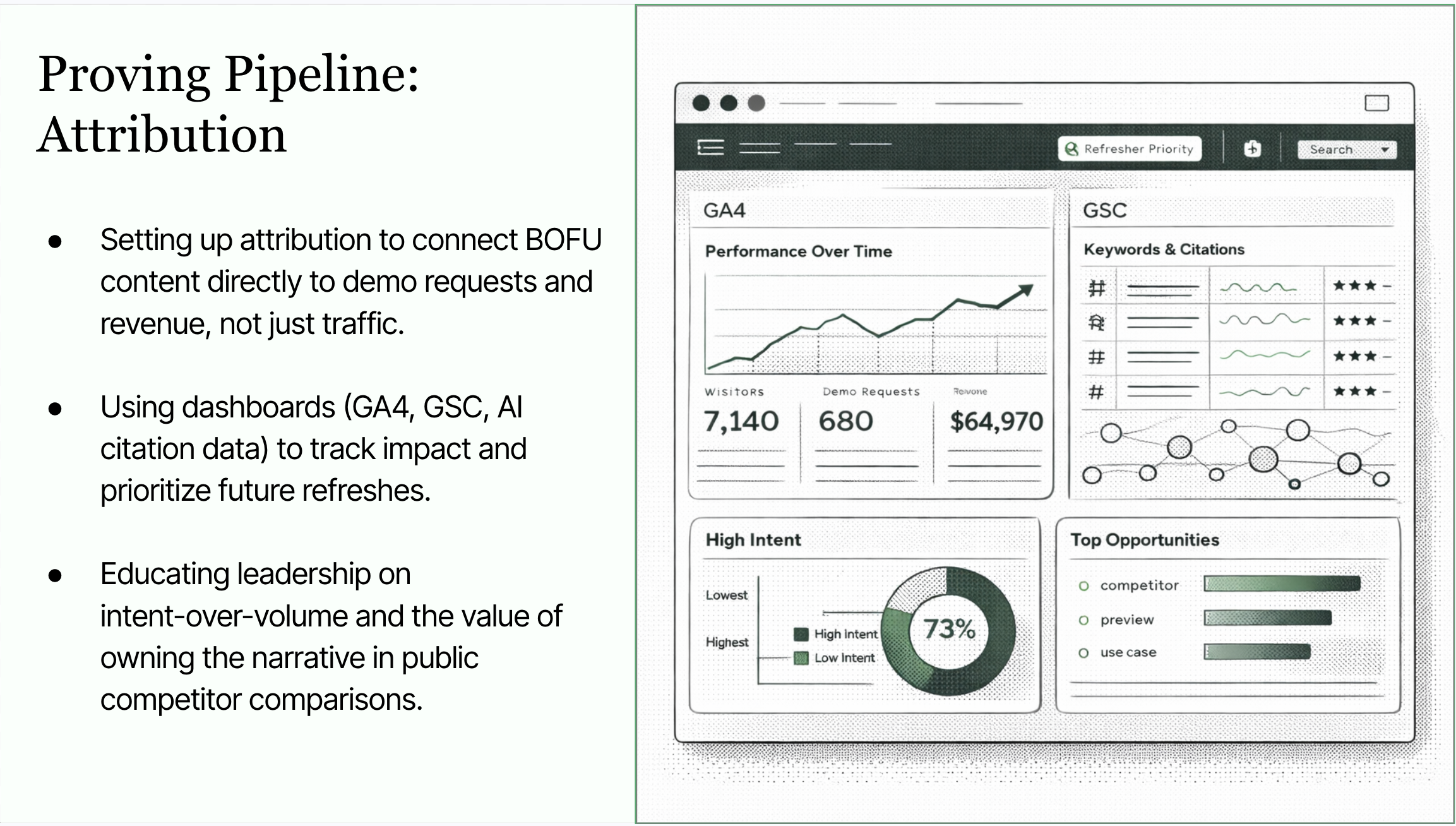
Leadership will ask for dollars, not "content vibes." Set up attribution, track which pages influence pipeline, and position BOFU as your way to control how buyers and AI describe you.
Track page to account to pipeline using tools like HubSpot, Leadfeeder, or Dreamdata.
"The best way to show executive leadership results is to… tie it to money." — Lashay Lewis
Adapt the framework for regulated industries without guessing
Regulated teams still need BOFU content, but they need clear internal guardrails. Treat compliance rules as inputs you store and reuse, not last-minute edits.
- Align early on what you can say (claims, outcomes, industries) and what legal/compliance won't allow.
- Store regulations as a reusable "rules" doc your writers and AI tools reference every time.
- Route drafts through the same review path so you keep speed without risk.
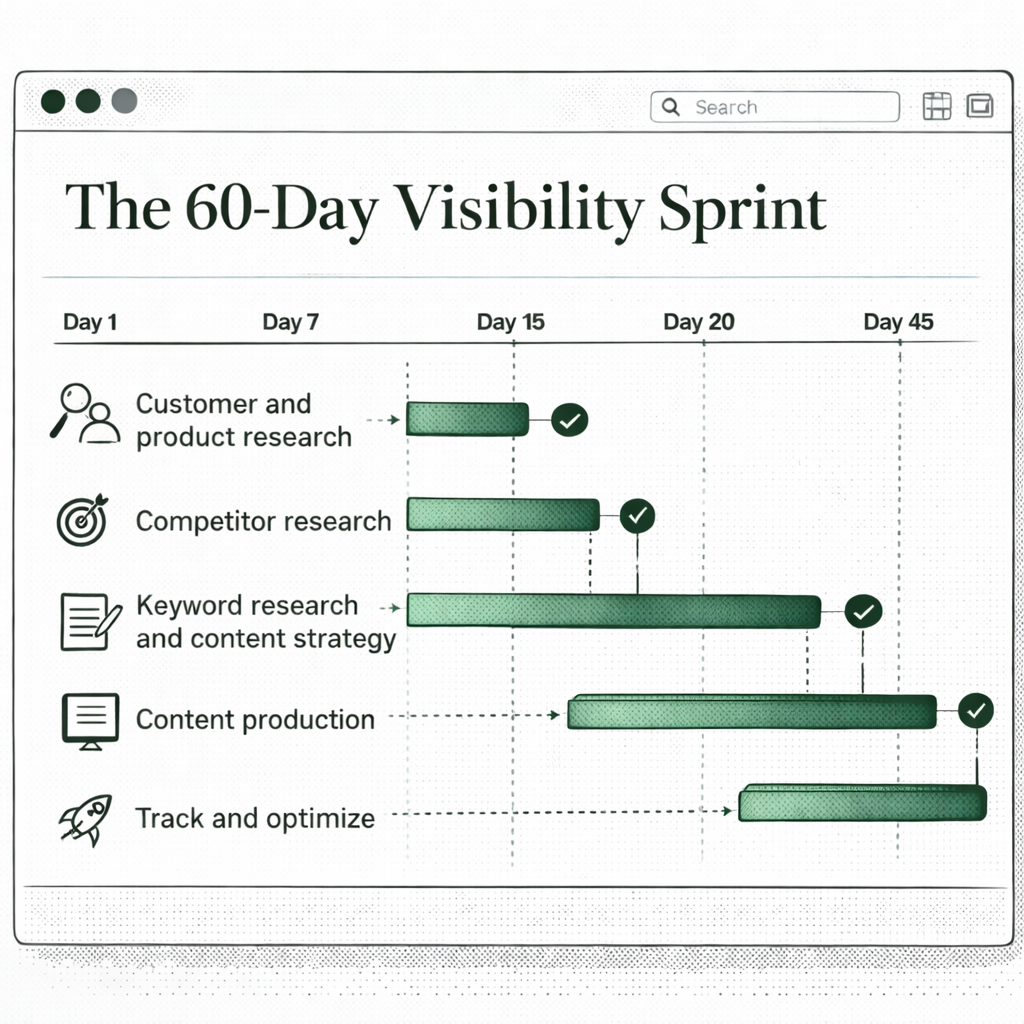
How to run a 60-day BOFU sprint for AI visibility
AI search puts more weight on decision-stage content because those queries require external research and citations. If you publish shallow pages or pages that talk past real pains, you won't earn trust from buyers or from LLMs.
Start with two weeks of research: mine sales calls, collect objections, and build a modular knowledge base that stays consistent across pages. Then publish the highest-intent formats first (alternatives, comparisons, integrations), measure pipeline influence with attribution, and refresh what you already rank for before you expand page count.
Final thoughts
BOFU pages help you show up where buying decisions happen, and they help you control how AI tools describe your category position. When you write for real pains, prove capabilities with depth, and tie pages to revenue, you give leadership a business case they can't ignore.
Want more for AEO and AI search?
How AirOps helps teams ship BOFU content that AI can cite
AirOps helps content and SEO teams turn BOFU content into a repeatable system instead of a one-off project. You can centralize product knowledge and customer language, generate consistent page drafts from your framework, and run refresh workflows that keep decision-stage pages accurate as your product and market change. Beyond the software, AirOps brings a team that builds the strategy alongside yours and runs it from owned content through the third-party sources AI already trusts, then ties the work back to pipeline and revenue.
Want to connect BOFU production to measurable outcomes like visibility, pipeline influence, and revenue? Book a call.
Get the latest on AI content & marketing
