AirOps vs seoClarity: Which AI Search Platform Closes the Execution Gap in 2026?
- AirOps is a Content Engineering platform that connects AI search insights to governed content creation, CMS publishing, and performance measurement inside one closed loop, giving your team a single system for the full content lifecycle.
- seoClarity is an enterprise Search Engine Optimization (SEO) intelligence platform with 18 years of search data depth and an optional Answer Engine Optimization (AEO) add-on, Clarity ArcAI, that monitors AI visibility across nine-plus engines.
- Content teams that need to act on AI search data and publish governed content at scale will get more from AirOps. Teams focused primarily on enterprise-grade rank tracking, technical SEO audits, and competitive intelligence across global markets will find seoClarity's data depth and analytical breadth hard to match.
- AirOps operates as the execution hub of your content stack, turning visibility gaps into published pages with brand governance built in. seoClarity functions as a monitoring and intelligence system that feeds into your team's separate production tools and reporting workflows.
Your content team already knows which pages need attention. The backlog of refreshes, new articles, and AI search gaps keeps growing, but the operational path from "we found the problem" to "we published the fix" still runs through five different tools and a dozen handoffs.
AirOps and seoClarity both address AI search visibility, but they approach the problem from opposite directions. AirOps connects insight to execution and measurement inside one platform. seoClarity provides deep search intelligence and AI visibility monitoring, then relies on your team to execute elsewhere.
This guide breaks down how both platforms handle features, architecture, pricing, and real-world workflows so you can decide which one fits your team's operating model.
AirOps vs seoClarity at a glance
AirOps gives your team a shorter path from identifying an AI search gap to publishing the content that closes it. seoClarity gives your team deep visibility into search performance across 190-plus countries and 32 billion keywords.
The core difference: AirOps measures what your content execution drives. seoClarity measures what your content execution should address.
AirOps vs seoClarity: platform overview
AirOps is a Content Engineering platform built around a closed loop: insight, action, and measurement that compounds over time. Your team sees how your brand shows up across AI search engines, takes action to improve it, and tracks what those actions drive. The platform's core value is operational: it connects AI visibility data to governed, published content.
seoClarity is an enterprise SEO intelligence platform with 18 years of search data depth and a growing AI visibility practice. Its core platform covers rank tracking, technical SEO, content optimization, and site auditing at scale. Clarity ArcAI, an optional add-on, extends monitoring to nine-plus AI search engines. seoClarity serves large enterprises including Samsung, Marriott, and Expedia.
Core features: how AirOps and seoClarity stack up
Both platforms offer strong capabilities, but their feature sets reflect fundamentally different priorities. AirOps builds for content execution and measurement. seoClarity builds for search intelligence and monitoring.

AirOps features:
- Quill
- Quill is AirOps' AI agent that runs Playbooks across content creation, refresh, brand monitoring, and AI search optimization. Your team sets the strategy. Quill runs the execution.
- Your team defines the process once, and Quill handles repetitive work across hundreds of pages.
- seoClarity's Content Fusion provides writing assistance but doesn't operate autonomously across multi-step workflows or report back against visibility metrics.
- Page360 unified view
- Page360 combines Search Engine Optimization metrics from Google Search Console (GSC), engagement data from Google Analytics 4 (GA4), and AI search citation signals in a single page-level view.
- Your team evaluates every page across traditional search and AI search without switching dashboards.
- seoClarity offers strong rank tracking, but AI visibility data lives in the separate ArcAI module, requiring movement between platform sections to connect signals to action.
- Prompt Discovery from four intent sources
- Prompt Discovery surfaces the actual questions buyers ask AI search engines by mining four intent sources: Search Engine Results Page (SERP) mining, ChatGPT fanouts, Perplexity questions, and Voice of Customer data.
- Your team builds content around real buyer intent rather than keyword proxies, increasing relevance in AI answers.
- seoClarity's Prompt Research tracks AI prompts but focuses on monitoring existing brand mentions rather than surfacing net-new intent from multiple buyer touchpoints.
- Grids for bulk operations
- Grids is a spreadsheet-style interface where each row can trigger a full content workflow, from SERP analysis to Content Management System (CMS) publishing.
- Your team runs operations across hundreds of pages in a single session, replacing weeks of manual work with a repeatable process.
- seoClarity's Research Grid supports data exploration and filtering but doesn't connect row-level actions to content creation or publishing.
- Brand Kits
- Brand Kits store your brand's voice guidelines, terminology rules, audience definitions, and product positioning as structured governance that every workflow references automatically.
- Content your workflows create stays on-brand without manual review of every draft, which matters at volume.
- seoClarity doesn't offer a centralized brand governance system. Content quality depends on manual review or separate tools outside the platform.
- AirOps MCP with 35+ tools
- AirOps MCP is a Model Context Protocol (MCP) server with 35-plus tools that reads, writes, creates, and publishes content across your stack from AI assistants like Claude.
- Your team manages content operations from their preferred AI interface without context-switching into the platform.
- seoClarity offers an MCP server for data querying, limited to pulling intelligence out rather than pushing content actions back in.
- Offsite
- Offsite helps your team manage third-party publisher placements and grow AI citation share across sources that Large Language Models (LLMs) reference when generating answers.
- Most brand discovery in AI search happens through third-party sources. Offsite builds the consensus LLMs look for between what you say about your brand and what others say.
- seoClarity's Pulse monitors web mentions but doesn't provide tools for actively building or managing offsite placements.
- Query Fan-outs
- Query Fan-outs reveal the sub-queries AI engines run behind each prompt, showing the full research path an LLM takes before generating an answer.
- Your team optimizes for the actual information-gathering behavior of AI engines, beyond the surface-level prompt a user types.
- seoClarity tracks AI prompts and sentiment but doesn't expose the intermediate sub-queries that shape how AI engines construct responses.
- Workflows
- Workflows is a visual builder for multi-step AI content pipelines that chains research, generation, governance checks, editorial review, and CMS publishing into repeatable sequences.
- Your team encodes its best content processes into systems that run consistently, regardless of who triggers them or how many pages need updating.
- seoClarity's ClarityAutomate handles technical SEO tasks like schema optimization and link building but doesn't support custom content production workflows.
- Closed-loop execution
- Closed-loop execution maps every content action to a visibility signal, so you can trace which refresh, new page, or offsite placement moved which metric.
- Your team proves content ROI with direct attribution rather than relying on quarterly traffic reports.
- seoClarity tracks performance changes over time, but connecting a specific action to a specific outcome requires manual correlation across separate modules.

seoClarity features:
- Rank Tracker at scale
- seoClarity's rank tracking covers 190-plus countries with access to over 32 billion keywords, providing daily visibility into search position changes globally.
- Enterprise teams managing multi-region SEO get a single source of truth for ranking performance.
- The keyword database depth is unmatched for teams whose primary need is tracking positions and competitor movement across markets.
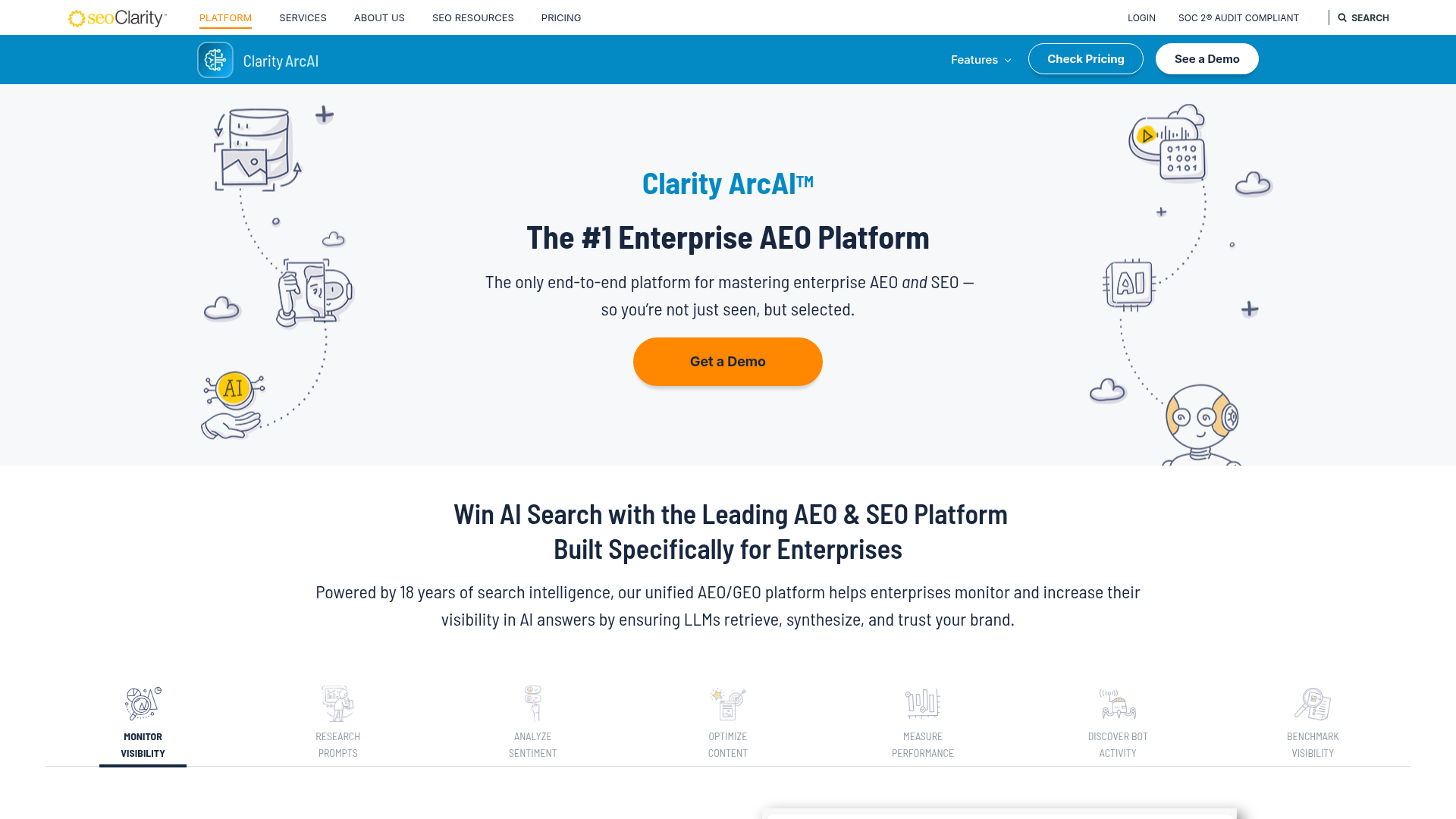
- Clarity ArcAI
- Clarity ArcAI monitors AI visibility across nine-plus engines, tracks prompt-level brand mentions and sentiment, and provides AEO content optimization recommendations.
- Teams see how their brand appears in AI-generated answers and where sentiment or citations trend down.
- ArcAI is an add-on with separate pricing, so teams pay extra for AI visibility on top of the core platform.
- ClarityAutomate
- ClarityAutomate handles technical SEO through Page Optimizer, Schema Optimizer, SEO Split Tester, Link Seeker, and Bot Optimizer for AI crawler management.
- Technical SEO teams automate schema markup, run A/B tests on SERP features, and manage AI bot access without custom code.
- These automations focus on technical SEO rather than content creation or publishing, so content teams still need separate execution tools.
- Content Fusion
- Content Fusion is seoClarity's AI writing assistant that generates recommendations, topic suggestions, and draft text based on SERP analysis.
- Writers get data-informed guidance on what to cover and how to structure content for visibility.
- Content Fusion operates as a writing aid rather than a production system, so editorial workflow, governance, and publishing happen separately.
- Research Grid
- Research Grid provides a spreadsheet-style interface for exploring keyword and ranking datasets with filters, custom views, and exports.
- SEO analysts slice data across device type, location, and SERP feature to surface patterns informing strategy.
- Research Grid is built for analysis rather than triggering downstream content actions or automation.
- Bot Optimizer
- Bot Optimizer manages how AI crawlers discover and index your content, giving you control over which pages AI engines can access.
- As AI search becomes a larger traffic source, controlling bot access becomes part of technical SEO hygiene.
- Bot Optimizer complements the ArcAI monitoring suite for teams investing in AI search visibility.
The practical split: AirOps helps your team monitor AI visibility, act on what the data shows, and measure what those actions drive. seoClarity helps your team monitor AI visibility and diagnose what needs attention, then your team executes using other tools.
Product architecture overview: AirOps vs seoClarity
AirOps is built as an execution platform that connects visibility signals to published content. seoClarity is built as an intelligence platform that feeds insights into your team's separate production workflow.
Data layer
Data sources and integrations: AirOps pulls from GSC, GA4, AI citation signals, and third-party SEO tools, unifying inputs in Page360's page-level view. seoClarity relies on its proprietary crawl infrastructure and 32 billion-keyword database, supplemented by GSC and GA4, with AI data available through the ArcAI add-on.
Data accuracy and freshness: AirOps combines first-party performance data with AI citation signals on a rolling basis. seoClarity refreshes ranking data daily across its global index, providing strong directional accuracy for competitive benchmarking.
Data portability: AirOps connects bidirectionally with CMS platforms, PM tools, and data systems. seoClarity supports exports, API access, and BI tool integrations, but data primarily flows out for analysis rather than back in for execution.
Prioritization of opportunities
Decision engines and scoring: AirOps categorizes content gaps into action types with impact scoring. seoClarity surfaces keyword opportunities with difficulty and volume metrics without prescribing a specific next action.
AI-powered recommendations: AirOps generates recommendations tied to executable workflows and can trigger refresh workflows automatically. seoClarity provides optimization recommendations through Content Fusion and ArcAI, but acting on them requires separate production tools.
Integration of signals: AirOps merges AI citation rates, mention frequency, organic traffic, and content freshness into a single prioritization view. seoClarity combines ranking data, search volume, and AI visibility metrics, though AI signals require the separate ArcAI add-on.
Workflow building and automation
Workflow builder capabilities and flexibility: AirOps provides a visual workflow builder for custom multi-step pipelines. seoClarity's ClarityAutomate offers preconfigured technical SEO tools rather than a general-purpose content workflow builder.
Workflow automation features: AirOps automates research, brief generation, drafting, governance checks, editorial routing, CMS publishing, and measurement. seoClarity automates technical SEO tasks like schema deployment and bot access management.
Workflow conditional logic and triggers: AirOps supports conditional logic, performance-based triggers, and scheduled execution across large page sets. seoClarity provides monitoring alerts, but those don't trigger automated content actions.
Ease of building vs. complexity of what can be built: AirOps balances accessibility with depth through Grids for simple operations and Workflows for complex pipelines. seoClarity's automation tools are straightforward but limited to predefined technical SEO use cases.

Governance, context, and brand control
Brand voice and governance features: AirOps enforces tone, terminology, and editorial rules at the system level through Brand Kits that every workflow references automatically. seoClarity doesn't include a centralized brand governance system.
Knowledge Bases and Brand Kits: AirOps lets your team upload proprietary data into Knowledge Bases for semantic search and store voice guidelines in Brand Kits as structured rules. seoClarity's content tools rely on SERP data and competitive benchmarks rather than proprietary brand context.
Customization vs. templates: AirOps supports deep customization across brands, teams, and content types. seoClarity provides template-driven content recommendations through Content Fusion with less flexibility for multi-brand operations.
Integrations and ecosystem
AirOps integrations focus on bidirectional content execution. seoClarity integrations focus on data export and analytical reporting.
AirOps integrations:
- CMS: Your content team publishes directly to Webflow, WordPress, Contentful, Shopify, Ghost, Sanity, Strapi, Storyblok, and Framer from Workflows and Grids without switching tools.
- SEO research: Semrush, Ahrefs, Moz, and DataForSEO feed keyword and backlink data directly into content workflows.
- Project management: Notion, Airtable, Asana, monday.com, ClickUp, and Wrike keep content operations visible across your team.
- MCP: The AirOps MCP server with 35-plus tools brings full platform capabilities into AI assistants like Claude.
seoClarity integrations:
- Analytics: GSC, GA4, and Adobe Analytics feed search performance data into seoClarity's reporting dashboards.
- Business intelligence (BI): Looker, Tableau, BigQuery, and Snowflake connections let enterprise teams build custom reporting views.
- MCP: seoClarity's MCP server provides data querying for AI assistants, focused on pulling intelligence out rather than pushing content actions back in.
AirOps connects your content stack end to end. seoClarity connects your analytics stack for deeper reporting.
Platform depth and scalability
Architectural breadth and depth: AirOps covers the full content lifecycle from insight through execution and measurement. seoClarity covers the full SEO intelligence lifecycle from crawling through analysis, with optional add-ons for AI visibility and technical automation.
Scalability across teams and content volume: AirOps includes unlimited seats on paid plans for cross-functional teams. seoClarity's enterprise pricing scales with data volume, which works well for dedicated SEO teams but can limit broader adoption.
Long-term extensibility and future-proofing: AirOps adds AI engine support, CMS connectors, and workflow capabilities as AI search evolves. seoClarity's 18-year data foundation provides stability, with ArcAI representing its AI search investment.

AirOps vs seoClarity: out-of-the-box services and solutions
AirOps provides ready-to-use execution workflows that your team can deploy on day one. seoClarity provides deep intelligence tools that require your team to build execution processes around them.
AirOps compresses the gap between platform onboarding and measurable content output. seoClarity delivers intelligence value quickly, but the path to content execution depends on how fast your team connects that intelligence to separate production tools.
AirOps vs seoClarity: support, resources, and community
Execution and training
Implementation support and training: AirOps provides onboarding support, workflow configuration, and Content Engineering Certification. seoClarity assigns a dedicated Client Success Manager and Value Enablement Manager, earning a G2 support rating of 9.5/10.
Managed services vs. self-service: AirOps balances self-service workflow building with hands-on enterprise support. seoClarity leans toward high-touch managed support with dedicated team members guiding adoption.
Ease of use and onboarding
Onboarding process: AirOps' Grids provide a familiar spreadsheet entry point, and pre-built Playbooks reduce setup time. seoClarity's onboarding benefits from dedicated success management but involves learning multiple modules and add-ons.
Ease of use: AirOps is built for content and marketing teams who need operational tools. seoClarity is built for SEO professionals comfortable with large datasets and technical configurations.
Support and resources
Resources: AirOps offers documentation, an academy, and the Content Engineering community. seoClarity provides a knowledge base, webinars, and research reports backed by 18 years of thought leadership.
Community: AirOps invests in the Content Engineering community for peer learning. seoClarity engages enterprise customers through events and dedicated account relationships.
Customer support: AirOps offers in-platform support, Slack channels, and dedicated enterprise teams. seoClarity provides Client Success Managers, email support, and enterprise Service Level Agreements (SLAs).
AirOps vs seoClarity: pricing and value comparison
Total cost of ownership is where these platforms diverge most. AirOps includes content execution, governance, and CMS publishing in the core platform. seoClarity's base pricing covers SEO intelligence, but AI visibility (ArcAI) and technical automation (ClarityAutomate) are separate add-ons. Factor in the content production tools seoClarity teams still need, and the total stack cost can narrow or reverse depending on your volume.
Real-world: when to use each platform
AirOps and seoClarity serve different operational needs. The right choice depends on where your team's bottleneck sits: execution or intelligence.
AirOps
Workflow fit: AirOps fits teams managing ongoing content programs across hundreds of pages where the bottleneck is getting work shipped, not finding work to do.
Industry fit: SaaS, e-commerce, fintech, and publishing organizations that rely on AI search as a growth channel. Carta achieved 7x AI search citations, Docebo built a 25% share of voice lead, and Chime reached 3x AI citations using AirOps.
seoClarity
Workflow fit: seoClarity fits teams that need large-scale rank tracking, technical SEO auditing, and competitive benchmarking across global markets.
Industry fit: Large enterprises in travel, hospitality, retail, and technology managing SEO across multiple regions. Samsung, Marriott, and Expedia use seoClarity's data depth to track performance at scale.
AirOps vs seoClarity: strengths and limitations
AirOps
Strengths:
- Full-cycle attribution: AirOps ties every content action to a measurable outcome inside a single system, so your team traces which change moved which metric without manual correlation.
- Brand governance at scale: Brand Kits and Knowledge Bases ensure content your workflows create stays on-brand, even at volume across multiple content types and audiences.
- Unified performance view: Page360 unifies GSC, GA4, and AI citation data so your team prioritizes based on complete signals rather than partial pictures.
Limitations:
- Setup investment: Teams configure Brand Kits, Knowledge Bases, and workflows before reaching full velocity. That investment pays off at scale but adds time upfront.
- Traditional SEO data depth: AirOps relies on connected tools like Semrush and Ahrefs for backlink and keyword data rather than a proprietary crawl index.
- Platform maturity: As a newer platform, AirOps has a smaller educational library compared to seoClarity's 18 years of thought leadership.
seoClarity
Strengths:
- Search data depth: 18 years of search intelligence, 32 billion-plus keywords, and 190-plus country coverage make seoClarity one of the deepest SEO datasets available for global programs.
- Technical SEO automation: ClarityAutomate's schema optimization, split testing, and bot management give technical teams hands-on automation that other platforms leave manual.
- Enterprise support quality: A G2 rating of 9.5/10 reflects seoClarity's dedicated Client Success Manager and Value Enablement Manager model.
Limitations:
- Execution gap: seoClarity identifies what needs attention but doesn't provide content creation, editorial workflow, or CMS publishing. Your team still needs separate tools to execute.
- Add-on pricing: AI visibility (ArcAI) and technical automation (ClarityAutomate) are separate add-ons, so the full-featured platform costs significantly more than the base tier suggests.
- Content team accessibility: The platform is built for SEO analysts and technical practitioners. Content directors may find the interface more complex than their workflow requires.
Bottom line
AirOps is the stronger choice for content teams that need to act on AI search data and publish governed content at scale. seoClarity is the stronger choice for enterprise SEO teams that need deep search intelligence and technical automation across global markets.
Choose AirOps if:
- Your team is responsible for both identifying AI search gaps and publishing the content that closes them.
- You need brand governance built into your content production system, not bolted on after the fact.
- You want a single platform that connects visibility signals to published content and tracks what those actions drive.
Choose seoClarity if:
- Your primary need is enterprise-grade rank tracking and competitive intelligence across 190-plus countries.
- Your technical SEO team needs automation for schema optimization, bot management, and split testing.
- Your organization separates search intelligence from content execution across dedicated teams with different tool stacks.
Why teams choose AirOps
AirOps wins this comparison for teams whose bottleneck is execution, not intelligence. seoClarity gives you 18 years of search data depth, but your content team still needs separate tools to move from that data to published pages.
Carta achieved 7x AI search citations by connecting AirOps' insights directly to content execution. Docebo built a 25% share of voice lead while cutting production costs by 50%, with AI discovery sessions up 25% on ChatGPT and Gemini. These results come from running the full loop inside one platform.
Content directors managing teams of five to 20 people already know they need AI search intelligence. The gap is having an operational system to act on it fast enough to move metrics. AirOps closes that gap.
Book a call to see how AirOps turns AI search visibility into content your team can publish at scale.
Frequently Asked Questions
FAQs
What's the difference between an AEO analytics platform and an AEO execution platform?
An AEO analytics platform monitors how your brand appears in AI-generated answers: citation rate, mention frequency, sentiment. An AEO execution platform does that and provides tools to create content, govern brand consistency, publish to your CMS, and measure results. AirOps covers both. seoClarity's ArcAI covers analytics.
Does seoClarity offer direct CMS publishing?
AirOps publishes directly to nine CMS platforms including WordPress, Webflow, Contentful, and Shopify. seoClarity's ClarityAutomate handles technical SEO tasks like schema deployment and bot optimization, but content publishing happens outside the platform.
How much does seoClarity cost compared to AirOps?
AirOps starts at $0/mo (Solo, 20K tasks), with Pro at 75K tasks and unlimited seats. Enterprise pricing is custom. seoClarity starts at $2,500/mo for Research and Content, with Technical SEO at $3,200/mo and Enterprise at $4,500/mo. ArcAI and ClarityAutomate are additional add-ons with undisclosed pricing.
Can AI search optimization tools work alongside existing SEO stacks?
Yes. AirOps integrates with Semrush, Ahrefs, Moz, and DataForSEO, so your team keeps existing SEO tools while adding execution capability. seoClarity functions as a standalone platform or complements other tools through API access and BI integrations.
Which platforms track AI visibility and publish content in one tool?
AirOps tracks AI visibility through Insights and Page360, then connects those signals to content creation, governance, and CMS publishing through Workflows, Grids, and Quill. seoClarity tracks AI visibility through ArcAI but doesn't include content production or CMS publishing. Teams using seoClarity still need separate tools for execution.
Is seoClarity worth it for mid-size teams or only Fortune 500?
seoClarity is built for enterprise organizations with large-scale SEO programs. Its $2,500/mo entry point reflects that. Mid-size teams with five to 20 people who need both intelligence and execution may find better value in AirOps, which includes unlimited seats and starts with a free tier.
How do enterprise teams scale content refreshes based on AI search data?
AirOps lets your team identify pages losing AI citations through Page360, prioritize by impact, and trigger refresh workflows through Grids that handle research, generation, governance, and publishing automatically. seoClarity identifies pages needing attention through rank tracking and ArcAI, but your team handles the refresh process through separate tools.
Get the latest on AI content & marketing
