- Profound helps teams track where and how their brand appears inside AI-generated answers
- Many teams outgrow visibility-only tools once they need to update and ship content based on those insights
- As AI search scales, content execution and automation drive real gains in citations and mentions
- AI-native platforms support repeatable content updates across large libraries and teams
- The right alternative depends on whether your priority is measuring AI visibility or acting on it
Profound is an AI search visibility platform that helps brands understand how they appear in AI search engines like ChatGPT, Perplexity, Claude, and Google's AI Overviews. As Answer Engine Optimization (AEO) becomes a top priority for content teams, Profound has emerged as an early tool focused on AI Search visibility.
Over time, many teams start evaluating Profound alternatives and Profound competitors as their needs change.
AirOps differs from Profound by connecting AI search visibility data to content execution workflows within one governed platform.
Common reasons include pricing constraints, limited flexibility beyond tracking, missing automation, or the need to support execution across larger teams and content libraries. Teams comparing Profound alternative software weigh these tradeoffs against budget and scale.
This article covers a range of Profound AI alternatives, from analytics-first AEO tools to AI-native platforms built for execution. Rather than naming a single "best" option, the goal is to help you choose the right tool based on team size, technical maturity, and how you plan to operationalize AI search over the next few years.
What is Profound?
Profound is a specialized platform focused on AI search visibility tracking. Its core purpose is to show brands how often, where, and in what context they appear inside AI-generated answers. Profound LLM visibility tracking spans ChatGPT, Perplexity, and Google's AI Overviews.
What Profound does well
- Tracks brand citations and mentions across AI engines
- Reports visibility metrics for AI-generated answers
- Shows competitive presence in AI search responses
Core features
- AI citation tracking across multiple LLM platforms
- Brand mention monitoring in AI responses
- Competitive analysis for AI visibility
- GEO (Generative Engine Optimization) recommendations
- Performance reporting and analytics
Who it's for: Marketing teams, SEO professionals, and content strategists who want visibility into how their brand performs inside AI-generated answers.
Profound excels at answering what is happening in AI search. It doesn't attempt to handle how teams create, update, or ship content in response. Most teams pair it with other tools to act on the insights.
Why teams look for Profound alternatives
Teams typically explore alternatives for a few practical, non-overlapping reasons:
- They want to move from insight to action: Dashboards show what's happening, but they don't update content. Teams increasingly want tools that deliver actions, not just tracking, helping them refresh and ship content based on AI visibility data.
- They need automation that scales: Visibility tracking does not rewrite sections, manage large content libraries, or support repeatable updates. As AI search becomes operational, execution carries more weight.
- Collaboration becomes a bottleneck: As teams grow, they need shared systems for review, approval, and repeatable processes.
- Their scope expands beyond monitoring: Many teams want one platform to support research, creation, optimization, and refresh.
- Cost and ROI need to align: As budgets shift, teams reassess tools that solve only one narrow problem. By 2026, a growing share of SEO budgets will move toward AI search optimization, which increases pressure to show downstream impact.
Execution matters because visibility depends on signals beyond your own site. AirOps research on offsite signals in AI search shows that up to 85% of AI search influence comes from content you do not own, so the strongest Profound alternatives help you act on that data, not just read it.
What to look for in a Profound alternative
Strong Profound AEO alternatives share a few traits. Use this checklist to compare options against how your team plans to operationalize AI search.
Region-based prompts and reporting: test how answers change by country and language, then report visibility per market.
Tracking AI search mentions: monitor brand mentions and citations across ChatGPT, Perplexity, and Gemini in one view.
Brand benchmarking across LLMs: compare your citation rate and share of voice against named competitors.
Content production and refresh: turn visibility gaps into shipped updates, so alternatives that include content production carry more weight than tracking alone.
Enterprise-grade controls: governance, approvals, and scale for teams running GEO across large content libraries.
Tracking citations and mentions together: monitor both signals, since AirOps research shows brands earning a citation and a mention are 40% more likely to resurface in AI answers than citation-only brands.
What tools are simliar to Profound?
These Profound AI competitors fall into four broad categories: AI execution platforms, analytics-first AEO tools, enterprise SEO platforms adding AI visibility, and page-level optimization tools.
1. AirOps: Best for enterprise AEO and GEO analytics and action
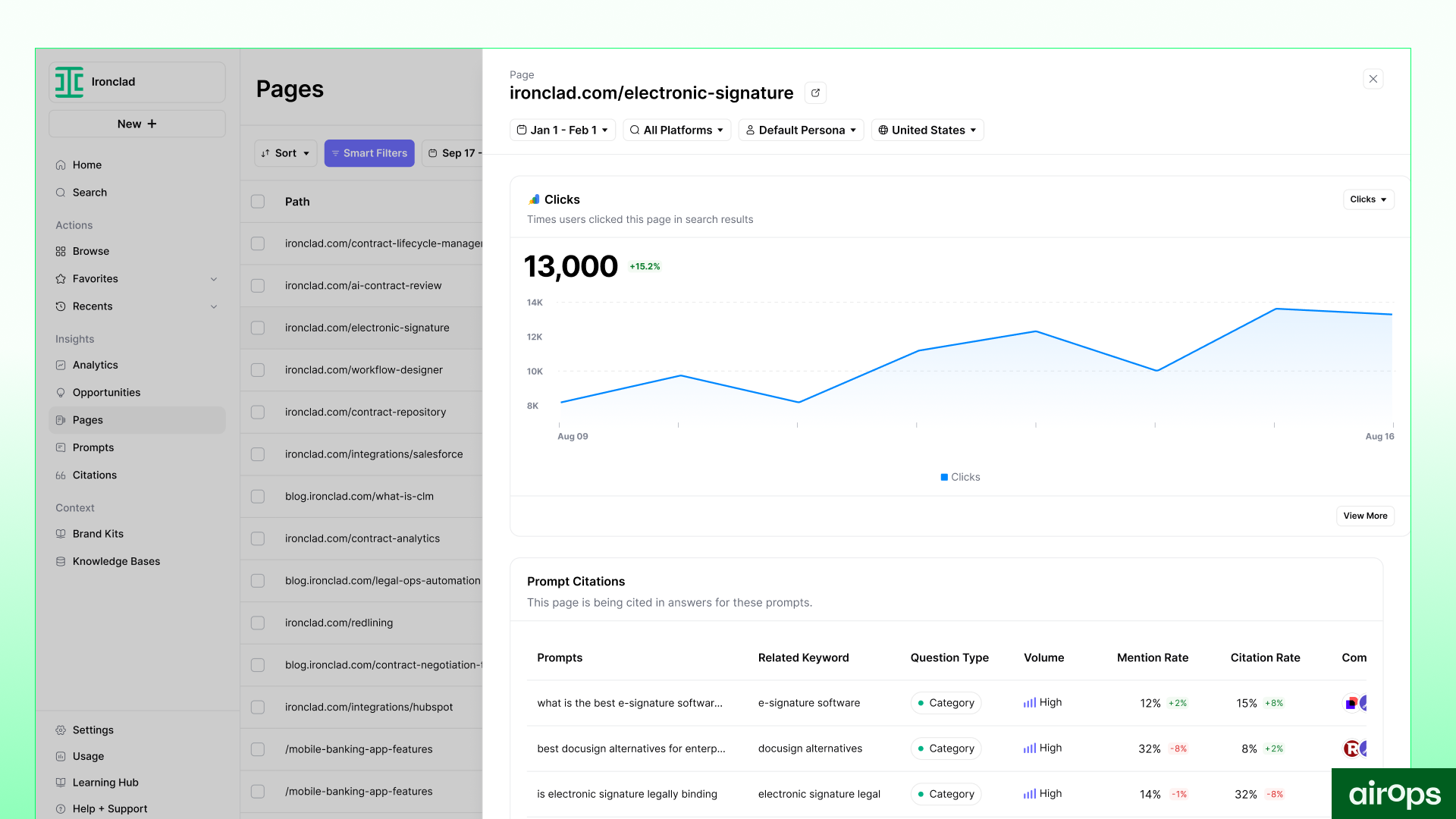
AirOps is built for teams that want to act on AI search insights, not just monitor them. While Profound focuses on where brands appear inside AI-generated answers, AirOps focuses on what teams do next, like updating content, managing large libraries, and shipping improvements at scale. Instead of thinking of AI search as a reporting function, AirOps treats it as an operational input. Teams use AI visibility data alongside SEO and performance metrics to prioritize work, update content, and maintain quality across thousands of pages with humans in the loop.
AirOps is the partner for this shift, bringing the platform, the media mix, and a hands-on team together to build and run the work alongside your team, tied back to pipeline and revenue growth.
Best for
Content operations leaders, growth teams, and technical SEOs who want AI embedded across the full content lifecycle.
Key capabilities
- Enterprise-grade AI visibility platform and end-to-end system of action for AI search
- Page360 analytics: Page-level view that combines AI citations, Google Search Console data, and GA4 performance to guide prioritization
- Bulk execution (Grids): Update hundreds or thousands of pages at once using structured, spreadsheet-style controls
- Configurable pipelines: Multi-step content processes that support review, approval, and direct CMS publishing
- Brand governance: Centralized brand voice, product knowledge, and proprietary context applied consistently across outputs
- Model and cost control: Support for multiple LLMs with direct control over usage and spend
- Quill: AirOps' AI agent captain runs content refresh and AEO Playbooks, routes work for human review, and reports impact against the metrics your team wants to move
.png)
Pros
- Connects AI search visibility directly to content updates
- Designed for large content libraries and multi-team collaboration
- Supports repeatable, systemized content operations
Cons
- More powerful than monitoring-only tools
- Requires upfront system design and setup
- Not intended for single-page or ad hoc use cases
Pricing
- Solo: Sales-led pricing
- Pro: Custom pricing
- Enterprise: Custom pricing
Learn more about how AirOps and Profound compare here.
2. Scrunch: Best for technical AI visibility and delivery control
Scrunch is an AI search visibility and delivery platform designed to help teams monitor how brands appear in AI-generated answers and measure real AI-driven traffic. It combines prompt-level visibility tracking with a technical delivery layer (AXP) that helps ensure content is accessible to AI systems. Scrunch is analytics- and diagnostics-first, focused on understanding where and why brands appear in AI search, rather than orchestrating the creation, refresh, or publishing of content based on those insights.
Best for
SEO and AEO analysts at technically mature organizations who want strong visibility into AI search performance, prompt behavior, and AI-attributed traffic.
Key features
- AI citation and mention tracking across major AI engines
- Prompt-level visibility analysis for AI-generated answers
- Answer Experience Platform (AXP) for AI crawler delivery control
- Bulk prompt management (uploading, tagging, editing)
- Enterprise access controls with RBAC and SSO
Pros
- Strong AI search monitoring and diagnostics capabilities
- Clear visibility into how prompts, personas, and regions affect AI answers
- Direct control over AI crawler delivery
- Clear attribution for AI-related traffic
Cons
- No native content creation or publishing workflows
- Recommendations-focused with no native execution or publishing layer
- No multi-step workflows for content creation, review, or deployment
- Lacks unified page-level prioritization combining AI signals, GSC, and GA4
- Limited bulk execution for content refresh or creation at scale
- No centralized brand governance, knowledge base, or content grounding system
Pricing
- Explorer: Custom
- Growth: Custom
- Professional: Custom
- Enterprise: Custom pricin
3. Peec.ai: Best for lightweight AEO measurement
Peec.ai is an analytics-first platform built for teams that want fast, low-friction insight into AI search visibility. It focuses on measuring where brands appear in AI-generated answers (LLM responses and AI Overviews) without requiring changes to existing content workflows or systems. Peec is intentionally lightweight, positioning itself as an entry point into AEO tracking rather than a system for executing or scaling content updates based on those insights.
Best for
Teams just getting started with AEO measurement who want affordable, low-effort monitoring.
Key features
- Daily AI answer and citation tracking
- Source-level visibility and citation analysis
- Support for multiple AI engines
- Shareable dashboards and reporting for stakeholders
- Looker Studio community connector and CSV export for downstream analysis
Pros
- Very fast setup with minimal configuration required
- Low-friction way to make AI search visibility measurable
- Unlimited seats on most plans, making it easy to share insights across teams
- Clear, transparent reporting on citation sources and AI answer composition
Cons
- Analytics-only platform with no native execution or publishing layer
- No built-in content operations, bulk workflows, or CMS integrations
- Limited automation beyond scheduled prompt runs and exports
- No brand governance, contextual grounding, or enforcement of on-brand execution
Pricing
- Starter: €89/month
- Growth: €199/month
- Enterprise: Custom pricing
4. BrightEdge: Best for SEO programs adding AI visibility
BrightEdge is an SEO and content performance platform built to support large, complex SEO programs across brands, regions, and teams. It combines traditional SEO capabilities (keyword research, technical audits, competitor analysis, reporting) with emerging AI visibility and insight tools that help enterprises understand and act on AI search trends
Best for
Large enterprises and mature SEO programs that want to extend existing SEO investments with AI visibility, analytics, and enterprise-scale governance without onboarding an entirely new tool.
Key features
- Enterprise-grade keyword and SEO performance tracking with deep data sets
- Copilot AI assistant for content insights and prompt-based recommendations
- AI Catalyst for unified AI search visibility across LLM-derived features like AI Overviews and conversational results
- Content optimization recommendations and prioritized SEO task feeds
- Large-scale reporting, visualization tools, and dashboards tailored for cross-team visibility
- Governance, security, and access controls appropriate for enterprise teams
- Competitive intelligence with Data Cube X and market share benchmarking
Pros
- Comprehensive enterprise SEO capabilities
- Strong reporting and governance features
- Familiar workflows for large teams
- Designed to handle multi-domain, multi-market SEO needs at scale
Cons
- High cost for smaller organizations
- AI visibility remains an add-on
- Premium pricing and custom quotes make it a poor fit for smaller organizations
- AI visibility remains an add-on extension of analytics rather than a native execution engine
- Complex interface and steep learning curve due to breadth of features
Pricing
Enterprise pricing
5. Surfer SEO: Best for page-level optimization
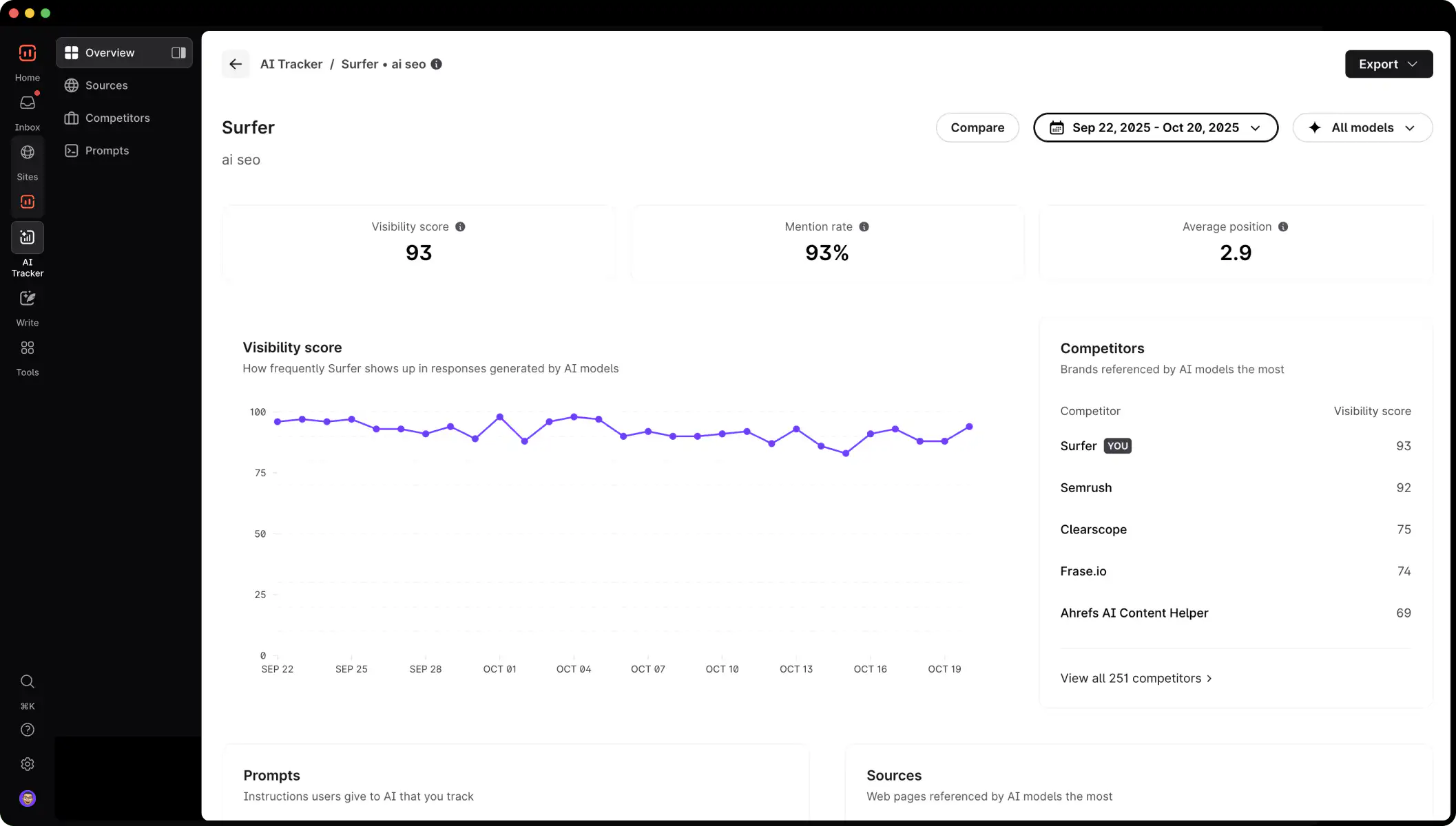
Surfer SEO focuses on improving individual pages using SERP-based recommendations and prescriptive on-page SEO guidance. The platform is document-centric, built around a real-time Content Editor that helps writers optimize a single article against ranking pages. While Surfer has expanded into AI with features like Surfer AI and the AI Tracker, these capabilities function as add-ons rather than a unified operational layer, and AI visibility insights remain largely disconnected from execution.
Best for
Content teams, writers, and SEO specialists focused on optimizing individual pages and producing higher-scoring content, rather than orchestrating end-to-end, multi-step content workflows at scale.
Key features
- SERP-based content optimization guidance driven by top-ranking pages
- Real-time Content Editor with keyword usage, structure, and content scoring benchmarks
- Keyword research, clustering, and topical mapping
- Surfer AI for one-off article generation and optimization
- AI visibility signals via the AI Tracker add-on, primarily for monitoring brand mentions in LLM responses
- Limited automation through 1-click features (Auto-Optimize, Internal Linking) or API-based bulk execution
Pros
- Clear, prescriptive optimization guidance that reduces guesswork for writers
- Intuitive, document-level workflows that are easy for editors and content creators to adopt
- Strong support for traditional on-page SEO and SERP alignment
- Helpful for teams producing a steady volume of individual articles
Cons
- Automation is shallow and largely task-based, with bulk operations requiring API access or external tools
- AI visibility insights are secondary and operate as a measurement layer, not an insight-to-action system
- Limited governance over brand rules, proprietary data, and contextual grounding beyond writing style
- Not designed for large-scale execution, multi-step workflows, or ongoing content operations across hundreds of pages compared to AirOps
Pricing
Plans start around $99 per month.
6. Ahrefs: Best for SEO teams adding basic AI visibility
Ahrefs is a long-established, best-in-class SEO platform known for its keyword, backlink, and competitive intelligence. In response to AI-driven search changes, Ahrefs has begun introducing early AI search visibility signals layered on top of its existing datasets. These features extend Ahrefs' role as a research and measurement platform, rather than transforming it into an execution or workflow system for AI search.
Best for
Established SEO teams and organizations already standardized on Ahrefs that want incremental AI search visibility insights without changing their existing SEO workflows or tooling.
Key features
- Keyword and backlink analysis
- Site audits and technical SEO tools
- Competitive research and benchmarking
- Early-stage AI search visibility insights
- Rank tracking and reporting
- Feature-rich data exports and integrations for downstream analysis in other tools
Pros
- Unmatched depth and reliability of SEO and backlink data
- Industry-leading SEO data depth
- Familiar interface for SEO teams
- Useful as a foundational research layer to understand how AI search is impacting visibility
Cons
- AI visibility features are still maturing
- Limited execution support for AI search
- No native execution layer for acting on AI visibility insights
- Lacks workflow orchestration, automation, or content update pipelines tied to AI search signals
- Primarily answers "what's happening?" rather than "what should we do next?"
Pricing
Plans start at $129 per month.
7. SE Ranking: Best for agencies managing multiple clients
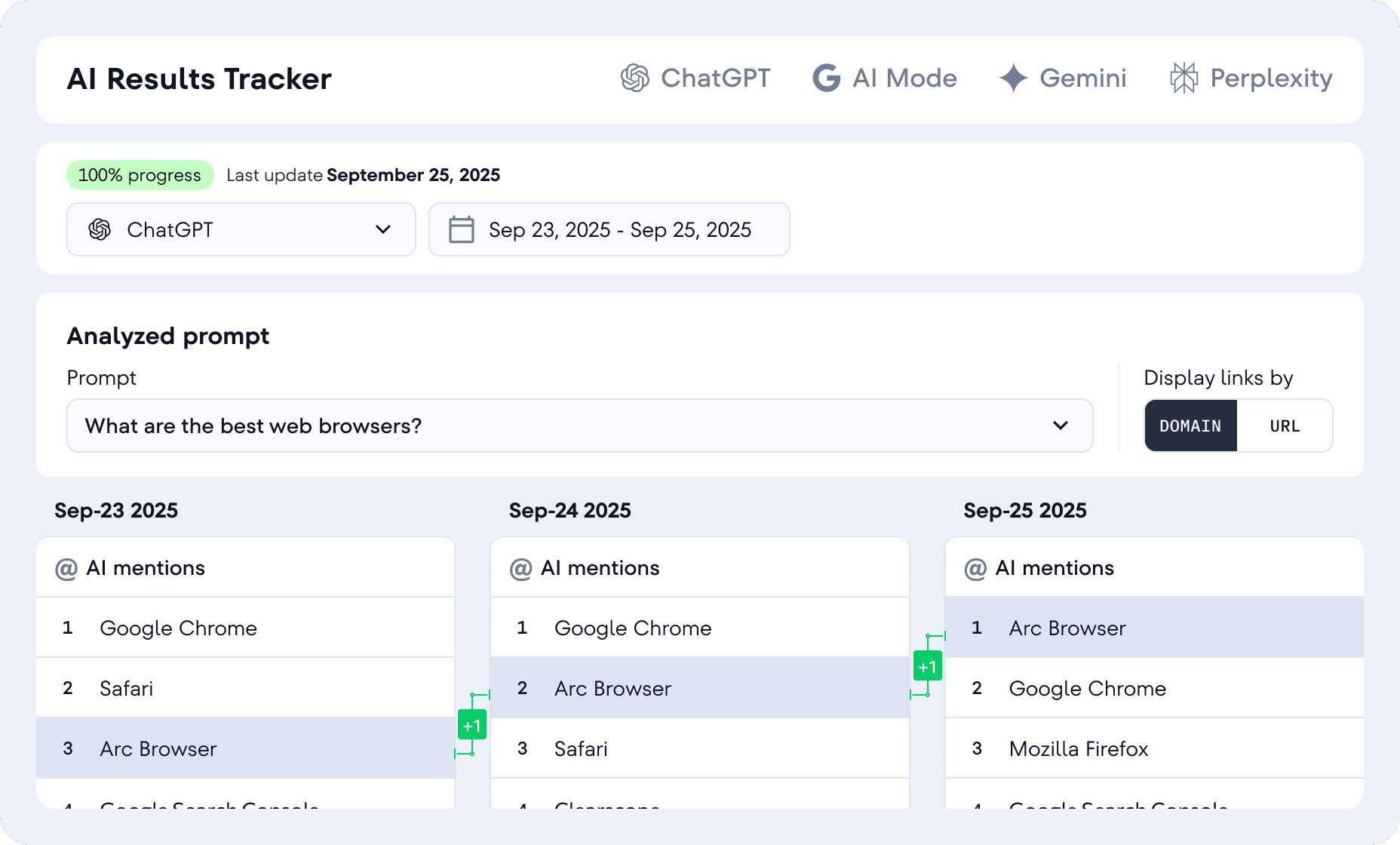
SE Ranking is an all-in-one SEO platform designed to help marketers and agencies manage keyword tracking, competitor research, site audits, and on-page optimization within a single suite. In recent versions, SE Ranking has introduced AI search visibility features (often as an add-on) that let teams monitor AI-generated results alongside traditional rank tracking and performance metrics.
Best for
Small to mid-sized SEO agencies managing multiple clients.
Key features
- AI citation and visibility tracking
- Daily rank tracking across locations and devices
- Multi-client project management
- White-label reporting
- Keyword tracking and competitor analysis
- Website audits and monitoring
Pros
- Agency-friendly pricing
- Built-in white-label reports
- Broad SEO feature coverage
- Competitive pricing with flexible add-on options
- Basic AI visibility insights complement keyword and performance data
Cons
- Less advanced AI visibility capabilities compared to Profound
- Limited automation for execution
- Not designed for large content systems
Pricing
Plans start around $65 per month.
How much does Profound cost compared to alternatives?
Profound usually costs more than its alternatives once you track more than one AI engine. Its published plan pricing as of mid-2026 breaks down like this:
- Starter: around $99 per month, limited to ChatGPT.
- Growth: around $399 per month, covering roughly three engines (ChatGPT, Perplexity, and Google AI Overviews).
- Enterprise: custom pricing, available on request.
Teams searching for affordable Profound alternatives want broader engine coverage at a lower price. Many cheaper alternatives to Profound start between $20 and $295 per month.
Before you choose on price alone, check two things:
- Which AI engines are included on the plan you can actually afford, since some tools move Gemini or Claude to paid add-ons.
- Whether the tool only tracks visibility or also helps you act on it, because AirOps turns those gaps into shipped content updates.
Profound Alternatives Compared
How to choose the right Profound alternative
- Choose AirOps if you need customizable, repeatable workflows and want AI embedded across your entire content operation.
- Choose analytics-first tools if you only need visibility measurement and reporting.
- Choose enterprise SEO platforms if AI visibility is an add-on to an existing SEO program.
- Consider budget, team size, integrations, and how much execution you want the tool to handle—not just insights.
- Choose AirOps for enterprise teams, mid-market teams, and smaller SEO teams that want one system for AI visibility tracking and content execution.
- Compare pricing across affordable Profound alternatives, and weigh cost against how much execution you want the tool to handle.
How to switch from Profound without losing momentum
Switch from Profound in stages so you keep your tracking history and avoid gaps. A structured move takes about a month and protects the data you already rely on.
- Export your current prompt library, dashboards, and reports before you cancel anything.
- Run two or three shortlisted answer engine optimization tools in parallel on the same prompts for one to two weeks.
- Compare data quality, and check whether each tool stores the full AI answer text or only a mention count.
- Confirm which AI engines are included on the plan you can afford, since coverage varies widely across generative engine optimization tools.
- Decide whether you need execution, like content refresh and workflows, or only tracking before you commit.
That last question usually decides the tool. AirOps fits teams that want AI visibility tracking and content execution in one system, so the switch replaces several point tools instead of one dashboard.
Frequently asked questions
What other LLM visibility tools are like Profound?
AirOps, Scrunch, and Peec.ai are the closest LLM visibility tools to Profound. AirOps stands out because it connects visibility tracking to content execution, so teams act on the data instead of only reading it.
How does Profound compare to alternatives?
Profound leads on AI search visibility tracking and reporting. Alternatives like AirOps add content execution, bulk refresh, and brand governance, which matters once teams need to act on the insights at scale.
Does Profound help content teams find citation opportunities?
Profound surfaces where your brand is cited and where competitors appear in AI answers. It reports the gaps but does not update or ship content, so teams pair it with an execution platform like AirOps to close them.
Which Profound alternatives include content production?
AirOps includes content production and refresh alongside AI visibility tracking. Most analytics-first alternatives, including Peec.ai and Scrunch, focus on measurement and leave content creation to separate tools.
Who is Profound best for?
Profound fits marketing and SEO teams that want a dedicated view of how their brand appears in AI-generated answers. Teams that also need to update content at scale often add an execution platform such as AirOps.
Who is Profound's top competitor?
AirOps is Profound's top competitor for teams that want to act on AI visibility data, not just monitor it. Other Profound competitors like Scrunch and Peec.ai focus on tracking, while AirOps connects visibility to content execution.
How does Profound compare to Conductor?
AirOps connects AI visibility to content execution, which sets it apart from both. Profound focuses on AI search visibility tracking and reporting, while Conductor bundles AI visibility into an enterprise SEO and content operations suite. Choose based on whether you need execution across your content or enterprise SEO breadth.
Are there cheaper Profound alternatives?
Yes. Several LLM visibility tools track AI search mentions from roughly $20 to $100 per month, well below Profound's Growth tier. AirOps focuses on turning that visibility into shipped content rather than competing on price alone.
Turning AI visibility into lasting impact
Profound remains a strong option for understanding how brands show up in AI search. But as AI search becomes operational, many teams need more than visibility alone. Execution, collaboration, and the ability to update content at scale increasingly determine who earns citations and who fades from AI answers.
That's where teams move from tracking to action, and where a better Profound alternative proves its value. Platforms like AirOps help content and SEO teams turn AI visibility insights into repeatable systems for updating, managing, and scaling content across both SEO and AI search.
Book a demo to see how AirOps helps teams operationalize AI search and earn more consistent citations and mentions at scale.
Get the latest on AI content & marketing
