- Snippet monitoring tools track where your brand appears (or doesn't) when buyers ask ChatGPT, Perplexity, or Google AI Overviews about your category.
- Traditional search engine optimization (SEO) tools track rankings and clicks. They can't tell you whether an AI assistant recommended a competitor instead of you.
- The biggest gap in this category is the distance between monitoring and action. Most tools show you the problem. Fewer help you fix it.
- AirOps is the best snippet optimization tool for enterprise teams. It closes the loop from citation gap detection to governed content production to CMS publishing in a single platform.
Your brand can rank on page one of Google and still be completely invisible in the AI answers shaping purchasing decisions. When a prospect asks an AI assistant “What’s the best project management tool for remote teams?”, the response typically names three to five solutions. If you’re not in that answer, you don’t exist to that buyer.
Traditional SEO tools track search engine results page (SERP) rankings and click-through rates. They can’t tell you whether Perplexity cited your content or whether Google’s AI Overview recommended a competitor instead.
AirOps automates voice and style rules in a governed system accessible to AI workflows and connected tools via MCP.
This guide is for enterprise SEO leaders, content operations teams, and marketing agencies who need to monitor brand references across AI answer engines and turn citation gaps into prioritized, repeatable content actions. We evaluated seven tools on engine coverage, citation detail, ability to prompt action, competitive benchmarks, and real-world team use.
AI snippet optimization tools comparison table
How we evaluated these tools
Each AI visibility tool was assessed against criteria that matter most for enterprise SEO and content operations teams tracking AI search references. Featured snippet optimization overlaps with AEO: both disciplines reward structured, direct answers that AI models prefer to cite.
Core capability fit: Multi-engine monitoring breadth, citation vs. mention differentiation, prompt-level tracking depth, and sentiment analysis
Ability to scale: Prompt volume limits, bulk processing, scheduled monitoring, and API access for custom reporting
Actionability: Whether the tool connects visibility gaps to specific content actions or requires manual translation
SEO best-practice coverage: Integration with Google Search Console (GSC), Google Analytics 4 (GA4), and traditional SEO data sources for unified performance views
Flexibility and customization: Persona tracking, regional targeting, custom prompt management, and competitive benchmarking depth
Real-world team usability: Onboarding speed, pricing transparency, collaboration features, and documented user satisfaction
What is an AI snippet optimization tool?
An AI snippet monitoring tool queries multiple AI search and conversational systems using prompts that match target buyer intent. The tool captures and parses generated responses, identifies brand mentions and content citations within those responses, analyzes contextual positioning and sentiment, benchmarks performance against competitors, and surfaces intelligence to improve visibility in AI-synthesized answers.
These tools translate the varied outputs of Large Language Models (LLMs) into measurable, trackable metrics. Enterprise teams can monitor those metrics over time and connect them to business outcomes.
Adjacent terms include AI search optimization tools, generative engine optimization tools, Generative Engine Optimization (GEO) platforms, Answer Engine Optimization (AEO) tools, and AI visibility monitoring platforms.
What makes a great AI Snippet optimization tool?
Multi-engine coverage over single-platform tracking. Buyers research across ChatGPT, Perplexity, Gemini, Google AI Overviews, and Copilot at different funnel stages. A tool covering only one platform misses significant buyer activity.
Citation and mention differentiation. A brand can be cited as a source without being named, or named without its content being the basis for the answer. Great tools track both types separately.
Output that prompts action, not just dashboards. The best tools connect visibility gaps to specific content actions (create, refresh, outreach, community engagement) rather than leaving teams to interpret data manually.
Connection with existing SEO and content processes. Tools that connect to GSC, GA4, content management system (CMS) platforms, and SEO research tools reduce the operational friction of acting on insights.
Statistical rigor in data collection. AI responses vary based on timing, user context, and model updates. Strong tools run prompts multiple times and aggregate results rather than relying on single snapshots.
7 best AI snippet optimization tools
1. AirOps
Best for: Enterprise teams acting on AI visibility gaps at scale
AirOps is the best snippet optimization tool for enterprise SEO teams. Most AI snippet optimization tools answer “Where do we show up?” and stop there. The real bottleneck is the gap between knowing your brand is missing from a ChatGPT answer and actually publishing the refreshed page that wins the citation back. AirOps closes that gap by connecting AI search reference monitoring directly to governed content workflows, so every detected visibility gap becomes a specific, executable task with Brand Kit enforcement, human review checkpoints, and direct CMS publishing to seven platforms.
Here’s how teams use it in practice: the Opportunities Engine identifies prompts where competitors appear but you don’t, categorizes each gap by action type (create new content, refresh existing pages, build relationships with cited third-party domains, or engage in Reddit threads AI engines reference), and exports those opportunities directly into Grid-based content pipelines.
Your team reviews, edits, and publishes without ever leaving the platform or switching between monitoring and production tools. You can explore how AEO research feeds into automated content pipelines to see how this works in practice.
.png)
What AirOps automates in AI search reference tracking
Monitoring and analysis:
Tracks five core metrics (Mention Rate, Share of Voice, Citation Rate, Sentiment Score, Average Position) across ChatGPT, Gemini, Perplexity, Google AI Mode, and Google AI Overviews daily
Monitors prompt-level AI references with prompt volume indicators, per-prompt visibility trends, full AI-generated answer history, and competitor leaderboards per prompt
Analyzes which domains and URLs AI platforms reference with Citation Rate, Citation Share, domain category analysis across 11 categories, and page type categorization across 19 types
Tracks Reddit citation rates and community content being referenced in AI responses
Scans existing articles for AEO readiness, flagging gaps in structure, citation signals, and answer formatting so teams can turn AI citation data into actionable content optimization
Prioritization and opportunity surfacing:
Automatically surfaces Creation opportunities (content gaps), Refresh opportunities (weak or declining content), Outreach opportunities (frequently-cited third-party domains), and Community opportunities (highly-cited Reddit threads)
Page360 unifies GSC, AI search citation data, and GA4 analytics for each URL to give a complete view for content decisions
Execution and publishing:
Exports identified opportunities directly to Grid for bulk content workflow execution
Publishes refreshed and new content directly to WordPress, Webflow, Contentful, Sanity, Ghost, Strapi, and ContentStack
Enforces brand consistency through Brand Kits and Knowledge Bases across all content operations
Includes human review checkpoints and content comparison diffs before anything goes live
Why this matters for real teams
Every monitoring tool in this category can tell you a competitor is being cited for “best CRM for small businesses” while you’re absent. What happens in the next 48 hours is where teams diverge.
With monitoring-only tools, the process is manual. Your team exports a CSV, creates a brief, assigns it, waits for a writer, reviews the draft, formats it for your CMS, and publishes. That process takes weeks. AirOps compresses it into a single governed pipeline where the opportunity, the brief, the content production, the review, and the publish all happen in one system. For teams managing hundreds of pages, that operational difference compounds fast. To see how teams like Webflow and Chime are tracking visibility and acting on gaps in one system, the results speak for themselves.

When AirOps is the right choice
AirOps works best for:
Content teams managing 100+ pages who need to act on AI visibility gaps at scale, not just observe them
SEO teams that want AI search data unified with GSC and GA4 in a single view (Page360) for sophisticated content prioritization
Marketing agencies building AEO as a measurable service line with repeatable, governed content workflows across client accounts
Organizations where the insight-to-execution gap is the primary bottleneck, not the monitoring itself
Teams already publishing to CMS platforms like WordPress, Webflow, or Contentful who want to push content live without manual handoffs
When AirOps isn’t the right choice
AirOps may not be the right fit if:
You need to track Claude, Grok, DeepSeek, or Meta AI. AirOps currently monitors five AI platforms, while Profound covers nine and Scrunch covers seven.
You need multi-region or multi-persona tracking on lower tiers. Both Solo and Pro plans are limited to one persona and one region.
Your primary need is pure monitoring with no content execution. Dedicated monitoring tools like SE Visible or Otterly may be simpler and cheaper.
You prefer fully transparent, self-serve pricing. Pro and Enterprise pricing require sales engagement.
Your team has fewer than 50 pages and prefers manual optimization over building automated workflows.
Pricing
AirOps offers a free Solo tier with 100 tracked prompts and ChatGPT-only insights so teams can validate AI reference tracking value before committing. The Pro tier includes multi-engine insights, 250 tracked prompts, weekly opportunity reports, and unlimited seats. Enterprise includes custom prompt limits, multiple regions and personas, dedicated account management, and API access. AirOps bundles monitoring and content execution together rather than charging separately for tracking and action.
2. Profound
Best for: Enterprise teams requiring the broadest AI engine coverage with CDN traffic attribution
Key features:
Tracks nine AI platforms at Enterprise tier (ChatGPT, Perplexity, Claude, Gemini, Grok, Copilot, Meta AI, DeepSeek, Google AI Overviews)
CDN traffic integration via Cloudflare, Akamai, Vercel, AWS, Netlify, and Fastly connects AI crawler activity to real site visits
Proprietary prompt volume research reveals actual query demand across answer engines
ChatGPT Shopping module tracks product visibility in AI shopping conversations
Attribute Analysis reviews which product features AI emphasizes in responses
Pros
Purpose-built for AI answer engines rather than retrofitted from traditional SEO tools
Strong citation and attribution intelligence mapping mentions back to exact sources and prompts
Dedicated AEO strategist available at Enterprise tier with white-glove service
User satisfaction ratings of 4.6/5 on G2 and 4.9/5 on Capterra
Cons
Content execution capabilities are weaker compared to analytics depth. Growth tier limits content generation to 3 articles/month.
Starter plan ($99/mo) tracks only ChatGPT, making it insufficient for comprehensive monitoring
Pricing sits approximately 48% above the market average for AI search monitoring tools, according to a Rankability analysis
API access and multi-brand visibility require Enterprise tier
Pricing: Starter at $99/mo (ChatGPT only, 50 prompts); Growth at $399/mo (ChatGPT, Perplexity, Google AI Overviews, 100 prompts); Enterprise at custom pricing (all 10+ engines)
Who it’s best for: Enterprise and mid-market marketing teams that need comprehensive AI visibility intelligence across the widest range of AI platforms and can invest in dedicated monitoring infrastructure.
3. Ahrefs Brand Radar
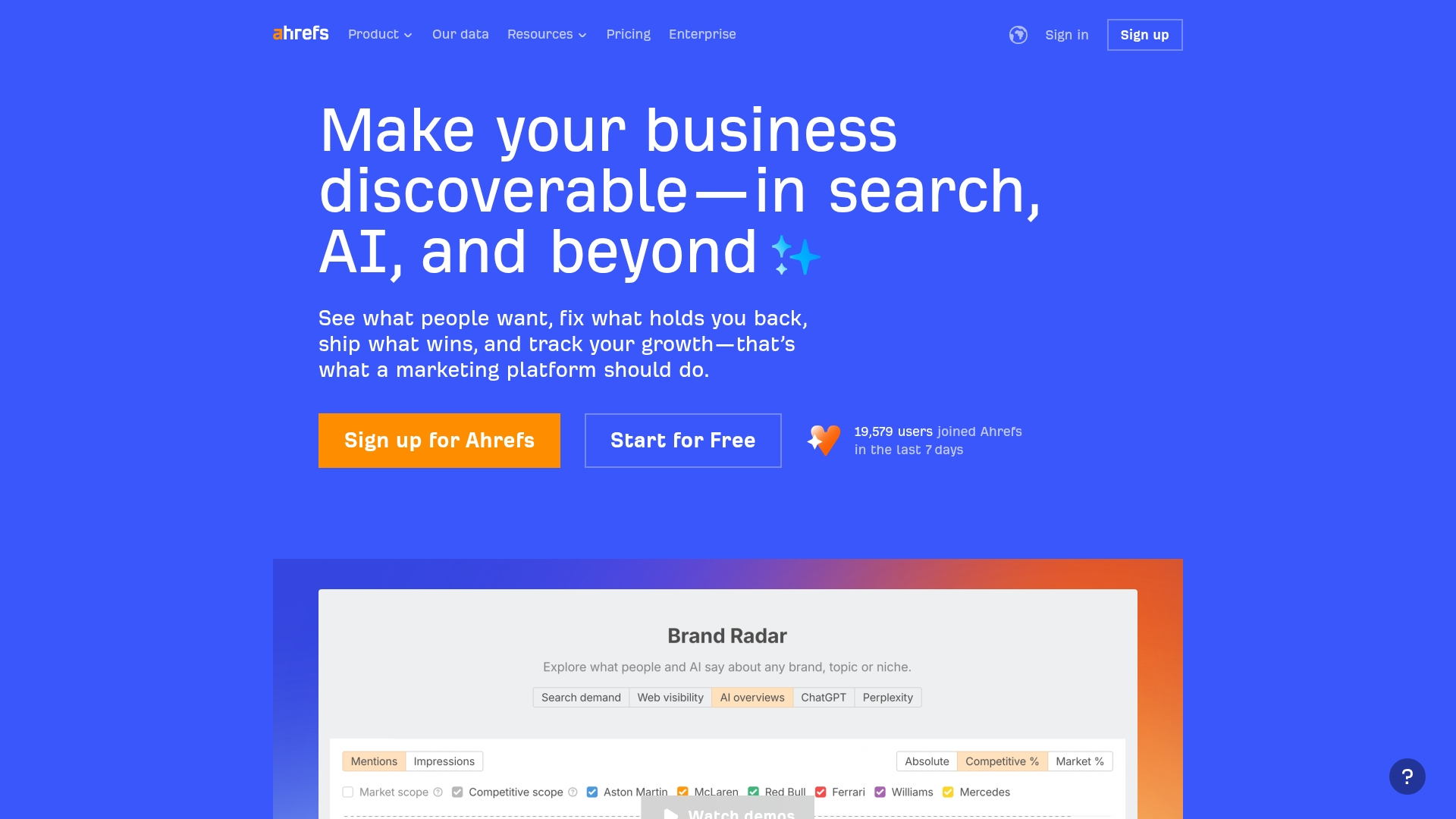
Best for: SEO teams already invested in the Ahrefs stack who want unified AI and traditional search intelligence
Key features:
Processes billions of queries across six AI prompt indexes (Google AI Overviews, AI Mode, ChatGPT, Perplexity, Gemini, Copilot)
Database of 239+ million real user prompts for comprehensive brand mention discovery
AI Share of Voice metric showing percentage of AI chats mentioning your brand vs. competitors
“Others only” filter for identifying content gaps where competitors appear but you don’t
YouTube, Reddit, and TikTok mention tracking in beta
Pros
Massive prompt database enables discovery of “unknown unknowns” across queries you didn’t know to track
Seamless integration with Ahrefs’ backlink analysis, keyword research, and site audit capabilities
Strong API for enterprise clients integrating AI visibility data into custom business intelligence (BI) dashboards
Zero-setup instant analysis of any brand’s AI visibility
Cons
AI tracking requires a $699/mo add-on on top of a base Ahrefs subscription of $129+/mo, putting the total at $828+/mo
Multiple independent reviews document accuracy issues, especially for ChatGPT and Perplexity mention detection
No native tracking for Claude or Grok
Observational only with no built-in optimization suggestions or content tools
Per-domain pricing makes it unworkable for most agencies
Pricing: Base Ahrefs plan starting at $129/mo + Brand Radar AI add-on at $199/mo per platform or $699/mo for all six platforms
Who it’s best for: Enterprise brands already paying for Ahrefs who need directional AI visibility insights and competitive intelligence without adopting a separate tool.
See how AirOps and Ahrefs stack up.
4. Scrunch AI
Best for: Enterprise teams requiring granular prompt-level segmentation with buyer persona and funnel-stage tagging
Key features:
Tracks 7+ AI platforms including ChatGPT, Claude, Perplexity, Gemini, Google AI Overviews, Google AI Mode, and Meta AI
Prompts labeled by buyer persona, location, sales funnel stage, and theme for precise segmentation
Agent Traffic feature monitors AI crawler activity on websites in real-time via GA4 integration
Content Delivery Comparison shows side-by-side human vs. AI agent views of the same URL
SOC 2 compliance and Role-Based Access Control for enterprise security
Pros
Most comprehensive AI engine coverage among tested competitors, including Meta AI
Data accuracy rated 5/5 by GenerateMore.ai with “no doubts about data accuracy”
Clean, modern interface with quick onboarding and excellent filtering capabilities
Enterprise-grade infrastructure justifies premium pricing for larger organizations
Cons
Optimization insights remain in beta and are “significantly more limited than other options,” according to GenerateMore.ai
No built-in content editor or optimization workflows. Users must export data to separate tools.
Prompt credit system counts each AI engine separately, which can surprise teams at billing time
Agent Traffic is an add-on for Growth tier rather than included
Pricing: Explorer at $100/mo (ChatGPT only, 100 prompts); Growth at $500/mo (8 engines, 700 prompts); Enterprise at custom pricing
Who it’s best for: Enterprise teams and agencies requiring detailed prompt-level intelligence with sophisticated segmentation and enterprise security compliance across all major LLMs.
See how AirOps and Scrunch stack up.
5. SE Visible
Best for: Teams that prioritize data accuracy and clean interface design at competitive per-prompt pricing
Key features:
Tracks ChatGPT, Perplexity, Gemini, AI Overviews, and AI Mode with real AI responses (not API simulations)
“No Cited” feature reveals where competitors are mentioned but your brand is absent
Multi-language configuration in English, French, German, Dutch, and Spanish
Unlimited user seats on all plans
AI-assisted setup suggests prompts based on brand name and domain
Pros
Tracks real AI responses rather than API simulations, providing authentic visibility data
Competitive analysis rated 5/5 by GenerateMore.ai for being “deep and transparent”
Cost per prompt at approximately $0.42 positions it well below Profound ($2.50) and Ahrefs Brand Radar ($1.00)
Built on SE Ranking’s 13+ years of search data accuracy expertise
Cons
Reporting limited to CSV exports with no built-in sharing formats or advanced reporting
Focuses exclusively on AI visibility tracking. SEO execution requires SE Ranking or other platforms.
Sentiment tracking rated 2/5 by GenerateMore.ai for lacking “context and clarity”
Starting price of $189/mo may be high for smaller teams in exploratory phases
Pricing: Core at $189/mo (450 prompts, 5 brands); Plus at $355/mo (1,000 prompts, 10 brands); Max at $519/mo (1,500 prompts, 15 brands). 10-day free trial available.
Who it’s best for: Teams that prioritize data accuracy and clean interface design over feature breadth, particularly those already familiar with the SE Ranking environment.
6. Otterly AI

Best for: SEO professionals and small-to-midsize teams seeking affordable, broad AI platform coverage
Key features:
Monitors six AI platforms daily (ChatGPT, Google AI Overviews, Google AI Mode, Perplexity, Gemini, Microsoft Copilot)
AI Prompt Research Tool converts traditional keywords into conversational prompts
Brand Visibility Index provides a single normalized score for cross-industry comparisons
GEO Audit analyzes 25+ technical and content factors affecting AI citations
Multi-Client Workspaces for agencies managing multiple brands
Pros
Most accessible entry point at $29/mo with all core monitoring features included
4.9/5 rating on G2 with 40 reviews. Named a Gartner Cool Vendor in AI in Marketing 2025.
Time-to-value praised by users, with one Content Strategist reporting monitoring setup within one hour
Unlimited users across all tiers
Cons
Does not track Claude, which represents a gap for teams whose audiences use that platform
Observational only without built-in tools for content creation or strategy execution
GEO audit identifies issues but does not provide detailed guidance on resolving them
Jump from Standard ($189/mo for 100 prompts) to Pro ($989/mo for 1,000 prompts) is steep
Pricing: Lite at $29/mo (~10 prompts); Standard at $189/mo (100 prompts); Pro at $989/mo (1,000 prompts). 14-day free trial. Also available through Semrush App Center.
Who it’s best for: SEO professionals and small-to-midsize teams seeking affordable, broad AI platform coverage with actionable technical recommendations.
7. Rankscale AI

Best for: Data-driven SEO teams and startups needing precise temporal and geographic tracking controls
Key features:
Tracks ChatGPT, AI Overviews, Perplexity, Gemini, Claude, DeepSeek, Mistral, Grok, Copilot, and AI Mode
Hourly, daily, and weekly tracking intervals across specific AI engines and geographic regions
AI Search Readiness Score evaluates content quality, authority, technical SEO, and engagement
Direct LLM response viewing shows actual AI-generated text for tracked prompts
Integrates with Semrush and Surfer SEO
Pros
Most granular temporal and regional controls in the category
Budget-friendly entry at $20/mo with a “surprisingly rich feature set”
OMR Reviews scores 9.8/10 for “Meets requirements” and 9.9/10 for “Customer Support”
Translates AI-generated answers into structured, defensible visibility data suitable for agency reporting
Cons
Ease of use scored 8.4/10 on OMR Reviews, notably below the category average of 9.2
Credit-based consumption model means tracking more terms increases costs without clear volume discounts
Monitoring-focused without content recommendations tied to visibility or optimization tools
Cannot connect AI visibility to business outcomes like conversion rates or assisted revenue
Pricing: Starting at $20/mo with credit-based system. Specific tier details beyond entry pricing are not publicly documented.
Who it’s best for: Data-driven SEO teams and startups that need precise, drill-down analysis of AI search appearances with temporal and geographic specificity at an accessible price point.
Common use cases for AI snippet optimization tools
Answer engine optimization tools support a range of workflows across SEO, content, and marketing operations teams.
Competitive share of voice monitoring. Track what percentage of AI-generated answers for category-relevant prompts mention your brand versus competitors. Spot trends and displacement risks before they affect pipeline.
Citation source analysis. Understand which URLs and content pieces on your site (or third-party sites) AI systems reference when generating answers. Use this to prioritize content refreshes and outreach.
Prompt discovery and prioritization. Identify the specific questions and prompts buyers actually ask AI systems. Prioritize those with commercial intent for content creation.
Sentiment and accuracy auditing. Detect when AI systems present incorrect information, outdated features, or negative sentiment about your brand. Build correction strategies before misinformation spreads.
Content improvement feedback loops. Test how changes to content structure, formatting, or claims affect subsequent AI citation behavior. Measure whether refreshed pages earn more citations over time. You can see how to measure these visibility shifts systematically with a structured monitoring approach.
Executive reporting and ROI attribution. Measure snippet optimization ROI by connecting AI visibility gains to organic traffic, pipeline influence, and revenue. Build dashboards that translate citation data into business outcomes stakeholders act on.
How Content Structure Affects AI Citations
AI models do not read pages the way humans do. They extract discrete answer fragments based on heading hierarchy, list formatting, and paragraph structure.
Structured content earns a 2.8x citation lift compared to pages without clear answer-target formatting. Question-based headings rank as the top citation driver, according to a recent AirOps webinar with HubSpot.
Use question-based H2s and H3s. Mirror the exact phrasing users type into AI search engines. Each heading should map to a single, answerable query.
Lead paragraphs with direct answers. Place the core answer in the first 1-2 sentences below each heading. Follow with supporting detail, data, or examples.
Add bullet lists for multi-part answers. LLMs prefer structured lists when summarizing comparison, feature, or step-based content.
Keep paragraphs to 2-3 sentences. Shorter blocks give AI models cleaner extraction boundaries and reduce hallucination risk.
Content teams that retrofit existing pages with these patterns see citation gains within weeks. The structural changes also improve featured snippet capture rates.
Why Content Freshness Drives AI Visibility
AI citation rankings are volatile. Roughly 50% of cited URLs change month over month, based on data from a recent AirOps webinar. Pages that go stale lose citations to fresher competitors, even when the underlying information remains accurate.
Stale pages experience a 3x citation loss compared to regularly updated content. Once a page drops from AI answer results, reclaiming that position requires more effort than maintaining it.
Set refresh cadences by citation value. Pages with high citation rates need monthly reviews. Lower-traffic pages can follow a quarterly schedule.
Update statistics, dates, and examples first. LLMs weigh recency signals when selecting sources. Swapping outdated data points is the fastest path back into citations.
Automate staleness detection. Manual audits do not scale across hundreds of pages. Use automated scans to flag content past its refresh window.
Pair refreshes with structural improvements. Each update is an opportunity to add question-based headings, direct answer leads, and bullet formatting.
Teams that treat freshness as an ongoing operation, not a one-time project, maintain their AI visibility over time.
AI search reference tracking needs to drive action
AI search tracking shows where your brand appears across AI-generated answers. It surfaces citation gaps, competitor mentions, and missed opportunities.
Most teams already have that visibility. What slows progress is turning those insights into consistent updates across content and distribution.
Citation gaps hide in plain sight. Most content ranks in traditional search but lacks the structure AI models need to cite it.
Speed compounds. 40% of brands that lost AI visibility resurfaced through citation and mention optimization. Delayed action widens the gap.
AI visibility tools close the loop. Tracking alone does not improve citations. Teams need workflows that connect detection to content updates at scale.
Speed separates leaders from followers. The gap between identifying a citation drop and publishing a fix determines whether competitors fill the void first.
That’s where execution breaks down. The work required to close gaps often sits outside the tools that surface them.
This is the shift. AI reference tracking works best when it connects directly to what gets published next.
AirOps brings those pieces together. It connects AI reference data to content updates and outreach so teams can address gaps, move faster, and track impact in one place.
Book a demo to see how teams turn AI reference tracking into ongoing content execution.
What is the best AI snippet optimization tool for enterprise SEO teams?
The best tool depends on your primary need. Profound offers the broadest AI engine coverage (nine platforms). AirOps provides the strongest connection between monitoring and content execution. Ahrefs Brand Radar works best for teams already invested in the Ahrefs SEO stack. For teams that need to both track AI references and act on gaps through governed content workflows, AirOps is the strongest fit.
Are free AI snippet optimization tools worth it?
Free tiers from AirOps (Solo plan) and Otterly (Lite plan) provide genuine value for establishing a baseline. AirOps’ free tier tracks 100 prompts across ChatGPT with monthly opportunity reports. These free options work well for initial validation but typically cover only one AI platform, which is insufficient for a comprehensive monitoring strategy.
How do AI snippet optimization tools work?
These tools programmatically query AI search platforms (ChatGPT, Perplexity, Gemini, etc.) with prompts that mirror real buyer questions. They capture the generated responses, identify brand mentions and content citations, analyze sentiment and positioning, and benchmark results against competitors. Because AI responses vary with each query, strong tools run prompts multiple times and aggregate results for statistical reliability.
Can you use AI to automate improvements in AI search visibility?
AI can automate monitoring, opportunity identification, and content production, but human oversight remains essential for quality. AirOps automates the full pipeline from detecting citation gaps to generating content briefs to publishing refreshed pages, with human review checkpoints built into every workflow. Pure monitoring tools require manual translation of insights into content actions.
Do I need AI snippet optimization tools if I already use Ahrefs or Semrush?
Traditional SEO tools track SERP rankings and click-through rates but cannot tell you whether AI platforms mention or cite your brand. Ahrefs Brand Radar adds AI tracking as an add-on, but at $699/mo for all platforms. Semrush offers Otterly through its App Center. For teams that need both monitoring and execution, a dedicated AI visibility tool alongside your existing SEO stack provides the most complete coverage.
Does Featured Snippet Optimization Overlap With AEO?
Yes. Featured snippet optimization and AEO share core techniques: direct answer formatting, question-based headings, and structured data markup. Pages that win featured snippets already signal the clarity and structure that LLMs prioritize when selecting citations. Optimizing for one discipline strengthens performance in the other.
AirOps for Snippet Optimization
AirOps Insights identifies which pages earn AI citations and which fall short. AirOps Workflows automates the content updates needed to close those gaps. Descript used this approach to run content refreshes at scale, achieving a 35% organic traffic lift while moving 9x faster than manual workflows.
Snippet optimization becomes repeatable when detection, prioritization, and execution run through a single system.
Book a call to see how AirOps turns snippet optimization into a repeatable system.
Frequently Asked Questions
What is the best AI snippet optimization tool for enterprise SEO teams?
The best tool depends on your primary need. Profound offers the broadest AI engine coverage (nine platforms). AirOps provides the strongest connection between monitoring and content execution. Ahrefs Brand Radar works best for teams already invested in the Ahrefs SEO stack. For teams that need to both track AI references and act on gaps through governed content workflows, AirOps is the strongest fit.
Are free AI snippet optimization tools worth it?
Free tiers from AirOps (Solo plan) and Otterly (Lite plan) provide genuine value for establishing a baseline. AirOps' free tier tracks 100 prompts across ChatGPT with monthly opportunity reports. These free options work well for initial validation but typically cover only one AI platform, which is insufficient for a comprehensive monitoring strategy.
How do AI snippet optimization tools work?
These tools programmatically query AI search platforms (ChatGPT, Perplexity, Gemini, etc.) with prompts that mirror real buyer questions. They capture the generated responses, identify brand mentions and content citations, analyze sentiment and positioning, and benchmark results against competitors. Because AI responses vary with each query, strong tools run prompts multiple times and aggregate results for statistical reliability.
Can you use AI to automate improvements in AI search visibility?
AI can automate monitoring, opportunity identification, and content production, but human oversight remains essential for quality. AirOps automates the full pipeline from detecting citation gaps to generating content briefs to publishing refreshed pages, with human review checkpoints built into every workflow. Pure monitoring tools require manual translation of insights into content actions.
Do I need AI snippet optimization tools if I already use Ahrefs or Semrush?
Traditional SEO tools track SERP rankings and click-through rates but cannot tell you whether AI platforms mention or cite your brand. Ahrefs Brand Radar adds AI tracking as an add-on, but at $699/mo for all platforms. Semrush offers Otterly through its App Center. For teams that need both monitoring and execution, a dedicated AI visibility platform alongside your existing SEO stack provides the most complete coverage.
Get the latest on AI content & marketing
