- AirOps is an AI search platform for enterprise teams that connects AEO to content creation and performance tracking in a single system.
- Frase is an agentic SEO (search engine optimization) and GEO (generative engine optimization) tool built around a single AI agent focused on content optimization scoring and automated content maintenance.
- AirOps is built for enterprise content teams that need a governed operating system for both on-site and offsite AI visibility. Frase is built for smaller teams that want faster time-to-value on SEO content briefs and AI search tracking.
- AirOps includes Quill for autonomous execution, Brand Kits for governance, Offsite for citation management, and Page360 for unified performance data. Frase includes Content Guard for automated decay fixes and dual SEO+GEO scoring with support for up to 8 AI platforms.
Content teams at enterprise companies are managing more channels and more pressure to prove ROI than ever before. The gap between monitoring where your brand appears in AI search and actually doing something about it is where most content operations stall.
AirOps and Frase both address the intersection of SEO and AI search visibility, but they solve different parts of the problem. AirOps turns visibility data into a system your team can act on and measure. Frase streamlines the content optimization process with an AI agent that handles briefs and scoring.
This comparison covers features and pricing alongside real-world fit so you can determine which platform matches your team's operating model.
AirOps vs Frase at a glance
AirOps gives your team a system that moves from AI visibility signals through content execution to performance tracking. Frase gives your team a faster path to optimized content with built-in AI search tracking.
AirOps vs Frase: platform overview
AirOps is an AEO platform that turns AI search visibility into a growth system for enterprise marketing teams. The platform connects AI visibility data to content execution in one system, so your team can act on what the data surfaces and measure the results. AirOps is the partner for this shift: the platform, the media mix, and the team together, not just software to log into, with the work tied back to pipeline and revenue.
Frase is an agentic SEO and GEO (generative engine optimization) platform that replaces multiple content optimization tools with a single AI agent. The platform handles content briefs and optimization scoring through a conversational interface, with automated content maintenance built in.
Core features: how AirOps and Frase stack up
AirOps builds features around a connected operating model where visibility data drives content execution. Frase builds features around a single AI agent that handles content tasks faster.
AirOps features
- Quill:
- Quill is AirOps' autonomous AI agent that runs entire content campaigns from brief through publication with built-in Playbooks and human review checkpoints. Your team sets the strategy. Quill runs the execution.
- Quill eliminates the bottleneck between content strategy and published output at a volume that manual processes can't match.
- Quill operates at the campaign level with structured workflows and Brand Kit enforcement built into every step. Frase's agent handles individual content tasks conversationally.
- Page360 unified view:
- Page360 pulls AI citation data alongside GSC and GA4 metrics into a single view for every page on your site.
- Page360 answers the question every Content Director needs to answer for leadership: "Is our content actually driving results?"
- Page360 unifies AI citation signals with GA4 data in a single view, giving your team a complete picture of content ROI. Frase provides separate dashboards for SEO and AI search tracking without GA4 integration.
- Prompt Discovery from four intent sources:
- Prompt Discovery surfaces the exact questions buyers are asking AI search engines about your brand, drawn from four distinct intent sources.
- Your team can build content strategies around the prompts that actually drive AI citations, rather than relying on keyword research tools alone.
- Prompt Discovery reveals AI-native queries your audience types into ChatGPT and Perplexity, which traditional keyword tools miss. Frase offers keyword research and SERP analysis without AI-native prompt sourcing.
- Grids for bulk operations:
- Grids give your team a spreadsheet-like interface for running AI workflows across hundreds of pages simultaneously.
- When your team needs to refresh 200 pages, Grids let you execute that project in hours rather than weeks.
- Frase supports programmatic SEO for batch creation (100+ pages per batch). Grids handle a broader set of bulk operations including audits and publishing workflows.
- Brand Kits:
- Brand Kits encode your brand's voice, terminology, audience guidelines, and content type conventions into a structured governance system that every AI workflow references.
- Every piece of content your workflows create follows the same rules, regardless of which team member initiated it.
- Brand Kits provide multi-dimensional governance with scoped rules per audience and content type. Frase offers brand voice profiles and reference document uploads without workflow-level enforcement.
- AirOps MCP with 35+ tools:
- AirOps MCP delivers Brand Kit context and Insights data directly into AI coding assistants through the Model Context Protocol, with 35+ purpose-built tools.
- Your team can access brand guidelines and AI visibility data directly inside the tools they already use.
- AirOps MCP is differentiated by its deep integration with Brand Kit governance and Insights data. Frase offers an MCP server with 63 tools across all plans, focused on content lifecycle operations.
- Offsite:
- Offsite manages third-party publisher placements and grows your brand's AI citation share by identifying where LLMs source information about your category.
- LLMs look for consensus between what your brand says about itself and what others say about it. Offsite addresses the third-party half of that equation directly.
- Offsite addresses the third-party half of AI visibility that drives citation growth. Frase focuses entirely on on-site content optimization without offsite capabilities.
- Query Fan-outs:
- Query Fan-outs reveal the sub-queries AI engines run behind each user prompt, showing the full chain of information retrieval that determines whether your brand gets cited.
- Your team can optimize content for the follow-up queries AI engines generate internally. This is a new optimization surface that traditional SEO tools don't address.
- Query Fan-outs give your team visibility into the sub-query chains AI engines run internally. Frase does not surface query fan-out data, leaving this optimization surface unaddressed.
- Content Publish Tracking:
- Content Publish Tracking automatically correlates content updates with changes in AI citations and search performance.
- Your team can see exactly how a content refresh affected citation rate within days. This closes the measurement gap that makes it difficult to justify content investment to leadership.
- Content Publish Tracking closes the measurement gap by showing exactly which content changes drove which metric movements. Frase's Content Guard detects and fixes decaying content but doesn't connect updates to visibility outcomes.
- Closed-loop execution:
- AirOps connects every stage of the content lifecycle: surface signals in Insights, prioritize with Page360, execute with Workflows and Quill, enforce quality with Brand Kits, and measure with Content Publish Tracking.
- Content operations become a compounding system. Each cycle of publishing and tracking improves the next.
- AirOps maps every content action to a visibility signal, creating a compounding cycle where each publish informs the next priority. Frase handles creation and monitoring as separate capabilities within one tool.

Frase features
- Frase Agent (80+ skills):
- Frase Agent is a single conversational AI with 80+ skills covering content research and optimization.
- The agent model simplifies workflow by replacing multiple tools with one conversational interface.
- It handles one request at a time, while AirOps runs structured, multi-step processes across entire content libraries simultaneously.
- AI search tracking (8 platforms):
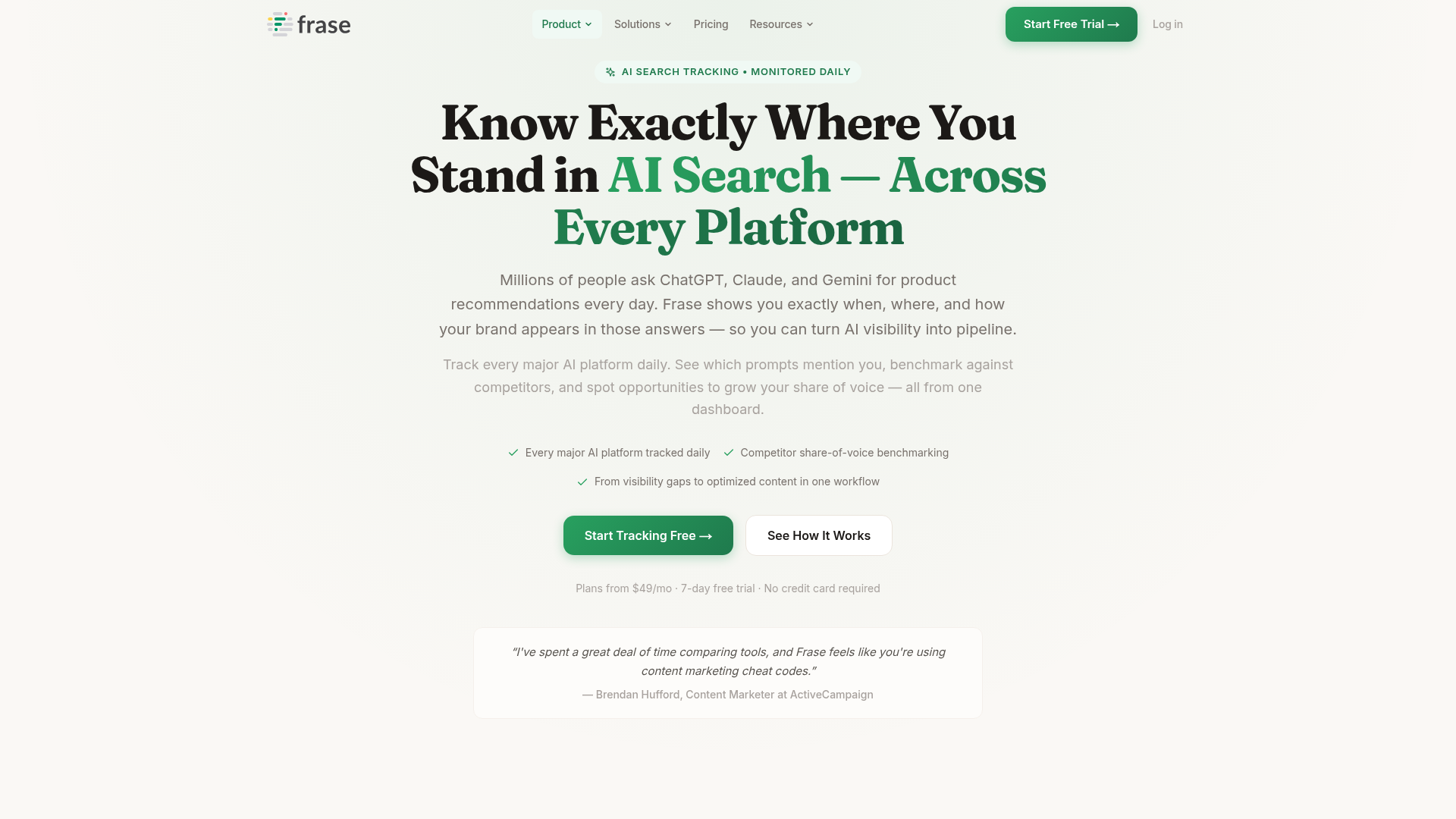
- Frase tracks brand visibility across up to 8 AI search platforms: ChatGPT, Claude, Perplexity, Gemini, AI Overviews, Copilot, Grok, and DeepSeek.
- Tracking 8 platforms gives your team broader AI search coverage than most competing tools.
- AirOps tracks 5 AI platforms currently. Frase's wider platform coverage is a genuine advantage for teams that want maximum visibility breadth.
- Content Guard:
- Content Guard monitors published content for performance decay and can automatically generate fixes.
- You set the rules, and Content Guard flags or fixes pages before performance drops become critical.
- AirOps routes content fixes through governed workflows. Content Guard is a faster, lighter approach for teams that want automated maintenance without custom workflows.
- Dual SEO + GEO scoring:
- Frase scores content for both traditional SEO optimization and GEO readiness in a single interface.
- The dual scoring approach is practical for writers optimizing for Google rankings and AI citations simultaneously.
- AirOps approaches optimization through Insights data and workflow-driven creation. The tradeoff is system-level automation versus per-article scoring feedback.
- Programmatic SEO:
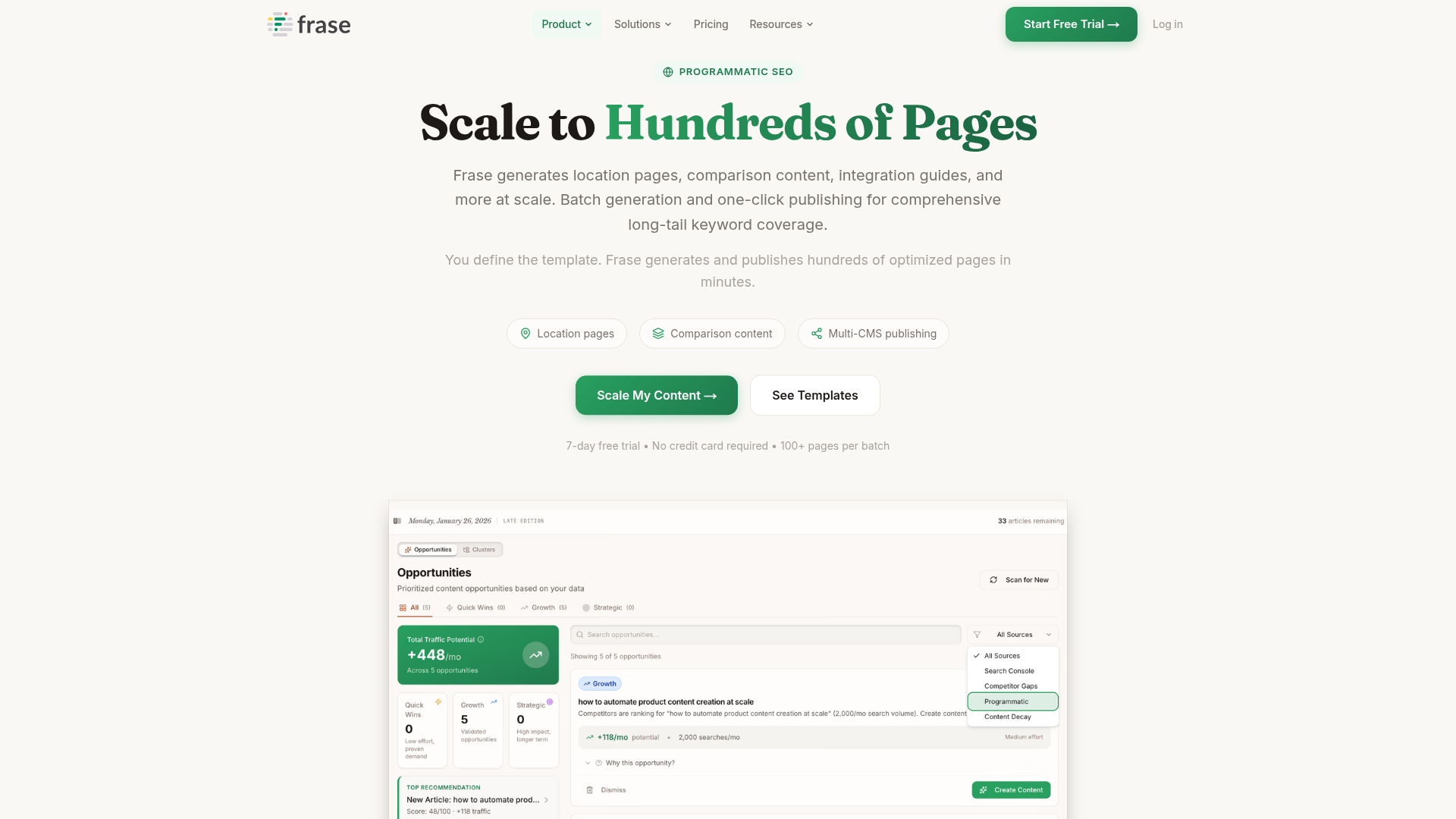
- Frase supports batch content creation of 100+ pages per run for programmatic SEO use cases.
- Teams running location pages or templatized content get fast production.
- AirOps handles similar batch operations through Grids with Brand Kit enforcement and human review. Frase's programmatic feature is simpler to set up.
AirOps builds each capability as a module in a connected system. Frase builds each capability as an agent skill, optimizing for speed on individual tasks. The choice depends on whether your team needs a content operating system or a faster optimization tool.
Product architecture overview: AirOps vs Frase
AirOps is a platform with interconnected modules: Insights feeds Page360, which informs Workflows, governed by Brand Kits, with results measured through Content Publish Tracking. Frase is an AI agent with 80+ skills in a single conversational interface.
Data layer
How each platform collects and connects data determines the quality of decisions your team can make.
- Data sources and integrations: AirOps pulls from AI search engines, GSC, GA4, native CMS (content management system) integrations, and data warehouses. Frase pulls from up to 8 AI platforms and GSC but doesn't integrate GA4.
- Data accuracy and freshness: Both update AI visibility data on a recurring cadence. AirOps adds GA4 signals and historical sentiment tracking.
- Data portability: AirOps supports Grids export and warehouse connectors. Frase supports export and an MCP server with 63 tools.
AirOps unifies signals in one view. Frase's separate modules work for smaller teams but require manual synthesis at scale.

Prioritization of opportunities
Knowing where you stand in AI search is the first step. Knowing what to work on next is where platforms accelerate your team or leave you sorting through dashboards.
- Decision engines and scoring: AirOps surfaces prioritized opportunities through Page360 based on business impact signals. Frase uses dual SEO+GEO scoring and E-E-A-T audits based on content quality signals.
- AI-powered recommendations: AirOps generates recommendations that connect directly to execution workflows. Frase generates briefs and suggestions through conversation.
- Integration of signals: AirOps combines AI citations with organic traffic, GA4 sessions, and competitor data. Frase combines AI tracking with SERP analysis and content scores.
AirOps connects more signal types into a single surface. Frase gives your team clear scores that are fast to act on.
Workflow building and automation
AirOps uses visual workflow builders and autonomous agents. Frase uses a conversational AI agent with skill-based commands.
- Workflow builder capabilities and flexibility: AirOps provides a visual workflow builder for multi-step processes with conditional logic. Frase uses conversational agent interaction. AirOps gives more control; Frase gives faster access.
- Workflow automation features: AirOps automates briefs, drafting, Brand Kit compliance, human review, and CMS publishing. Frase automates creation and scoring with Content Guard decay fixes.
- Workflow conditional logic and triggers: AirOps supports conditional branching and event-based automation. Frase's Content Guard triggers auto-fixes on decay, but other automation relies on user commands.
- Ease of building vs. complexity of what can be built: AirOps requires more configuration but supports arbitrarily complex processes. Frase works immediately but is bounded by the agent's skill set.
AirOps builds infrastructure for repeatable, governed content operations. Frase builds a faster path to content output through conversational AI.

Governance, context, and brand control
The more content your team produces, the more critical governance becomes.
- Brand voice and governance features: AirOps enforces governance through Brand Kits with structured rules every workflow references. Frase offers brand voice profiles and reference documents. AirOps is enforceable; Frase is advisory.
- Knowledge Bases and Brand Kits: AirOps provides Knowledge Bases with semantic search and Brand Kits for enforcement. Frase allows reference document uploads. AirOps separates context from governance for structured control.
- Customization vs. templates: AirOps supports configurable workflows and Brand Kit rules per audience and content type. Frase provides templates and voice profiles. AirOps offers more depth; Frase offers faster setup.
AirOps treats governance as structural. Frase treats it as a configuration option. Enterprise teams where brand consistency is a board-level concern need AirOps' approach.
In Bynder's 2026 State of DAM Report, which surveyed 2,000 management and C-suite respondents, the leading concerns about using AI in content operations were security, legal and regulatory compliance, and inaccurate outputs, not creative capability. That finding shows governance risk, not creative capability, is the real barrier to scaling AI content, which is exactly what AirOps enforces at the workflow level.

Integrations and ecosystem
How a platform connects to your existing stack determines whether it adds value or creates another silo.
AirOps integrations
- CMS: Your content team publishes directly to WordPress, Webflow, Contentful, ContentStack, Ghost, Sanity, Strapi, and HubSpot CMS from Workflows and Grids without switching tools.
- SEO research: Semrush, Ahrefs, Moz, and DataForSEO feed keyword data and backlink profiles into your workflows, so your team doesn't need to export and re-import between platforms.
- Analytics: GSC and GA4 connect natively to Page360, giving your team organic performance and engagement data alongside AI citation metrics.
- Project management: Asana, ClickUp, Monday.com, Airtable, Notion, and Wrike integrations keep your content pipeline connected to your team's project tracking.
- Data warehouses: BigQuery, Snowflake, Postgres, and Redshift connectors let your team push content performance data into your existing BI infrastructure.
- AirOps MCP (35+ tools): Brand Kit context and Insights data flow into Claude, Cursor, ChatGPT, and any MCP-compatible tool your developers use.
Frase integrations
- CMS: WordPress, Webflow, Sanity, Wix, and FraseCMS handle publishing from the Frase editor.
- Import and export: Google Docs, Notion, GitHub, and Linear connections let your team move drafts between tools.
- Automation: Zapier, Make, and n8n extend Frase into broader workflows through third-party connectors.
- Frase MCP (63 tools): Available on all plans with read and write access across the content lifecycle.
AirOps connects natively to 30+ tools across CMS, SEO, analytics, and project management categories. Frase covers core publishing and content movement with around 15 native integrations, supplemented by Zapier and Make for broader connectivity.
Platform depth and scalability
The right platform for your team today should still be the right platform when your content operations grow.
- Architectural breadth and depth: AirOps supports the full lifecycle from visibility through governance and offsite management. Frase covers research through maintenance with a simpler interface.
- Scalability across teams and content volume: AirOps offers unlimited seats on Pro and Enterprise with Grids for hundreds of pages. Frase uses $29/seat pricing and 100 articles/month on Scale.
- Long-term extensibility and future-proofing: AirOps' modular architecture lets new capabilities connect to the existing system. Frase adds capabilities as new agent skills.
AirOps is built to grow with enterprise content operations. Frase is built to be accessible for smaller teams from day one.
AirOps vs Frase: out-of-the-box services and solutions
The scope of what's available out of the box reflects each platform's target user.
Frase delivers faster initial time-to-value. AirOps delivers more durable value because its workflows, once configured, run autonomously and improve with each cycle.
AirOps vs Frase: support, resources, and community
AirOps provides enterprise-level implementation support. Frase provides self-service onboarding with documentation and responsive support.
Execution and training
- Implementation support and training: AirOps provides dedicated implementation support and the Content Engineering Certification program. Frase is self-service with documentation.
- Managed services vs. self-service: AirOps offers managed services for complex deployments. Frase is fully self-service.
Ease of use and onboarding
- Onboarding process: AirOps onboarding involves connecting data sources and configuring Brand Kits with workflows. Enterprise teams should plan for weeks to reach full capacity. Frase teams can be productive within hours.
- Ease of use: AirOps' interface reflects its depth and requires familiarity. Frase's conversational interface is immediately intuitive, reflected in its G2 rating of 4.8/5 from 500+ reviews.
Support and resources
- Resources: AirOps provides case studies with named enterprise customers and the Content Engineering Certification. Frase provides a help center and template library.
- Community: AirOps has an active Content Engineering community with events and certification cohorts. Frase has a 30,000+ member community with active forums.
- Customer support: AirOps offers Slack-based support and dedicated CSMs for Enterprise accounts. Frase offers email support across all plans with priority support at Enterprise. Both platforms provide enterprise-grade support at the top tier.
AirOps vs Frase: pricing and value comparison
AirOps uses task-based pricing with unlimited seats at higher tiers. Frase uses article-based pricing with per-seat charges.
Frase's seat-based pricing adds $29 per team member, which accumulates quickly for a 10-person team. AirOps' unlimited seats on Pro and Enterprise plans mean your team grows without per-user surcharges. Frase's lower entry cost works for smaller teams. AirOps' pricing makes more sense as headcount scales.
Real-world: when to use each platform
The right platform depends on how much of the content lifecycle you want a single system to cover.
AirOps
Workflow fit: AirOps fits teams that need governed content operations with multiple stakeholders and brand rules at a volume where manual coordination has become the bottleneck.
Industry fit: Enterprise SaaS and B2B organizations where brand governance is critical. Companies like Webflow, Carta, and Docebo use AirOps to scale content operations with measurable AI visibility results.
Frase
Workflow fit: Frase fits teams where the primary bottleneck is content creation speed and optimization quality, with a single tool that handles research and writing without complex configuration.
Industry fit: Content marketing agencies and teams with 1 to 5 creators who need optimized content quickly. Straightforward operations with lower governance requirements get the most value.
AirOps vs Frase: strengths and limitations
AirOps
Strengths:
- Connected content operations: LLM visibility data and content execution feed into performance tracking in a single system. Results compound over time.
- Enterprise-grade governance: Brand Kits enforce rules across audiences and content types. Every piece of content your workflows create follows the same brand standards.
- Offsite visibility management: AirOps addresses offsite AI visibility, helping your team earn citations from third-party sources where LLMs look for consensus about your brand.
Limitations:
- Longer onboarding cycle: Enterprise deployment requires Brand Kit and workflow configuration. Plan for weeks before reaching full capacity.
- Higher complexity ceiling: Your team needs to invest time learning the workflow builder and Brand Kit configuration to get full value.
- Custom pricing on core plans: Pro and Enterprise pricing requires a conversation with AirOps, adding a step for teams that prefer self-service purchasing.
Frase
Strengths:
- Immediate productivity: Teams can produce optimized content within hours of signing up. No workflow setup required.
- Broader AI platform coverage: Tracking across 8 AI search platforms gives your team more visibility breadth than most competing tools.
- Lower entry cost: Starting at $49/mo with a 7-day free trial, Frase is accessible for smaller teams without an enterprise commitment.
Limitations:
- No unified data model: SEO and AI visibility data live in separate dashboards. Your team needs to manually connect signals that AirOps unifies in Page360.
- Limited governance depth: Brand voice profiles don't enforce rules at the workflow level. Enterprise teams need governance that goes beyond profile-based suggestions.
- Seat-based cost scaling: At $29 per additional seat, Frase becomes expensive for larger teams. A 10-person team on Scale pays $299 base plus $145 in seat costs, totaling $444/mo.
Bottom line
AirOps is the AI search platform for enterprise content teams that need a governed, measurable content operation. Frase is the platform for smaller teams that want optimized content faster with a lower barrier to entry.
Choose AirOps if:
- Your team needs to connect AI visibility signals to content execution to measurable outcomes in a single system
- Brand governance across multiple audiences, content types, and products is a requirement, not a nice-to-have
- You need both on-site content optimization and offsite AI citation management to grow your brand's presence in AI search
Choose Frase if:
- Your team is 1 to 5 people and you need to produce optimized content quickly without complex setup
- You want the widest AI search tracking coverage (8 platforms) at a lower monthly cost
- Your content operation is primarily focused on article creation, optimization scoring, and content maintenance
Why teams choose AirOps
AirOps is the right choice when your team has outgrown point tools and needs a governed content operating system. Frase handles content optimization well, but the tradeoff is speed and simplicity for a narrower scope.
Webflow achieved 5x content refresh velocity and 40% organic traffic uplift, with AI-attributed signups growing from 2% to 10%. Carta saw 7x AI search citations with a 75% citation rate on new pages. Chime earned 3x AI search citations in 4 weeks with 89% time reduction per refresh. Docebo increased sessions from AI discovery by 25% and cut production costs by 50%.
These results come from the platform's architecture: visibility data drives prioritization, and governed workflows drive execution that you can measure.
Book a call to see how AirOps connects your AI visibility data to governed content execution and measurable growth.
Frequently Asked Questions
FAQs
What's the difference between AirOps and Frase in terms of workflows?
AirOps provides a visual workflow builder for multi-step content processes with conditional logic and Brand Kit enforcement. Frase uses a conversational AI agent with 80+ skills. AirOps automates at the campaign level. Frase automates individual tasks through conversation.
Can I use AirOps to replace both Surfer and Frase?
AirOps covers content optimization and AI visibility tracking with brand governance in one platform. Teams using Surfer and Frase can consolidate into AirOps while adding workflow automation and offsite visibility management that neither tool provides.
Does Frase have AI visibility tracking like AirOps?
Frase tracks brand visibility across 8 AI search platforms, more than AirOps currently supports. The difference is what happens after tracking. AirOps connects visibility data to governed content execution and offsite citation management. Frase surfaces data alongside optimization tools but doesn't connect tracking to an execution system.
Which tool is better for managing brand voice?
AirOps' Brand Kits provide multi-dimensional governance with scoped rules per audience and content type that every workflow enforces automatically. Frase offers brand voice profiles that guide the AI agent. AirOps is more structured; Frase is simpler to set up.
Should I use AirOps if I'm already using Frase?
Teams that have outgrown Frase typically switch when they need governed workflows, offsite visibility management, or unified performance data through Page360. AirOps replaces Frase's optimization and AI tracking while adding capabilities Frase doesn't offer.
What is the difference between GEO and AEO?
GEO (generative engine optimization) focuses on optimizing content for AI-generated responses. AEO (answer engine optimization) is the broader discipline of ensuring your brand appears accurately across all AI-powered answer engines, including citations and sentiment. AirOps supports both through Insights and content execution tools.
Is AirOps better than Clearscope or Frase for AI-powered SEO?
Clearscope and Frase focus on content optimization scoring. AirOps provides the full loop: AI visibility tracking with governed content creation and offsite citation management. Teams that need a content operating system choose AirOps. Teams that need a scoring tool choose Clearscope or Frase.
Which platform offers better internal linking recommendations, AirOps or Frase?
AirOps offers automated internal linking recommendations; Frase does not. AirOps analyzes your content library, surfaces linking gaps, and suggests internal links inside its workflows and Grids. Frase centers single-article optimization and does not include internal link analysis across your site.
Can AirOps replace multiple point AI tools in a single platform?
Yes. AirOps combines AI search visibility tracking, content optimization, governed workflows, and offsite citation management in one content operating system. Teams running separate tools for AI-powered SEO, optimization scoring, and analytics can consolidate those point tools into AirOps. Frase covers optimization and AI search tracking for a narrower part of that stack.
How do AirOps, Surfer, and Frase compare on capabilities?
AirOps runs the full content lifecycle, while Surfer and Frase focus on optimization scoring. AirOps tracks AI search visibility, governs workflows through Brand Kits and Quill, and manages offsite citations, while Surfer scores content-editor optimization against SERP data and Frase adds AI search tracking across 8 platforms. Choose AirOps when you need an operating system, and choose Surfer or Frase when you need a standalone optimization scorer.
What are the main use case differences between AirOps and Frase?
AirOps fits enterprise teams that need governed content operations, while Frase fits small creator teams. AirOps supports multiple stakeholders, brand rules, and both on-site and offsite AI visibility, while Frase suits teams of one to five creators whose main bottleneck is content-creation speed and optimization quality. The dividing line is clear: AirOps is a governed operating system, and Frase is a faster standalone optimization tool.
Get the latest on AI content & marketing
