17 Best Answer Engine Optimization (AEO) Tools for AI Search in 2026
AirOps publishes this comparison and AirOps is listed first. We think AirOps is the right choice for enterprise teams that need to act on AI visibility data rather than only track it, and we have said plainly where we are the wrong choice. Every tool here was assessed against the same published criteria.
What changed in the August 2026 update
- Added G2 ratings with review counts and retrieval dates for all 17 tools, including AirOps.
- Added SOC 2 status for all 17 tools. Eight publicly state SOC 2 Type II. Ahrefs states it is not currently certified.
- Added reviewer composition data from G2 for all 17 tools, plus verbatim reviewer quotes with attribution for 9 of them.
Quick answer: For enterprise teams that need to act on AI visibility data rather than only watch it, AirOps is the strongest fit in this list. It is the only platform here that connects citation tracking directly to content production, it holds a 4.7/5 rating on G2 across 134 reviews, and it has been SOC 2 Type II compliant since January 2023.
Full criteria and per-tool detail below.
Your prospects are asking ChatGPT, Gemini, and Perplexity questions that used to live in Google. The brands that show up in those answers capture attention, citations, and pipeline. The brands that don't are invisible in a channel growing faster than any other in digital marketing.
Most marketing teams have no system for managing AI search presence. They can track Google rankings and measure website traffic, but when it comes to how AI models talk about their brand, they're flying blind. AEO tools are built to close that gap.
This guide breaks down the best answer engine optimization (AEO) tools for enterprise content and marketing teams evaluating their options in 2026. Each review covers what the tool does well, where it falls short, pricing, and who it's built for.
Answer engine optimization tools compared at a glance
This answer engine optimization tools comparison covers all 17 tools below on starting price, engines tracked, free tier or trial, SOC 2 status, and G2 rating.
All prices, engine counts, and G2 figures verified against vendor pricing pages and G2 product pages in August 2026. Engine counts show entry tier first, top tier second, where the vendor publishes both.
Prices and engine counts reflect each vendor’s published pricing page as of August 2026. G2 ratings are taken from each product’s G2 page, not the category listing, because category pages lag. "Not publicly stated" means we could not find an explicit claim on the vendor’s own site.
1. AirOps: Best for enterprise teams that need to act on AI visibility data, not just measure it
If your team spots a declining citation rate on a high-value topic, what happens next? Who builds the brief, writes the content, checks brand alignment, and measures whether it moved the needle?
AirOps is the growth partner for AI search and AEO, built for enterprise teams. It's the only tool on this list that connects AI visibility data to content execution and measurement in a single system. The insight-to-action-to-measurement loop is the core of the platform, and it's what separates AirOps from every dashboard-only tool in this category. As enterprise AEO software, AirOps connects AEO insights directly to content creation workflows, not a dashboard you still have to act on by hand.
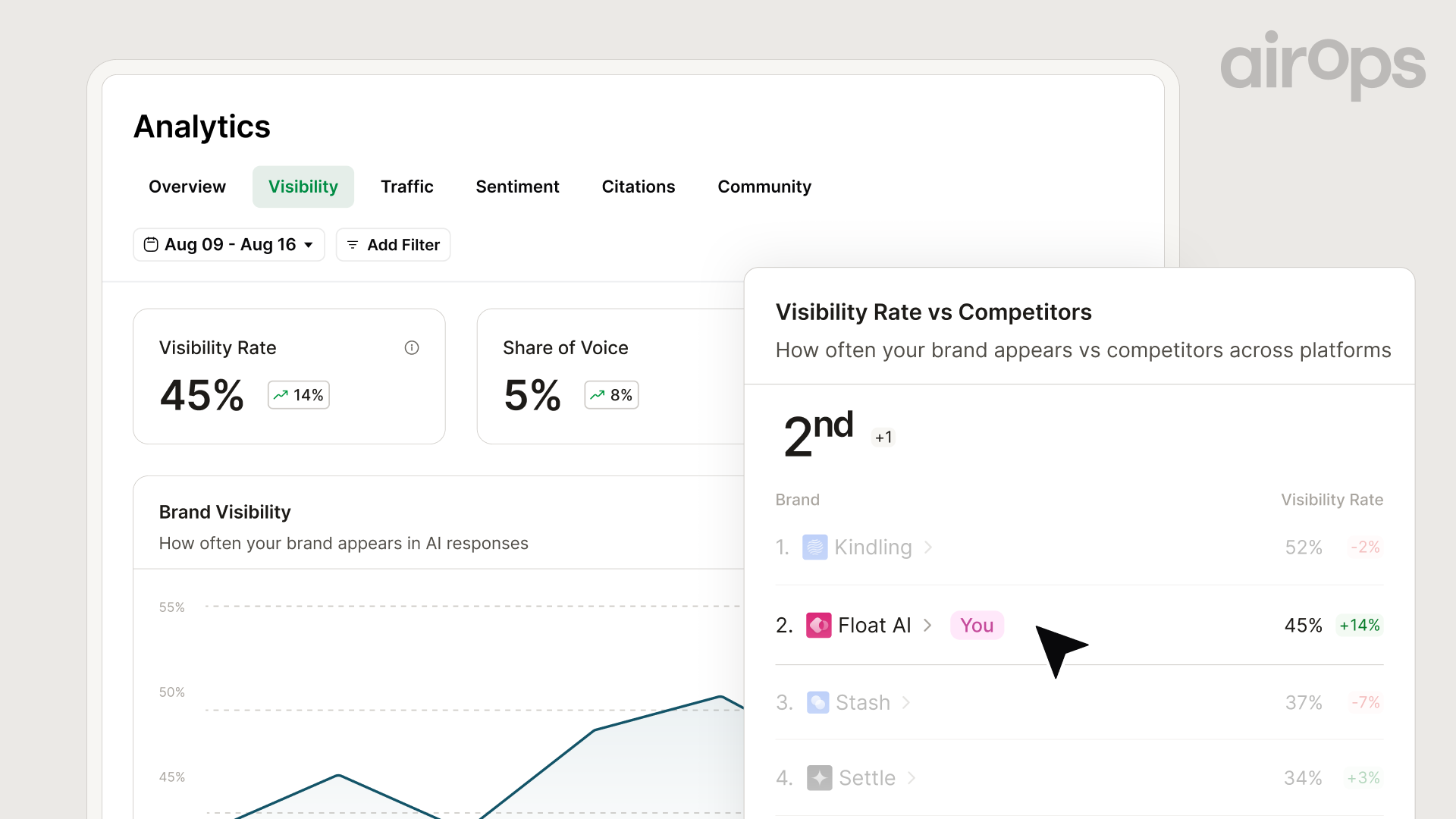
How AirOps helps Answer Engine Optimization(AEO)
Insights tracks how your brand appears across ChatGPT, Gemini, Perplexity, Google AI Overviews, and Google AI Mode. It monitors citation rate, mention rate, sentiment, and competitive positioning, then surfaces the specific questions your buyers are asking before they reach your site. Page360 connects that signal directly to Google Search Console and GA4 data, so you can see which pages are earning AI citations and how that maps to organic performance.
AirOps is the partner brands bring in for this work: the platform, the media mix, and a team that builds and runs the strategy alongside your own, tied to pipeline and revenue.
Here's where AirOps breaks from the pack. When Insights surfaces a declining page or an uncovered topic, Quill, AirOps' AI agent captain, takes action. Point Quill at a declining page, and it pulls competitive SERP data, analyzes the content gap, drafts an optimized refresh grounded in your Brand Kit, and queues the update for human review.
Your team sets the strategy. Quill runs the execution. Every content piece Quill produces passes through your Brand Kit's tone, terminology, and writing rules, so output stays consistent whether one person reviews it or twenty.
That system extends beyond single-page refreshes. Grids manage production at scale when you're running hundreds of pages through optimization cycles. And Offsite tackles the visibility gap that most competitors ignore entirely. LLMs form brand opinions from third-party sources, not just your own site. AirOps helps you build and track offsite mentions so the story AI tells about your brand matches the one you want told.
Why this matters for real teams
- Carta used AirOps to identify citation gaps and close them through targeted content updates.
- Chime achieved a 3x citation increase while cutting content production time by 89% and increasing refresh velocity by 70%.
- Webflow hit a 5x content refresh velocity with a 40% traffic uplift, and AI-sourced signups went from 2% to 10% of total.
- Docebo holds a 25% share of voice lead in their category, and AI discovery now drives 12.7% of their high-intent leads.
- Merge achieved #1-2 LLM visibility rankings with a solo content leader running the entire program through AirOps.
These results come from the closed loop. Insights finds the opportunity. Quill and Workflows execute the fix. Measurement confirms the outcome. Then the loop runs again.
Case study: Asana nearly doubled AI citations across four languages
Asana's global organic growth team was manually refreshing 20 to 30 pages per month, with legacy articles in secondary markets that had not been touched in five years. AirOps deployed automated localized content refreshes across French, Japanese, German, and Spanish with human review in the loop.
Measured over 33 days after publish, across 200+ refreshed articles: citation count rose 71% and citation rate rose 16%. First-mention rate, meaning how often Asana appears first in an AI answer, rose 18%. ChatGPT citations rose 93%, Google AI Overviews rose 42%, and Google AI Mode rose 11%. 58% of tracked prompts went from zero Asana presence to active citation.
“Quill has been a genuine game-changer for how we approach global SEO. We're not replacing human oversight. We're making it sharper and 800% faster.” - Enrique Santamaría, Head of Global Organic Growth, Asana
Case study: Brainlabs grew mention rate 42% in three months
Comparing December 1 to February 28 against March 1 to May 31, Brainlabs' mention rate grew from 7.33% to 10.41% and its share of voice grew from 28.57% to 38.67%, reaching 91.03% in Google AI Overviews. Per engine: Google AI Mode up 12.11 points, Gemini up 23.05 points, ChatGPT up 5.25 points, and Perplexity down 7.88 points. 80 pieces of content published in six months.
When AirOps is (and isn't) the right choice
- AirOps works best for:
- Enterprise content teams that need to move from AI visibility monitoring to scaled content execution without adding headcount.
- Marketing orgs that want one platform for AI search insight, content production, and performance measurement instead of stitching together three or four tools.
- Teams managing brand consistency across multiple writers, regions, or product lines who need governed AI content output.
- AirOps may not be ideal if:
- You only need a lightweight monitoring dashboard and have no plans to act on the data with content changes.
- Your team is pre-content-strategy and needs to build foundational pages before optimizing for AI search.
When AirOps is not the right choice
AirOps is built for enterprise content and SEO teams, and it is priced and structured that way. If you are a solo marketer or a two-person team looking for a dashboard you can log into on Monday and read on Tuesday, this is the wrong tool. There is real setup involved: connecting your brand kit, defining your prompt universe, and building the workflows that turn insight into published pages. Teams that get the most from AirOps usually have someone who owns that system.
If you want a first report in an afternoon, Otterly starts at $29/mo and Athena HQ has a free tier. Both will get you a visibility number faster. Neither will do anything about it once you have one.
AirOps also does not publish a starting price for paid tiers, which means evaluating it requires a conversation. If you need to compare line-item pricing on a spreadsheet before you talk to anyone, that is a real friction point.
What AirOps customers say on G2
“AirOps is helping us scale our AEO and SEO content strategy without scaling headcount. We use it to run content refreshes, track AI citation wins and drops, build offsite workflows for brand mention building, and generate reporting that would otherwise take the team hours to pull manually. It's become the backbone of how we measure and improve our visibility across AI search platforms like ChatGPT and Gemini.” - Bridget N., AEO/SEO Editorial Strategist, Enterprise, March 2026, 5.0/5 on G2
“The biggest problem AirOps solves is the gap between spotting an issue and actually fixing it. Most tools stop at the dashboard: they show you where you're losing visibility in AI search, but then you're left on your own to figure out what to do next. AirOps closes that loop by surfacing what's underperforming and then giving you workflows to create, refresh, and publish content directly.” - Manohar D., SEO Analyst, Mid-Market, August 2026, 4.5/5 on G2
Pricing & features
The Solo plan includes 100 tracked prompts, ChatGPT insights, and 20,000 content tasks. Pro includes multi-engine insights across all five AI platforms, weekly opportunity reports, 75,000 tasks, and unlimited seats. Enterprise includes custom limits, multiple regions, personas, and languages, dedicated account management, and expert onboarding.
AirOps holds a 4.7/5 rating on G2 across 134 reviews as of August 2026, and has been SOC 2 Type II compliant since January 2023.
Pricing verified: August 2026 · Last reviewed: August 2026
2. HubSpot AEO: Best for teams already running HubSpot
HubSpot pairs a free AI Search Grader with a standalone (or Marketing Hub-bundled) AEO tracking tool, so teams can go from a one-time AI visibility snapshot to ongoing prompt-level monitoring without leaving the HubSpot ecosystem.
Key features
- AI Search Grader: a free, one-time diagnostic that queries ChatGPT, Perplexity, and Gemini about your brand and returns a composite score across five weighted dimensions: Sentiment (40 pts), Presence Quality (20 pts), Brand Recognition (20 pts), Share of Voice (10 pts), and a fifth market-score component. No signup or credit card is required.
- Ongoing AEO tracking: the paid tool moves from "how does AI represent my brand right now" to "how is that changing, and what should I do about it," monitoring brand mentions, citations, sentiment (−100 to +100), and Share of Voice against named competitor domains across ChatGPT, Gemini, and Perplexity.
- CRM-connected reporting and prompt tracking: AEO metrics sit next to CRM and content data, with a starting allotment of 25 tracked prompts (expandable) covering the specific questions buyers ask.
Pros
- Free entry point (the Grader) makes HubSpot an easy first step for teams testing AEO before committing budget.
- First-party CRM data and built-in content creation tools ground reporting in real customer signals, offering a strong bridge before moving to a dedicated AEO platform.
- HubSpot reports beta customers saw AI-referred traffic up roughly 20% and AI-referred leads converting at about 3x versus other channels, alongside a broader ~27% YoY decline in organic search traffic across its customer base, which is exactly the trend line AEO is meant to address.
- HubSpot AEO carries a 5.0/5 rating on G2 across 2 reviews as of August 2026. The parent HubSpot Marketing Hub product rates separately and has thousands of reviews, so treat the AEO score as early-stage signal rather than established consensus.
Cons
- Ecosystem dependency: the deepest value (CRM tie-in, bundled pricing) comes when you already run Marketing Hub Pro/Enterprise.
- Limited multi-engine depth (3 engines: ChatGPT, Perplexity, Gemini) compared with dedicated AEO platforms tracking 6-10+ engines.
- Independent reviewers note the tool requires more setup and patience than early coverage suggested, and results take time: expect roughly 24 hours for initial data and several weeks before optimization changes register, since answer engines update gradually.
Pricing
The AI Search Grader is free. The standalone AEO tool runs $50/month ($45/month billed annually) outside Marketing Hub, or is bundled into Marketing Hub Pro/Enterprise plans, which scale with contacts and seats. Additional prompts beyond the starting allotment can be purchased at any time with no cap.
Pricing verified: August 2026 · Last reviewed: August 2026
3. Otterly AI: Best for fast, affordable AI visibility monitoring
Otterly AI is an entry-level monitoring tool built for teams that want a clear picture of their AI search presence without a large commitment.
Key features
- Multi-engine tracking: Monitors brand mentions and citations across ChatGPT, Gemini, Perplexity, and other AI platforms with daily or weekly cadence.
- Quick setup: Teams can start tracking within minutes of signing up, with no complex integration or onboarding required.
Pros
- Speed to value: Fastest time-to-insight on this list. You'll have data the same day you sign up.
- Accessible pricing: Starts at $29/mo, making it one of the most budget-friendly options for small teams or agencies.
Cons
- Monitoring only: No content creation, optimization, or execution workflows. You'll need separate tools to act on what Otterly surfaces.
- Limited depth: Enterprise teams tracking hundreds of queries across multiple products and regions may outgrow the platform quickly.
What Otterly AI’s reviewers say on G2
“The UI is very intuitive, and it helps me quickly understand which prompts are working well for my organization and which ones aren't. Being able to see the exact prompt response for each one is a game changer.” - Verified user, Frontend Developer, Small-Business, May 2026, 5.0/5 on G2
“One area for improvement is turning insights into actionable recommendations. While the monitoring capabilities are useful, it's not always clear what specific actions should be taken based on the findings. At this price point, I would expect more concrete guidance.” - Anastasiia P., Content Strategist, Small-Business, June 2026, 4.0/5 on G2
Pricing
Otterly publishes four tiers. Lite is $29/mo for 15 prompts, Standard is $189/mo for 100 prompts, Premium is $489/mo for 400 prompts, and Enterprise is custom priced. Annual billing drops the first three to $25, $160, and $422. Every tier tracks four engines (ChatGPT, Google AI Overviews, Perplexity, and Microsoft Copilot). Claude, Google AI Mode, and Gemini are paid add-ons. Pricing verified August 2026.
Otterly AI holds a 4.8/5 rating on G2 across 54 reviews as of August 2026.
Pricing verified: August 2026 · Last reviewed: August 2026
4. Profound: Best for multi-engine visibility dashboards
Profound is a monitoring dashboard that tracks brand presence across 10+ AI engines with a focus on data depth and competitive intelligence.
Key features
- Broad engine coverage: Monitors visibility across more than 10 AI search platforms, giving a wide view of brand presence across the AI search landscape.
- Front-end data capture: Uses real browser-based scraping to collect AI answers as users see them, capturing the full response context.
Pros
- Engine breadth: Covers more AI platforms than most tools on this list, useful for teams that need visibility beyond the top three engines.
- Reporting: Dashboards designed for reporting with exportable data and trend visualization.
Cons
- Synthetic query methodology: Uses AI-generated questions to test visibility rather than real user queries, which can skew results toward questions nobody actually asks.
- Monitoring only: No content execution or optimization workflows. Closing the gap between a visibility finding and a content fix requires separate tools and manual processes.
- Steep learning curve: Onboarding takes time, and the interface can overwhelm teams that need fast, focused answers.
What Profound’s reviewers say on G2
Profound has the largest user base of any dedicated AEO tool, with 1,128 reviews on G2, and its enterprise dashboards are the most established in the category. It is also the only tool in this comparison with no G2 pros and cons summary block, confirmed across three separate checks.
“The main limitation with Profound today is that it still requires a fair amount of interpretation and expertise to turn insights into action. It's powerful, but not yet fully self-explanatory. Citation data can also be inconsistent or glitchy at times, which means teams need to rely more on qualitative citation review than the aggregated metrics.” - Parinaaz S., Digital Marketing Lead UK and Ireland, Enterprise, May 2026, 3.5/5 on G2
“First, the Average Position Rank tracking is often flooded with brands I don't want to see, either because I don't consider them direct competitors or because they're completely undefined assets. For example, I'll see generic names like 'Banks,' 'A lenders,' or 'Big 5 Banks' show up, rather than an actual brand name. Second, if you run a business in Canada, the AI-generated answers being tracked might pull results from the US, which can affect how accurately your real performance is reflected.” - Haley T., SEO Manager, Enterprise, May 2026, 4.0/5 on G2
“One such area is the availability and transparency of the underlying prompt universe. The absence of visibility into this dataset can materially limit the level of confidence and trust clients place in Profound's recommendations and reporting outputs.” - Dharam J., Principal Search Marketing Strategist, Mid-Market, May 2026, 3.5/5 on G2
“It has great data, and I think what comes with having access to that great data and those fancy features is an enterprise price tag. But it's a little bit out of reach for the smaller operators.” - Maddy F., SEO Content Strategist and Founder, Enterprise, May 2026, 4.5/5 on G2
Pricing
Profound publishes three tiers. Starter is $99/mo and tracks ChatGPT only, with 50 prompts and 100 agent credits. Growth is $399/mo and covers three answer engines with 100 prompts and 400 credits. Enterprise is custom priced and covers up to nine answer engines, with SSO/SAML and SOC 2. Pricing verified August 2026.
Profound holds a 4.5/5 rating on G2 across 1,128 reviews as of August 2026.
See how AirOps and Profound compare.
Pricing verified: August 2026 · Last reviewed: August 2026
5. Peec AI: Best for precise citation tracking
Peec AI focuses on accuracy in citation measurement, using UI scraping methodology to capture exactly how AI engines cite content in their responses.
Key features
- UI scraping methodology: Captures citations as they appear in the AI engine interface, reducing the gap between what you measure and what users see.
- Unlimited seats: Every plan includes unlimited team members, removing per-seat cost scaling that plagues other enterprise tools.
Pros
- Data accuracy: UI scraping produces citation data that closely matches what real users see. Unlimited seats on every plan. Peec AI holds a 4.8/5 rating on G2 across 18 reviews as of August 2026.
- Team-friendly pricing: Unlimited seats mean you won't pay more as your team scales.
Cons
- Not an AI content generator. Peec surfaces opportunities via Actions (its prioritized recommendation layer, included on all plans), but your team still writes the content.
- No historical data: Tracking only begins from the date you sign up. You can't backfill historical trends or benchmark against prior performance.
What Peec AI’s reviewers say on G2
“The MCP integration is the reason we picked Peec. I don't adopt tools without an MCP anymore, and Peec's is super useful: all the visibility and competitor data is right there where my other tools can reach it, instead of locked in a dashboard.” - Alexandre A., Founder, Small-Business, July 2026, 5.0/5 on G2
Peec AI’s only enterprise reviewer names its tier packaging as the constraint:
“The subscription wall between seeing all AI models. Only few models per tier, so smart business model but feels limiting from time to time.” - Verified user in Tobacco, Enterprise, August 2026, 4.0/5 on G2
Pricing
Plans range from approximately $95/mo to $495/mo depending on tracking volume and feature access. All tiers include unlimited seats.
Compare AirOps and Peec.
Pricing verified: August 2026 · Last reviewed: August 2026
6. SE Visible: Best for SEO teams adding AI visibility to an existing stack
SE Visible, built by SE Ranking, brings AI visibility intelligence to teams already invested in the SE Ranking ecosystem.
Key features
- Clean dashboards: Intuitive interface that makes AI visibility data accessible to team members who aren't AEO specialists.
- SE Ranking integration: Connects AI visibility data directly to your existing SE Ranking SEO workflows and keyword tracking.
- Unlimited seats: All plans include unlimited users, supporting team-wide adoption without cost escalation.
Pros
- Ease of adoption: Teams already using SE Ranking can add AI visibility tracking without switching platforms or learning a new tool.
- Visual clarity: Dashboards are designed for quick comprehension, making it easy to spot trends and share findings with leadership.
Cons
- Monitoring only: No content execution or optimization capabilities. Insights need to be acted on through separate tools.
- SE Ranking dependency: Strongest value comes when paired with SE Ranking's SEO suite. As a standalone AEO tool, it's less differentiated.
What SE Ranking’s reviewers say on G2
“API Access for AEO was particularly useful because it allowed us to access AI visibility information programmatically instead of relying entirely on manual checks and exports.” - Amanda M., Deputy Manager, Retail, Enterprise, August 2026, 5.0/5 on G2
Pricing
Plans run from $89/mo to $259/mo. SE Visible has no separate G2 listing. The parent SE Ranking platform holds 4.7/5 across 1,594 reviews as of August 2026.
Pricing verified: August 2026 · Last reviewed: August 2026
7. Semrush AI Toolkit: Best for adding AEO data to an established SEO workflow
Semrush's AI Toolkit brings AEO monitoring features into one of the most widely used SEO platforms on the market.
Key features
- AI search tracking: Monitors brand visibility and citations within AI-generated search results alongside traditional keyword data.
- 17 years of search data: Adding AEO metrics on top of Semrush's deep keyword and backlink database gives historical context that newer tools can't match.
Pros
- No tool switching: Teams already in Semrush get AEO data without adding another platform to their stack.
- Data depth: Combining AI visibility metrics with 17 years of traditional search data produces competitive context that standalone AEO tools can't replicate.
Cons
- AEO features are shallow: AI search tracking is an add-on to Semrush's core SEO product, not a dedicated focus. Depth and granularity lag behind purpose-built AEO tools.
- No content execution: Semrush helps you identify opportunities but doesn't provide automated content workflows to act on them at scale.
What Semrush’s reviewers say on G2
“Semrush saves me significant time on SEO and AEO research and benchmarking. I can quickly see where my site stands against competitors.” - Ben R., Senior Manager, Digital Marketing, Enterprise, June 2026, 4.0/5 on G2
Pricing
Semrush Pro starts at $139.95/mo and includes the AI Toolkit features. Semrush AI Toolkit holds a 4.4/5 rating on G2 across 4,029 reviews as of August 2026.
See how AirOps and Semrush compare.
Pricing verified: August 2026 · Last reviewed: August 2026
8. Scrunch AI: Best for competitive share-of-voice benchmarking
Scrunch AI focuses on competitive intelligence in AI search, helping teams understand how their brand stacks up against competitors in AI-generated responses.
Key features
- Competitive share-of-voice: Measures how often your brand appears relative to competitors in AI search answers across key topics and categories.
- AI agent experience testing: Simulates how AI agents interact with and perceive your brand, surfacing gaps in how your content is interpreted by LLMs.
Pros
- Competitive framing: Strong at showing relative brand positioning, which is useful for executive reporting and competitive strategy discussions.
- Brand perception insights: The AI agent simulation gives a unique lens on how LLMs construct narratives about your brand.
Cons
- Limited execution: Content auditing provides recommendations, but the platform doesn't include automated content creation or publishing workflows.
- Higher entry price: Starting at $250/mo, Scrunch is more expensive than monitoring-only tools without offering the execution layer that justifies the premium.
Pricing
Plans start at $300/mo billed month-to-month, or $250/mo billed annually. Exact tier breakdowns require a sales conversation for enterprise volume. Scrunch AI holds a 4.6/5 rating on G2 across 73 reviews as of August 2026.
See how AirOps and Scrunch compare.
Pricing verified: August 2026 · Last reviewed: August 2026
9. Athena HQ: Best for brand integrity monitoring with content optimization agents
Athena HQ pairs AI search intelligence with content agents designed for generative engine optimization (GEO), offering both monitoring and guided content improvements.
Key features
- 7+ AI engine tracking: Monitors brand presence across seven or more AI search platforms, covering the major engines and several emerging ones.
- Brand integrity monitoring: Tracks not just visibility but the accuracy and sentiment of how AI engines represent your brand.
- Content agents for GEO: Provides AI-assisted content optimization workflows that help improve content for AI extractability.
Pros
- Monitoring plus optimization: One of the few tools in this category that pairs visibility tracking with content improvement capabilities.
- Free trial credit: $300 in free credit lets teams test the platform before committing to a paid plan.
Cons
- Newer platform: Less market validation than established competitors. Fewer case studies and customer references available for enterprise evaluation.
- Price gap between tiers: Annual pricing at $95/mo jumps to $295/mo on a monthly basis, creating a significant commitment for teams that want flexibility.
Pricing
Annual billing starts at $95/mo. Monthly billing is $295/mo. A $300 free credit is available for new accounts. Athena HQ holds a 4.9/5 rating on G2 across 38 reviews as of August 2026, and states SOC 2 Type II compliance.
Pricing verified: August 2026 · Last reviewed: August 2026
10. BrightEdge: Best for Fortune 500 SEO programs adding AI visibility
BrightEdge is an established enterprise SEO platform with 18+ years of search data and a growing AI visibility layer built on top of its existing infrastructure.
Key features
- Massive data footprint: 18+ years of search performance data provides deep historical context for understanding how AI search visibility relates to traditional SEO performance.
- Fortune 500 adoption:57% of the Fortune 500 use BrightEdge, which means extensive enterprise integration support and proven scalability.
- AI visibility reporting: Tracks brand mentions and citations in AI-generated search results as part of its broader search analytics suite.
Pros
- Enterprise credibility: For organizations where vendor selection goes through procurement, BrightEdge's market presence and enterprise track record reduce buy-in friction.
- Historical data depth: No other tool on this list can layer AI visibility on top of nearly two decades of SEO performance data.
Cons
- Complex interfaces: The platform's depth comes with complexity. Teams often need dedicated BrightEdge administrators to extract full value.
- No content execution: BrightEdge reports on performance but doesn't provide content creation, optimization, or publishing workflows. The gap between insight and action stays open.
- Opaque pricing: No public pricing. Credit-based models and multi-year contracts make cost evaluation difficult before engaging sales.
What BrightEdge’s reviewers say on G2
“The biggest improvement BrightEdge can currently make is the AI and content suggestions. They aren't always nuanced enough.” - Jonathan C., Senior Digital Marketing Analyst, Enterprise, April 2026, 5.0/5 on G2
Pricing
BrightEdge does not publish pricing. Contracts are custom, typically credit-based, and often multi-year. Expect enterprise-level investment. BrightEdge holds a 4.4/5 rating on G2 across 842 reviews as of August 2026.
Pricing verified: August 2026 · Last reviewed: August 2026
11. Surfer SEO: Best for optimizing content structure for AI extractability
Surfer SEO is a content optimization platform that helps writers structure and score content for search performance, with growing relevance for AI extractability.
Key features
- Content Editor: Scores content in real-time against top-ranking pages, providing specific guidance on structure, word count, heading usage, and keyword density.
- NLP scoring: Uses natural language processing to evaluate how well content matches the semantic patterns AI engines look for when selecting sources to cite.
- SERP analysis: Breaks down what's working for top-ranking pages so writers can model their content structure against proven patterns.
Pros
- Writer-friendly: The Content Editor provides actionable, real-time feedback that writers can apply without AEO expertise. Surfer SEO holds a 4.8/5 rating on G2 across 546 reviews as of August 2026.
- Accessible pricing: Starting at $89/mo, Surfer is affordable for teams that want to improve content quality without a large platform investment.
Cons
- SEO-first tool: AEO optimization is a secondary benefit, not the primary design goal. Teams that need dedicated AI visibility tracking will need a separate tool.
- No AI visibility monitoring: Surfer doesn't track how your content appears in AI search results after publishing. You can optimize for extractability but can't measure the outcome.
Pricing
Plans range from $89/mo for Essential to $219/mo for Scale, with an Enterprise tier available for larger teams.
Pricing verified: August 2026 · Last reviewed: August 2026
12. Writesonic: Best for combining AI writing with visibility tracking
Writesonic pairs its AI Article Writer with generative engine optimization (GEO) monitoring, giving teams a content creation and basic tracking bundle.
Key features
- Cross-LLM tracking: Monitors how content performs across multiple AI engines, providing visibility data alongside the writing tool.
- AI Article Writer: Generates draft content optimized for search with built-in SEO guidance and structural templates.
- GEO insights: Surfaces data on how AI engines are citing and referencing your content relative to competitors.
Pros
- Two-in-one value: Combines content creation and AI visibility tracking in a single subscription, reducing tool sprawl for smaller teams. Writesonic holds a 4.7/5 rating on G2 across 2,124 reviews as of August 2026.
- Affordable entry: Starting at $79/mo, Writesonic is one of the more budget-friendly options that includes both writing and monitoring capabilities.
Cons
- Surface-level GEO insights: The monitoring features lack the depth of dedicated AEO tools. Enterprise teams will find the competitive analysis and granularity insufficient.
- No brand governance: The AI writer doesn't include brand kit, style guide, or writing rule enforcement, which means output consistency depends on manual review.
What Writesonic’s reviewers say on G2
“We started using Writesonic because we needed to know whether our content was actually being cited when people asked AI tools about our industry. The citation share view answered that immediately.” - Verified user in Computer Software, August 2026, 5.0/5 on G2
“The biggest drawback is content accuracy. While Writesonic produces well-written drafts quickly, I don't consider the output publication-ready without reviewing the facts, refining the tone, and removing occasional repetition.” - Verified user in Oil and Energy, Enterprise, July 2026, 4.5/5 on G2
Pricing
Plans range from $79/mo for Individual to $249/mo for Team, with Enterprise pricing available on request.
Compare AirOps vs Writesonic.
Pricing verified: August 2026 · Last reviewed: August 2026
13. Ahrefs Brand Radar: Best for adding AI visibility data to Ahrefs workflows
Ahrefs Brand Radar brings AI visibility tracking to one of the most established SEO toolsets, powered by a database of 350M+ real-user prompts.
Key features
- 350M+ prompt database: Built on real user queries rather than synthetic prompts, giving a large-scale view of how AI engines respond to actual search behavior.
- Ahrefs integration: AI visibility data connects to Ahrefs' keyword research, backlink analysis, and site audit tools for a unified view.
Pros
- Real query foundation: The 350M+ prompt database provides a stronger data foundation than tools relying on smaller or synthetic query sets.
- Familiar interface: Teams already using Ahrefs get AI visibility data in an interface they know. Ahrefs holds a 4.5/5 rating on G2 across 713 reviews as of August 2026.
Cons
- Documented underreporting: Some users have reported that Brand Radar underreports visibility in certain AI engines, which can create gaps in competitive analysis.
- Price barrier: The AI indexes add-on requires an Ahrefs subscription at $699/mo, putting it out of reach for teams that don't already pay for Ahrefs.
Pricing
Brand Radar is available as an add-on to Ahrefs plans. Full AI indexes access requires an Ahrefs subscription at $699/mo.
See how AirOps and Ahrefs compare.
Pricing verified: August 2026 · Last reviewed: August 2026
14. Frase: Best for question-based content research and drafting
Frase helps content teams research questions their audience is asking and draft content structured to answer them, making it a useful pre-publishing optimization tool.
Key features
- Question clustering: Aggregates questions from search results, People Also Ask boxes, and forums to identify the queries your content should address.
- Content Editor: Provides real-time scoring and optimization guidance as you write, based on top-performing pages for your target queries.
Pros
- Research-to-draft speed: Frase reduces the time between identifying a content opportunity and having a first draft ready for review. Frase holds a 4.8/5 rating on G2 across 309 reviews as of August 2026.
- Affordable: Starting at $49/mo, Frase is one of the lowest-cost tools on this list.
Cons
- No post-publish monitoring: Frase helps you create content but doesn't track how that content performs in AI search results after publishing. The feedback loop is missing.
- No citation tracking: You can't measure whether your optimized content is earning AI citations or mentions.
Pricing
Solo starts at $49/mo. Team plans run $299/mo. Enterprise pricing is available on request.
Compare Frase and AirOps for AEO.
Pricing verified: August 2026 · Last reviewed: August 2026
15. Conductor: Best for multi-brand SEO reporting with AEO data
Conductor is an enterprise SEO platform that has added AI visibility reporting to its suite, giving large organizations a unified view of traditional and AI search performance.
Key features
- Multi-brand, multi-market reporting: Supports enterprise organizations managing SEO and AI visibility across multiple brands, products, and geographic markets from one platform.
- AI visibility reporting: Tracks brand presence in AI-generated search results alongside traditional organic search metrics.
Pros
- Scale for large orgs: Built for enterprises managing complex, multi-brand content programs that need centralized reporting. Conductor holds a 4.5/5 rating on G2 across 788 reviews as of August 2026.
- Unified reporting: Combines traditional SEO and AI visibility data in a single dashboard, reducing the number of tools leadership needs to review.
Cons
- Insight over execution: Conductor reports on performance but doesn't provide content creation or automated optimization workflows. The gap between finding a problem and fixing it stays open.
- Enterprise pricing only: No self-serve plans. Teams must go through a sales process, which slows evaluation and commitment.
What Conductor’s reviewers say on G2
“Steep learning curve. UI can be complex. Some data discrepancies vs GSC. Reporting setup can be time-intensive.” - Brian B., SEO Consultant, Enterprise, June 2026, 4.5/5 on G2
Pricing
Conductor uses enterprise-only pricing with no public tiers. Expect a sales-driven process with annual contracts.
Compare AirOps and Conductor.
Pricing verified: August 2026 · Last reviewed: August 2026
16. Rankshift: Best for dedicated AI answer engine tracking
Rankshift is a newer AEO tracker built to monitor how brands appear across AI answer engines, with a focus on prompt-level visibility and competitive share.
Key features
- Prompt tracking: monitors brand mentions and citations against the prompts buyers actually ask AI engines.
- Competitive share: benchmarks your visibility against named competitors across ChatGPT, Gemini, and Perplexity.
Pros
- Built specifically for AI answer engine visibility rather than bolted onto an SEO suite.
- Fast setup lets teams start tracking prompts shortly after signing up.
Cons
- Monitoring only: Rankshift tracks visibility but leaves content execution to your team.
- Emerging platform with fewer public case studies, and no G2 or TrustRadius profile yet.
Pricing
Rankshift publishes plan pricing on its site, starting from $82/mo billed annually, with tiers that scale by the number of tracked prompts and engines. Rankshift has no G2 listing as of August 2026.
See how AirOps and Rankshift compare.
Pricing verified: August 2026 · Last reviewed: August 2026
17. AIclicks.io: Best for turning AI visibility data into automated content execution
AIclicks.io is a GEO (Generative Engine Optimization) platform that tracks brand mentions, citations, and sentiment across 10+ AI platforms, including ChatGPT, Perplexity, Gemini, Google AI Overviews, and Claude, with a focus on uncovering the exact prompts buyers use and turning findings into done-for-you action plans.
Key features
- Prompt-level tracking: monitors mentions, citations, and sentiment across ChatGPT, Perplexity, Gemini, Copilot, Claude, Grok, DeepSeek, Meta AI, and more.
- Source intelligence: identifies which external domains get cited for your topics, their traffic, and page type (Reddit, directories, listicles, etc.), so you can target the sources that actually influence AI answers.
- Automated action plans: uses AI agents to optimize content and pursue citations where competitors currently lead, rather than just reporting the gap.
Pros
- Covers more AI platforms than most competitors (10+ vs. the typical 3-5), with daily data updates.
- Moves beyond visibility auditing into automated content execution within a single platform.
- Filterable by platform and country, useful for teams whose competitive position varies by model or market.
Cons
- Best suited for lightweight/budget-conscious teams and positioned as less robust than enterprise-focused tools like Profound AI for large-scale precision monitoring.
Pricing
Three tiers: Starter at $59/month (30 prompts, 3 platforms), Pro at $189/month (150 prompts, 4 platforms), and Business at $499/month (300+ prompts, 6 platforms), each with a 3-day free trial. Custom plans are available for larger commitments. AIclicks.io holds a 4.9/5 rating on G2 across 46 reviews as of August 2026.
Pricing verified: August 2026 · Last reviewed: August 2026
Why Answer Engine Optimization matters for AI search in 2026
AI answers now decide who buyers find first. G2 reports that 93% of buyers say AI has changed how they research, so the responses ChatGPT, Gemini, and Perplexity return shape your pipeline before anyone reaches your site.
The signals that win AI citations differ from the ones that won blue-link rankings. Backlink authority no longer predicts AI visibility, and sequential heading structure earns 2.8x more citations than flat pages. That gap is why teams now buy dedicated AEO tools instead of stretching a backlink dashboard to cover AI search. The best AEO software tracks that shift continuously, so you catch drops before they cost you pipeline.
Here is what the data means for how you evaluate tools:
- Track citations and mentions, not domain authority. In a recent AirOps webinar, HubSpot showed that answering the question clearly matters more than backlink authority for AI citations.
- Cover multiple engines. Buyers split their questions across ChatGPT, Gemini, and Perplexity, so single-engine tracking misses real demand.
- Connect insight to action. Generative engine optimization tools that stop at a dashboard leave the content work to you.
What is an Answer Engine Optimization tool?
An Answer Engine Optimization (AEO) tool helps marketing teams monitor, influence, and measure how their brand appears in AI search results. These tools track metrics like citation rate, mention rate, sentiment, and competitive positioning across AI platforms, and the best ones connect that data to content workflows that improve visibility over time. AEO software also goes by names like AEO trackers, AEO checkers, generative engine optimization (GEO) tools, and AEO visibility tools, but the job stays the same: measure and improve how your brand shows up in AI answers. AEO differs from traditional SEO, which targets blue-link rankings, and it overlaps with generative engine optimization (GEO), the practice of earning visibility inside generative AI answers.
Common use cases for Answer Engine Optimization tools
- AI visibility monitoring: Track how often AI engines cite or mention your brand when answering questions in your category, track your AEO ranking against competitors, and spot drops before they become trends. AI visibility tools automate this tracking so you catch changes early.
- Competitive benchmarking: Compare your share of voice against competitors across ChatGPT, Gemini, Perplexity, and other AI search platforms to identify where you're winning and losing.
- Content gap identification: Find the questions your buyers are asking AI that your content doesn't answer well enough to earn a citation.
- Content optimization for AI extractability: Structure and rewrite existing pages so AI models can more easily parse, summarize, and cite your content in their responses.
- Citation source analysis: Understand which of your pages are being cited, which competitor pages are beating you, and what third-party sources are shaping the AI narrative about your brand.
- Performance attribution: Connect content changes to movements in AI visibility metrics so you can prove what worked and prioritize what to do next.
What makes a great Answer Engine Optimization tool?
- Real query data: The best tools track visibility against the questions real buyers type, not AI-generated synthetic prompts. Data quality is the foundation everything else depends on.
- Multi-engine coverage: AI search is fragmented across ChatGPT, Gemini, Perplexity, Google AI Overviews, and others. A tool that only covers one platform gives you a partial picture. Coverage across ChatGPT, Gemini, and Perplexity matters, because single-engine coverage misses real demand.
- Actionability beyond dashboards: Insight without a path to action creates a reporting burden, not a competitive advantage. Look for tools that connect monitoring to content workflows.
- Content performance attribution: The ability to tie a specific content change to a measurable shift in AI visibility separates strategic tools from vanity dashboards.
- Brand governance at scale: Enterprise teams need AI-assisted content production that stays on brand across writers, regions, and product lines without manual review bottlenecks.
- Continuous monitoring over one-time audits: AI citations shift from month to month, so the best answer engine optimization tools track visibility on an ongoing cadence instead of a single snapshot.
What metrics do Answer Engine Optimization tools track?
Answer engine optimization tools track how often AI engines cite and mention your brand, and how that visibility changes over time. The strongest platforms report these metrics per prompt, per engine, and against your competitors.
Citations and mentions play distinct roles in AI visibility, so good AEO tracking software measures them separately.
- Citation rate: how often an AI answer links to your page when it includes sources.
- Mention rate: how often an AI answer names your brand, with or without a link.
- Citation share and share of voice: your visibility against named competitors in the same answers.
- Sentiment: whether AI engines describe your brand positively, neutrally, or negatively.
- Average position and trends: where you appear in an answer, and whether that visibility holds from month to month.
Track trends, not snapshots. AI citations shift constantly, with many cited pages changing from one month to the next, so a single score tells you little about how you will perform next month.
How did we evaluate these AEO tools?
This comparison is built on primary-source documentation review, not hands-on product testing. Here is exactly what that means.
For every tool on this list we reviewed the vendor’s own pricing page, product documentation, security and trust pages, and published feature specifications. We recorded starting prices, tier structures, the number and names of AI engines tracked at each tier, free tier and trial terms, and whether the vendor makes an explicit SOC 2 claim. Where a vendor’s own pages disagreed with each other, we have said so rather than picking the more favorable figure.
For user experience we relied on third-party review platforms rather than our own impressions. Every rating on this page comes from the product’s own G2 page, along with its review count and reviewer composition by company size. We have quoted both positive and critical reviews verbatim, with G2’s attribution, and linked to the source.
What this evaluation does not include
We have not run these tools side by side against a controlled prompt set, and we are not reporting our own measurements of any tool’s citation-detection accuracy. Where a tool’s capability is described here, it reflects what the vendor publishes and what its reviewers report, not what we independently observed.
Verification dates
Pricing, engine coverage, and SOC 2 status verified against vendor pages in August 2026. G2 ratings, review counts, and reviewer composition retrieved August 2026. We re-verify pricing quarterly.
How tools qualified for this list
A tool needed a public pricing page or a published enterprise sales process, coverage of at least three AI engines, and general availability rather than waitlist access. Tools we assessed and did not include are listed below with the reason.
Tools we assessed and did not include
How to choose the right Answer Engine Optimization tool for your needs
- Enterprise teams: If you need to close the gap between AI visibility data and content execution at enterprise scale, prioritize platforms with built-in content workflows and brand governance. The best enterprise AEO tools connect that governance to measurement, so large teams prove impact.
- Small businesses and startups:If you're starting from zero and need to understand your current AI search presence before building a strategy, look for AEO tracking software with fast setup and free answer engine monitoring tiers. The best answer engine optimization tools for small businesses pair a free tier with a clear path into answer engine optimization as you scale.
- SEO-led teams:If your team already runs on an established SEO platform like Semrush, Ahrefs, or SE Ranking, evaluate whether the AEO add-on provides enough depth or if you need a dedicated tool or one of the best Semrush alternatives for AI search visibility tracking.
- Executive reporting:If executive reporting on competitive share-of-voice is your primary use case, prioritize answer engine optimization reporting tools with strong benchmarking dashboards and multi-engine coverage.
- Content and editorial teams:If your concern is content quality and AI extractability rather than visibility tracking, look at content optimization tools that score and structure content for AI consumption. You can also scan content for AEO readiness before you publish.
- Multi-brand and agency teams:If you manage content across multiple brands, regions, or product lines, prioritize enterprise features like brand governance, multi-market support, and team-wide access. Agencies and B2B SaaS teams comparing affordable AEO tools should weigh per-seat pricing against platforms that include unlimited seats.
The right tool depends on where your team is in its AEO maturity. Teams that only need monitoring can start lean. Teams ready to act on what they find need a platform that connects insight to execution and measures the result. The tools that stop at dashboards will eventually create a new problem: a growing backlog of visibility gaps with no scalable way to close them.
Answer Engine Optimization best practices for 2026
The best AEO tools point you toward the work that earns citations. Pair your tool with these practices to get more from every optimization cycle.
- Format headings as questions. AI engines match questions to answers, so question-style H2s and H3s help your content get extracted and cited.
- Add FAQ sections with schema. Structured FAQ blocks give answer engines clean, quotable passages to pull from.
- Keep paragraphs short and self-contained. One idea per paragraph makes it easier for an LLM to lift your answer.
- Publish pricing and product facts on your own pages. If the details are not on your site, AI engines learn them from someone else, sometimes wrong.
- Build offsite mentions, and scan your content for AEO readiness before you publish.
- Test prompts as your own customer. Ask ChatGPT, Gemini, and Perplexity the questions your buyers ask, then note where you are missing.
Track each change so you can see what moved your visibility. That feedback loop is how these answer engine optimization best practices compound through 2026.
AirOps: Build your AEO strategy with the best tool for AI search
AI search is the fastest-growing discovery channel in marketing, and the teams that build systems for it now will compound their advantage over the next two years. Whether you start with monitoring or go straight to a full-loop platform, the important thing is to start measuring how AI talks about your brand and building the operational muscle to influence it. AirOps gives your team the AI visibility data and execution system to turn AI search into a growth channel you can manage.
Book a demo to see how your enterprise team can close the loop between AI search insight and content execution with AirOps.
Which AEO tools do enterprise buyers actually rate well?
A star rating without its reviewer base is not a comparison. Two tools on this page hold ratings above 4.7, and neither has a meaningful number of enterprise reviewers behind it. Here is the reviewer composition G2 publishes for each tool, retrieved August 2026.
Read that table from the right, not from the left. Otterly holds the joint-highest rating in this comparison and not one of its 54 reviewers is at an enterprise. Writesonic’s 4.7/5 rests on a base that is 91.5% small business. Peec AI has exactly one enterprise reviewer out of eighteen.
The three tools with real enterprise review volume all rate lower overall than the tools with almost none. That is not a coincidence. Enterprise buyers score tools on multi-brand support, SSO, data governance, and integration depth, and those requirements are harder to satisfy than a solo marketer’s.
If you are buying for an enterprise, the ratings that should carry weight are the ones with enterprise reviewers behind them.
What can AEO tools not do?
Peec AI does not offer content auditing or optimization. It measures.
Semrush's AI Toolkit monitors visibility but does not optimize content for it.
Surfer SEO's Discovery tier includes no AI engine tracking at all.
No tool in this category can guarantee a citation. Answer engines re-rank sources continuously, and cited domains turn over substantially month to month, so any vendor promising a fixed placement is describing something the underlying systems do not offer.
No tool measures your true mention rate across every engine. Each platform samples a finite prompt set on a schedule, so every number you see is an estimate with a sampling method behind it. Ask any vendor how often they sample each prompt and how many models they query before you compare their numbers to anyone else's.
Frequently Asked Questions
FAQs about Answer Engine Optimization tools
What is Answer Engine Optimization and how is it different from SEO?
Answer Engine Optimization (AEO) focuses on how your brand appears in AI-generated search responses from platforms like ChatGPT, Gemini, and Perplexity. Traditional SEO optimizes for ranking in blue-link search results. AEO optimizes for citations, mentions, and sentiment in AI answers. Both matter, but AEO addresses the growing channel where buyers go directly to AI for recommendations and research.
Do I need a dedicated AEO tool or can my SEO platform handle it?
Several SEO platforms have added AI visibility features, and they can work as a starting point. The limitation is depth. Add-on AEO features in tools like Semrush or Ahrefs typically offer basic monitoring without the granularity, multi-engine coverage, or content execution workflows that dedicated AEO platforms provide. If AI search is becoming a meaningful channel for your business, a dedicated tool will give you more signal and more ways to act on it.
How quickly can I see results from AEO optimization?
Most teams see initial data within 24 hours of setting up a monitoring tool. Content changes that improve AI visibility typically take two to six weeks to show measurable movement in citation rates and mention frequency, depending on how often AI engines refresh their training data and source indexes. Teams that run continuous optimization loops see compounding improvements over three to six months.
Can AEO tools help with both branded and non-branded queries?
Yes. Branded queries track how AI engines respond when someone asks about your company by name. Non-branded (category) queries track how you appear when someone asks a general question in your space, like "best project management software." Category queries are where the biggest growth opportunities live because they capture buyers before they've formed a brand preference.
What should I look for in AEO tool pricing?
Watch for per-seat costs that scale as your team grows, credit-based models that make costs unpredictable, and hidden fees for features like multi-engine tracking or historical data. The most transparent tools publish their pricing, include unlimited seats, and make it clear what each tier includes. Free tiers or trial credits are useful for evaluating data quality before committing.
What tools automate an AI content pipeline from research to publishing with AEO tracking?
AirOps automates the full pipeline. Quill runs Playbooks that research, draft, and publish content to your CMS, then tracks AEO performance so you see what each update moved. Your team sets the strategy, and Quill runs the execution.
Which tools track AI search visibility and AEO performance over time?
AirOps Insights tracks citation rate, mention rate, and sentiment across ChatGPT, Gemini, Perplexity, and Google AI Overviews, and Page360 ties that to your Google Search Console and GA4 data over time. Monitoring-first tools like Otterly AI, Profound, and Peec AI also track visibility trends, though they stop at the dashboard.
What is the best CMS with AEO features?
No CMS ships native AEO features yet, so the strongest setup pairs your CMS with a dedicated AEO platform. AirOps connects AEO insights to content and publishes directly to Webflow, WordPress, Contentful, Sanity, and Ghost, so optimized pages ship without leaving your workflow.
What's the difference between basic and enterprise AEO tools?
Basic AEO tools monitor brand mentions and citations across a few AI engines and suit small teams testing the channel. Enterprise AEO software adds multi-engine coverage, brand governance, multi-market support, and content execution at scale. AirOps covers the enterprise end by connecting insight to action in one system.
What tools are best for keyword research for AEO?
AEO keyword research starts with the prompts real buyers ask AI, not just search keywords. AirOps Prompt Discovery pulls from real ChatGPT, Perplexity, and Google AI sessions, People Also Ask data, and your own customer conversations to surface prompts worth tracking. Traditional tools like Semrush and Ahrefs add keyword volume context on top.
What's the difference between AI answer tracking tools and AI-optimized content platforms?
AI answer tracking tools show where your brand appears in AI responses and stop there. AI-optimized content platforms also help you write and publish content that earns citations. AirOps combines both, tracking AI visibility and running the content that improves it.
What is the difference between an AEO checker, an AEO tracker, and an AEO grader?
The terms overlap. An AEO checker or AEO grader usually runs a one-time audit that scores how well a page or brand is set up for AI answers. An AEO tracker monitors that visibility continuously over time. The strongest AEO tools do both, grading your current state and tracking how it changes as you optimize.
What are the best AEO tools for small and mid-market teams?
Small and mid-market teams get the most value from AEO tools with a free tier or low starting price and fast setup, like Otterly AI or HubSpot's free AI Search Grader. As AI search becomes a core channel, a platform that connects tracking to content execution, like AirOps, scales with the team without adding headcount.
What's the difference between an AEO analytics platform and an AEO rank tracker?
An AEO rank tracker tells you where your brand appears in AI answers for a set of prompts. An AEO analytics platform goes further, connecting those positions to citation rate, mention rate, sentiment, and the content changes that moved them. Rank trackers report the score. Analytics platforms help you improve it.
Should you use an AEO tool or an AEO agency?
Use an AEO tool when you want to own tracking and optimization in-house, and consider an agency when you need extra hands to execute. Many teams start with a tool for visibility data, then add outside help only for content production. AirOps covers both, pairing AEO tracking with content execution so you scale without adding headcount.
What are the sources referenced on this page?
Pricing and product claims verified against each vendor’s own pages in August 2026:
Vendor pricing pages
- www.tryprofound.com/pricing
- otterly.ai/pricing
- www.peec.ai/pricing
- www.peec.ai/ai-instructions
- visible.seranking.com
- seranking.com/pricing.html
- www.semrush.com/pricing/ai
- www.semrush.com/prices
- www.scrunch.com/pricing
- www.athenahq.ai/pricing
- surferseo.com/pricing
- writesonic.com/pricing
- ahrefs.com/pricing
- ahrefs.com/brand-radar
- www.frase.io/pricing
- www.conductor.com/pricing
- www.rankshift.ai/pricing
- aiclicks.io/pricing
- www.airops.com/pricing
- www.hubspot.com/products/marketing/aeo
Vendor security and trust pages, where SOC 2 status was checked
- www.airops.com/blog/airops-is-soc-2-type-ii-compliant
- www.tryprofound.com/blog/soc-2-type-2
- www.scrunch.com/faqs
- trust.athenahq.ai
- www.brightedge.com/trust
- www.frase.io/security
- www.conductor.com/security
- writesonic.com/enterprise
- ahrefs.com/legal/security-measures
- legal.hubspot.com/security
- otterly.ai/security
- www.semrush.com/company/security
G2 product pages for all rated tools were retrieved in August 2026, using each product’s own G2 page rather than the category listing.
Where a vendor’s own pages disagreed with each other, we have said so in the table footnote above.
Get the latest on AI content & marketing
