- Question-based headings paired with direct answer blocks increased extractability and improved citation consistency across AI responses
- Integrating AEO into existing SEO workflows prevented fragmentation and made AI visibility part of standard production
- Topical clusters built around real question sets strengthened authority signals and supported repeat citations
- Shared answer templates enabled teams to scale across product lines without sacrificing clarity or structure
- Ongoing structural updates protected citation stability and turned AEO into a durable operating standard
- For teams scaling these strategies, platforms like AirOps connect the visibility audit to the content workflow — flagging underperforming pages and routing them into refresh pipelines automatically.
Your content can rank #1 on Google and still never appear in an AI answer.
When someone asks ChatGPT or Perplexity a question, they don't scroll through links. They receive a synthesized response. If your brand isn't cited inside that answer, your visibility ends before the click.
Answer engine optimization strategies focus on making your content extractable, credible, and citation-ready. This guide explains what to build, how to structure it, and how to scale AEO across product lines without turning it into a side project.
What is answer engine optimization?
Answer engine optimization (AEO) is the practice of structuring content so AI systems can retrieve it, interpret it, and cite it when they generate answers to user questions.
Traditional SEO focuses on rankings and clicks. AEO focuses on extractable answers and credible sourcing inside AI-generated responses.
You don't compete for a list position. You compete to become the source that answers the question cleanly.
How answer engines pull answers from your content
Answer engines don't read a page the way a human does. They break pages into smaller passages. They match intent to specific sections, prioritize clear claims and structured headings, and favor sources that appear current and credible.
AEO success often happens at the section level rather than the page level. A single well-structured paragraph can drive citations even if other parts of the page are weaker. Steve Toth, founder of SEO Notebook, recommends keeping paragraphs to 100–300 tokens so each block contains one self-contained idea. Compact, declarative paragraphs reduce the number of inference hops an LLM needs, which raises the chance your content gets cited.
What scalable AEO strategies do differently
Schema updates and FAQ rewrites can support visibility, but they aren't a strategy on their own.
Scalable AEO systems standardize how answers appear on the page, build content around question sets instead of isolated keywords, and operate on a repeatable publishing and refresh cadence.
You can see this in action in this short walk-through of real AI search visibility patterns below. The top answer engine optimization strategies share three traits: standardized answer blocks, question-set-driven planning, and a refresh cadence that keeps content current for AI retrieval.
Start with the page types answer engines cite most
If you want sustained AI visibility, start with the right inventory. Certain formats resolve intent quickly, which makes them easier for AI systems to extract and cite.
Step 1: Build strong definition and "what is" pages
Start with "what is" content.
Open with a clear, plain-language definition. Avoid fluff. Clarify what the concept includes, what it doesn't, and why it matters. Then ground it with a short example.
These pages often become citation anchors for category education and early-stage evaluation queries because they provide clean framing that AI systems can reuse.
If you want durable visibility, this is usually step one.
2. Create how-to pages with real steps
When someone asks an answer engine how to do something, it looks for structured action.
Use clearly numbered steps. Keep them practical. Acknowledge constraints and common mistakes. Add a short troubleshooting section at the end to handle edge cases.
That extra layer signals experience, not theory, and improves extractability for implementation-stage queries.
3. Publish comparison pages that simplify decisions
Comparison content works well because it mirrors how people evaluate options.
Keep it structured. Keep it focused. Instead of listing everything, evaluate a defined set of options against consistent criteria.
Strong comparison pages usually include:
- Clear evaluation criteria
- Tables that make differences easy to scan
- Scenario guidance such as "best for X" or "choose this if…"
These formats align with high-intent decision queries and are frequently cited in commercial responses.
4. Introduce framework pages people can reuse
Framework-driven content earns repeat citations when it gives readers a model they can apply.
Name the model clearly. Define inputs and outputs. Show how it works in practice. Then provide a checklist or quick summary so it's easy to reuse.
When a framework becomes shorthand for thinking about a topic, AI systems tend to reference it across related questions. That's where citation durability comes from.
Structure answers so AI can cite them cleanly
Content structure directly affects whether your content gets extracted. AirOps research found that pages with clean heading hierarchy and structured schema markup earned 2.8× higher citation rates than poorly structured pages. Extraction depends on clarity. The cleaner the structure, the easier it is for AI systems to lift and reuse your content.
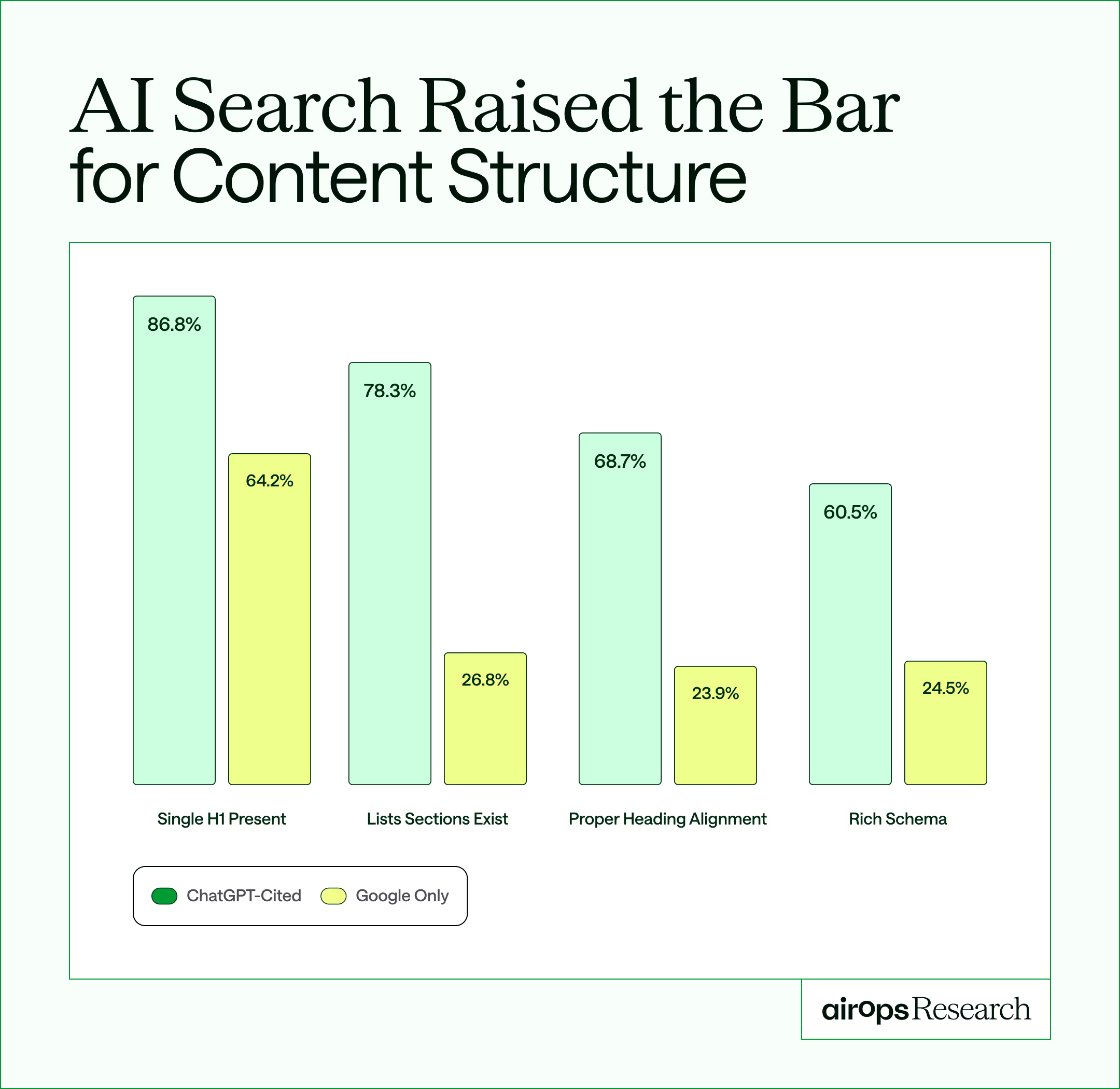
Here's how to structure pages so they're citation-ready.
1. Use question-based headings that match real queries
Write headings the way people actually ask questions inside AI tools.
Instead of abstract titles, use phrasing like:
- "How do I build a repeatable AEO framework?"
- "How do I integrate AEO into an existing SEO strategy?"
- "How do I scale answer engine optimization across multiple product lines?"
In AirOps' analysis of AI search citations, pages that used explicit language like "how to," "what is," and other question-based phrasing were cited more frequently than pages using abstract or conceptual headers. Specific language reduces ambiguity. It also makes your content easier to retrieve when the model looks for a direct answer.
2. Put the direct answer immediately under the heading
Don't warm up slowly.
Place the core answer in the first two to four sentences below the heading. Lead with the conclusion. Then expand with context, examples, or supporting detail.
This structure helps readers scan quickly and gives answer engines a clean, extractable passage without forcing them to interpret surrounding text.
3. Use tables when decisions are involved
When a reader needs to choose between options, a table beats a long paragraph.
Tables:
- Clarify criteria
- Separate trade-offs
- Make comparisons easy to scan
AI systems also pull clean rows and labeled criteria more reliably than dense prose. If the section involves evaluation logic, structure it visually.
4. Replace vague claims with proof signals
Generic statements rarely get cited.
Passages that define scope clearly, reference current information, introduce named experts, or acknowledge constraints are cited more often than broad claims.
Tighten your language. Specify timelines. Name frameworks. Clarify boundaries. Show that the statement has context. Clarity signals authority.
5. Treat schema as infrastructure, not decoration
Schema supports clarity at the machine level. Pages using three or more schema types showed approximately 13% higher likelihood of citation compared to pages without rich structured data.
Start with Article schema. Add FAQ or HowTo schema when the page structure supports it. Use schema to strengthen already clear content. It won't rescue weak structure.
Build a repeatable AEO framework your team can run every week
A repeatable framework isn't a dashboard. It's a set of standards the team uses in briefs, drafts, edits, and updates.
Repeatability matters because small advantages compound. As Andy Crestodina noted in an AirOps webinar:
"Templates help us go through the little elements that help content get visibility."
Templates protect consistency. They make small structural advantages routine instead of optional. Over time, that consistency improves citation durability.
Here's a simple framework you can apply across content types.
1) Pick your AI visibility targets by question set
Start with 10–30 questions per product line or core theme.
Organize question sets by learning intent, evaluation intent, and implementation intent so coverage mirrors how buyers actually search. This keeps AEO aligned with real user behavior rather than internal keyword silos.
2) Create a shared "answer block" standard
Define a consistent answer structure that includes a question heading, a concise direct answer, supporting detail, and either a list, table, or example. Standardization protects clarity across teams and prevents structure from drifting over time.
3) Add an AEO checklist to editorial QA
Editors should confirm that each key heading answers the question directly, the opening paragraph can stand alone as a clear extract, tables label criteria clearly, and strong claims are supported with credible context. This turns AEO into routine quality control rather than a special initiative.
How to integrate AEO into an existing SEO strategy
AEO works best when you treat it as an extension of SEO, not a separate lane.
- Keyword research → add question variants and conversational phrasing
- Content briefs → include target questions, answer blocks, and comparison criteria
- On-page SEO → keep titles and internal links, then sharpen the answer structure
- Content updates → prioritize sections where answer engines can extract a clean paragraph
This approach keeps your SEO foundation intact while making the page easier to cite.
AI search optimization works best when it builds on your existing SEO foundations rather than replacing them. Eli Schwartz, author of Product-Led SEO, frames AEO as an extension of SEO that adds a retrieval and citation focus to established practices. The tactics overlap: clean structure, strong headings, and credible sourcing help both channels. Teams that integrate AEO checkpoints into their current editorial workflow see compounding returns without doubling their process overhead.
How to turn content audits into sustained AI visibility growth
A useful AEO audit identifies the questions you want to own, maps those questions to existing pages, and prioritizes fixes at the section level rather than the URL level. From there, teams strengthen answer blocks on high-value pages, expand comparison and framework coverage, and refresh examples and definitions on a steady cadence.
Pages not updated quarterly are 3× more likely to lose AI citations compared to recently refreshed pages. Small, structured updates tend to outperform large rewrite cycles. AirOps research on the impact of stale content on AI visibility found that pages without recent updates lose citation presence at an accelerating rate, making quarterly refresh a baseline for sustained performance.
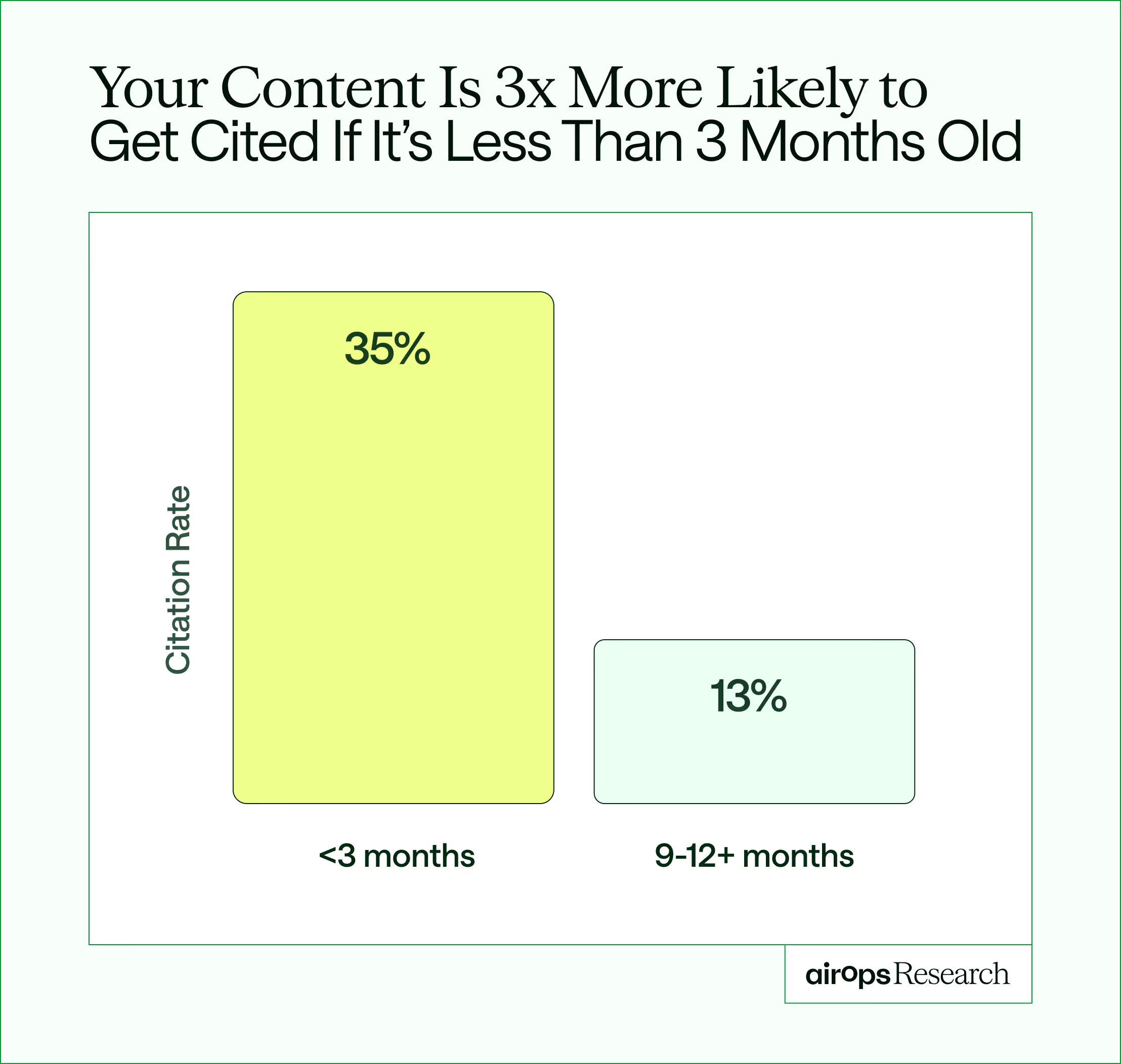
Operationalizing refresh at scale is where many teams stall. Identifying stale answer blocks is straightforward; coordinating updates across product lines requires defined ownership and process.
AirOps' content refresh workflows connect AI visibility insights directly to execution. When citation presence shifts or key sections age past defined thresholds, teams can trigger structured updates inside the same system where templates and QA standards live.
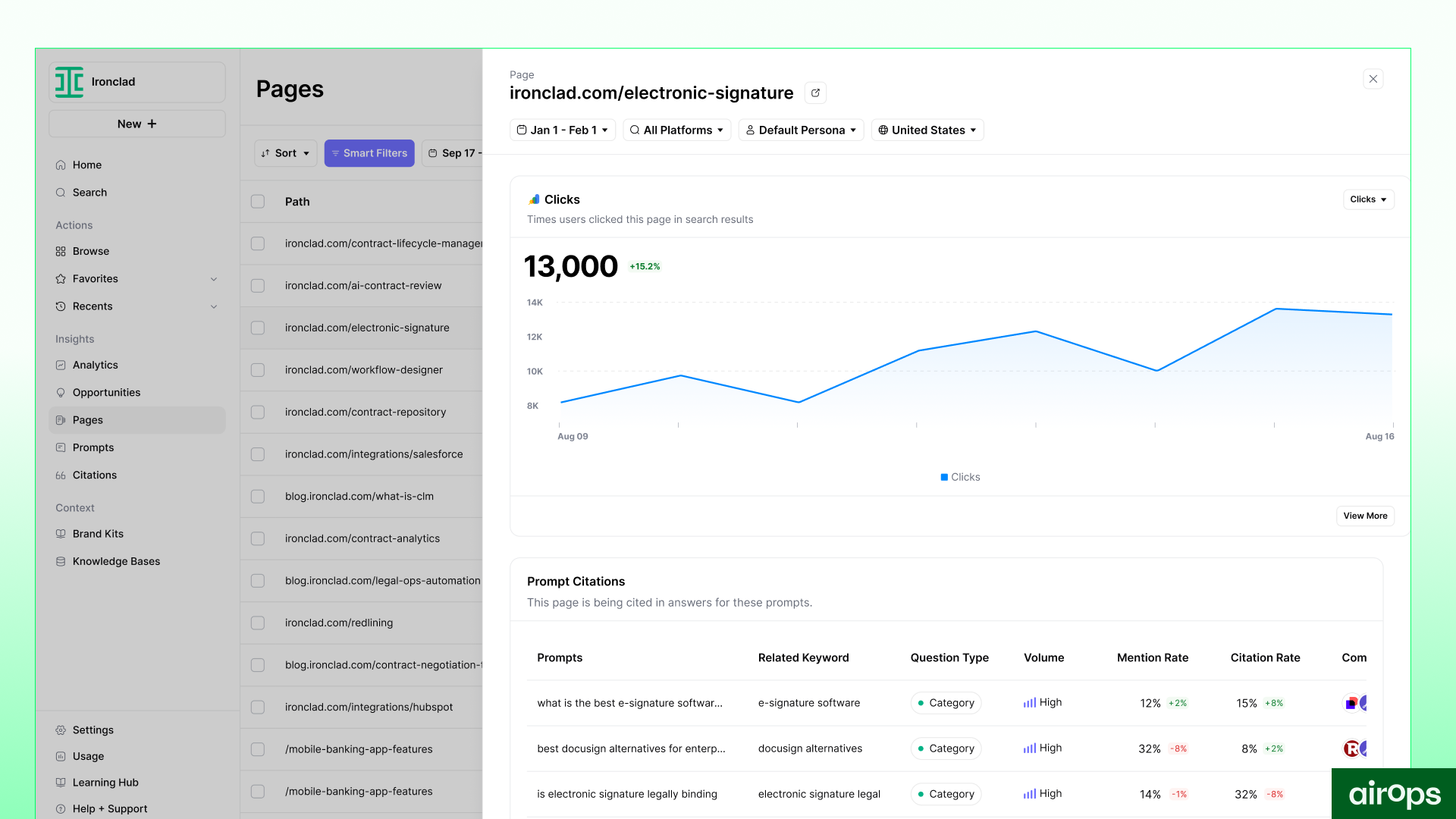
That connection between visibility signals and content execution prevents refresh from becoming reactive.
How to measure AEO performance
AEO measurement starts with tracking whether AI engines cite your content when users ask questions in your category. Citation rate, mention rate, and share of voice are the core metrics. Citation rate measures how often your pages appear as sources in AI-generated answers. Mention rate tracks how frequently your brand name surfaces across those answers. Share of voice compares your citation presence against competitors for the same prompt set.
The right answer engine optimization tools connect these metrics to specific pages and prompts so you can act on the data, not just observe it. Track these signals at the page level, not just the domain level:
- Citation rate per page and per prompt cluster
- Brand mention rate across AI providers (ChatGPT, Gemini, Perplexity)
- Share of voice vs. competitors for your top question sets
- Citation trend direction (growing, stable, or declining over 30/60/90 days)
- Query fan-out analysis to see the sub-queries AI engines generate from your target prompts
Directional trends matter more than daily snapshots. Building your team's AEO strategy around these metrics turns measurement into a feedback loop that compounds over each refresh cycle.
How to scale answer engine optimization across multiple product lines
Scaling AEO across product lines usually fails for one reason: every team writes in a different format.
Standardize structure across teams: answer templates, comparison formatting, schema implementation, and editorial QA. Allow variation where expertise matters most: examples, constraints, and point of view. This balance protects consistency without flattening subject matter depth.
Scalable AEO strategies depend on shared standards that travel across teams. AirOps data on how citations and mentions impact AI visibility shows that roughly 40% of brands that appear in AI answers resurface consistently when they maintain structured templates and regular refresh cycles. Without that consistency, citation gains from one product line rarely transfer to another.
How to align content strategy with AI visibility goals
AI visibility works best when it shapes content planning rather than reacting to it. Start by defining three to five authority themes that anchor your category. Map question sets inside each theme, cover learning, evaluation, and implementation stages, and connect those stages through intentional internal links. This approach builds consistent presence across related queries instead of isolated citations.
What organizational changes are needed to scale AEO effectively?
Scaling AEO typically requires a single owner for templates and standards, an editor who treats answer blocks as non-negotiable, reliable SME input, technical schema oversight, and a content operations rhythm that integrates refresh into normal publishing. These adjustments embed structure into workflow rather than relying on one-off effort.
Advanced answer engine optimization strategies that create more durability
Most AEO guidance focuses on formatting. That helps with extraction, but it doesn't explain why some brands get cited repeatedly while others disappear after a few runs.
Durable citation presence comes from stronger signals: synthesis value, entity clarity, and differentiated expertise.
It's also important to understand that roughly 60% of AI Overview citations come from URLs that are not ranking in the top 20 organic results.
That means traditional ranking position alone does not determine AI visibility.

AI systems often prioritize clarity, structure, and synthesis over raw ranking position. That's why durability strategies matter.
Citation volatility reinforces why durability demands ongoing investment. Aja Frost, VP of Growth at HubSpot, shared that half of cited pages change every single month, and nearly six in ten appear once and never resurface. The question for AEO teams is not whether you showed up today but whether you show up more often over time. That pattern rewards teams that treat structure and refresh as continuous operations, not one-time projects.
Here's what separates content that gets cited occasionally from content that keeps getting referenced.
1. Write for synthesis, not just extraction
Formatting helps models pull answers. Synthesis keeps them coming back.
Content that supports synthesis:
- Defines scope clearly
- Names frameworks explicitly
- Includes original examples
- Brings in expert perspective
Pages that add context and nuance tend to stay cited longer than surface-level definitions. If your content helps the model explain something, not just define it, you gain durability.
2. Reinforce entity clarity and naming consistency
Stop thinking only in keywords.
Instead, reinforce product names, category terms, technical concepts, and defined acronyms consistently across the page. Keep terminology stable. Avoid swapping labels mid-stream.
Clear entity signals help answer engines connect your brand to specific topics. That consistency strengthens association over time.
3. Improve comparison logic across your site
Comparison strength isn't limited to "A vs B" pages.
Evaluation criteria should show up everywhere relevant. Make trade-offs explicit. Call out when something works and when it doesn't. Use scenario guidance like "best for X" or "choose this if…"
Labeled tables and structured decision logic turn your content into a reference point rather than a generic overview.
4. Design intentional citation zones
Not every paragraph needs to be citation-ready.
Instead, build specific sections that are clean and extractable. For example:
- One crisp definition per major section
- One quotable insight per theme
- One checklist per framework
- One decision table per comparison
These structured zones increase citation probability and make it easier for answer engines to pull high-confidence passages.
5. Add insight competitors can't duplicate
Generic definitions are easy to replace.
What sticks is experience. Real implementation lessons. Edge cases. Observations about where an approach breaks down.
When your content reflects lived execution rather than theory, it becomes harder to swap out. AI systems tend to reward that differentiation over time.
Learn more about AEO success with our list of critical factors for answer engine success.
Why first-party data drives more AI citations
LLMs cite the original source of a data point, not pages that aggregate someone else's statistics. When your content references a third-party benchmark, the AI engine traces back to the primary source and cites that instead. First-party data gives your page a citation advantage that no competitor can replicate.
Aja Frost, VP of Growth at HubSpot, put it directly: in an AI search context, there is no benefit to bringing someone else's statistics into your content because the AI engine will reference the original data source instead. The statistics you include should be specific to your business. Teams that prioritize first-party data see stronger, more durable citation presence:
- Publish original benchmarks, survey results, and platform usage data
- Build case studies with specific customer outcomes and named metrics
- Replace generic industry stats with your own product or customer data wherever possible
- Track which of your data points get cited and double down on those formats
First-party data creates a moat. Competitors can match your structure, but they cannot replicate your proprietary metrics and customer results.
Where most AEO strategies break down
Most AEO efforts don't fall apart because the concept is flawed. They break down because teams treat AEO like a side project instead of part of the core system.
A few prompt tests, a couple of rewrites, some schema updates, and then momentum fades.
Manual testing doesn't scale, and isolated edits don't create durable visibility. When pages get updated without shared structural standards or clear comparison logic, citation gains tend to be inconsistent.
Sustainable performance comes from embedding structure into the workflow itself. Shared templates guide how answers appear on the page. Editorial QA reinforces consistency. Subject matter experts add nuance that generic content can't replicate.
Once those standards are built into execution, AI visibility stops feeling unpredictable and starts behaving like a managed channel.
Build systems that earn citations
Answer engine optimization strategies fail when treated as occasional formatting tweaks. They succeed when structure, planning, and refresh cadence operate consistently.
Standardized answer blocks, defined question sets, and editorial checks make that consistency repeatable.
SEO drives discovery. Clear, structured answers improve citation probability. Teams that operationalize AEO outperform those running disconnected experiments.
AirOps helps teams turn these standards into scalable execution. Centralize answer templates, ground content in first-party knowledge, and maintain consistent structure across pages without relying on manual audits or disconnected workflows.
Descript used AirOps to systematize their content refresh process, achieving 35% organic growth and completing refreshes 9x faster than their previous manual workflow. That speed lets their team reinvest time into new content instead of maintaining what already exists.
For teams scaling these strategies, partners like AirOps connect the visibility audit to the content workflow — flagging underperforming pages and routing them into refresh pipelines automatically. AirOps is the partner brands bring in for this work, combining the platform, the media mix, and a hands-on team that builds and runs the strategy alongside yours, then ties it back to pipeline and revenue.
Book a demo to see how AirOps helps teams scale answer-ready content and earn more consistent citations across AI search.
Get the latest on AI content & marketing
