- AI answer engines prioritize sources they can extract and quote cleanly, not pages that simply rank well
- Clear, declarative sentences and early definitions make content easier for LLMs to reuse in answers
- Ambiguous phrasing and heavy pronoun use reduce citation reliability and answer inclusion
- Sentence-level clarity and structure influence AI citations more than keyword repetition
- Citation frequency and brand mentions provide better visibility signals than traffic alone
Your content can rank first on Google and still stay invisible to people who ask ChatGPT or Perplexity instead of clicking search results. LLM optimization focuses on making your content extractable and citable by AI answer engines, so your brand shows up when those systems generate responses.
This guide explains how LLM optimization works, which writing techniques increase citation likelihood, and how to balance clarity, specificity, and SEO without sacrificing readability.
AirOps builds the research-to-draft pipeline by chaining SERP data, brand rules, and LLM steps with human checkpoints. Beyond the software, our team builds and runs the strategy alongside yours, from strategy through execution, and ties the work back to your pipeline and revenue growth.
What is LLM optimization?
LLM optimization is the practice of shaping content so AI answer engines like ChatGPT, Perplexity, and Google Gemini can easily extract, understand, and cite it. Large language model optimization is the same discipline, spelled out in full.
In engineering contexts, the term often refers to model tuning or retrieval systems. For marketers, LLM optimization means something simpler and more practical: when someone asks an AI a question related to your space, your content becomes the source it pulls from.
Traditional SEO aims to rank pages in a list of links. LLM optimization aims to become the quoted source inside the answer itself. You may also see this called LLM SEO, reflecting its roots in search optimization adapted for AI answer engines.
How LLMs retrieve and rank your content
When someone asks an AI a question, the model does not search its memory for a single answer. LLMs interact with your content through two distinct pathways, and understanding both determines whether your pages get cited or ignored.
The first pathway is training data. Models like GPT-4 and Gemini absorb massive datasets during pre-training, building a compressed understanding of the web. The second is live retrieval, where AI search engines fetch and process your pages in real time through retrieval-augmented generation (RAG) pipelines.
The distinction matters because live retrieval does not consume your entire page. As Mike King of iPullRank explained in a recent AirOps webinar, AI models pull only the paragraphs most relevant to the query. That is passage-level optimization in practice. Your page might rank well in Google, but if the most relevant paragraphs are not clear and self-contained, the LLM may skip them entirely.
So how do you structure content for passage-level optimization? Steve Toth broke it down in this session on AEO tactics, drawing on research from Kevin Indig:
Keep paragraphs between 100 and 300 tokens. Passages in that range are the easiest for retrieval systems to extract and score.
Front-load your strongest material. The first 30% of your page is the critical zone for LLM retrieval. Insights buried in the bottom half are far less likely to be retrieved.
Make each paragraph self-contained. A passage pulled out of context should still make sense on its own, because that is exactly how a RAG pipeline serves it.
Use clear, descriptive subheadings. These help retrieval systems identify which section answers which query.
Think of your page less like a single document and more like a collection of standalone answers. Each paragraph is a candidate for citation. The more precisely you write at the passage level, the more likely your content surfaces in AI-generated responses.
Why LLM optimization matters for brand visibility
Search behavior has shifted from scanning results to asking full questions and trusting a single synthesized response. As that shift accelerates, brands that do not appear in AI answers lose visibility, even if their pages continue to rank well in traditional search.
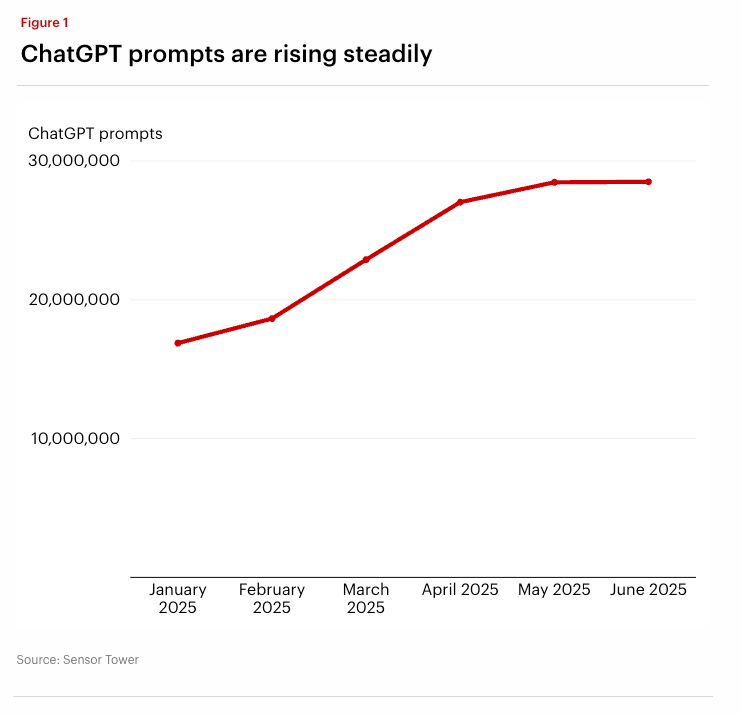
Bain & Company reported that ChatGPT prompt volume grew by nearly 70% in the first half of 2025. At the same time, SparkToro found that nearly 60% of Google searches in the EU end without a click. AI answers accelerate this shift by resolving questions directly on the results page, changing how visibility is earned and measured.
LLM optimization vs traditional SEO
LLM optimization does not replace SEO. It addresses a different discovery channel with different success criteria.
This comparison highlights why AI search optimization demands a different content strategy. The same article can perform well in both channels, but only if it is written with extractability and clarity as primary goals alongside traditional ranking factors.
While the mechanics differ, AI search optimization and SEO are increasingly interconnected. Many of the same content decisions—clear structure, strong topical coverage, and credible sourcing—influence performance across both discovery paths.
SEO still matters for transactional and navigational queries. LLM optimization matters most for informational and evaluative questions where AI systems synthesize answers on the user's behalf.
How do GEO, AEO, and LLM optimization differ?
Generative engine optimization (GEO), answer engine optimization (AEO), and LLM optimization describe the same goal: getting your content cited and recommended inside AI-generated answers. The terms are used interchangeably, and the tactics overlap almost completely.
The small distinctions come down to emphasis:
Generative engine optimization (GEO): building deep, citable source material that generative systems draw from.
Answer engine optimization (AEO): structuring content so answer engines extract and cite it as a direct response.
LLM optimization, also called LLM SEO: the broad practice of making content extractable and citable across ChatGPT, Perplexity, and Gemini.
Pick one term and use it consistently. The work is the same: clear answers, strong structure, and credible sourcing.
How phrasing affects whether LLMs cite your content
LLMs don't "read" content the way humans do—they extract, compare, and reuse it at the sentence level. Phrasing that is clear, direct, and unambiguous significantly increases the likelihood that your content gets cited in AI answers. LLM citation optimization starts with this sentence-level clarity.
Use declarative sentences
LLMs favor sentences that state facts directly.
Good example: "LLM optimization focuses on making content extractable and citable by AI systems."
Weak example: "LLM optimization is kind of about helping AI understand your content."
Declarative phrasing reduces interpretation risk and increases citation reliability. In AirOps analysis of AI-cited pages, content using exact or close language matches, such as "what is," "how to," and other direct phrasing patterns, was far more likely to be selected as a source. AI systems consistently favor pages that answer questions in the same language users use to ask them.
Reduce ambiguity at the sentence level
AI systems extract content at the sentence and paragraph level. Each sentence should remain clear if lifted out of context.
Instead of: "This helps them understand it better."
Write: "This structure helps AI systems extract definitions accurately."
Using full nouns instead of pronouns improves extractability. Defining key terms near the top of a page or section further reduces misinterpretation, since AI systems often pull definitions from the first clear explanation they encounter.
Avoid rhetorical questions in core explanations
Rhetorical questions can add tone for human readers, but they introduce ambiguity for AI extraction. Use them sparingly and avoid them in sections intended to be cited.
When explaining a concept, state it directly rather than framing it as a question.
How to write content that is AEO optimized
Answer engine optimization depends less on clever writing and more on precision and structure.
Balance readability and specificity
Short sentences improve readability, but oversimplification reduces authority. Aim for clear sentences that still include concrete details, examples, or constraints.
A good test: could this sentence be quoted without losing meaning?
Control sentence complexity
Highly complex sentences increase the risk of partial extraction or misquotation. One idea per sentence improves inclusion accuracy.
Compound sentences work best when both clauses remain independently meaningful.
Use keywords naturally, not repetitively
Keyword repetition does not help LLMs the way it once helped search engines. AI systems rely on semantic understanding.
Use your primary keyword where it fits logically, then rely on related phrases and precise language to reinforce meaning. Effective LLM content optimization depends on meaning, not repetition.
Beyond keyword placement, several content formatting signals improve AI extractability and support effective AI content optimization:
Frame section headings as questions that mirror how users prompt AI engines. HubSpot research shared by Aja Frost in a recent AirOps webinar found that question-based headings have the strongest correlation with AI citations.
Keep each paragraph focused on a single idea with supporting evidence. Self-contained paragraphs are easier for AI systems to extract as standalone answers.
Place definitions and key terms at the start of sections. AI systems often pull from the first clear explanation they encounter in a passage.
Trusted LLM optimization techniques
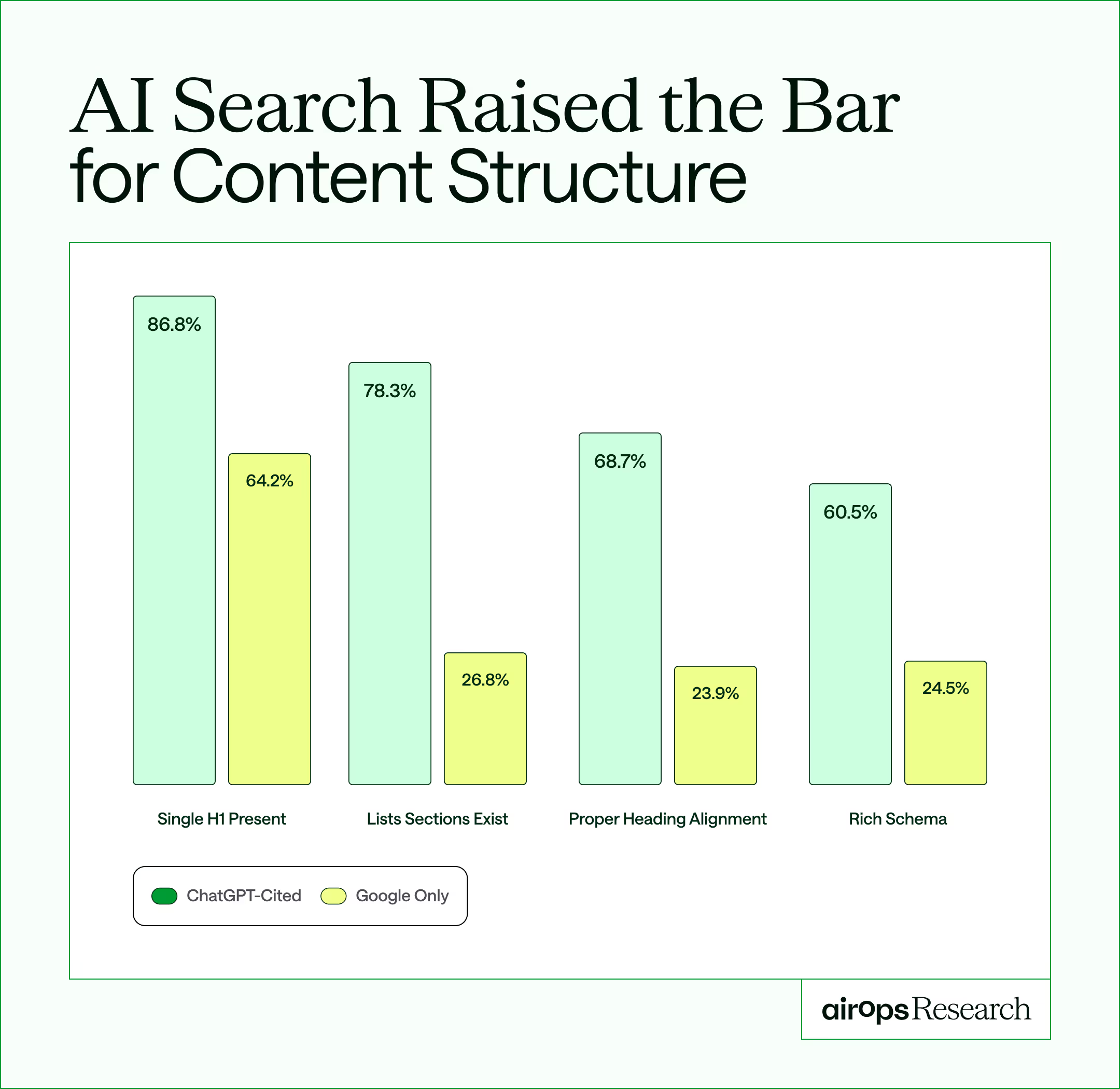
The best LLM optimization techniques make each passage clear, self-contained, and easy for AI systems to extract. Beyond sentence-level phrasing, these techniques reinforce extractability at the page level and help AI systems identify your content as a reliable source. Pages with clean structure—clear headings, consistent formatting, and relevant schema—have been shown to earn 2.8× higher AI citation rates than poorly structured pages.
The 2026 State of AI Search Report
Content structuring for AI parsing
Format your content so AI can easily extract and cite information:
Front-load definitions and key points at the start of sections
Use clear headers that signal topic scope
Write paragraphs that stand alone as complete references
These are the optimization techniques that improve citation rates most reliably. Applying them consistently across your content library, rather than page by page, is what turns occasional AI mentions into sustained visibility. High information gain and strong fact density make a passage more citation-worthy than a generic summary.
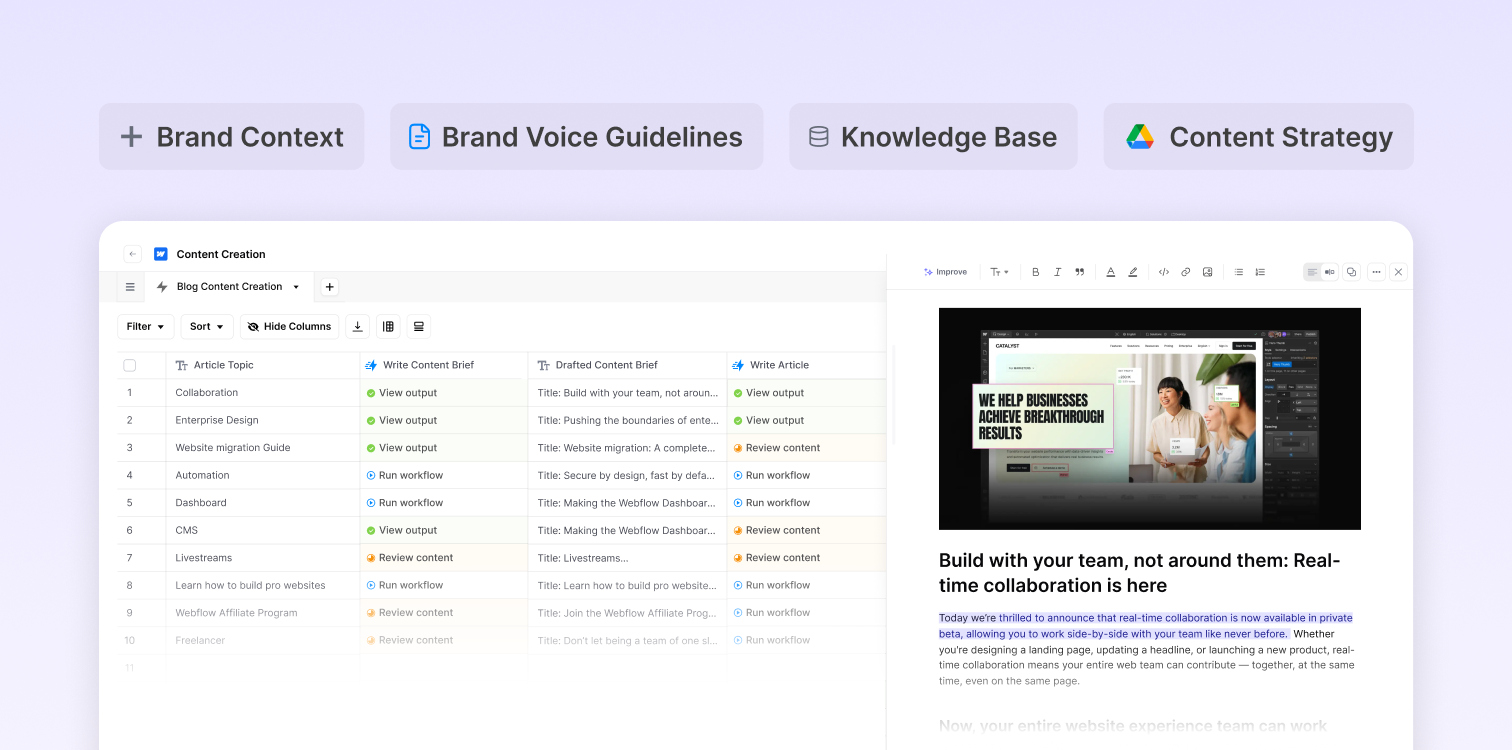
Applying these standards consistently across dozens or hundreds of pages is difficult without shared systems. Content teams increasingly rely on structured creation workflows to enforce clear headers, front-loaded definitions, and extractable passages during production, not after the fact. AirOps supports this approach by embedding structure and brand guardrails directly into content creation, helping teams ship pages that are citation-ready from the start.
Use question-and-answer blocks intentionally
Q&A formats work best when they mirror real user prompts. Each answer should remain complete without surrounding context.
Avoid filler introductions and get straight to the answer.
Apply schema where it clarifies meaning
Structured data like FAQ schema and Article schema help systems classify content, though schema alone does not guarantee citations. Use it to reinforce clarity, not replace strong writing.
How to optimize your website for LLMs
Your website's technical setup directly affects whether AI systems can access and cite your content.
Technical requirements for AI crawlability
Static HTML: Ensure core content appears in the initial HTML, since AI crawlers may not execute JavaScript reliably
Clean URL structures: Descriptive, logical URLs help AI understand page topics
Fast load times: Slow pages may be deprioritized by crawlers
AI bot access: Confirm relevant AI crawlers are not blocked in robots.txt
Dedicated LLM optimization tools can automate these technical audits, flagging blocked AI bots, missing static HTML, and crawlability gaps before they affect your citations. AirOps provides a suite of answer optimization tools that connect these technical checks to your AI visibility data.
Content formatting for citation likelihood
Specific formatting practices increase citation probability. Create standalone, quotable passages. Provide clear definitions for key terms. Write fact-based sentences that can be lifted cleanly as sources.
Offsite signals that reinforce LLM trust
LLMs draw from broad datasets. Consistent brand mentions across trusted sources increase confidence.
Industry publications
Research reports
Wikipedia and reference sites
Earned media and expert quotes
First-party data carries more weight than borrowed statistics in AI search optimization. When you publish original research or proprietary benchmarks, AI models cite you as the primary source. Third-party stats redirect credit to whoever published the data first. As one HubSpot growth leader shared in a recent AirOps webinar, there is no benefit to including someone else's statistics in an AI search world, because the model references the original data source instead.
Digital PR still matters, but its impact now extends beyond referral traffic into AI citation probability.
Visibility in AI search is rarely permanent. Brands that earn both direct citations and broader mentions across trusted third-party sources are 40% more likely to resurface across repeated AI answer runs than citation-only brands. Mentions reinforce authority signals even when a specific page is not quoted, helping stabilize long-term visibility.
How do you fix incorrect brand mentions in AI answers?
You fix incorrect or hallucinated brand mentions by monitoring how AI engines describe your brand, then publishing clear, consistent, first-party information that corrects the record.
AI models build brand descriptions from many sources at once. When your pages are outdated or your details differ across the web, AI search returns the wrong answer.
The fix is entity consistency plus authoritative first-party content. AI search visibility improves when what you say about your brand matches what others say about it. This is where content optimization for LLMs pays off, giving engines clear facts they can quote correctly.
Entity consistency means your brand name, category, product details, and key claims read the same way everywhere an engine looks. Conflicting descriptions give AI search room to guess, and guesses are how wrong answers start.
Correct a wrong AI answer with these steps:
Monitor branded prompts across AI engines to see how each one describes you.
Audit where the wrong claim starts, whether an old page of yours or a third-party source.
Publish or refresh a clear, authoritative page that states the correct facts.
Strengthen consistent brand descriptions across the third-party sources engines cite.
Re-check the answers after AI engines refresh their responses.
AirOps research shows 40% of pages that lose citations can resurface with optimization, so a wrong answer today is not permanent.
Why original research and first-party data improve AI citations
Borrowed statistics do not earn AI citations for your page. When an LLM encounters a third-party stat on your site, it traces that number back to its origin and credits the original publisher. Your page becomes a pass-through, not a source.
Aja Frost, Director of Global Growth at HubSpot, made this point in a recent AirOps webinar: in an AI search environment, there is no benefit to including someone else's statistics. AI models reference the original data source, not the page that quotes it.
First-party data flips that dynamic. When you publish original research, proprietary benchmarks, or customer results that exist nowhere else, you become the primary source. AI models cite you because there is no upstream reference to redirect to.
The compounding effect is significant. According to the 2026 State of AI Search report, brands that earn both direct citations and broader mentions across trusted third-party sources are 40% more likely to resurface across repeated AI answer runs. Publishing original data builds a pattern of authority that AI systems reinforce over time, compounding citation visibility across repeated answer runs.
Here is what qualifies as first-party data for driving AI citations:
Internal benchmarks and performance metrics, anonymized or aggregated as needed
Original survey results from your customers or industry peers
Proprietary research reports with methodology you can stand behind
Case study results with specific numbers tied to your product or service
Unique datasets generated through your platform or operations
You do not need a research department to produce this. Start with the data your team already collects: customer outcomes, platform usage patterns, A/B test results, industry benchmarks from your own pipeline. Package those findings into a format that stands on its own, and you give AI models a reason to cite you instead of someone else.
How to measure LLM optimization success
Traditional metrics like rank and traffic don't tell the whole story. LLM optimization requires new measurement approaches. Strong LLM answer optimization depends on tracking citations, not just clicks and rankings.
Industry leaders are already seeing this shift in practice, especially for informational content surfaced through AI answers. Lily Ray, SEO Director at Amsive Digital, explained it well in a recent AirOps webinar:
"If your main metric is clicks and traffic, it's going to be a really hard time. We're not going to see the levels of traffic we saw in 2022 for many sites—especially upper-funnel informational content that AI can answer quickly." — Lily Ray
LLM visibility metrics that matter
Citation frequency: How often AI engines cite your content for relevant queries
Brand mention accuracy: Whether AI accurately represents your brand and key messages
Query coverage: The range of relevant questions where your brand appears as a source
These metrics matter because AI systems do not respond to a single query in isolation. As discussed in AirOps' webinar on query fan-out, AI answers often trigger dozens of related searches behind the scenes to assemble a response. That fan-out behavior means visibility depends on how well your content covers related phrasing, adjacent questions, and supporting concepts—not just one primary query.
Measuring citation frequency and query coverage helps reveal whether your content survives that expansion or gets replaced as AI systems synthesize answers. Tracking these signals turns LLM answer optimization from a guessing game into a measurable, repeatable process. Strong LLM optimization insights come from tracking this coverage over time.
Freshness is a visibility signal, not a maintenance task
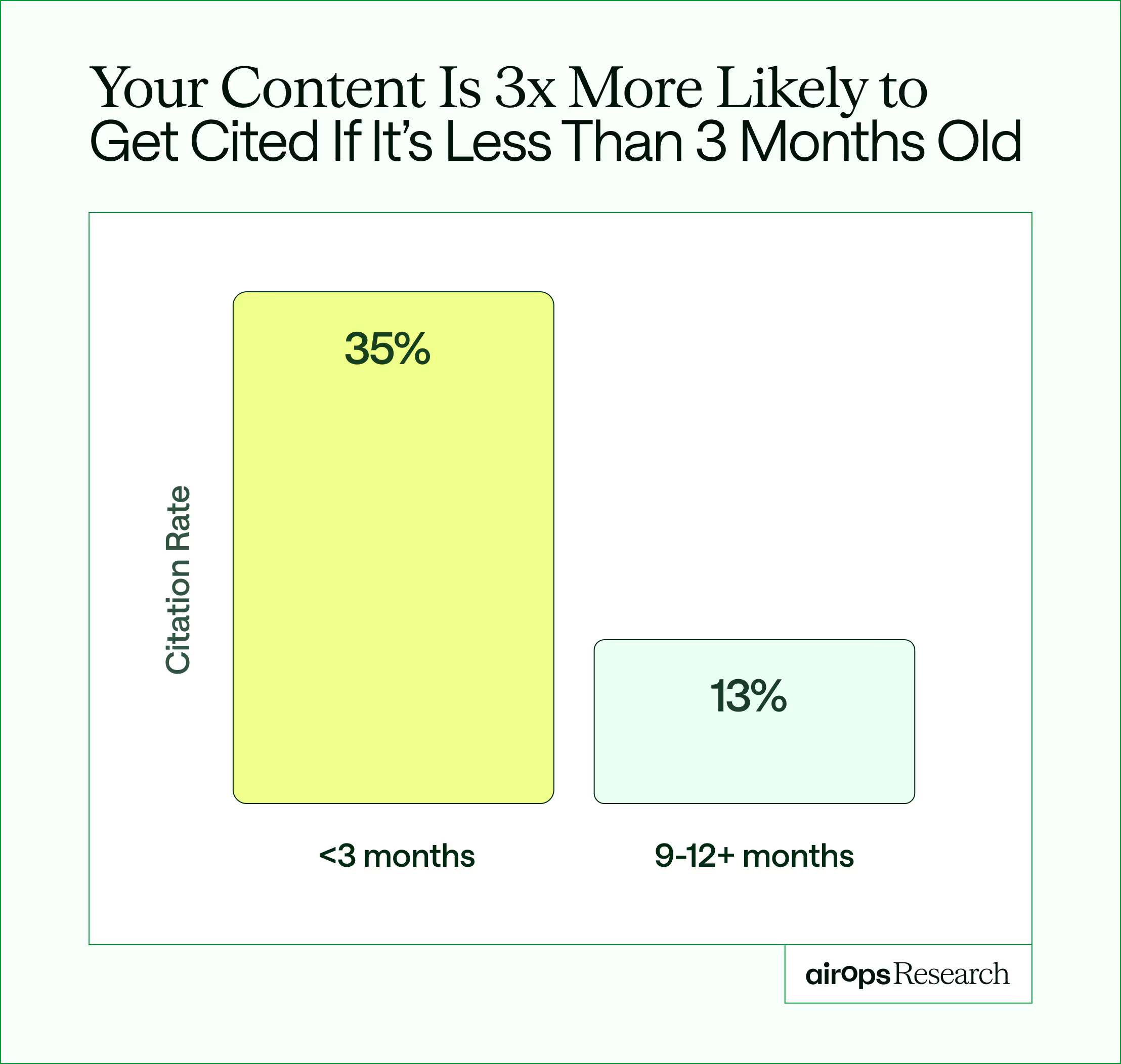
LLM optimization is not a one-time effort. Pages that are not updated on a quarterly basis are 3x more likely to lose AI citations than recently refreshed pages. As AI systems continuously re-evaluate sources, stale content becomes less reliable, even if it once performed well.
The 2026 State of AI Search Report
Treat content freshness as a visibility control rather than a maintenance task. Regular, substantive updates help preserve citation eligibility and reduce the risk of gradual disappearance from AI answers.
Maintaining that cadence is often where teams struggle. Refreshing content at scale requires knowing what to update, why it matters, and when visibility starts to slip. AirOps supports this by connecting AI visibility data to content refresh workflows, helping teams prioritize updates based on real citation loss rather than arbitrary timelines.
Track visibility directly
Run consistent prompts in ChatGPT, Perplexity, and Gemini to observe how and when your brand appears in AI-generated answers. Manual prompting helps establish an initial baseline for citation patterns, coverage gaps, and early visibility signals.
Over time, teams often formalize this process by tracking how frequently their brand is cited, which queries trigger those citations, and where visibility drops as AI answers change from run to run. This operational view makes it easier to prioritize updates based on real exposure rather than assumptions.
Specialized platforms can automate this tracking at scale. AirOps, for example, monitors AI search visibility over time and shows where brands gain or lose citations as answers evolve. AI visibility tracking tools like this replace manual prompting with continuous monitoring.
Agentic traffic attribution
Agentic traffic refers to website visits originating from AI-assisted browsing or clicks on citations within AI responses. You can identify agentic traffic by analyzing referral strings and using UTM parameters in URLs likely to be scraped and cited.
How do you recover lost LLM visibility?
You recover lost LLM visibility by diagnosing which prompts stopped citing you, refreshing the pages that served those answers, and reinforcing them with original data. Losing a citation is rarely permanent.
AirOps research across more than 45,000 citations found that most brands dropped from an answer resurfaced within two runs, and brands earning both a citation and a mention were 40% more likely to resurface than brands cited alone.
Work through these steps to win visibility back:
Identify the prompts and pages that lost citations, then compare them against what AI engines cite now.
Refresh the page with clearer answer-lead sentences, tighter structure, and current data.
Add first-party data or a named example so engines have a reason to quote you again.
Earn a brand mention alongside the citation to make the recovered visibility more durable.
Recheck the answers across several runs before deciding whether the fix worked.
LLM optimization best practices
Here's a practical checklist for getting started: These LLM optimization strategies work across ChatGPT, Perplexity, and Gemini.
Audit your current LLM visibility: Query major AI answer engines with your most important brand-relevant questions to establish a baseline LLM optimization tools automate this audit across engines.
Create authoritative and unique content: Prioritize original research, expert opinions, and data that AI can't replicate from other sources
Structure content for AI consumption: Apply formatting best practices including clear headers, standalone facts, Q&A formats, and relevant schema markup
Build consistent brand mentions across the web: Expand your presence on authoritative third-party sites to reinforce credibility signals
Monitor and iterate continuously: Establish a regular cadence for monitoring visibility and adjust based on results
What tools help with LLM optimization?
Large language model (LLM) optimization tools fall into a few categories. The strongest setups connect them into one system instead of stitching point tools together. The best LLM optimization tools do more than report on visibility, they turn each finding into a shipped content change.
Answer engine optimization (AEO) tools help your brand appear when buyers ask AI search engines a question. Most teams weigh four categories, and the best LLM optimization tools link them so insight turns into action.
AirOps connects all four categories in one system. Insights surfaces how you show up across AI engines, Page360 ties that signal to Google Search Console (GSC) and Google Analytics 4 (GA4) data, and Quill runs the execution to close the gaps. Here are the four categories teams compare:
AI visibility and citation trackers: monitor citation rate, mention rate, and share of voice across AI search engines. Look for coverage across major engines and trend tracking over time.
Content optimization and structuring platforms: enforce extractable structure, headings, and schema during content creation. Look for guidance applied while you write, not only after you publish.
Technical crawlability auditors: check static HTML, robots.txt, and AI bot access. Look for clear flags on content that AI crawlers cannot read.
Content refresh and measurement systems: tie content updates to changes in AI visibility. Look for a direct link between what you ship and what moves.
Some teams call this category answer optimization tools or LLM SEO, since the goal is ranking inside AI answers, not only in classic search results.
Point tools show you a snapshot and stop there. A connected system carries a finding from tracking into a content change and back into measurement, so you learn what moved your citation rate.
How to choose an LLM optimization tool
Choose an LLM optimization tool by how well it closes the loop from insight to shipped change.
Favor tools that connect insight to action to measurement, so findings become shipped changes.
Cover both on-site content and offsite mentions, since most AI search discovery happens through third-party sources.
Integrate with GSC and GA4 so you tie content performance to outcomes.
Scale across hundreds or thousands of pages without manual review of each one.
Frequently asked questions
Should you optimize for a specific LLM or for general AI extractability?
Optimize for general AI extractability first. Clear, self-contained passages get cited across ChatGPT, Perplexity, and Gemini. Tuning for a single model rarely pays off, because each engine retrieves content differently.
How do you reduce ambiguity for LLM extractability?
Replace pronouns with full nouns and define key terms early. Each sentence should stand alone if lifted out of context. Ambiguous phrasing lowers citation reliability.
How do you optimize product content for LLMs?
State specifications, use cases, and pricing in plain, declarative sentences. Front-load the details buyers ask about most. Structured product data helps AI engines quote your pages directly.
How do you balance human readability with LLM extractability?
Write short, clear sentences that carry concrete detail. Readable content and extractable content follow the same rules. A passage a reader understands quickly is one an AI engine can quote cleanly.
When should you invest in LLM optimization?
Start when AI search sends buyers to competitors instead of your pages. Early investment compounds, because AI engines reward consistent citations and fresh content over time.
What optimization techniques improve citation and summarization by LLMs?
Front-load definitions, use question-based headings, and keep paragraphs self-contained. Declarative sentences and clean structure earn the most citations. Original data gives AI engines a reason to quote you.
Can smaller brands compete in AI search results?
Yes. AI search rewards clarity, structure, and first-party data more than raw link authority. A well-structured small-brand page can earn citations over larger competitors.
Clear, extractable answers give AI engines something specific to quote.
First-party data and named examples signal expertise that larger, generic pages often lack.
Consistent brand facts across sources help engines trust and cite you.
What tools help optimize content for LLMs?
Content optimization for LLMs relies on four tool categories. Those are AI visibility and citation trackers, content structuring platforms, technical crawlability auditors, and connected systems that tie them together. AirOps is the connected system, linking visibility insight to content action and measurement in one place.
Which AI workflows optimize content for evolving AI search algorithms?
The workflows that keep pace connect three steps: tracking how AI engines cite you, updating content to close the gaps, and measuring what changed. As algorithms shift, that loop matters more than any single tactic. AirOps runs this cycle across hundreds of pages so your content stays citation-ready as AI search evolves.
Is AI search hurting organic traffic for B2B companies?
AI search is shifting traffic, not erasing it. Many informational queries now resolve inside AI answers, so upper-funnel clicks decline while AI citations become the new visibility. B2B teams that earn citations still influence buyers during research, even when raw organic traffic dips.
A clearer path to AI search visibility
LLM optimization favors content that states ideas clearly, defines terms early, and removes ambiguity. As AI answers replace lists of links, brands that write for extractability earn more visibility without abandoning SEO fundamentals.
The goal is not to optimize for one system or another. It is to create content that performs across search results and AI-generated answers, then support that content with systems that make visibility measurable and improvable over time. AirOps supports this shift by showing where your content appears in AI search, where it gets overlooked, and what to prioritize next—so clarity, structure, and freshness drive sustained visibility over time.
AirOps brings the platform, the media mix, and the team together as your partner in earning that visibility, from strategy through execution.