- Content teams lose AI visibility when refresh cycles lack structure
- Production-ready systems rely on documented steps and review checkpoints
- Research, briefs, drafting, and linking deliver the fastest automation wins
- Teams measure ROI through publish speed, revision volume, and citation stability
- Feedback loops separate teams that sustain visibility from those that lose it
Content teams face a simple math problem. Publishing demands keep climbing while headcount stays flat, and manual workflows cap output no matter how hard the team pushes. Teams that rely on spreadsheets and inboxes introduce hidden risks that slow delivery and erode quality over time.
AI systems change that dynamic. Instead of adding people, teams build repeatable systems that handle research, drafting, and optimization with consistent results. This guide explains how to choose the right tasks to automate, build production-ready AI systems, and measure whether the effort pays off.
Why content and SEO teams need scalable AI workflows
An AI SEO workflow is a repeatable process that uses artificial intelligence to support content research, creation, and optimization. The system connects AI tools with your existing marketing stack so teams produce consistent outputs without copying and pasting between tools.
Content demands continue to rise while team sizes stay flat, with over half of marketers reporting pressure to deliver more with fewer resources.
Teams now need faster ways to test ideas, update pages, and respond to AI search changes. AirOps research shows that only 30% of brands remain visible from one AI answer to the next, which makes one-off publishing a losing strategy. AI-assisted content operations help teams ship faster, iterate based on real data, and keep pace with how search continues to evolve. Teams that adopt AI content automation replace manual bottlenecks with repeatable systems that connect research, drafting, and optimization into a single pipeline.
What makes an AI content system production-ready
A production-ready system differs from an experiment in one way: reliability. Teams can run the same process repeatedly and expect consistent, publishable results.
Production-ready systems share three traits:
- Repeatable: The same inputs create predictable outputs
- Documented: Prompts, templates, and SOPs exist for every step
- Quality-controlled: Human review catches issues before content goes live
Most systems follow a clear flow: inputs (keywords, briefs, internal data), AI processing (drafting, scoring, optimization), quality checks (editorial and subject-matter review), and outputs (published content). Each stage passes work forward without manual handoffs. The right content automation tools enforce this flow by default, so teams spend time on strategy instead of stitching steps together.
AirOps data shows that pages with clean structure, including proper headings and schema, earn 2.8 times more AI citations than poorly formatted pages. That performance gap explains why documentation and structure belong inside every production-ready system.

How to choose which SEO and content tasks to automate
Not every task benefits from automation. The strongest candidates share three traits: high volume, repetitive execution, and rule-based logic. Effective SEO content automation targets these tasks first, then expands to more complex workflows as the team builds confidence.
- Content research and keyword analysis: AI groups keywords by intent, flags content gaps, and analyzes competitor topics. Pattern recognition matters more than creative judgment here, which makes research a strong starting point.
- Brief creation and content planning: AI reviews top-ranking pages and creates structured briefs with recommended headers, questions, and target word counts. What once took hours now takes minutes, turning briefs into a fast handoff instead of a bottleneck.
- Content drafting and optimization: AI generates first drafts. Writers focus on accuracy, expertise, and brand voice instead of initial structure.
- Technical SEO and internal linking: Internal links, meta descriptions, and schema markup follow clear rules. AI handles these tasks consistently and avoids the fatigue that causes manual errors.
- Performance monitoring and reporting: AI tracks rankings, flags content decay, and surfaces pages that need updates. Automated alerts replace spreadsheet reviews and surface issues early.
How to build an AI SEO workflow step by step
1. Define your content goals
Start with outcomes. Do you need more organic traffic, more leads, or stronger product education? Each goal changes what you automate and how you measure success.
2. Audit your current content operations
Track where time actually goes. Note bottlenecks, rework loops, and manual steps that repeat across every piece.
3. Select AI tools for each stage
Choose tools based on tasks, not hype. Confirm that each tool connects cleanly to your CMS, analytics, and planning systems. Evaluate each tool by how well it supports AI content operations across the full lifecycle, from keyword research through performance monitoring.
Platforms like AirOps connect multiple AI capabilities into unified workflows, which removes the friction of jumping between tools.
4. Design the system architecture
Map the sequence from input to output. Decide where AI acts and where humans review. Clear handoff points keep the system stable.
5. Train AI on your brand voice
Generic output erodes trust. Feed your tools with brand rules, approved terminology, and real examples so every draft reflects your standards.
6. Add quality checkpoints
Insert human review after AI drafts and before publishing. Use checklists with clear pass or fail criteria so quality never depends on who reviews the piece.
7. Create feedback loops
Review which topics lose traction, which pages fall out of alignment with intent, and where edits cluster. These patterns show where the system needs tuning. Feedback loops are what allow teams to run AI content at scale without quality erosion. Each cycle surfaces the adjustments that keep output aligned with search intent as it shifts.
"Automating the monitoring of intent shift across your content is one of the biggest missed opportunities right now." — Mark Williams-Cook
Intent changes before rankings fall. Systems that watch for those shifts let teams update content while it still performs, not after visibility disappears.
This walkthrough on refreshing content with AI workflows shows how intent monitoring feeds directly into update systems that keep pages aligned with real search behavior.
How to maintain content quality and brand voice at scale
Scaling content does not require sacrificing standards.
Strong systems rely on:
- A brand knowledge base with approved messaging and terminology
- Prompt libraries tested for each content type
- Tiered reviews that match effort to risk
A high-stakes product page may need expert review, while a minor FAQ update may only need an editorial pass. This tiered approach reflects a content engineering mindset: match review depth to content risk so the system moves fast without cutting corners.
AI tools that support scalable content systems
A production-ready system relies on a focused set of tools that support each stage of content production.
Strong systems pass data smoothly from planning through publishing. When tools fail to share context, teams face slow handoffs and avoidable errors. The best tool stacks also include AI search visibility tracking, so teams can measure whether published content earns citations across ChatGPT, Gemini, and Perplexity.
How to measure AI workflow performance and ROI
Start with a clear measurement framework. Production-ready systems show value when teams track speed, quality, and search impact together.
Content freshness plays a central role in that measurement. AirOps found that pages not updated on a quarterly cadence are three times more likely to lose AI citations, which ties refresh cadence directly to ROI. Visibility fades when content stops evolving.

"Content refresh is always in my top three… Google rewards that with a freshness signal." — Kevin Indig
Teams that schedule updates before performance declines avoid emergency rewrites and ranking losses.
Use three metric groups to measure progress:
- Efficiency metrics: Time to publish, pieces shipped per week, hours saved per task.
- Quality metrics: Revision cycles, brand compliance, factual accuracy.
- SEO metrics: Organic traffic to AI-assisted pages, ranking movement, time on page.
Compare results against your baseline from before system adoption. That difference shows whether the system delivers real ROI. Track citation stability alongside traditional SEO metrics. Content freshness is a direct signal AI search engines use when selecting sources to cite, which means refresh cadence belongs in every ROI framework.
For teams that want to turn freshness into a repeatable system, this guide on building AI workflows for content refreshes outlines how to structure update pipelines that protect visibility at scale.
How to structure content for AI search visibility
AI search engines pull specific passages, not full pages. The structure of your content determines whether it gets cited.
Pages with clear heading hierarchy and structured formatting earn 2.8x more AI citations than unstructured equivalents. That gap makes content structure a production requirement, not an afterthought.
Build these structural patterns into every workflow:
Lead each section with a direct answer sentence that states the key point before supporting it
Use descriptive H2 and H3 headings that match how users phrase questions in AI search
Add FAQ schema and structured data to increase citation rates in AI Overviews
Keep paragraphs short and claims specific so AI models can extract clean passages
Include comparison tables and bullet lists that AI engines can parse without ambiguity
Production-ready workflows bake these patterns into templates and quality checklists. When structure is enforced by the system, every piece ships citation-ready by default.
Why content refresh automation drives the highest ROI
Publishing new content is expensive. Refreshing existing content that already ranks costs less and delivers faster results.
Oyster HR built a structured refresh workflow in AirOps and saw a 25 to 30 percent uplift in rankings and citations on refreshed articles compared to those left untouched. Their system detects ranking declines, pulls in search data, applies brand context, routes through human review, and exports to their CMS in a single pipeline.
Unrefreshed pages lose up to 3x their AI citation rate over time compared to regularly updated pages. Automated refresh workflows prevent that decline by:
Monitoring ranking and citation changes to trigger updates before traffic drops
Pulling current search data and competitor analysis into every refresh cycle
Applying brand voice rules and first-party knowledge automatically so refreshed content stays on-brand
Routing every update through human review before publishing
Teams that schedule refresh cycles before performance declines avoid emergency rewrites and protect the visibility they already earned.
How teams put production-ready systems into practice with AirOps
Many teams understand the theory behind scalable AI systems, but struggle to apply it across research, creation, refresh cycles, and performance tracking. That gap often shows up as disconnected tools and reactive cleanup.
AirOps closes that gap by giving content teams a single content engineering platform built for the AI era. It connects strategy, execution, and measurement so teams can see how content performs across SEO and AI search, act on visibility changes, and track results over time. Beyond the platform, an AirOps team builds and runs that strategy alongside your own, staying hands-on from strategy through execution.
Turning insights into action
Through AirOps Insights, teams monitor performance across traditional search and AI discovery. These signals reveal where pages lose traction, which topics gain momentum, and where refreshes will recover visibility.
This insight feeds directly into workflows that support:
- Content refresh pipelines that prioritize pages losing AI citations or organic visibility

- Scalable content creation systems that generate drafts grounded in first-party knowledge and brand governance
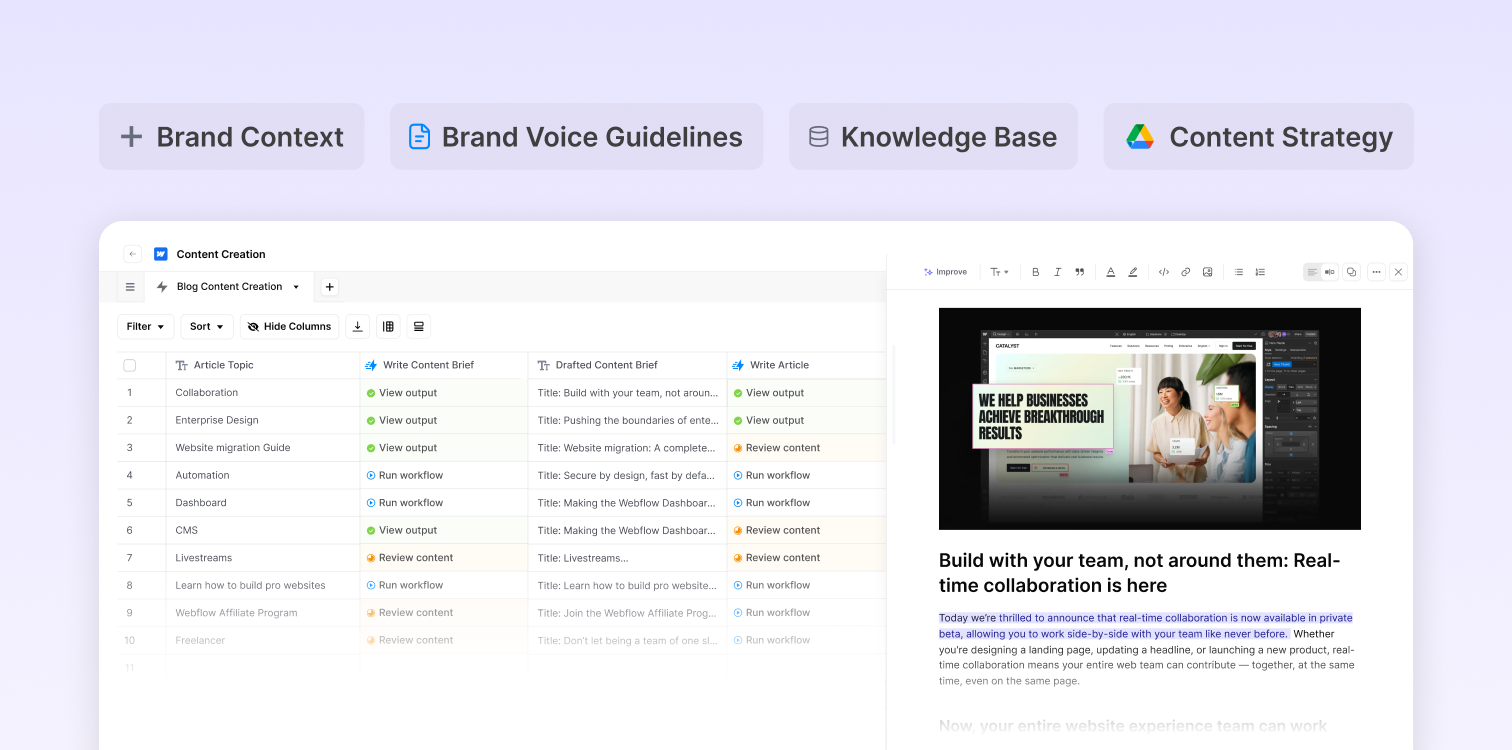
Rather than reacting to traffic drops, teams maintain visibility through intentional refresh and creation cycles driven by performance data.
From disconnected tasks to a single operating system
Under the hood, AirOps connects dozens of data sources and outputs across your stack. Research tools, internal knowledge, briefs, drafts, refresh rules, and reporting all live inside one operating system. That structure gives teams direct control over how AI supports research, drafting, refreshes, and reporting.
This is how content teams move from experimenting with AI to building production-ready systems that protect quality and improve visibility over time.
How AI systems create lasting advantage
Teams that invest in production-ready systems compound results over time. Faster iteration leads to more experiments. More experiments create better data. Better data leads to smarter decisions.
When algorithms shift or trends emerge, these teams publish in days instead of weeks. Over time, that speed gap shapes market visibility.
Production-ready AI systems remove friction so teams spend more time applying judgment and expertise where it matters most.
Book a demo to see how AirOps connects content creation, refresh automation, and AI search visibility tracking into one system.
What are the biggest risks of automating content workflows?
The three most common risks are brand voice drift, factual errors at scale, and content cannibalization. Production-ready systems mitigate all three by encoding brand rules into prompts, grounding AI output in first-party knowledge bases, and running deduplication checks before publishing. Human review checkpoints catch what automation misses.
What size team is needed to manage AI content workflows effectively?
A single content operations specialist can manage AI workflows that previously required 3-5 people, though most teams benefit from having at least one person dedicated to system maintenance and optimization. The key requirement is someone who understands both content strategy and basic workflow logic rather than technical AI expertise.
How do you prevent AI-generated content from sounding generic across competitors?
The difference comes from training AI systems on proprietary data sources like customer conversations, internal research, and unique case studies that competitors cannot access. Teams that feed AI tools with first-party knowledge and enforce strict brand governance rules produce content that reflects genuine expertise rather than recycled industry talking points.
What happens to AI content workflows when search algorithms change?
Production-ready systems with built-in feedback loops adapt faster than manual processes because they surface performance changes immediately and enable rapid content updates. Teams using automated monitoring catch algorithm shifts within days and can push refreshed content before significant ranking losses occur, while manual teams often discover changes only after traffic has already dropped.
Frequently Asked Questions
What size team is needed to manage AI content workflows effectively?
A single content operations specialist can manage AI workflows that previously required 3-5 people, though most teams benefit from having at least one person dedicated to system maintenance and optimization. The key requirement is someone who understands both content strategy and basic workflow logic rather than technical AI expertise.
How do you prevent AI-generated content from sounding generic across competitors?
The difference comes from training AI systems on proprietary data sources like customer conversations, internal research, and unique case studies that competitors cannot access. Teams that feed AI tools with first-party knowledge and enforce strict brand governance rules produce content that reflects genuine expertise rather than recycled industry talking points.
What happens to AI content workflows when search algorithms change?
Production-ready systems with built-in feedback loops adapt faster than manual processes because they surface performance changes immediately and enable rapid content updates. Teams using automated monitoring catch algorithm shifts within days and can push refreshed content before significant ranking losses occur, while manual teams often discover changes only after traffic has already dropped.
Get the latest on AI content & marketing
