AirOps vs Jasper vs Writesonic: which AI content platform scales marketing output without losing brand control (2026)
- AirOps runs the full content operation, connecting brand context, AI search visibility, and governed publishing into one loop of insight, action, and measurement.
- Jasper is a brand-governed AI writing platform with strong voice controls and marketing agents, but its newer visibility and execution features sit outside a measured loop.
- Writesonic pairs fast multi-format generation with AI visibility tracking, though its governance and workflow depth stay shallow below Enterprise.
- The question for content teams is whether a platform helps you scale output and govern quality across a team, or just speeds up the writing.
Content teams can now generate a blog post in minutes, so the bottleneck moved. The hard part is scaling that output across a 15-person team without brand drift, endless editing, and no way to prove what the content actually moved.
AirOps, Jasper, and Writesonic all promise to help you create marketing content with AI, but they solve different slices of the job. AirOps runs the whole content operation from brand context to published page, while Jasper focuses on brand-governed writing and Writesonic on fast multi-format output with visibility tracking.
This comparison breaks down how each platform handles content creation, governance, workflow automation, and measurement, so you can decide which fits the way your team actually works.
AirOps vs Jasper vs Writesonic at a glance
AirOps is the only option that pairs built-in automation with full-stack workflows, so the same platform that surfaces a content gap also drafts, governs, and publishes the fix. Jasper and Writesonic accelerate the writing, but leave the surrounding operation to other tools.
AirOps vs Jasper vs Writesonic: platform overview
AirOps is the growth partner for AI search, built for enterprise content teams that need to move from brand strategy to governed, published, measured content in one system. Its philosophy is a closed loop: understand how your brand shows up in AI search, act on the gaps, then measure what shipped and what it moved. It fits marketing, content, and search engine optimization (SEO) teams that want a content operation, not a standalone writing assistant.
Jasper is the agent workspace built for modern marketing teams that want brand-consistent AI content at speed. Its philosophy centers on embedding brand context into every output so marketers generate on-brand copy across ads, emails, and blogs from a running start. It fits content, product, and performance marketers who want a dependable AI writing assistant with guardrails.
Writesonic is an AI search growth engine that combines fast content generation with visibility tracking across AI answer engines. Its philosophy is a track-to-act loop bridging traditional SEO tools and AI-only trackers in one affordable platform. It fits growth teams, agencies, and lean marketing teams that want high output volume and a starting view of their AI presence.
Core features: how AirOps, Jasper, and Writesonic stack up
The features below show where each platform invests, and where the capability ends for a team that needs to create, govern, publish, and measure content at scale.
AirOps features:
- Quill
- Quill is an AI agent captain that monitors visibility signals, recommends and executes campaigns with human approval, and learns from every run.
- Your team sets the strategy and Quill runs the execution, turning reactive triage into planning.
- Jasper's task agents and Writesonic's trial workflows run on demand, but neither is an autonomous monitor-to-execution loop tied to visibility metrics.
- Page360
- Page360 combines AI citations, Google Search Console (GSC) and Google Analytics 4 (GA4) signals, and content freshness into one per-page health score.
- A Content Director prioritizing 200+ pages sees business impact per page in one view, not three dashboards.
- Jasper has no first-party SEO or analytics data and Writesonic connects GA4 only at Enterprise, so neither ties content decisions to search performance.
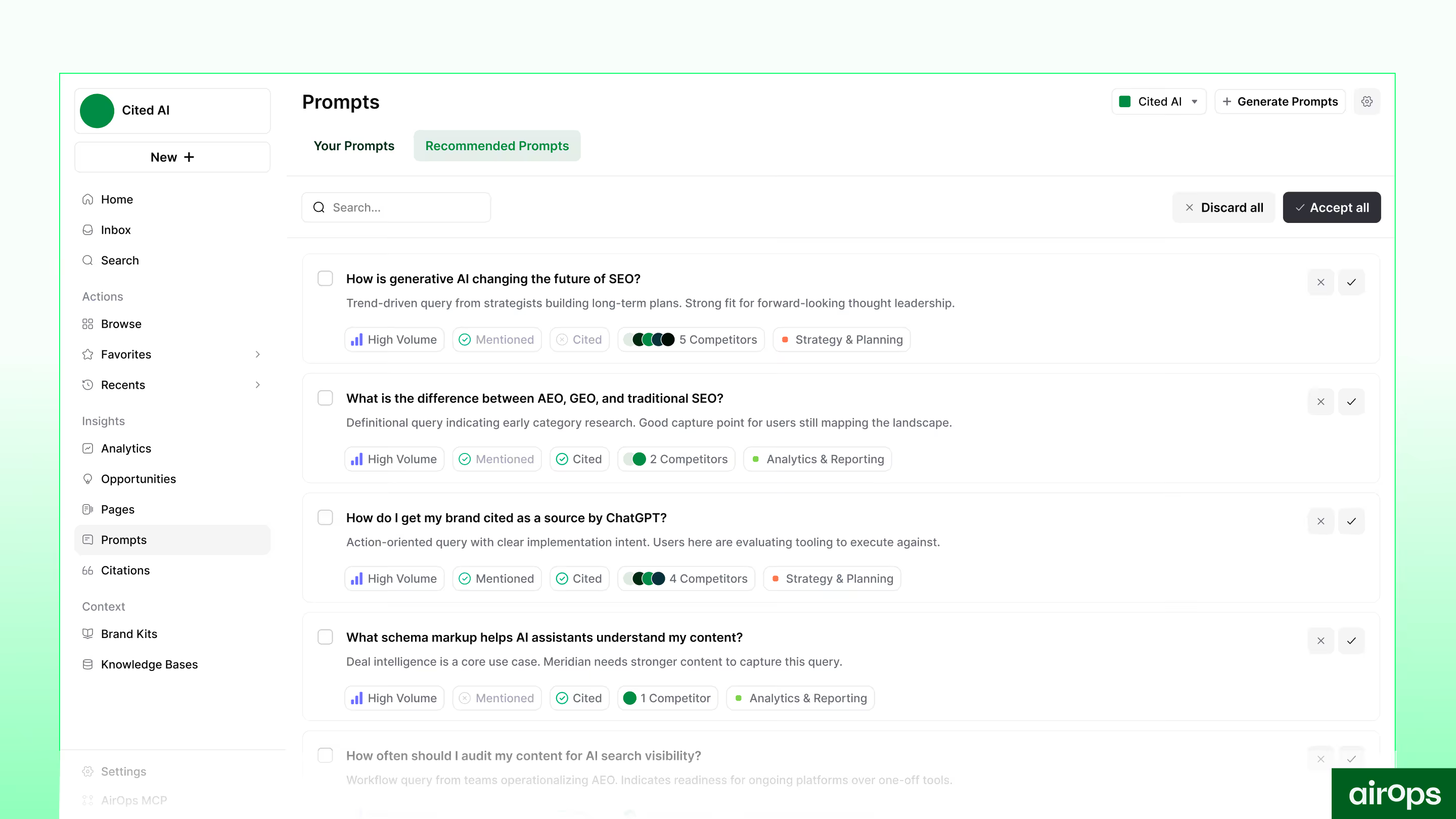
- Prompt Discovery
- Prompt Discovery finds the questions buyers ask AI from four intent sources: keyword mining, ChatGPT and Perplexity signals, Voice of Customer data, and search People Also Ask.
- Your editorial plan grounds in verified demand, not keyword volume alone.
- Writesonic estimates prompt volume from its conversation dataset, while Jasper offers no comparable demand-mining source for content planning.
- Grids
- Grids give you a spreadsheet-style interface to run bulk updates and trigger Workflows across hundreds of pages at once.
- A 500-page refresh becomes one governed operation where each row runs its own Workflow, not 500 manual tasks.
- Jasper Grid organizes generation in a table and Writesonic audits sites in bulk, but neither triggers governed publishing Workflows per row.
- Brand Kits
- Brand Kits store tone, writing rules, audiences, regions, and content types as structured, versioned, scoped rules.
- When 15 people and agency partners produce content, Brand Kits hold consistency automatically, so scaling volume does not scale review.
- Jasper IQ embeds brand voice well but is not scoped by region or content type, and Writesonic offers only one to ten writing styles by plan.
- AirOps MCP
- AirOps MCP connects Brand Kit context to 35+ AI tools through the Model Context Protocol (MCP), including Claude, ChatGPT, Cursor, and Lovable.
- Your brand rules and positioning travel into every AI tool, so outputs start on-brand instead of from zero.
- Jasper offers an MCP endpoint for its own data and Writesonic focuses on in-platform generation, so neither pushes governed brand context outward.
- Offsite
- Offsite tracks and helps grow third-party publisher placements, earned media, and review-site mentions that shape AI brand citation share.
- Most AI brand discovery happens through third-party sources, so owned-page monitoring alone leaves you blind to what drives citations.
- Jasper has no offsite management, and Writesonic tracks mentions but does not run structured offsite placement programs.
- Copilot
- Copilot is conversational AI assistance inside the platform that helps build Workflows, query data, and draft content grounded in your Brand Kit.
- Non-technical team members get productive faster because they describe what they need instead of learning a builder.
- Jasper Chat and Writesonic's assistant answer prompts, but neither builds governed, data-connected Workflows from the conversation.
- Query Fan-outs
- Query Fan-outs reveal the sub-queries an AI engine runs behind a single prompt, showing what the model researches before it answers.
- Each sub-query is a content opportunity your team would miss by reading the original prompt alone.
- Neither Jasper nor Writesonic surfaces sub-query behavior, so this planning signal exists only inside AirOps.
- Workflows
- Workflows provide a visual builder with multiple AI models, live data sources, Brand Kit context, and human review gates.
- Your team automates drafting, quality assurance, approvals, and publishing as one repeatable process, not manual handoffs.
- Jasper Content Pipelines automate content stages and Writesonic runs limited workflows, but neither matches this depth of custom logic wired to CMS publishing.
- Closed-loop execution
- Closed-loop execution connects visibility insight to content action and back to measured outcomes, with Content Publish Tracking logging every publish against performance.
- You can prove which update moved which citation, ranking, or traffic result, the conversation leadership cares about.
- Jasper and Writesonic stop short of connecting content actions to measured performance, so proving impact means exporting data elsewhere.
Jasper features:
- Jasper IQ
- Jasper IQ embeds brand voice, style guides, audience profiles, and product knowledge into AI outputs automatically.
- Marketers get on-brand first drafts across formats, cutting the editing burden on repetitive copy.
- AirOps Brand Kits extend this into structured rules scoped by audience, region, and content type, so governance holds across a larger operation.
- Marketing agents and Content Pipelines
- Jasper offers 100+ purpose-built agents and Content Pipelines that run individual marketing jobs and multi-step content stages.
- Teams spin up repeatable content tasks quickly without building each from scratch.
- These agents generate in isolation without citation tracking or performance feedback, so AirOps Quill adds the monitoring and learning loop.
- GEO and AI Optimization
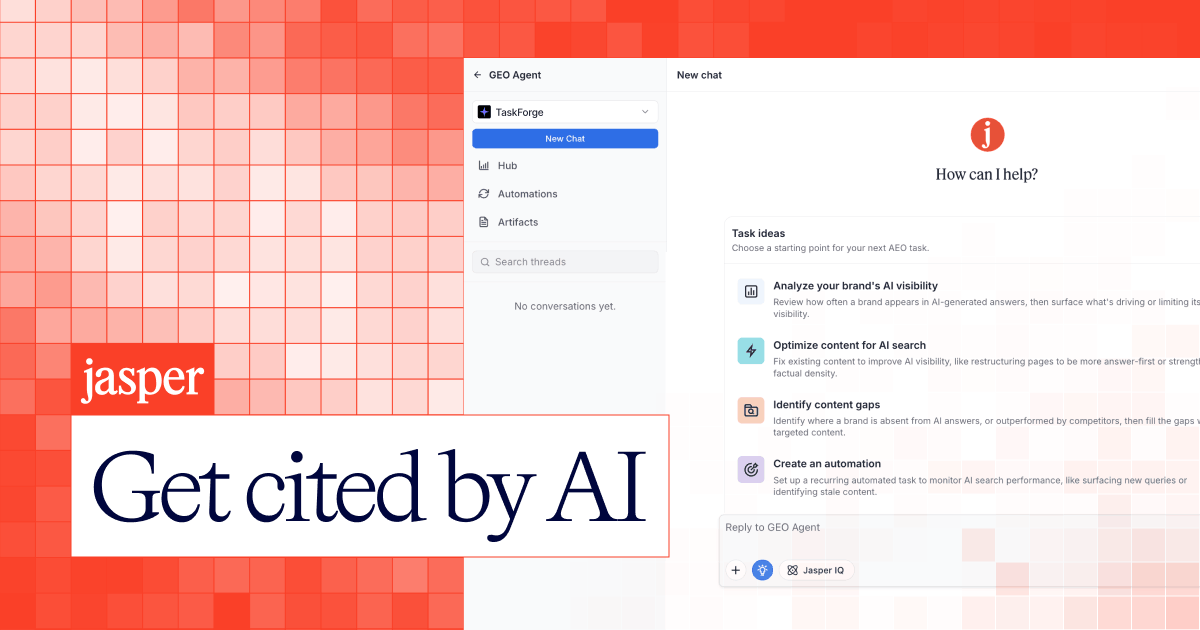
- Jasper's generative engine optimization (GEO) feature measures brand presence across AI answer engines and generates content to close gaps.
- Teams get a starting view of AI visibility alongside their writing tool.
- Jasper launched GEO in June 2026 and its depth is unproven, while AirOps tracks five engines daily and connects that data to execution.
Writesonic features:
- AI Visibility Tracker
- Writesonic's AI Visibility Tracker monitors brand presence, citations, sentiment, and share of voice across AI answer engines.
- Teams see where AI engines recommend competitors instead of them, which frames what to fix.
- Lower tiers track only three engines, so full ten-engine coverage needs Enterprise, whereas AirOps includes multi-engine Insights on Pro.
- AI Article Writer and site audits
- Writesonic generates SEO articles at volume and runs site audits that flag and auto-fix on-page issues across many pages.
- Lean teams produce a high volume of drafts and technical fixes quickly.
- Governance stays light, with one brand voice on Starter, so AirOps Brand Kits give larger teams tighter control as output scales.
- Action Center
- Writesonic's Action Center prioritizes visibility improvements and routes on-page, off-page, and technical actions for execution.
- Teams get a ranked list of fixes tied to visibility gaps.
- Full access is gated to Enterprise with only a small trial on Growth, so AirOps offers deeper execution earlier through Workflows and Grids.
The split is clear. AirOps covers the full loop from insight to governed, measured publishing, while Jasper concentrates on brand-governed creation and Writesonic combines fast output with visibility tracking. For a team that needs to govern content at scale and prove its impact, that gap decides how many other tools stay in the stack.
Product architecture overview: AirOps vs Jasper vs Writesonic
Architecture decides what a platform does today and how far it stretches. AirOps spans the full content operation from data to governed publishing, while Jasper is built around brand-governed creation and Writesonic around output plus visibility tracking.
Data sources and signals
Broader, fresher inputs mean fewer blind spots when deciding what to create.
- Data sources & integrations: AirOps pulls AI visibility from five engines and connects natively to GSC, GA4, Semrush, and Ahrefs. Jasper has no first-party SEO or analytics data, while Writesonic connects GSC on all tiers but reserves GA4 for Enterprise.
- Data accuracy & freshness: AirOps refreshes engine data daily and grounds demand in Prompt Discovery from real intent. Writesonic crawls AI interfaces daily for a large conversation dataset, while Jasper's visibility data is newer and its depth unproven.
- Data portability: AirOps exposes data through comma-separated values (CSV) exports, an application programming interface (API), MCP, Grid exports, and direct CMS publishing. Jasper offers API and MCP access for its own data, while Writesonic provides exports and Looker Studio at Enterprise.
AirOps combines AI visibility with first-party SEO and analytics data, while Jasper lacks search data and Writesonic gates richer connections behind Enterprise.
Prioritization of opportunities
After the data shows a gap, the question is what to fix first and whether the platform can act.
- Decision engines & scoring: AirOps Page360 scores each page by combining AI citations, search performance, traffic, and freshness. Writesonic's Action Center ranks fixes by impact, while Jasper surfaces GEO recommendations without scoring them against SEO or traffic data.
- AI-powered recommendations: AirOps recommendations act inside the platform, since Page360 can trigger Workflows that draft, govern, and publish updates. Writesonic routes actions into its Action Center at higher tiers, while Jasper points to content to create but relies on separate steps to execute.
- Integration of signals: AirOps blends AI citations, brand mentions, traffic, rankings, and freshness into one view. Writesonic centers on AI visibility with lighter SEO context, while Jasper prioritizes from brand and generation signals rather than combined performance data.
AirOps turns prioritization into action inside one system, while Writesonic reserves execution depth for Enterprise and Jasper scores nothing against performance data.
Workflow building & automation
Workflow depth decides whether a team automates a full content operation or just individual writing tasks.
- Workflow builder capabilities & flexibility: AirOps offers a visual builder with multiple AI models, live data, and Brand Kit context for custom processes. Jasper provides Content Pipelines and an agent builder, while Writesonic's agentic workflows stay limited to trial runs below Enterprise.
- Workflow automation features: AirOps automates drafting, quality assurance, approvals, publishing, and reporting as repeatable Workflows. Jasper automates generation steps through Pipelines and agents, while Writesonic automates content and audit tasks with capped runs on most plans.
- Workflow conditional logic & triggers: AirOps supports branching logic and threshold triggers, such as auto-drafting an update when visibility drops. Jasper offers scheduled and agent-driven execution, while Writesonic runs on fixed task templates rather than deep conditional logic.
- Ease of building vs. complexity of what can be built: AirOps pairs a visual builder and Copilot with the depth to build full operations, so power does not force complexity. Jasper stays approachable for content tasks, while Writesonic is simple to start but hits a ceiling as needs grow.
AirOps is the only platform here with a full Workflow builder wired to live data and CMS publishing, while Jasper automates content stages and Writesonic keeps deeper automation behind its top tier.
Governance, context & brand control
Brand control decides whether AI content ships on-brand automatically or needs manual review on every piece.
- Brand voice & governance features: AirOps Brand Kits enforce tone, terminology, and editorial rules across every Workflow output, scoped by audience, region, and content type. Jasper IQ enforces brand voice well, while Writesonic applies one to ten writing styles by plan with lighter enforcement.
- Knowledge Bases & Brand Kits: AirOps pairs Brand Kits with Knowledge Bases that feed Workflows and Copilot reusable context. Jasper offers a Knowledge Base and Brand IQ for reference context, while Writesonic lets teams upload data without the same structured governance.
- Customization vs. templates: AirOps supports deep customization through the Workflow builder plus pre-built Power Agents. Jasper balances templates with an agent builder, while Writesonic relies more on fixed templates for content and audits.
AirOps treats governance as a structured system that scales, while Jasper governs voice at the point of writing and Writesonic offers lighter controls suited to smaller teams.
Integrations & ecosystem
Stack connections decide how much manual bridging your team does every day.
AirOps integrations:
- CMS: Teams publish directly to Webflow, WordPress, Contentful, Sanity, Ghost, and more from Workflows and Grids without copy-pasting.
- SEO and analytics: Page360 pulls Semrush, Ahrefs, GSC, and GA4 data so teams prioritize by business impact, not visibility alone.
- AI tools through MCP: Brand Kit context travels into Claude, ChatGPT, Cursor, and Lovable, keeping outputs on-brand outside the platform.
Jasper integrations:
- API and MCP: Jasper offers an API and MCP endpoint to connect its content into other systems with engineering support.
- Browser and app extensions: Jasper extends into browsers and design tools so marketers generate copy where they already work.
Writesonic integrations:
- CMS and search: Writesonic connects WordPress and GSC across tiers so teams publish and pull search data.
- Analytics at Enterprise: GA4 and Looker Studio connect only on Enterprise, so lower tiers cannot tie content to traffic outcomes.
AirOps offers the broadest ecosystem across CMS, SEO, analytics, project management, and AI tools, while Jasper connects mainly through its API and Writesonic reserves analytics connections for Enterprise.
Platform depth & scalability
Depth and scale decide whether a platform grows with your team or becomes the bottleneck.
- Architectural breadth & depth: AirOps spans the full content operation from visibility insight through governed publishing and measurement. Jasper goes deep on brand-governed creation, while Writesonic covers a broad feature set with lighter depth in each.
- Scalability across teams & content volume: AirOps Pro includes unlimited seats and Grids handle bulk operations across hundreds of pages. Jasper reserves unlimited users for its Business plan, while Writesonic caps seats at one to three below Enterprise and charges per added user.
- Long-term extensibility & future-proofing: AirOps MCP adds new AI tools as teams adopt them and the Workflow builder adapts to new channels without a rebuild. Jasper's API extends its content capabilities, while Writesonic's roadmap adds engines but keeps the deepest features behind Enterprise.
AirOps scales in capacity and adaptability without seat limits, while Jasper scales creation at its Business tier and Writesonic's seat caps surface before enterprise teams outgrow them.
AirOps vs Jasper vs Writesonic: out-of-the-box services & solutions
AirOps offers the most out-of-the-box operational value for teams that want to ship governed content fast, since its templates cover full Workflows rather than single tasks. Jasper leads on ready-to-use content templates, while Writesonic focuses on quick-start content and audit setups.
Jasper and Writesonic both reach a first draft in minutes, real value for teams that mainly need output. AirOps takes more setup to connect brand context and data, then returns governed content that ships to your CMS in hours, so early investment removes manual handoffs later.
AirOps vs Jasper vs Writesonic: support, resources & community
AirOps invests in hands-on enablement through managed services and structured training, while Jasper backs self-serve use with courses and Writesonic pairs documentation with plan-based support tiers.
Execution & training
- Implementation support & training: AirOps offers University, Academy, and live cohort trainings, plus 1:1 expert onboarding at Enterprise. Jasper provides courses and customer success, while Writesonic offers documentation and a dedicated AI search strategist at Enterprise.
- Managed services vs. self-service approaches: AirOps provides managed services covering Brand Kit setup, custom Workflow building, Knowledge Base ingestion, and CMS integration. Jasper leans self-serve with professional partners, while Writesonic is primarily self-serve with strategist support at Enterprise.
Ease of use & onboarding
- Onboarding process: AirOps pairs a visual builder with Copilot and Power Agent templates to shorten setup for non-technical users. Jasper onboards quickly for content tasks, while Writesonic offers a fast self-serve start with a free trial.
- Ease of use: AirOps balances depth with guided building so teams grow into advanced Workflows. Jasper and Writesonic offer approachable interfaces, their narrower scope making initial use straightforward.
Support & resources
- Resources: AirOps maintains documentation, University courses, and the AI Search Playbook. Jasper offers a help center, prompt library, and marketing courses, while Writesonic provides documentation and a help center.
- Community: AirOps runs an active Slack community, a Champions program, and Content Engineering Certification. Jasper hosts a marketing community, while Writesonic engages users through events and webinars.
- Customer support: AirOps offers community and live chat support with a dedicated account manager at Enterprise. Jasper offers tiered support with product training on Business, while Writesonic runs email support that rises to priority email on Growth and dedicated channels at Enterprise.
AirOps vs Jasper vs Writesonic: pricing & value comparison
Subscription price is only part of the picture, since the real cost includes the extra tools each platform needs to run a full content operation. AirOps is sales-led, Jasper starts at $69/mo, and Writesonic starts at $99/mo on month-to-month billing.
Total cost of ownership reaches past the subscription line. Jasper's per-seat model climbs toward its Business plan and leaves you sourcing separate visibility, analytics, and publishing tools. Writesonic looks affordable at entry, yet the execution depth, extra AI engines, GA4, and single sign-on (SSO) you need at scale all sit inside Enterprise, with per-user fees on added seats. AirOps is sales-led and bundles creation, governance, publishing, and measurement with unlimited seats on Pro, lowering total tool spend.
Real-world: when to use each platform
Each platform fits a different operating model, so the right pick depends on how far past the first draft your team needs to go.
AirOps
Workflow fit: Teams running systematic content creation, refresh programs, and AI search optimization with governed execution across many pages. When an SEO manager needs to move from content gap to published, measured update without switching tools, AirOps is the hub.
Industry fit: Enterprise and growth-stage B2B software, e-commerce, media, and financial services teams producing 50 to 500+ pieces a year with a 5 to 20 person team.
Jasper
Workflow fit: Marketing teams that need brand-consistent copy across ads, emails, and campaigns at speed, with governance guardrails on generated content. Teams that value a dependable writing assistant will get strong day-one value, then add other tools for visibility and publishing.
Industry fit: Large marketing organizations across retail, financial services, and professional services where brand voice consistency across many creators is the priority.
Writesonic
Workflow fit: Growth teams and agencies that want high output volume across formats plus a starting view of AI search visibility in one affordable tool. Teams comfortable upgrading to Enterprise for deeper execution will find the fuller feature set there.
Industry fit: Lean marketing teams, agencies managing multiple clients, and e-commerce brands exploring AI shopping visibility.

AirOps vs Jasper vs Writesonic: strengths & limitations
AirOps
Strengths:
- Closed-loop content operation. The one platform connecting visibility insight to governed creation, CMS publishing, and measured outcomes.
- Structured brand governance. Brand Kits scope tone and rules by audience, region, and content type so quality holds as output scales.
- Broad integration ecosystem. Native connections across CMS, SEO, analytics, project management, and AI tools reduce manual bridging.
Limitations:
- Initial setup investment. Connecting brand context and data takes more upfront work than a pure writing tool, though Copilot and Power Agents shorten the curve.
- Sales-led pricing. Pro and Enterprise require a sales conversation to scope task volumes.
- Depth rewards commitment. Teams that only want a fast draft may not use the full platform, which suits operations more than one-off writing.
Jasper
Strengths:
- Brand-consistent content creation. Jasper IQ embeds voice and style into outputs, producing reliable on-brand copy across formats.
- Broad marketing agent library. More than 100 purpose-built agents cover common content tasks out of the box.
- Strong content template coverage. Extensive templates for ads, emails, and campaigns speed up repetitive copy.
Limitations:
- No first-party SEO or analytics data. Jasper does not connect GSC or GA4, so teams cannot prioritize content by search performance in the platform.
- Unproven visibility depth. GEO launched in June 2026, so its coverage across engines is not yet established.
- Limited closed-loop measurement. Content generation is strong, but connecting published content to outcomes relies on separate tools.
Writesonic
Strengths:
- Fast multi-format output. The AI Article Writer and format templates produce a high volume of drafts quickly.
- Built-in visibility tracking. Monitoring across AI answer engines gives teams a starting read on their AI search presence.
- Accessible entry point. A low starting price and free trial make it easy for lean teams to begin.
Limitations:
- Execution gated to Enterprise. The full Action Center, ten-engine tracking, and GA4 connection all require the top tier.
- Light governance. Limited writing styles below higher tiers make brand consistency harder to hold across a large team.
- Shallow workflow automation. Agentic workflows run as capped trials on most plans, so repeatable operations need Enterprise.
Bottom line
For content teams that need to scale output and govern quality across a whole operation, AirOps is the strongest fit, connecting creation, governance, publishing, and measurement in one loop. Jasper suits teams focused on brand-consistent writing, while Writesonic fits lean teams that want fast output with a starting read on visibility.
Choose AirOps if:
- Your team needs to scale content volume without lowering quality or losing brand consistency across many creators
- You want one platform that decides what to create, drafts it under governance, publishes to your CMS, and measures the result
- You need to prove content ROI by connecting published work to AI citations, rankings, and traffic
Choose Jasper if:
- Your priority is brand-consistent AI copy across ads, emails, and campaigns at speed
- Your team wants a large library of marketing agents and content templates day one
- You already run separate tools for AI visibility, analytics, and publishing
Choose Writesonic if:
- You want high multi-format output volume from an affordable, self-serve tool
- A starting view of AI search visibility alongside content generation covers your needs
- Your team is lean and comfortable upgrading to Enterprise for deeper execution

Why teams choose AirOps
AirOps gives content teams one system to create governed content, publish it, and measure what it moves, so scaling output does not mean scaling brand risk. Webflow grew AI-attributed signups from 2% to over 10% in under a year with zero headcount growth. Docebo increased sessions from AI discovery by 25% while cutting production costs by 50% and doubling content velocity.
The pattern holds across teams that need governance at scale. Asana drove a 93% increase in ChatGPT citations in two weeks with Quill, and Chime reached 3x AI search citations in four weeks while cutting per-article refresh time by 89%. Each team replaced manual handoffs between a writing tool, a tracker, and a CMS with Brand Kit-governed Workflows that carry work from insight to published page.
Ready to scale content without losing brand control? Book a call with our team to see how AirOps fits your workflow
Frequently Asked Questions
FAQs
What is the difference between AirOps, Jasper, and Writesonic for content teams?
AirOps runs the full content operation, connecting brand context, AI search visibility, governed creation, publishing, and measurement in one loop. Jasper focuses on brand-consistent writing, while Writesonic pairs fast output with visibility tracking that deepens at Enterprise.
Which platform is best for enterprise content teams?
AirOps fits enterprise content teams best because it governs quality with structured Brand Kits, publishes natively to major content management systems (CMS), and ties content to measured outcomes. Teams that only need brand-consistent copy may find Jasper sufficient, while lean teams may start with Writesonic.
Do Jasper and Writesonic track AI search visibility like AirOps?
Writesonic tracks AI visibility across answer engines, though ten-engine coverage and GA4 require Enterprise. Jasper added GEO tracking in June 2026, newer than the daily multi-engine Insights AirOps has run for longer.
Which platform gives content teams the most editorial control?
AirOps gives the most control through Brand Kits that scope tone and rules by audience, region, and content type across every Workflow. Jasper IQ enforces brand voice well at the point of writing, while Writesonic applies lighter writing-style controls by plan.
Why do content teams switch from Jasper or Writesonic to AirOps?
Teams that outgrow a writing-first tool switch to AirOps when they need to connect content creation to visibility data and measured outcomes. The move usually happens when editing burden, brand drift, and unproven content return on investment (ROI) make a governed operation the priority.
Get the latest on AI content & marketing
